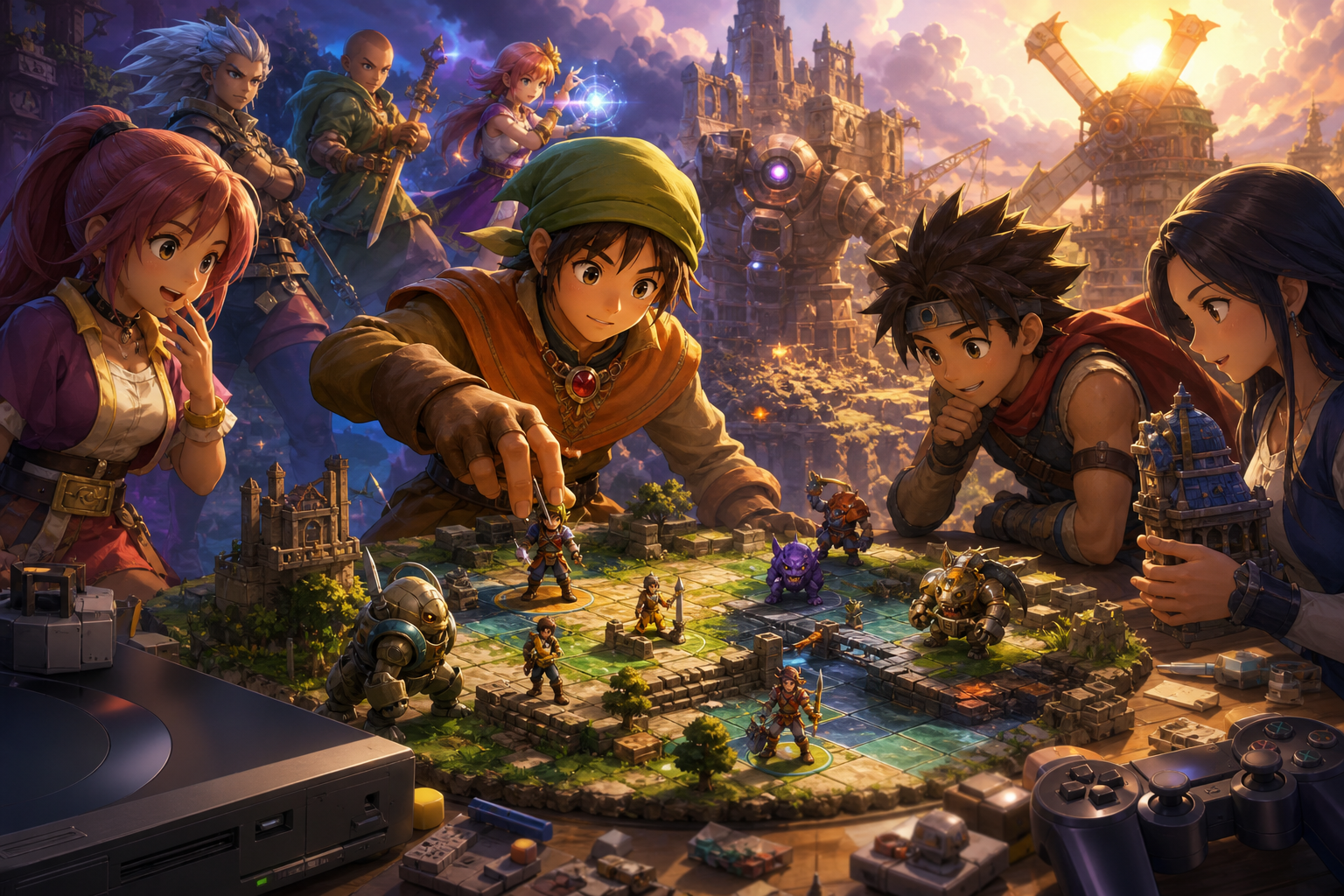
The PlayStation 2 is often remembered for action games, role-playing adventures and survival horror, but its strategy library is unusually broad. This ranking includes tactical RPGs, battlefield command games and grand-strategy simulations when strategic decision-making is central to play. Every entry was released for PlayStation 2 and earns its place through meaningful choices involving positioning, formations, unit development, resources or campaign planning.
The ranking weighs tactical depth first, then mechanical individuality, campaign structure, replay value and how clearly each game communicates its systems. It is an editorial selection rather than an objective measurement. The goal is not to pretend that a real-time battlefield game and an isometric tactics RPG work alike, but to show how differently the PlayStation 2 approached strategy.
10. Romance of the Three Kingdoms IX
Romance of the Three Kingdoms IX is the broadest management game in this ranking, and that breadth is both its strongest feature and its largest barrier. Rather than concentrating on a sequence of individual battles, it asks the player to think like a ruler managing territory, officers, armies and rival powers across a historical or fictional scenario. Troop movement, geography, formations and officer development all matter, but they matter inside a much larger political and military framework.
That makes it a strong choice for players who enjoy campaign planning more than rapid tactical missions. A decision made several turns earlier can affect where an army is available, which officer leads it and whether a neighboring power becomes an ally or a threat. The tradeoff is immediacy: players looking for constant battlefield action may find its administrative layers slower than the rest of this list. Its scenario structure, including historical, fictional and challenge scenarios, gives it considerable replay potential and makes every campaign feel like a different strategic problem. The PlayStation 2 release should also be distinguished from the later Romance of the Three Kingdoms IX with Power Up Kit compilation, which was released separately in Japan.
9. Stella Deus: The Gate of Eternity
Stella Deus is a deliberate, traditional tactical RPG built around isometric maps and action-point management. The central question in many battles is not simply which character should attack, but how far that character can move, which action must happen first and whether the resulting formation leaves the rest of the group exposed. Movement, physical attacks and magic all consume action points, so wasted movement can be just as damaging as a poor attack choice.
Its item-fusion system adds a second layer of preparation, while the optional Catacomb of Trials supplies a longer-term challenge for players who want more than the main campaign. Stella Deus is less flamboyant than the Nippon Ichi games below it, but that restraint can be appealing. It suits players who want a focused tactical structure with a serious tone and a slower pace. Its weakness is that the systems can feel more demanding than expressive when the story and maps do not provide enough variety.
8. La Pucelle: Tactics
La Pucelle: Tactics presents itself with bright characters and a playful visual style, but its battle system is more serious than the presentation suggests. Tactical maps revolve around turn-based positioning, monster purification and the interaction between environmental energy and the battlefield. Controlling space can be as important as defeating an enemy, because the condition of an area influences what the player can do next.
Monster recruitment also connects the battle system to long-term planning. A player is not merely choosing a fixed party for every mission; the available roster and the way enemies are purified can shape future options. That gives La Pucelle an identity separate from the more familiar Disgaea formula. It is best for players who enjoy experimenting with map effects and unusual progression systems. The tradeoff is that its cheerful tone, repeated battles and layered mechanics may initially obscure the tactical logic underneath.
7. Kessen II
Kessen II is the clearest break from the grid-based games in this ranking. Its battles unfold in real time, with the player issuing commands to formations and generals rather than moving individual characters across compact tactical maps. Positioning still matters, but the emphasis shifts toward choosing when to commit formations, how to use commanders and how to manage the flow of a large battlefield while events continue around the player.
The game’s dramatized interpretation of ancient China gives it a different personality from a historical simulation. It favors spectacle and momentum over exhaustive unit-by-unit control, which makes it more approachable for players who want battlefield drama without the administrative density of Romance of the Three Kingdoms IX. That accessibility comes with a tradeoff: players seeking precise equipment tuning or intricate turn-by-turn puzzles may find its command options less granular. Its value lies in showing how console strategy could turn formation management into something immediate and theatrical. The story is heavily fictionalized, so it works better as historical fantasy than as a serious reconstruction of the Three Kingdoms period.
6. Dynasty Tactics 2
Dynasty Tactics 2 focuses on what happens when battlefield decisions are connected rather than isolated. Officer abilities, morale, terrain and chained tactics encourage the player to think about sequencing commands and exploiting relationships between units. A successful turn is not only about choosing the strongest attack; it is about arranging a chain that makes the next action more effective or denies the opposing force a chance to recover.
That focus makes Dynasty Tactics 2 meaningfully different from Romance of the Three Kingdoms IX, even though both use the Three Kingdoms setting. Romance emphasizes long-term rule and national management, while Dynasty Tactics 2 concentrates on battlefield combinations and officer interaction. It is a strong fit for players who enjoy building momentum through carefully ordered commands. The presentation and historical dramatization may not appeal to everyone, and its systems can take time to understand, but the underlying design rewards players who treat each battle as a sequence of tactical opportunities rather than a collection of unrelated attacks. Its separate versus mode also gives the command system a different kind of replay value from the campaign.
5. Disgaea 2: Cursed Memories
Disgaea 2: Cursed Memories takes the turn-based tactical RPG structure and expands it into an enormous progression playground. Battles use isometric maps, character classes, combo positioning and Geo Panels, while the Dark Assembly and Item World push the experience well beyond a straightforward campaign. Players can spend time refining a party, experimenting with classes or pursuing increasingly ambitious improvements to equipment and characters.
That abundance is the reason Disgaea 2 ranks highly, but it is also the reason it will not suit every player. Someone looking for a compact story with a clearly defined cast may find the progression systems overwhelming or distracting. Players who enjoy testing combinations, developing unusual units and returning to the game for stronger challenges will find far more to do. Its tactical depth is inseparable from its role-playing systems: positioning matters in individual battles, but the larger strategy comes from deciding which characters, classes and items deserve long-term investment. The combo system rewards coordinated placement because nearby characters can contribute to attacks without necessarily consuming all of their own opportunities, making formation a meaningful part of party development.
4. Phantom Brave
Phantom Brave changes one of the basic assumptions of tactical RPGs: the player does not always deploy a permanent roster of units. Its Confine system summons phantoms by placing them into objects on the battlefield, making terrain and temporary availability part of the tactical puzzle. A unit’s position is therefore tied not only to movement and attack range, but also to which object can host it and how long that deployment remains useful.
The system produces maps that feel less conventional than the standard grid-and-party arrangement. Players must consider the order in which phantoms enter the field, the properties of available objects and how to use a unit before its battlefield presence ends. That makes Phantom Brave an excellent choice for players who want tactics built around improvisation rather than a fixed formation. It can also feel less predictable and less immediately readable than Disgaea. Its unusual rules are the point, but they demand patience from anyone expecting familiar tactical RPG habits to transfer directly.
3. Front Mission 4
Front Mission 4 makes customization part of the tactical problem before a battle even begins. Its Wanzers can receive different weapons and equipment, while pilots learn skills that influence how those machines perform. The player is therefore balancing battlefield roles, weapon ranges, defensive needs and pilot development rather than simply selecting the most powerful available character.
Once combat begins, action points and positioning determine whether that preparation pays off. A machine built for a particular role can be effective only if the player creates the right conditions for it, and an apparently strong loadout may struggle if the team cannot support it. The game’s two campaign theaters also give its structure a wider scope than a single linear squad story. Front Mission 4 suits players who want mecha warfare where construction and combat inform each other. Its equipment detail can be intimidating, but that complexity creates decisions with consequences instead of cosmetic customization.
2. Ring of Red
Ring of Red is one of the PlayStation 2’s most mechanically distinctive strategy games. Set in an alternate-history postwar Japan, it combines armored fighting walkers with supporting infantry units. That pairing means the player is not managing a single type of force: the larger machines and their accompanying troops contribute different strengths, vulnerabilities and tactical possibilities. The battlefield therefore asks questions that ordinary character-based tactics rarely raise.
Its turn-based movement is joined by more immediate combat encounters. When armored walkers engage, combat shifts into a real-time sequence in which positioning, aim, weapon pressure and timing affect the result. Day-and-night changes and weather also influence accuracy and available abilities, while support units such as infantry, shooters, medics, mechanics and reconnaissance troops give each force a broader tactical identity. The setting and structure give the game a texture unlike the fantasy tactics RPGs that dominate the system. Ring of Red is not the cleanest recommendation for someone seeking a simple introduction to strategy, but its unusual combination of military science fiction, infantry support and armored units gives every decision a strong identity. It ranks near the top because it does not merely apply familiar tactics to a new setting; it builds its strategy around a genuinely different force structure.
1. Disgaea: Hour of Darkness
Disgaea: Hour of Darkness earns the top position because it combines an approachable tactical foundation with an unusually deep set of systems that invite experimentation. Its turn-based battles use isometric maps, while character creation, Geo Panels, lifting and throwing, the Dark Assembly and the Item World create layers of possibility beyond the immediate objective. A player can solve a battle through positioning, but the longer-term game is about deciding how to build a roster capable of solving future problems in different ways.
The design also supports several kinds of replay. Players can develop different classes, pursue stronger items, experiment with unusual party structures or spend time in optional systems that dramatically extend the campaign’s strategic life. The Item World turns equipment into a series of additional battle spaces, while the Dark Assembly allows players to create units and propose laws that alter how the broader game operates. That density can be excessive for anyone who wants a short, tightly controlled tactics game, and the numbers may distract from the story. The ranking rewards systemic range and repeatable experimentation rather than realism, cinematic presentation or historical scope. On those terms, Disgaea provides the most complete expression of the PlayStation 2’s strategy potential.
The ten games show that PlayStation 2 strategy was not one fixed style. Romance of the Three Kingdoms IX is built around national management, Kessen II turns formations into real-time commands, Front Mission 4 makes machine construction part of combat, and Ring of Red creates a distinct walker-and-infantry battlefield. The tactical RPGs then explore different ideas of positioning, action points, environmental effects, temporary units and long-term character development.
Choose based on the decisions you want to make. Start with Disgaea for open-ended experimentation, Front Mission 4 for mecha customization, Ring of Red for unusual military systems, Dynasty Tactics 2 for chained battlefield commands or Romance of the Three Kingdoms IX for campaign-scale planning. Together, these games make a strong case that the PlayStation 2’s strategy library deserves to be considered alongside its better-known genres.