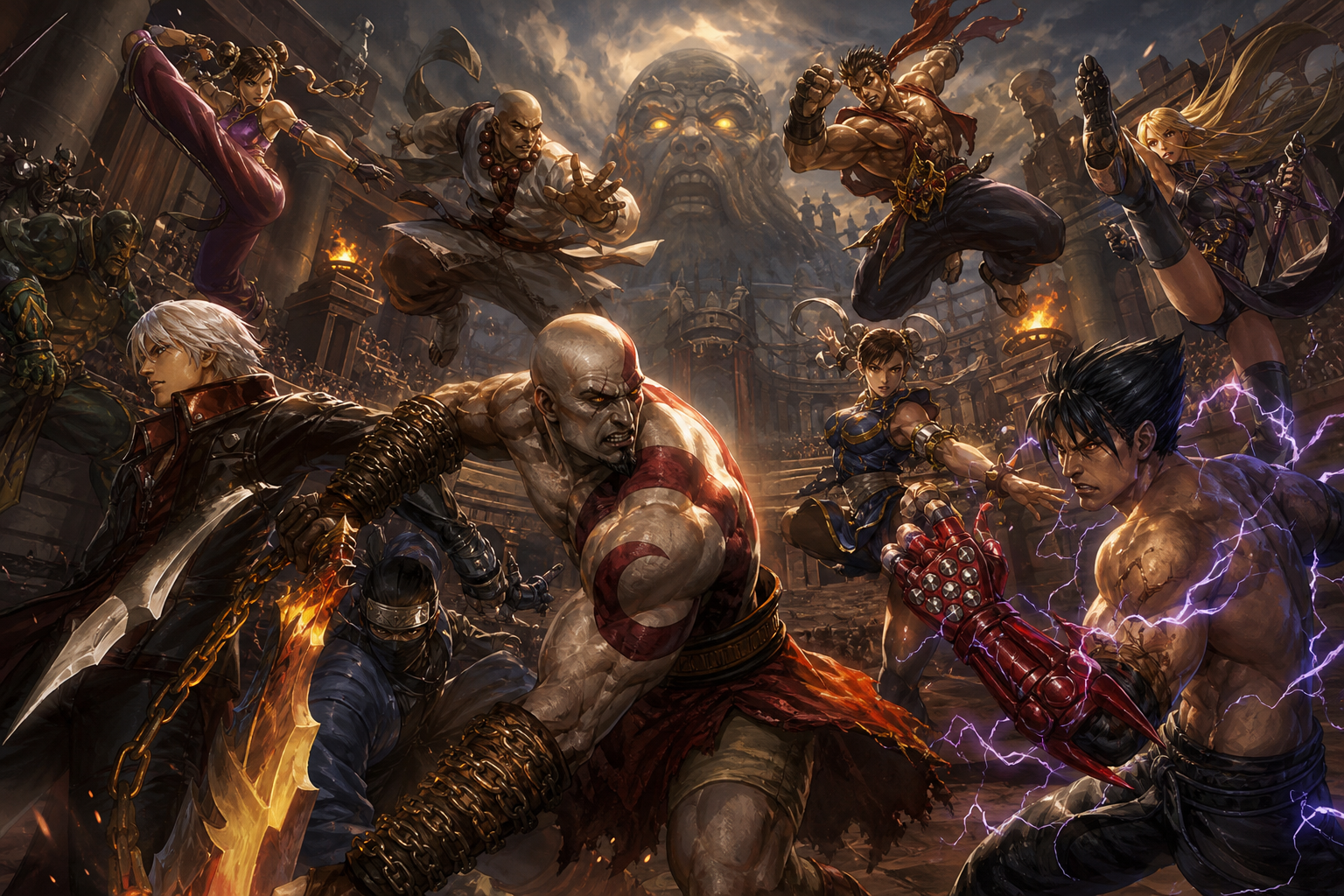
The PlayStation 2 is often remembered for role-playing games, stealth adventures and cinematic action, but its fighting catalog is unusually broad. It includes serious arcade conversions, technically demanding 2D fighters, weapon-based duels, licensed brawlers and compilations that preserve several branches of fighting-game history in one package.
This ranking considers combat identity first: how clearly each game distinguishes itself from its rivals. Roster variety, the quality of single-player content, local multiplayer value, mechanical depth and replay potential also matter. Traditional one-on-one fighters are compared with arena brawlers and compilations by what they offer within their own format, not by pretending every game is designed for the same kind of competition. Games such as God of War, Devil May Cry and Onimusha remain outside the list because combat-heavy action is not automatically a fighting game.
10. War of the Monsters
War of the Monsters is the pick for players who want fighting games to feel enormous, loud and slightly out of control. Its combat takes place between giant creatures in science-fiction movie settings, where buildings, vehicles and scattered weapons become part of the battle. That gives every match a different rhythm from a conventional tournament fighter: positioning is about surviving the arena as much as reading an opponent’s next attack.
Its roster is built around contrasting monster ideas rather than subtle martial-arts archetypes. Characters use different movement patterns, ranged attacks and close-range tools, while the stages encourage improvised tactics. Adventure, Free-for-All, Endurance and Elimination modes provide reasons to play beyond a standard arcade ladder, and unlockable costumes, arenas and minigames add welcome variety.
The tradeoff is that War of the Monsters is less precise than Virtua Fighter or Tekken. Camera movement, environmental chaos and large character models can make it harder to read exchanges. That is also its appeal. It belongs here because it turns local multiplayer into a giant-monster movie playground rather than a test of tournament fundamentals.
- Best for players who prefer arena spectacle to strict competitive spacing.
- Choose it for giant characters, environmental weapons and varied multiplayer formats.
- Do not expect the measured timing or compact stages of a traditional 3D fighter.
9. Guilty Gear XX Accent Core Plus
Guilty Gear XX Accent Core Plus represents the PlayStation 2’s late-life 2D fighting expertise. Its cast is full of mechanically unusual characters, and the game rewards players who enjoy learning distinctive movement, attack patterns and resource interactions rather than selecting a familiar all-rounder. The speed and visual density make it immediately expressive, but the depth reveals itself gradually through matchup knowledge and execution.
This version is especially valuable because it is a revision rather than a simple port. It includes balance changes, bug fixes, added characters, Mission and Survival modes, and an additional story mode. That package gives both competitive-minded players and solo players more to investigate than a bare arcade conversion.
Edition details matter. Guilty Gear XX Accent Core Plus appeared as a standalone PlayStation 2 release and, in some markets, as an append disc requiring the earlier Accent Core game. Treating those editions as interchangeable can lead to confusion when identifying a copy. The game also demands more patience than the ranking’s accessible entries: its roster variety is immense, but beginners may find the first hours unusually busy.
- Best for players who want fast 2D combat and unconventional characters.
- Check whether a copy is standalone or an append disc before assuming it works independently.
- Its replay value comes from mastery and matchup learning, not relaxed button-mashing.
8. Mortal Kombat: Deception
Mortal Kombat: Deception expands the series’ familiar violence with a broad combat package. Fighters use a three-style structure, and the game adds weapons, interactive arenas and stage hazards that make positioning more consequential than in a simple flat-stage brawler. The result is a fighter with a strong identity even when its systems are less elegant than those of Virtua Fighter or SoulCalibur.
Its biggest strength is breadth. Konquest provides a substantial adventure framework, while Chess Kombat and Puzzle Kombat offer very different diversions from ordinary matches. That makes Deception unusually easy to recommend to a group with mixed tastes: one player can pursue the campaign, another can learn character styles, and others can treat the side modes as their main attraction.
The PlayStation 2 version also included historical online competitive support, but that should not be confused with a currently active service. Today, Deception’s replay value rests on its local modes, its large roster and the pleasure of discovering how each fighter’s styles and weapons alter familiar Mortal Kombat confrontations. It is not the purest competitive choice, but few fighters on the system attempt so much.
- Best for players who want a fighter surrounded by adventure and minigames.
- Choose it for weapons, stage hazards and the series’ three-style combat structure.
- Treat its online feature as historical context, not a present-day expectation.
7. SoulCalibur III
SoulCalibur III builds on the series’ accessible weapon duels with one of the most ambitious single-player packages on the PlayStation 2. Each character’s weapon gives attacks a readable identity, while spacing, guard decisions and ring positioning keep matches understandable even when the roster becomes deep. The weapons also make the cast feel meaningfully different rather than merely cosmetic variations on the same moveset.
Its character-creation system adds a personal layer to the usual arcade structure. Players can build original fighters and experiment with visual designs and combat roles, while the broader single-player offering gives the game more longevity than a short succession of standard matches. That combination makes it especially attractive to players who enjoy customization alongside versus play.
SoulCalibur III’s release history is part of its unusual place in the series. It first appeared on PlayStation 2 before a later arcade edition, so it should not be treated like a routine simultaneous arcade-to-console conversion. The game’s ambitious scope can occasionally feel less focused than SoulCalibur II, but that same ambition gives it a distinct identity and a substantial amount to explore.
- Best for players who want weapon combat plus character creation.
- Its single-player scope is a major reason to choose it over a simpler arcade fighter.
- Pick SoulCalibur II instead if you prefer a tighter, more immediately focused package.
6. Capcom vs. SNK 2: Mark of the Millennium
Capcom vs. SNK 2 turns crossover design into a mechanical argument. Instead of offering one universal ruleset, it gives players six selectable Grooves based on different Capcom and SNK fighting philosophies. That choice changes how a team builds meter, handles defensive options and approaches momentum, so the crossover is not merely about seeing famous characters share a screen.
The roster variety is valuable, but the Groove system is the real reason to return. A player who dislikes one ruleset can try another without abandoning the cast, and Groove Edit Mode allows custom rulesets assembled from available mechanics. This makes the game particularly rewarding for players who enjoy comparing systems and adjusting a fighter to match their preferred rhythm.
The learning curve can be demanding. Team construction, Groove selection and character compatibility create more decisions than a standard arcade ladder explains clearly. Capcom vs. SNK 2 therefore ranks below the most complete all-purpose fighters, but it remains one of the best choices for players who see fighting games as systems to analyze rather than simply stages to clear.
- Best for players who enjoy team construction and ruleset experimentation.
- Study the six Grooves before judging the game’s apparent complexity.
- Its greatest replay value comes from comparing systems, not just collecting characters.
5. Street Fighter Alpha Anthology
Street Fighter Alpha Anthology earns its place through historical and practical breadth. Rather than presenting one newly built fighter, it gathers the arcade versions of Street Fighter Alpha, Alpha 2, Alpha 2 Gold, Alpha 3 and Super Gem Fighter MiniMix. That makes it a compact tour through several approaches to the Alpha formula, from grounded footsies and custom-combo experimentation to the playful simplicity of Gem Fighter.
The collection’s value is not simply the number of games on the disc. Each Alpha entry has a different pace, roster balance and relationship between meter, defense and offense. Players can compare those changes directly, which makes the anthology useful for anyone curious about how a fighting series evolves without losing its core visual language.
Unlockable material, including an expanded Alpha 3 variant and Hyper Street Fighter Alpha, adds further incentive to explore. The limitation is obvious: no single game receives the same concentrated presentation as a standalone fighter. Still, as a PlayStation 2 package, it offers extraordinary variety for players who want arcade history, local matches and multiple versions of a familiar fighting framework.
- Best for players who want several Alpha-era systems in one package.
- Do not judge it solely by the number of included games; their mechanical differences are the point.
- It is a compilation, so its appeal is breadth rather than one unified campaign.
4. Def Jam: Fight for NY
Def Jam: Fight for NY is the PlayStation 2’s most distinctive licensed brawler because the license supports the combat instead of merely decorating it. Developed by AKI Corporation and Electronic Arts Canada, the game combines five fighting styles with grappling, strikes, environmental attacks and weapons. A match can shift from a clean exchange to a wall slam or a dangerous interaction with the surrounding venue.
Its story progression is built around crews and rivalries, giving character choice a role beyond selecting a portrait before a match. The cast’s exaggerated personalities and celebrity identities help the combat feel theatrical, but the underlying design remains flexible enough for versus play. Different styles encourage different approaches to range, throws and damage opportunities.
Def Jam’s classification can vary between fighting, wrestling and action, yet its direct combat structure and versus focus make its inclusion defensible. Local multiplayer is another strength, with PlayStation 2 Multitap support allowing up to four players in supported battle modes. The game is less suitable for players seeking a clean competitive laboratory, but it is exceptional for anyone who wants a social fighter with a combat system no conventional tournament game can replicate.
- Best for groups who want grappling, stage attacks and a strong license.
- Choose it for variety in fighting styles rather than frame-perfect traditional competition.
- Multitap requirements and supported player counts can vary by mode and regional documentation.
3. SoulCalibur II
SoulCalibur II is one of the easiest PlayStation 2 fighting games to recommend because its weapon combat is readable without being shallow. Attacks have clear visual identities, movement around the ring matters, and guarding or sidestepping can turn a defensive moment into a counterattack. New players can understand the basic exchanges quickly, while experienced players can spend much longer studying range, timing and matchup choices.
Weapon Master mode gives the game a useful single-player spine. Its alternate objectives and conditions encourage players to approach familiar characters and stages differently, making the package more substantial than a sequence of arcade matches. The mode also demonstrates how the game’s weapons and movement systems work together rather than existing as disconnected features.
The PlayStation 2 edition has a meaningful platform difference: Heihachi Mishima is its exclusive guest fighter. That does not make the version universally superior, but it gives the PS2 release a clear identity beside the GameCube and Xbox editions. SoulCalibur II ranks above SoulCalibur III because its core combat is more focused, its onboarding is smoother and its replay loop remains exceptionally well balanced.
- Best for players seeking approachable weapon-based combat.
- The PS2 edition’s guest character is Heihachi Mishima; do not confuse platform rosters.
- Weapon Master mode is the main reason the single-player package lasts beyond arcade play.
2. Tekken 5
Tekken 5 is the PlayStation 2’s strongest all-purpose traditional fighter. It returned to more conventional stage design after Tekken 4 experimented with uneven arenas, allowing the series’ movement, spacing, sidesteps and character-specific punishments to take center stage. The roster is broad without losing its recognizable archetypes, and each fighter offers a different route into the same fundamental language of close-range combat.
Customization gives long-term players another reason to invest in a main character, while the wider package provides more than a straightforward arcade ladder. The PlayStation 2 release also includes Devil Within and playable earlier Tekken games through its Arcade History material, giving the package additional historical value beyond the main fighter.
Its main tradeoff is that the game can feel less immediately transparent than SoulCalibur II. Tekken’s animations, attack heights and timing conventions require attention, and button-mashing quickly exposes gaps in defense. That learning curve is precisely why it ranks so highly: Tekken 5 supports casual matches, character experimentation and serious improvement without sacrificing its broad PlayStation 2 appeal.
- Best for players who want one fighter that serves casual and technical audiences.
- Choose it for movement, roster depth, customization and its substantial PlayStation 2 extras.
- Expect to learn attack heights, sidesteps and punishment rather than relying on improvisation alone.
1. Virtua Fighter 4: Evolution
Virtua Fighter 4: Evolution is the ranking’s best example of fighting design reduced to purposeful essentials. Its martial-arts-inspired roster is built around distinct stances, ranges and tactical priorities, but the game avoids the visual clutter that can obscure why a match was won or lost. Movement, throws, defensive choices and precise attacks all matter, making every exchange feel connected to a readable decision.
The Quest mode gives the game a powerful long-term structure. Players move between arcade venues, face different opponent groups and earn rewards while building experience with their chosen fighter. Customization and progression make the solo content feel connected to the competitive system rather than functioning as a detached story mode. Training tools and tutorial material further support the game’s technical identity, giving newcomers a route into a demanding system while offering experienced players the information needed to examine their habits.
Evolution does not have the explosive spectacle of War of the Monsters or the licensing surprise of Def Jam. Its roster is also less immediately flamboyant than Guilty Gear’s. But as a complete traditional fighter, it combines combat clarity, training depth, solo longevity and mastery potential better than any other entry here. Players seeking the PlayStation 2’s most disciplined one-on-one experience should start with Virtua Fighter 4: Evolution.
- Best for players who want precise martial-arts combat and a serious learning curve.
- Use Quest mode, tutorials and training tools as the foundation for long-term improvement.
- Its appeal depends on deliberate play, so choose another entry if spectacle matters more than technical clarity.
The right starting point depends on the kind of fighting game you want. Virtua Fighter 4: Evolution and Tekken 5 are the strongest choices for traditional one-on-one combat, SoulCalibur II is the smoothest entry into weapon fighters, and Guilty Gear XX Accent Core Plus suits players who want fast 2D systems with unusual characters. Capcom vs. SNK 2 and Street Fighter Alpha Anthology are ideal for arcade-history exploration, while Def Jam: Fight for NY and War of the Monsters bring a more social, theatrical energy.
Mortal Kombat: Deception and SoulCalibur III show how much room the PlayStation 2 gave fighting games to build identities beyond a standard arcade ladder. The best choice is therefore not simply the game with the largest roster or most modes. It is the one whose combat structure gives you a reason to learn, compete or return.