Choosing between Final Fantasy X and Kingdom Hearts is less about deciding which game is universally better and more about identifying the kind of attention you want to give a long RPG. Final Fantasy X asks you to study turns, exploit enemy weaknesses and develop a broad party. Kingdom Hearts puts movement, targeting and timing at the center of nearly every fight.
This comparison covers the original PlayStation 2 editions in a spoiler-light way. It focuses on combat, progression, exploration, story commitment and saving rather than walkthrough details. Later International, Final Mix and HD releases add or alter content, so advice about those versions should not automatically be applied to the original North American PS2 games.
The short answer: decide how you want to solve problems
Choose Final Fantasy X first if you enjoy pausing over a battle, checking the upcoming action order and selecting the most useful character for each enemy. Its combat is deliberate, its journey is comparatively directed, and its character growth gives you a visible system to manage. It suits players who want tactical decisions to matter more than reflexes.
Choose Kingdom Hearts first if you want to control a character directly, move around enemies and attack while pressure is building. Its RPG systems are wrapped around real-time action, recognizable Disney-inspired settings and a more visibly divided world structure. It is a natural first choice for someone who wants an action game that gradually introduces equipment, magic and party management.
Neither choice removes repetition or commitment. Both are long single-player adventures, and both become more rewarding when you accept their particular rhythm instead of wishing they behaved like the other game.
- Pick Final Fantasy X for planning, party roles and a focused route.
- Pick Kingdom Hearts for movement, timing and action-game momentum.
- Treat the original PS2 release as its own edition, not as a substitute for later remasters.
Battle control: visible turns versus immediate pressure
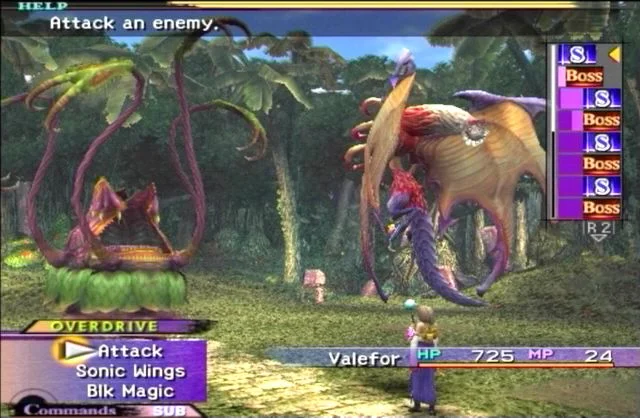
Final Fantasy X uses Conditional Turn-Based Battle rather than the Active Time Battle system found in several earlier Final Fantasy games. The upcoming action order is visible, so you can consider speed, enemy turns and the delay attached to an action before committing. A powerful technique is therefore also a decision about when that character will act again.
The game lets you switch available party members during battle. That makes party coverage a moment-to-moment tool rather than something decided only before entering an area. You can bring in the character best suited to an enemy’s defenses, use a support ability, then change the active lineup as the situation develops. The system rewards observation and discourages treating every encounter as a single repeated attack command.
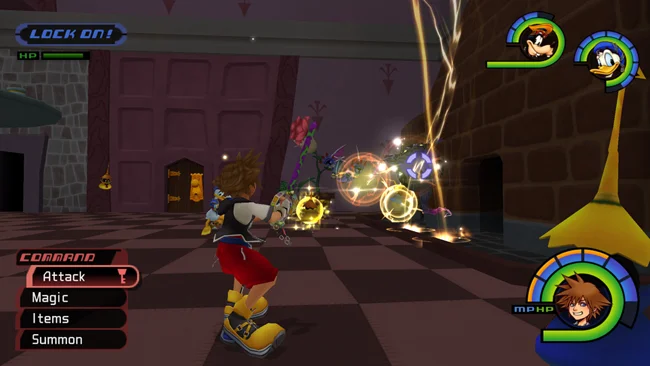
Kingdom Hearts instead places Sora in a live combat space. Attacks, jumping, guarding, magic, items, targeting and command-menu choices happen while enemies continue to move. The command menu is not evidence of turn-based combat; it is a way to select actions inside a real-time fight. Success depends on where Sora stands, what the camera shows and whether you can select the right command before the group surrounds you.
That difference is the central decision. Final Fantasy X gives you room to reconsider before an action. Kingdom Hearts gives you more direct control but makes positioning and execution part of the problem.
- Prefer Final Fantasy X if you dislike reflex-heavy combat.
- Prefer Kingdom Hearts if selecting attacks while moving sounds more appealing than reading a turn order.
- Do not judge either battle system by the presence of a menu alone.
How each game teaches its combat language
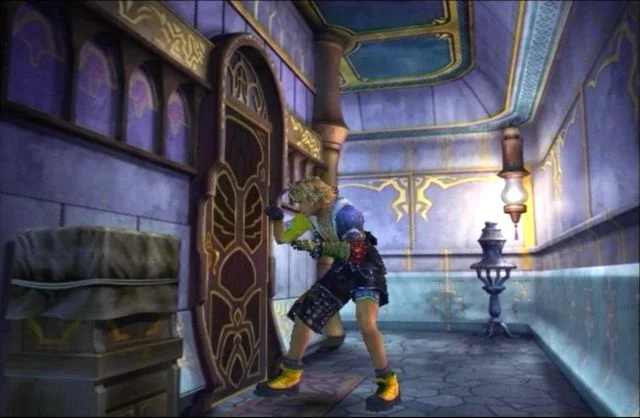
Final Fantasy X teaches through enemy roles, weaknesses and repeatable tactical patterns. The useful question is often not simply how much damage you can deal, but which party member or ability answers the threat in front of you. Because turns are readable, mistakes can become lessons: you can see whether the problem was poor targeting, an unprotected character or an action that gave an opponent too much time.
This structure is friendly to players new to traditional RPG planning, although it still expects attention. A party that has the right tools but never rotates its members can feel weaker than it needs to be. The game’s design encourages you to use the full group rather than selecting one favorite attacker and ignoring everyone else.
Kingdom Hearts teaches a different vocabulary. You learn to keep enemies in view, manage distance, choose targets, recognize openings and use the command menu without losing awareness of the room. The learning curve is not only about statistics. Camera behavior, crowded encounters and the timing of defensive or magical actions can matter as much as equipment.
The tradeoff is clear. Final Fantasy X makes its tactical information easier to inspect, while Kingdom Hearts makes the player’s hands and eyes part of the solution. Players accustomed to action games may find Kingdom Hearts immediately legible, while turn-based RPG newcomers may appreciate Final Fantasy X’s ability to stop the pressure and present the situation through its menus.
- Use Final Fantasy X to learn enemy analysis at a deliberate pace.
- Use Kingdom Hearts to learn RPG ideas through movement and repeated action.
- Expect different kinds of mistakes: planning errors in one, positioning and execution errors in the other.
Character development: route planning or layered upgrades
Final Fantasy X builds character growth around the Sphere Grid. Battles provide AP, which leads to Sphere Levels, while collected spheres activate stat increases, abilities and magic. The grid makes development visible: you can see where a character is going and decide whether to follow the expected path or pursue a different set of improvements when the game permits it.
Weapons and armor can also be customized by adding abilities when you have the required materials. That gives equipment a second role beyond replacing a weaker item with a stronger one. You are not required to turn the system into a spreadsheet to progress, but players who enjoy planning a build will have more to think about than simple level totals.
Kingdom Hearts uses a more layered but less grid-like structure. Experience levels, abilities, magic, equipment and Keyblade selection each contribute to Sora’s growth, while companions have their own equipment and behavior to account for. The result is easier to understand as a collection of upgrades, but it offers a different kind of decision-making from tracing a development route.
Final Fantasy X is the stronger fit for someone who wants progression to feel like a map. Kingdom Hearts is better for someone who wants improvements to arrive through equipment, abilities and new options while the main attraction remains action combat. Neither game requires perfect optimization for a first story-focused run, and neither should be approached as though every early choice permanently ruins the adventure.
- Choose Final Fantasy X for visible route planning and role specialization.
- Choose Kingdom Hearts for incremental upgrades surrounding a central action system.
- Avoid importing Expert Sphere Grid advice into the original North American PS2 release.
Party management and the feeling of control
Final Fantasy X makes the party feel like a toolkit. Switching available members during battle means that the group’s range of abilities remains relevant even when only a smaller selection is active. Development therefore has a practical question attached to it: which characters are ready to answer different threats, and have you kept their equipment and abilities useful?
That flexibility can be satisfying for players who like assigning jobs, but it can also create mental overhead. You may feel pressure to keep everyone reasonably developed rather than relying on a single preferred lineup. The benefit is that battles often invite a specific response instead of reducing the party to interchangeable damage dealers.
Kingdom Hearts centers the adventure on Sora, with Donald and Goofy acting as active companions for much of the journey. Other party-management options and temporary changes appear in context, but the structure does not ask you to operate a large roster in the same way. You spend more attention on Sora’s immediate actions and on how companions behave around the encounter.
This makes Kingdom Hearts feel more personal and direct, while Final Fantasy X feels more like directing a small tactical team. If you enjoy swapping roles and making every party member earn a place, Final Fantasy X offers the richer conversation. If you want one central character whose movement and abilities define the experience, Kingdom Hearts creates less pre-battle administration.
- Pick Final Fantasy X for active roster rotation.
- Pick Kingdom Hearts for a protagonist-led action loop.
- Remember that party control is part of difficulty: less management does not mean no pressure.
Exploration: one journey through Spira or connected worlds
Final Fantasy X presents a comparatively continuous journey through Spira. Its route progression and story momentum give the game a directed quality, with exploration generally supporting the sense of traveling toward the next stage of a larger pilgrimage. That focus helps the narrative feel cohesive, especially for players who prefer knowing that a long RPG is moving toward a clear destination.
Kingdom Hearts divides much of its adventure among separate Disney-inspired worlds connected by an original cast and story. Each setting has its own visual identity and local problems, while the broader plot returns you to recurring ideas and characters. The world-by-world structure can feel more varied than a single road, but it also asks you to remember how the game’s different spaces connect.
Neither game is a pure open-world experience. Final Fantasy X’s strength is forward momentum with room for optional detours, while Kingdom Hearts’ strength is the contrast between distinct environments and the anticipation of seeing how another world fits into the overall adventure. Revisits and field interactions can add friction when you want the story to move quickly, but they also give the settings more value than a one-time backdrop.
Choose based on the kind of exploration you enjoy. If you want a focused route that supports a unified journey, start with Final Fantasy X. If you want a sequence of themed destinations and enjoy returning to a familiar place with new context, Kingdom Hearts may hold your attention more naturally.
- Choose Final Fantasy X for directed travel and continuity.
- Choose Kingdom Hearts for distinct themed worlds and a recurring crossover structure.
- Do not expect either game to behave like a modern open-world RPG.
Story commitment without major spoilers
Final Fantasy X asks for investment in a focused journey, its party and the emotional consequences of the path they are following. The drama is closely tied to travel, duty and the way the group responds to the world around them. You do not need to know its late revelations to understand the commitment it requests: pay attention to the characters and let the journey establish its meaning gradually.
Kingdom Hearts mixes an original mythology with familiar Disney settings and recognizable characters. That combination makes the early premise approachable, but the game is not simply a collection of unrelated guest appearances. Its original cast, recurring terminology and central mysteries ask you to follow a more unusual blend of fairy-tale familiarity and invented lore.
The practical difference is tone and narrative texture. Final Fantasy X is a more concentrated character journey, while Kingdom Hearts uses contrast between worlds to keep changing the presentation around a continuing story. Players who want emotional continuity may prefer the former. Players who enjoy discovering how familiar settings are reinterpreted may prefer the latter.
In both cases, avoid researching late-game explanations before starting. Spoiler-heavy guides can flatten the reason to explore and make the games feel more complicated than they are at the beginning. Let the original PS2 release introduce its own vocabulary at its intended pace.
- Start Final Fantasy X for concentrated character drama.
- Start Kingdom Hearts for original mythology presented through familiar settings.
- Keep searches spoiler-light until you know which questions you actually need answered.
Save habits, recovery and PS2 memory-card pressure
Final Fantasy X uses Save Spheres as its primary save locations on the original PS2 release. Using one also restores the party’s HP and MP, so saving doubles as a recovery decision. The original instruction manual states that each save file uses at least 64 KB on an 8 MB PlayStation 2 memory card. That is modest by modern standards, but it still makes a crowded card worth checking before beginning a long game.
Kingdom Hearts uses save points that restore HP and MP and provide access to the save menu. Some save points also provide a route back to the Gummi Ship map. The result is a similar but not identical rhythm: you are looking for safe points in the world, recovering as you go, and deciding whether the next stretch is worth attempting before saving again.
For either game, save before entering an unfamiliar sequence, after meaningful progress and before experimenting with optional content. Do not treat a convenient save point as proof that the next challenge will be short. A player using an original console should keep more than one save file when possible and should avoid deleting an older file simply because a newer one exists.
Save pressure is not extreme in either game, but it shapes how you divide sessions. Final Fantasy X’s recovery at Save Spheres makes them valuable landmarks. Kingdom Hearts’ points are equally important because action encounters can turn a confident route into an unexpected retreat.
- Check available PS2 memory-card space before starting.
- Keep separate saves when the card allows it.
- Save before optional detours and after major progress, not only when the game feels difficult.
Where frustration is most likely to appear
Final Fantasy X’s friction comes from deliberation, repetition and the responsibility of maintaining a broad party. Players who dislike stopping to inspect abilities may find its battles slow, even when the system is working as intended. A difficult encounter can also expose neglected characters or an equipment setup that has not kept pace with the journey.
Kingdom Hearts’ friction is more physical. Camera awareness, targeting, enemy groups and real-time command selection can create trouble even when you understand the correct spell or attack. A player who prefers clean menus may find that knowing the answer is not enough; Sora still has to reach the right position and perform it under pressure.
Exploration creates different kinds of repetition too. Final Fantasy X’s directed route can feel narrow when you want to roam, while Kingdom Hearts’ world structure can feel stop-and-start when you would rather follow the main story. Neither issue is an objective flaw for every player. They are warnings about what may test your patience.
The best preparation is to choose the friction you can tolerate repeatedly. A single impressive feature will not carry a long RPG if its basic rhythm irritates you. Imagine playing ten ordinary battles, navigating another area and saving at the end of a session; the game whose ordinary moments sound better is probably the safer first choice.
- Select Final Fantasy X if menu deliberation feels calming rather than tedious.
- Select Kingdom Hearts if camera and movement challenges feel engaging rather than exhausting.
- Judge the repeated loop, not only the opening premise.
Who should start with Final Fantasy X
Final Fantasy X is the better first PS2 RPG for a player who wants tactical pauses, a clear party identity and a story that keeps moving along a focused route. It is especially suitable if you enjoy matching tools to enemies, watching a turn order and making character-development decisions that remain visible outside combat.
It also works well for players who are curious about traditional Japanese RPG structure but do not want to manage a real-time battlefield. The game still has plenty of systems, yet its central combat language is patient enough to let you think. You can take a break after a Save Sphere without feeling that every session must end at a carefully chosen chapter boundary.
The main caution is that its accessibility should not be confused with simplicity. The Sphere Grid, equipment customization and party rotation can become as deep as you want them to be. Start by learning what each character contributes and by observing enemy behavior rather than chasing an ideal route from an outside guide.
If the phrase “plan the answer” sounds appealing, Final Fantasy X is the natural starting point. Its rewards come from understanding the team as a set of complementary tools and from watching that understanding make future encounters more manageable.
- Start here if you prefer tactical control without reflex pressure.
- Use the whole party instead of building around one favorite character.
- Treat progression as a set of useful options, not a test of perfect optimization.
Who should start with Kingdom Hearts
Kingdom Hearts is the better first PS2 RPG for a player who wants direct movement, active combat and a steady stream of visually distinct destinations. It is a natural bridge for someone who normally plays action games but wants to try experience levels, equipment, magic and party systems without giving up control of the protagonist.
Its Disney-inspired settings also provide an immediate point of recognition, but the game’s original story is substantial enough that familiarity with those settings is not the only reason to continue. The attraction is the combination of recognizable worlds, a central cast and action encounters that ask you to stay involved rather than wait for a turn.
The tradeoff is that real-time control brings real-time frustration. Camera positioning, target selection and groups of enemies can make a fight feel messy even when your overall strategy is sound. Players who want to pause and reconsider every decision may need more patience here than they expect from an RPG with a command menu.
If the phrase “perform the answer” sounds appealing, Kingdom Hearts is the natural starting point. Its best moments come from turning knowledge of an enemy or ability into movement and timing while the encounter is still unfolding.
- Start here if you want an action game with RPG progression.
- Expect to learn camera, targeting and command habits together.
- Do not mistake familiar settings for a simple or purely casual adventure.
Check the edition before you begin
This comparison is for the original PlayStation 2 editions of Final Fantasy X and Kingdom Hearts. That distinction matters. Final Fantasy X’s later International-based and HD versions include differences such as the Expert Sphere Grid and additional content, while the original North American PS2 release should be evaluated on its own progression and feature set.
Kingdom Hearts Final Mix is also not interchangeable with the original North American PS2 game. Later releases and remastered collections incorporate Final Mix material and adjustments, so a guide written for those versions may mention encounters, options or content that do not exist in the same form on the original disc.
When buying or selecting a version, read the regional label and the actual game title rather than assuming every PS2-era or modern compilation is identical. This is particularly important if you are following a manual, control guide or optional-content reference. A mismatch can turn a helpful explanation into confusing instructions.
The choice between the games remains similar across broad categories, but edition accuracy prevents avoidable surprises. Start with the version you actually own, then use advice that names that version.
- Confirm whether Final Fantasy X is the original North American PS2 release or an International-based version.
- Do not treat Kingdom Hearts Final Mix as the original North American release.
- Match guides and manuals to the disc or collection in front of you.
Final decision matrix: which first PS2 RPG fits you?
Choose Final Fantasy X when your priority is deliberate battle planning, active party rotation, a visible character-development route, a focused journey and recovery tied to recognizable save landmarks. It is the better fit for a player who wants to think before acting and who enjoys learning enemy patterns through repeatable tactical choices.
Choose Kingdom Hearts when your priority is direct movement, real-time attacks, themed worlds, a protagonist-centered progression system and an action-game learning curve. It is the better fit for a player who wants to stay physically involved in every encounter and who is willing to accept camera and positioning friction as part of the challenge.
If you are still undecided, use the simplest rule: choose Final Fantasy X if you want to plan the answer; choose Kingdom Hearts if you want to perform the answer. Both can introduce the scale and commitment of a long PS2 RPG, but they reward different habits. Pick the one whose ordinary battles and exploration sound enjoyable, not merely the one whose premise is easiest to summarize.
For additional context on Final Fantasy X’s opening presentation, Joking Joystick’s existing feature about its opening can complement this choice guide. It should not replace the broader comparison here, since the decision depends on the complete play rhythm rather than the first dramatic sequence.
- Final Fantasy X: planning, party roles, visible progression and directed travel.
- Kingdom Hearts: action, movement, world variety and protagonist-focused upgrades.
- Make the choice according to the rhythm you can sustain across a long adventure.
Final Fantasy X and Kingdom Hearts are both strong gateways into the PS2 RPG library because they represent two different answers to the same design problem. One gives you time to inspect the battlefield and shape a party; the other asks you to move, target and react while the fight is alive.
Start with Final Fantasy X if thoughtful turns and a concentrated story sound like the better evening. Start with Kingdom Hearts if direct action and connected themed worlds are more likely to keep you playing. The right first game is the one whose repeated decisions feel inviting rather than like homework.