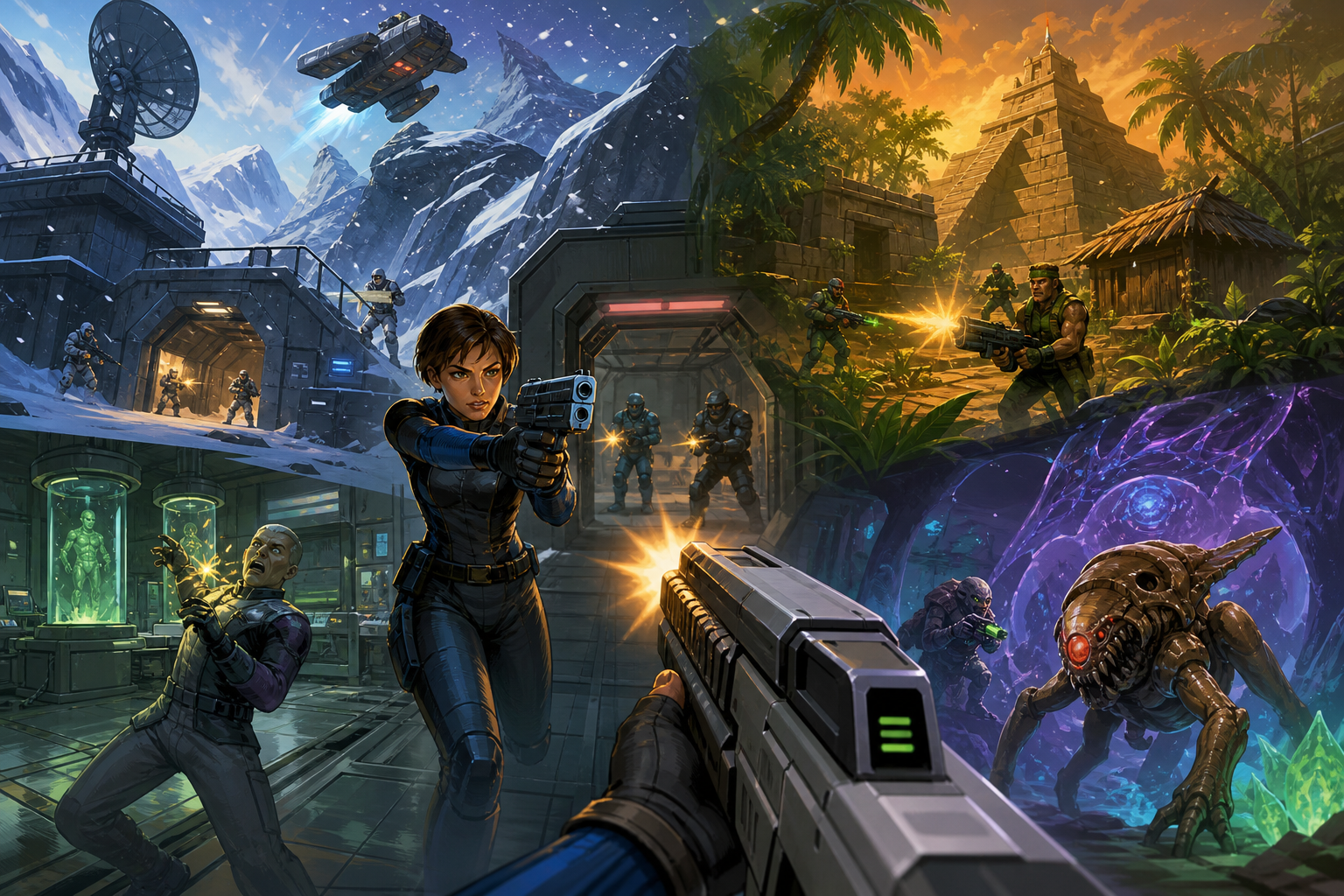
The Nintendo 64 is often remembered as the console that made four-player shooters a living-room event, but its first-person catalogue is broader than that reputation. Rare’s spy games share space with dinosaur-hunting adventures, dark science-fiction campaigns, maze-heavy combat, vertical flight and a Nintendo 64-specific reworking of Doom. Treating all of these games as interchangeable would miss what made the system’s shooters interesting.
This ranking considers North American Nintendo 64 releases as games first, not as historical popularity contests. Campaign variety carries the most weight, followed by combat identity, exploration, control demands, technical ambition and the quality of each game’s console-specific ideas. Multiplayer matters when it strengthens a game’s overall identity, but it does not automatically outrank a focused solo campaign. The list also stays within the first-person shooter boundary: third-person action games, rail shooters and vehicle-based shooters are not included simply because they involve guns.
10. Forsaken
Forsaken earns its place by refusing to behave like a conventional corridor shooter. Its six-degrees-of-freedom movement sends the player through open arenas, tunnels and vertical spaces where enemies can approach from above, below or behind. The result is closer to piloting a heavily armed craft through a hostile maze than walking from room to room with a rifle.
That freedom is also the game’s main barrier. Players who enjoy building a mental map in three dimensions will find a distinctive challenge, while anyone seeking straightforward forward-facing shooting may spend more time becoming oriented than enjoying the firefights. Its ranking reflects that narrow but memorable identity: Forsaken is not the broadest recommendation here, but no other entry makes navigation such a central part of combat. The Nintendo 64 version also gives the concept a social dimension through split-screen multiplayer, though its strongest reason to be here is the unusual campaign movement model.
- Best fit: players who want movement unlike most Nintendo 64 shooters.
- Tradeoff: the vertical arenas demand more spatial awareness than ordinary FPS layouts.
9. The World Is Not Enough
The World Is Not Enough is valuable because it shows a different route for a Bond shooter after GoldenEye 007. Developed by Eurocom and published by Electronic Arts, it presents a separate Nintendo 64 campaign built around firearms, objectives and set-piece situations rather than simply reusing Rare’s game. The Bond licence supplies a recognizable spy framework, but the game’s appeal depends on whether its mission rhythm works for the player rather than on nostalgia alone.
It sits below the stronger shooters because its identity is less mechanically singular. GoldenEye makes objectives feel like the structure of the game, while The World Is Not Enough more often feels like a capable console FPS carrying Bond themes. That still makes it a useful choice for players who want a story-led N64 shooter without dinosaur exploration or the stranger movement demands of Forsaken. Its four-player support also gives it a place in the system’s local multiplayer history, even though this ranking gives greater weight to its campaign.
- Best fit: Bond fans who want a separate N64 campaign rather than another GoldenEye session.
- Tradeoff: its combat and level identity are less distinctive than the games above it.
8. Quake
Quake brings a grim, industrial form of three-dimensional combat to the Nintendo 64. Its atmosphere is heavier than the colourful adventure shooters, and its arenas reward quick reactions, aggressive movement and attention to enemy positioning. The campaign’s dark visual language gives the game a strong mood even when its basic loop remains familiar: enter a hostile space, find a route through it and survive escalating encounters.
The Nintendo 64 version matters as a controller-driven adaptation of a computer shooter strongly associated with mouse-and-keyboard play. That makes its placement a balance between atmosphere and compromise. Players looking for a bleak, focused action game will find a clear identity here; those wanting elaborate objectives, character switching or broad exploration will find a more direct experience. Quake is an important part of the N64’s darker FPS side, but its structure is narrower than the adventure campaigns ranked above it.
- Best fit: players who prefer grim atmosphere and direct arena combat.
- Tradeoff: its campaign structure is less varied than the larger adventure-oriented shooters.
7. Turok 3: Shadow of Oblivion
Turok 3: Shadow of Oblivion represents the series late in the Nintendo 64’s life, when the formula had room for a broader arsenal and more elaborate encounters. It remains recognizably a Turok game, combining first-person shooting with large enemies, outdoor spaces and weapon experimentation, but it pushes toward a more structured action campaign than the exploratory original.
Its lower position is not a dismissal of ambition. Turok 3 benefits from arriving after earlier games had established the series’ vocabulary, yet that also makes its innovations feel less foundational. It is a good pick for players who want a late-generation N64 shooter with a substantial campaign and a developed combat toolkit, especially if the first two Turok games’ rougher exploratory edges are not appealing. The game is best understood as a late refinement of the series rather than the entry that most clearly defines what Turok brought to the console.
- Best fit: players wanting a later Turok campaign with a substantial weapon selection.
- Tradeoff: it has less of the original’s sense of discovery and historical surprise.
6. Quake II
Quake II deserves separate treatment from Quake because the Nintendo 64 release is not merely the same campaign placed on a cartridge. Its campaign arrangement differs from the computer versions, and the console version includes its own multiplayer presentation and content decisions. The setting also shifts toward military science fiction, making the weapon-and-enemy relationship feel more deliberate and readable than Quake’s stranger nightmare imagery.
The result is a strong middle-ranking choice for players who want an organised action campaign without giving up the speed and aggression associated with the series. It lacks the mission-objective sophistication of Perfect Dark or GoldenEye, but its Nintendo 64 interpretation has enough differences to stand as its own release rather than a footnote to the PC original. Four-player support adds value for groups, while the solo campaign remains the reason to consider it in a list weighted toward campaign variety.
- Best fit: players interested in a console-specific Quake II campaign.
- Tradeoff: the campaign is more linear and conventional than the top five entries.
5. Turok: Dinosaur Hunter
Turok: Dinosaur Hunter helped define the Nintendo 64’s early first-person identity by combining shooting with exploration, platforming and prehistoric spectacle. The campaign is not just a sequence of indoor combat rooms. Players move through environments that ask them to search, climb, backtrack and discover weapons while dealing with dinosaurs and armed enemies. That mixture gives the game a sense of adventure missing from more strictly arena-based shooters.
Its age shows in the pacing and in the way some encounters feel more like obstacles on an expedition than carefully staged modern combat scenarios. Those rough edges are part of the appeal for players who want an N64 game that treats the FPS as an exploration framework. Turok ranks below its sequel because the later game expands the formula, but the original remains the cleaner introduction to the series’ central idea. It is also one of the clearest examples of a console shooter using large outdoor spaces to make first-person play feel like an adventure rather than an arcade-style room-clearing exercise.
- Best fit: explorers who want platforming and weapon discovery alongside shooting.
- Tradeoff: its pacing and navigation can feel less streamlined than later N64 shooters.
4. Doom 64
Doom 64 should not be reduced to a cartridge port of the original PC Doom. It is a Nintendo 64-specific game with its own levels, darker presentation and single-player focus. The campaign uses the familiar Doom language of weapons, demons, secrets and increasingly dangerous spaces, but its mood is more oppressive and its visual identity belongs to the console rather than simply reproducing the earlier computer release.
That focus gives Doom 64 unusual discipline. It does not need a large multiplayer feature set to justify itself, because its strength is the relationship between level layout, weapon escalation and atmosphere. Players who want a compact, solo-first shooter will find a clearer recommendation here than in many technically louder games. It ranks fourth because its range of systems is narrower, but its consistency is exceptional within that range. The game’s distinct identity also explains why it remains a meaningful N64 selection even when later releases have made the Doom name widely available elsewhere.
- Best fit: solo players who want a darker, Nintendo 64-specific Doom campaign.
- Tradeoff: there is no conventional multiplayer mode to broaden the experience.
3. Turok 2: Seeds of Evil
Turok 2 expands the first game’s adventure structure into a larger and more technically ambitious campaign. Its environments are broader, its encounters more elaborate and its arsenal more memorable, with the Cerebral Bore standing out as a weapon designed to give the game personality beyond ordinary rifles and explosives. The game also supports one-to-four-player split-screen play, adding another layer without making the campaign feel secondary.
The Expansion Pak is part of the game’s historical identity, reflecting the way Nintendo 64 developers used additional memory for some of the system’s more demanding software. More space and ambition do not automatically make every level effortless to navigate, however. Turok 2 asks for patience with its scale and objectives. For players willing to explore, it offers one of the console’s fullest combinations of shooting, spectacle and adventure. Its ranking above the original Turok comes from the broader range of encounters and weapons, not simply from being a newer release.
- Best fit: players who want a large campaign, unusual weapons and N64 technical ambition.
- Tradeoff: its size and navigation can make progress less immediate than in Doom 64.
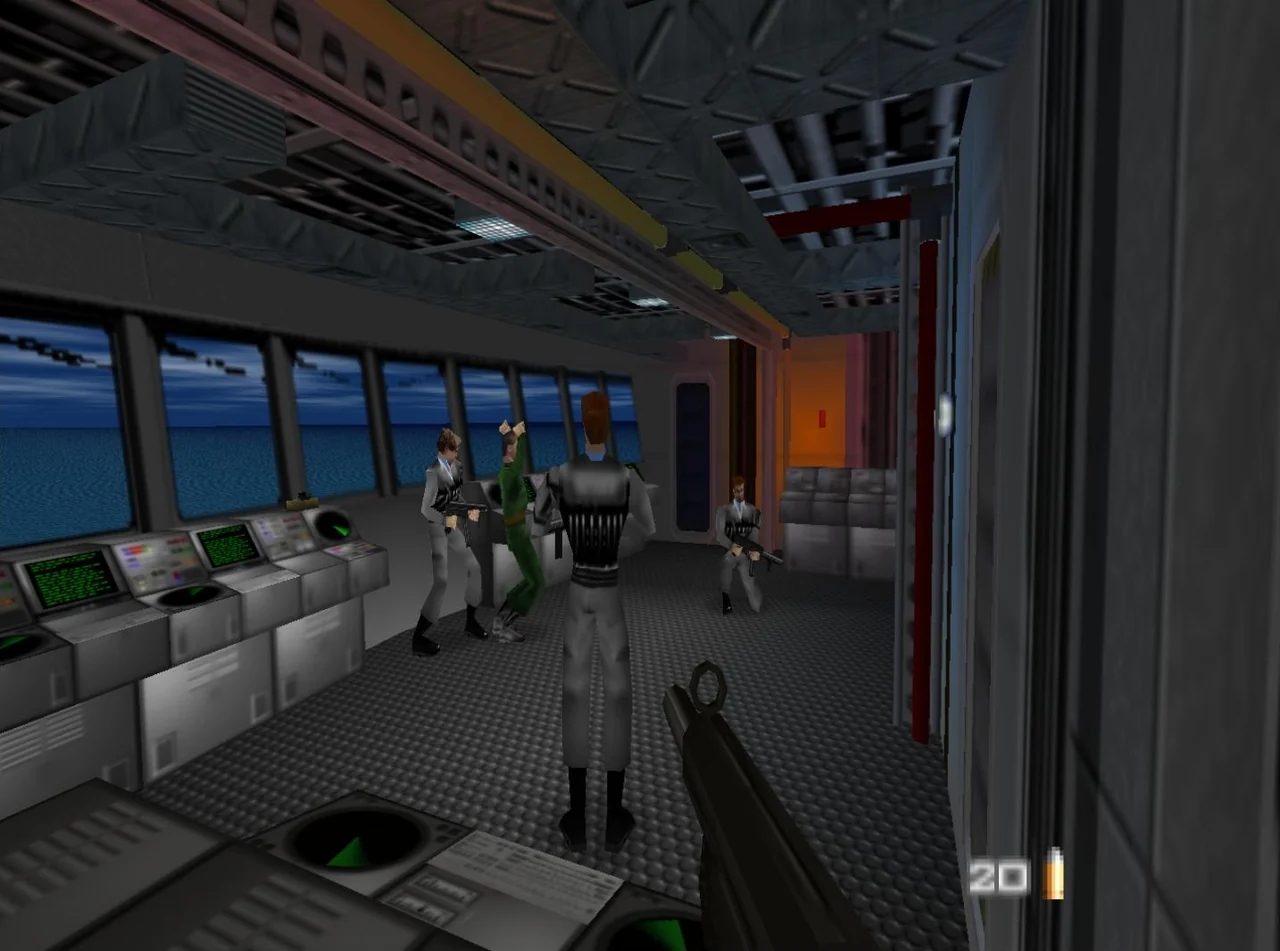
2. GoldenEye 007
GoldenEye 007 changed expectations for console first-person shooters by making objectives as important as enemy elimination. Missions ask players to infiltrate, protect, destroy, escape and gather information, so success depends on reading the situation rather than simply clearing every room. Difficulty settings also alter the demands of missions, encouraging repeat runs that focus on better execution rather than merely reaching the ending.
Its four-player split-screen mode became the most famous part of its legacy, but the campaign earns this ranking independently. The weapons, enemy reactions and objective structure work together to create a spy fantasy that feels different from a typical military shooter. The game’s semi-open mission spaces and changing requirements give it a distinctive rhythm, with the player often balancing stealth, exploration and direct combat. Perfect Dark ultimately offers more systems, yet GoldenEye remains the cleaner demonstration of how mission design can give a console FPS its own personality.
- Best fit: players who want objective-driven missions and memorable local multiplayer.
- Tradeoff: its campaign systems are less expansive than Perfect Dark’s.
1. Perfect Dark
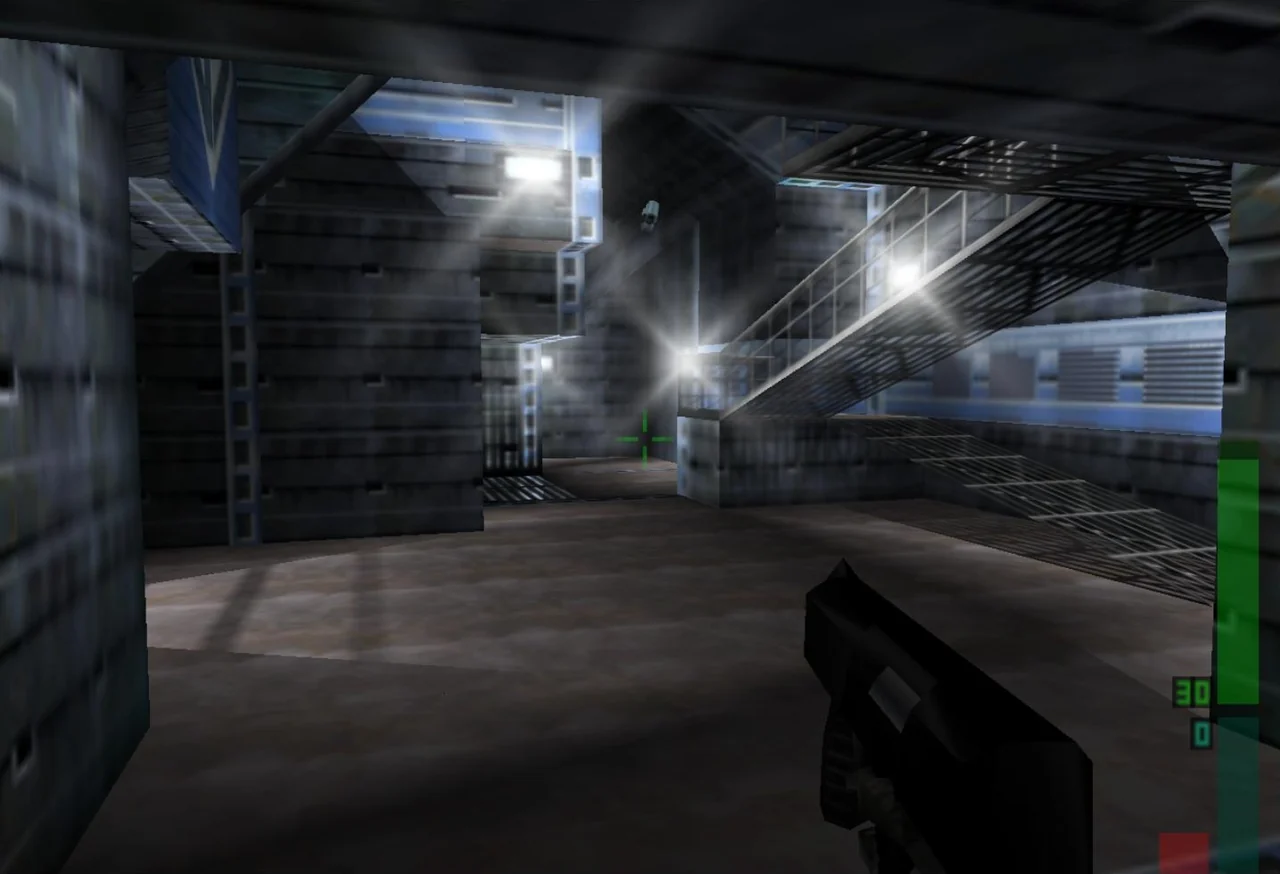
Perfect Dark takes the foundation of GoldenEye 007 and builds a more elaborate science-fiction shooter around it. Its campaign combines varied objectives, a wider weapon selection and more ambitious mission scenarios, while the setting supports gadgets, infiltration and shifting combat situations. The game’s additional systems do not erase the simple pleasure of shooting; they give players more ways to approach what each mission asks them to do.
Its multiplayer design also contributes to its identity, including AI-controlled opponents and a broad set of options, but the ranking rests on the complete package. Perfect Dark best represents the Nintendo 64’s first-person ambitions: it is a campaign shooter, a stealth-tinged mission game, a weapons sandbox and a substantial local multiplayer experience. The Expansion Pak is required for the solo missions and three- or four-player multiplayer modes; without it, the game offers a restricted selection of multiplayer and challenge content. That limitation is important for anyone approaching the original cartridge, but it also reflects the scale of Rare’s design.
Perfect Dark is not automatically the best choice for every player. Its larger design can feel demanding when a simpler action loop would be preferable, and its mission variety asks for more attention than a straightforward arena shooter. For players seeking the broadest blend of objectives, weapons, systems and Nintendo 64-specific multiplayer, however, it is the clearest number-one selection.
- Best fit: players who want the broadest blend of objectives, weapons, systems and multiplayer.
- Tradeoff: its larger design can feel demanding when a simpler action loop would be preferable.
The best Nintendo 64 first-person shooter depends on the kind of campaign you want. Choose Doom 64 for focused solo combat, Turok or Turok 2 for exploration and spectacle, Forsaken for three-dimensional movement, and GoldenEye 007 or Perfect Dark for objectives and local multiplayer. Quake and Quake II suit players who prefer darker, more direct action, while The World Is Not Enough offers a separate Bond-flavoured route.
The important lesson is that the N64 shooter catalogue was not one formula repeated ten times. Its strongest releases disagree about what first-person play should involve: navigation, secrets, mission work, platforming, atmosphere, weapon experimentation or social play. That variety is why the system’s shooters remain worth examining as individual designs rather than as a single GoldenEye aftershock.