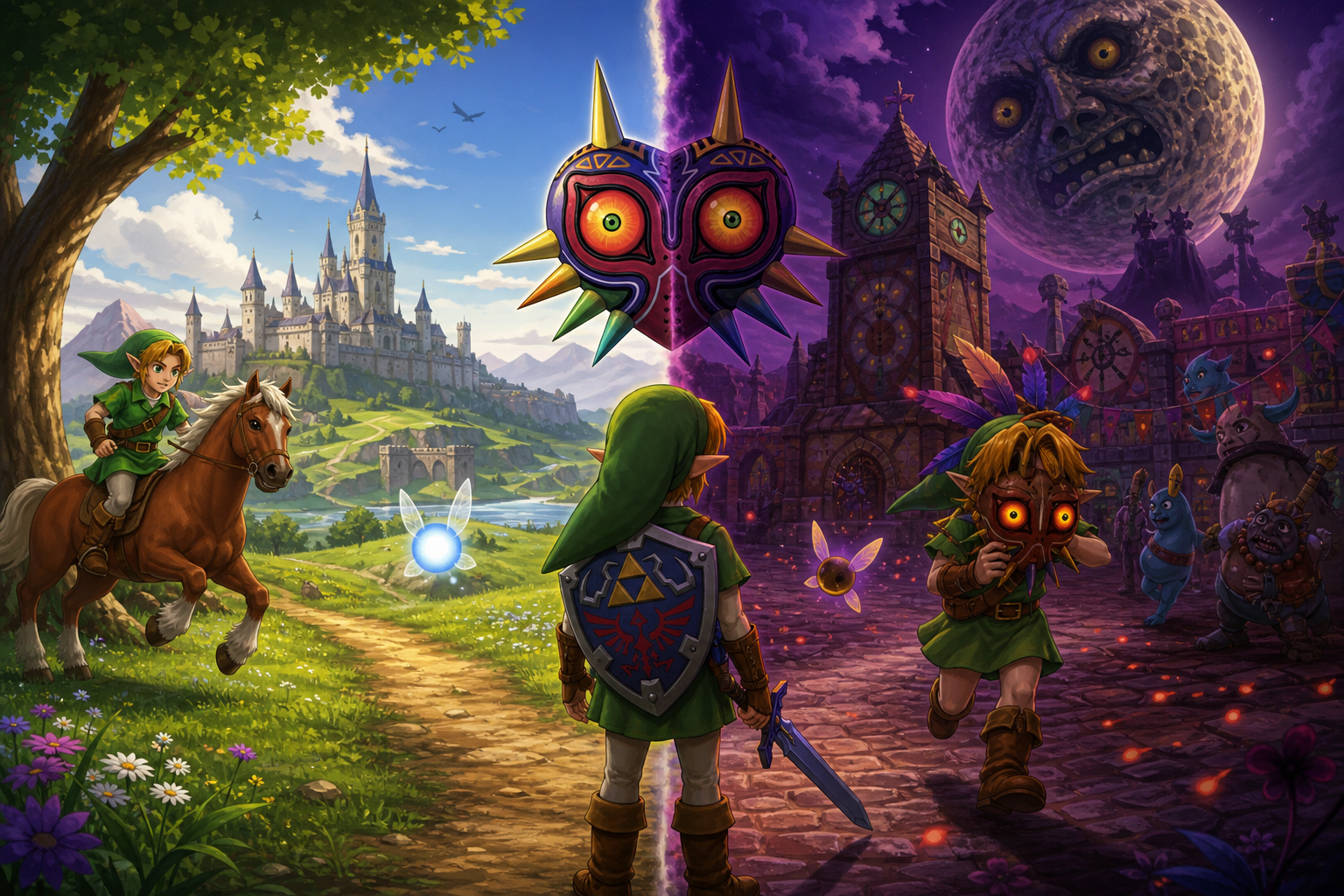
The Legend of Zelda: Ocarina of Time and The Legend of Zelda: Majora's Mask are often treated as neighboring versions of the same classic formula. That is true at the level of controls, combat and familiar adventure ideas, but it misses the decision that matters most to a new player: how much structure do you want your play sessions to have?
Ocarina of Time is a long-form journey. Its major discoveries tend to remain useful, its world opens through story-linked progression and its dungeons provide clear stretches of concentrated exploration. Majora's Mask is built around a repeating three-day cycle. It asks you to notice when people act, decide what belongs in the current attempt and turn partial failures into permanent knowledge. This comparison covers the original Nintendo 64 releases and avoids late-game story details.
The basic choice: steady adventure or planned attempts
Ocarina of Time is the easier game to understand as a traditional adventure. You travel through Hyrule, acquire tools, solve increasingly complex dungeons and return to earlier locations when a new ability reveals another route. Time matters, but mostly as a progression idea: Link's movement between childhood and adulthood changes what he can do and how the world is presented. You are usually free to stop exploring one objective and resume it later without reconstructing a schedule.
Majora's Mask takes the same broad action-adventure foundation and changes the player's priorities. Termina operates on a repeating three-day, 72-hour cycle. Characters follow routines, events occur at particular times and the player repeatedly returns to the start of the cycle to preserve the most important progress. The result is not a real-world deadline. You can reset the cycle as often as needed, but each attempt works best when it has a purpose.
Choose Ocarina of Time if you want the game to keep pointing toward the next broad milestone. Choose Majora's Mask if learning a place, person or puzzle through observation sounds more rewarding than simply moving forward. The difference is not that one game has time and the other does not; it is that Majora's Mask makes time part of navigation, planning and problem solving.
- Choose Ocarina of Time for a clearer main path and more conventional session breaks.
- Choose Majora's Mask for routines, experimentation and progress built from repeated attempts.
How Majora's Mask's three-day cycle actually works
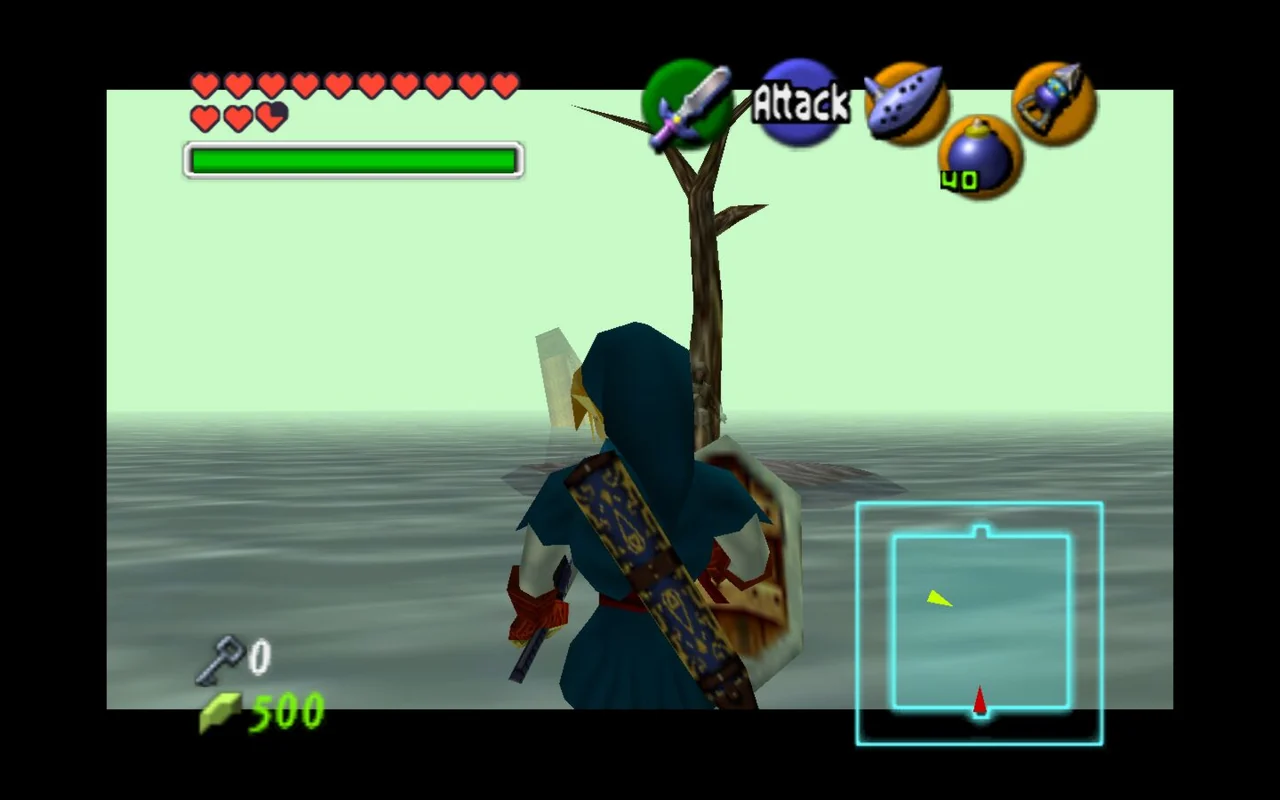
The clock in Majora's Mask advances during ordinary play, except during conversations and while the game is paused. A cycle begins on the First Day and continues through the Second Day and Third Day. When the cycle ends, the game returns Link to the beginning of the cycle. The Song of Time returns Link to 6:00 a.m. on the First Day and serves as the primary permanent save method in the original Nintendo 64 game.
That reset sounds harsher than it is because the game separates durable progress from local, temporary work. Major items, masks, songs, maps, dungeon maps, compasses, notes written in the Bomber's Notebook and Rupees deposited at the bank remain available after a return through the Song of Time. By contrast, many local events, cleared maze puzzles, conversations, Small Keys, Big Keys, Stray Fairies, wallet Rupees and usable items do not carry over in the same way.
The practical lesson is to treat a cycle as a work session rather than an entire playthrough. You might spend one cycle learning a route, another preparing supplies and a later one executing the plan. The Inverted Song of Time slows the clock, while the Song of Double Time moves you forward to later periods. Both tools reduce empty waiting without removing the game's central scheduling challenge.
The three-day structure creates pressure inside the fictional world, but it does not impose a real-world completion deadline. A player can return to the First Day repeatedly. What changes is the amount of planning needed before a reset, not the possibility of continuing the adventure.
- Reset deliberately after securing the progress you want to keep.
- Do not assume a time reset erases masks, songs, maps or major quest items.
- Use the Inverted Song of Time when you need more room to explore rather than rushing through a cycle.
- Treat the Song of Double Time as a way to reach a useful period instead of waiting through uneventful hours.
Saving habits on the original Nintendo 64
The original Ocarina of Time uses a familiar save-file model. Its instruction booklet describes three save files and explains that a file records acquired items, collected hearts and cleared dungeons. That structure makes it comfortable for players who want to finish a meaningful objective, save and return later without first arranging their next several in-game hours.
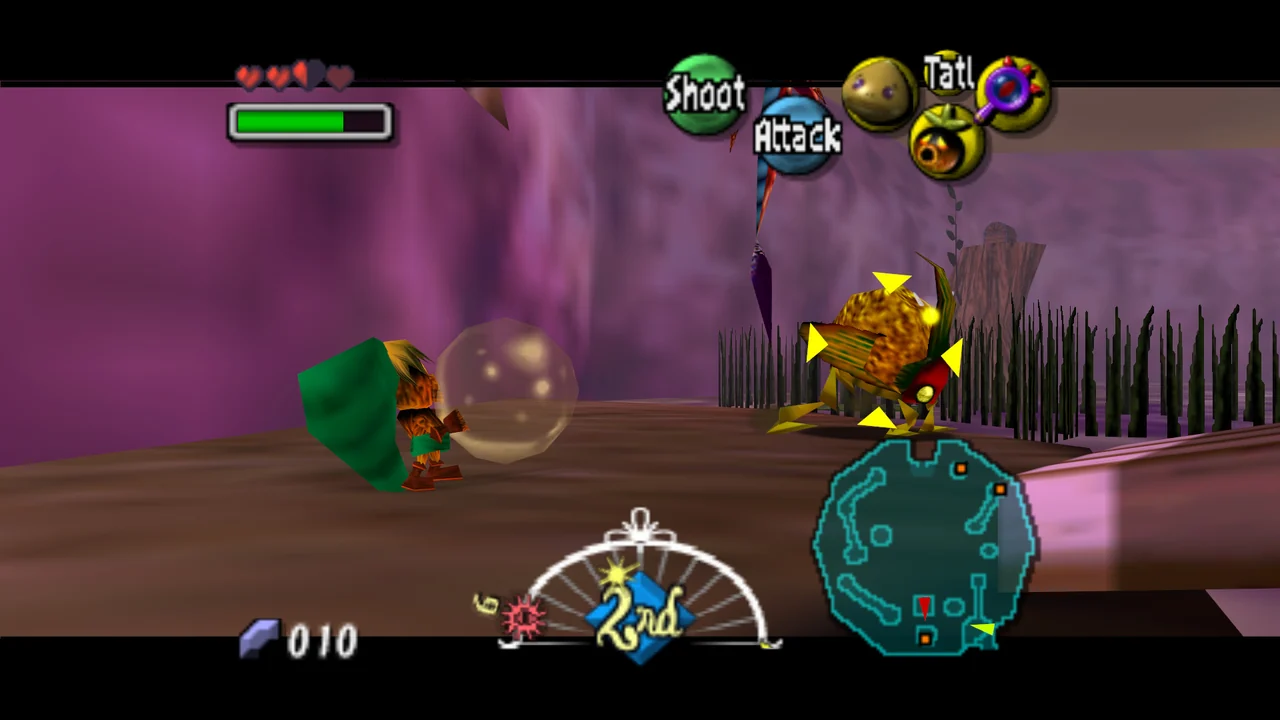
Majora's Mask needs more deliberate saving habits. Playing the Song of Time creates the main permanent save and places Link at the beginning of a new cycle. The game also allows a temporary interrupt save through an owl statue. In the original Nintendo 64 version, that save is not equivalent to a permanent file: it remains until the file is loaded and is then deleted. The manual warns players to save again after loading an interrupt save if they want to preserve later progress.
This distinction matters for both original cartridges and emulation setups that aim to reproduce original behavior. A convenient emulator save state may be useful as an additional safety net, but it does not change the game's own rules. For a faithful comparison, Majora's Mask expects you to understand what the Song of Time preserves and when a temporary interruption save has stopped protecting you.
The difference affects session planning. In Ocarina of Time, saving is mostly a matter of deciding when to stop. In Majora's Mask, saving is also a matter of deciding which state of the world should become the foundation for the next attempt. A player who treats every owl-statue save as a permanent checkpoint can easily misunderstand the original game's risk.
- Use Ocarina of Time's ordinary save files when you need a straightforward stopping point.
- Treat the Song of Time as Majora's Mask's permanent progress tool, not merely a clock trick.
- After loading an owl-statue interrupt save, create a permanent save before assuming the work is secure.
- Do not use remake-specific saving behavior as a guide to the original Nintendo 64 release.
Progression and navigation: geography versus geography plus time
Ocarina of Time teaches navigation mainly through space. Hyrule's regions connect through recognizable routes, landmarks and gates, while dungeons gradually teach their own internal layouts. A new item often changes the meaning of a familiar location, so returning to an old area can be satisfying without requiring you to remember an hourly schedule.
Majora's Mask still rewards knowledge of geography, but every destination has a temporal condition attached to it. The correct room may be accessible only on a certain day. A resident may appear in one place in the morning and another at night. A conversation that seems unimportant during one visit can become the clue that tells you when to return. Navigation therefore means learning both where to go and when being there matters.
The Bomber's Notebook supports this design by giving the player a place to record information and observations. It is a planning aid rather than a replacement for attention. Players who prefer map knowledge alone may find Majora's Mask less immediately comfortable, while players who enjoy making mental connections between schedules and locations may find its compact world unusually rich. Ocarina of Time asks, “Which route leads there?” Majora's Mask often adds, “At what point in the cycle should I take it?”
This changes the kind of memory each game rewards. Ocarina of Time favors remembering routes, landmarks, dungeon rooms and the purpose of newly acquired equipment. Majora's Mask adds a second layer: the player must remember whether a person, door, event or shortcut behaves differently on a particular day or at a particular time. The world is not only a map; it is a timetable.
- Pick Ocarina of Time if spatial landmarks are more appealing than schedule tracking.
- Pick Majora's Mask if observing routines feels like part of solving the world.
- Use the in-game notebook and your own notes to record a useful time and place rather than relying on memory alone.
Dungeon pressure and the cost of interruption
Ocarina of Time's dungeon rhythm is comparatively forgiving. Once you enter a dungeon, you can focus on doors, switches, keys, combat encounters and navigation without a short repeating clock constantly shaping the attempt. A player can wander, backtrack and stop after a major room without also asking whether a character's evening routine will be missed.
Majora's Mask's dungeon work exists inside the cycle. The clock does not make every dungeon a frantic race, especially when time-slowing tools are available, but it changes how you prepare. You may want to reach the dungeon with enough time remaining, understand which objectives must be completed before resetting and decide whether a first attempt should be exploratory rather than final. Losing time can mean losing temporary dungeon progress, even though the knowledge gained remains valuable.
This creates two kinds of pressure. Ocarina of Time's pressure comes mostly from puzzle difficulty, combat and the uncertainty of an unfamiliar dungeon. Majora's Mask adds logistical pressure: entering at the right point in the cycle, managing a route and recognizing which tasks can wait. If you dislike repeating a section after an interruption, Ocarina of Time is the safer choice. If a failed attempt that teaches you the route feels productive, Majora's Mask offers a stronger payoff.
Majora's Mask therefore rewards preparation more visibly. A player may use one attempt to identify a route, another to collect what is needed and a later attempt to complete the objective efficiently. This is different from a conventional dungeon progression system, where exploration and completion usually happen in one continuous stretch. The game is not necessarily asking you to move faster; it is asking you to understand what belongs in the current cycle.
- Choose Ocarina of Time for uninterrupted dungeon sessions and conventional backtracking.
- Choose Majora's Mask if planning an approach is part of the fun.
- Separate first attempts, preparation runs and completion runs instead of demanding perfection immediately.
Side stories are central in Majora's Mask
Optional content in Ocarina of Time usually sits beside the main adventure. It can deepen the world, improve Link's resources or reward curiosity, but the game remains legible if you concentrate on the central objective. You can often leave a side activity and return later without needing to reconstruct a chain of meetings.
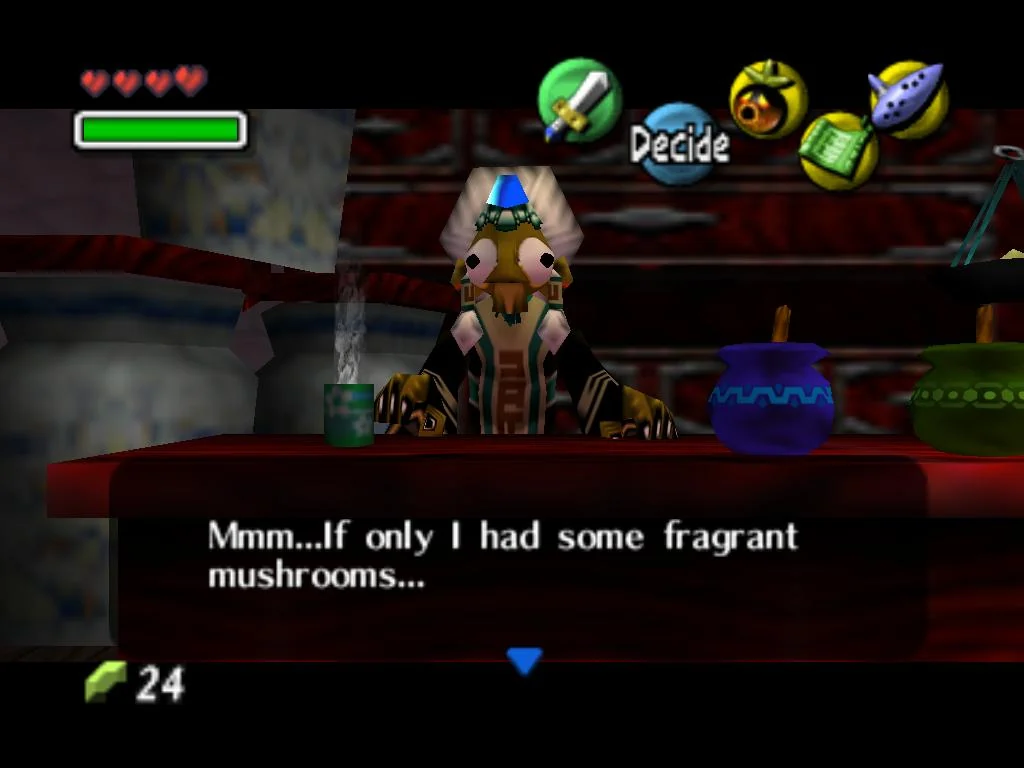
Majora's Mask makes side stories much more structural. Because characters follow routines and reset their memories of Link's actions when he travels through time, many optional situations feel like small investigations. The player observes a pattern, identifies a useful intervention and repeats the cycle with better timing. The reward is not only an item; it is also the sense that a dense local community has become understandable.
This design explains why reducing Majora's Mask to its dungeon count gives the wrong impression. Its main dungeons are important, but the surrounding areas, character schedules, masks and optional stories carry a large share of the game's identity. Ocarina of Time is better for players who want side content to remain optional. Majora's Mask is better for players who see the side stories as the reason to learn the clock.
The side content also changes how the player reads failure. Missing a scheduled meeting in Ocarina of Time may simply mean returning later. Missing one in Majora's Mask can mean waiting for the right point in a future cycle and reconstructing the conditions that made the opportunity possible. That extra setup can feel demanding, but it gives ordinary residents and their routines unusual importance.
- Choose Ocarina of Time if you want optional activities to stay clearly separate from the main route.
- Choose Majora's Mask if character routines and connected side stories are a major attraction.
- When a side story fails, preserve the lesson about timing instead of treating the attempt as wasted.
Masks and equipment change the familiar Zelda formula
Ocarina of Time builds its progression around equipment that expands Link's reach and problem-solving options. A new tool commonly answers a question posed by a dungeon or opens a route in the overworld. The pleasure comes from seeing the world become more readable as the adventure advances.
Majora's Mask places greater emphasis on masks as active tools. Masks can affect movement, combat, transformation and puzzle solving, while three transformation masks substantially change Link's abilities. This means the question is not only which item opens the next door. It may be which form suits the terrain, the timing or the task in front of you.
That flexibility also increases learning pressure. Majora's Mask expects the player to test abilities in situations that may not look like conventional equipment checks. Ocarina of Time tends to teach a new tool through a more directed progression. Majora's Mask often makes the value of a mask clearer through repeated use across different contexts. Players who prefer a clean sequence of upgrades may favor Ocarina of Time; players who enjoy building a toolkit of situational answers may prefer Majora's Mask.
The masks also reinforce the time system because a form can change how efficiently Link handles a task during a particular attempt. A player may not simply ask whether a mask is powerful. The more useful questions are whether it changes movement, solves a specific obstacle, saves time or makes a repeat visit less cumbersome. That is a more flexible but less linear relationship between equipment and progression.
- Choose Ocarina of Time for a more direct equipment-to-progression relationship.
- Choose Majora's Mask if switching forms and testing unusual abilities sounds appealing.
- Do not judge Majora's Mask's masks only by combat power; movement and problem solving are equally important.
Who should choose Ocarina of Time
Ocarina of Time is the stronger starting point for players who want to learn the classic three-dimensional Zelda structure without first managing a schedule. Its goals are easier to separate into broad categories: follow the story, explore the next region, solve the next dungeon and return to optional work when convenient. That makes it particularly suitable for shorter or irregular play sessions.
It also suits players who enjoy visible mechanical escalation. Link's abilities grow through a sequence of equipment and story changes, while the world gradually asks more from the same basic control scheme. If you prefer learning one major system at a time, Ocarina of Time provides a calmer introduction than Majora's Mask's combination of clock, routines and transformations.
The tradeoff is that Ocarina of Time is less focused on the intimate schedules and repeated problem solving that define its follow-up. Its world is broad and adventure-oriented rather than organized around a single compact community whose daily patterns you gradually decode. Choose it when momentum, clarity and a conventional save rhythm matter more than schedule-based discovery.
Ocarina of Time is also the better choice for players who want to put the game down after a clearly defined accomplishment. Completing a dungeon room, obtaining an item or reaching a new region provides a natural stopping point. There is less need to ask whether the next attempt must begin at a particular time of day or whether an unfinished local event will be reset by the next save.
- Choose Ocarina of Time if you are new to this style of Zelda.
- Choose Ocarina of Time if you pause games often or play in brief sessions.
- Choose Ocarina of Time if dungeon progression is more important to you than side-story density.
- Choose Ocarina of Time if you prefer progress that remains broadly intact after saving.
Who should choose Majora's Mask
Majora's Mask is the better fit for players who enjoy turning information into a plan. The game rewards noticing where someone goes, remembering what changes between days and deciding which objective belongs in the current cycle. It is less about blindly pushing forward and more about making each return to the beginning useful.
It suits players who enjoy experimentation and do not measure progress only by permanent items. An unsuccessful run can reveal a route, a schedule or a puzzle condition that makes the next attempt faster and more confident. The cycle also gives the world a distinctive emotional texture: people continue their routines even as the player repeatedly learns how to help, redirect or understand them.
The tradeoff is cognitive overhead. You must learn what resets, what remains, when to save and how much time a plan needs. Players who find repeated setup tedious may prefer Ocarina of Time. Players who enjoy planning around constraints, collecting masks and exploring character-driven stories may find Majora's Mask more rewarding than a straightforward sequel.
Majora's Mask is especially suited to players who enjoy gradual mastery. The first visit to a location may be confusing because the player lacks context. A later visit becomes more efficient because the player knows where to be, when to arrive and which temporary tasks are not worth repeating before a reset. The satisfaction comes from understanding the system rather than merely overpowering it.
- Choose Majora's Mask if schedules and observation sound like enjoyable puzzles.
- Choose Majora's Mask if you can accept repeating an attempt after learning something useful.
- Choose Majora's Mask if side stories and transformation mechanics matter as much as dungeon progression.
- Choose Majora's Mask if you prefer accumulated knowledge to a purely forward-moving adventure.
Original Nintendo 64 edition notes
This comparison applies to the original Nintendo 64 releases only. Majora's Mask requires the Nintendo 64 Expansion Pak; the original instruction manual identifies that hardware as mandatory. That requirement is separate from the game's time system and should not be confused with later ports or remakes.
The original Nintendo 64 version also has saving behavior that should not be replaced with descriptions of Majora's Mask 3D. Later versions alter some interface, convenience and saving details, so advice based on them can give a new player the wrong expectations about interrupt saves and cycle management. Ocarina of Time 3D likewise is not the edition being compared here.
For collectors and players using an original-edition setup, the useful decision is therefore about structure rather than feature shopping. Ocarina of Time offers a conventional long-form save model. Majora's Mask asks you to work with the Song of Time, the temporary owl-statue save and the rules governing what survives a cycle reset. Both games remain approachable, but they teach different habits.
The edition distinction is important even for players using emulation. A modern emulator may add save states or other convenience features, but those features are external to the original software. They can make stopping easier without changing what the Nintendo 64 game itself considers permanent progress.
- Confirm that your Majora's Mask setup includes the Nintendo 64 Expansion Pak.
- Use original Nintendo 64 saving expectations when judging Majora's Mask's convenience.
- Do not import remake-specific features into an original-release comparison.
- Treat emulator features as optional conveniences rather than evidence of the original game's save behavior.
The final decision: match the game to your session style
Pick Ocarina of Time if you want a steadily unfolding heroic adventure with clear dungeon milestones, spatial navigation and a conventional approach to saving. It is the better match for players who want to stop after a dungeon room, return days later and immediately understand what broad objective remains.
Pick Majora's Mask if you want a compact world that rewards attention to time, routines and repeated attempts. It is the better match for players who enjoy making plans, learning from failed runs and treating side stories as a central part of progression. The three-day cycle creates pressure inside the game, but it is not a real-world deadline and never requires completing the entire adventure in one cycle.
Neither game is simply the longer or shorter option in a meaningful sense. Ocarina of Time concentrates its momentum in conventional progression. Majora's Mask distributes its depth across schedules, masks, character stories and knowledge that accumulates from one cycle to the next. Decide whether you want your next Zelda session to ask, “What dungeon comes next?” or “What can I accomplish before this cycle turns over?”
The best choice is therefore less about ranking the games than matching their demands to your habits. Ocarina of Time protects forward momentum and makes the next objective easier to identify. Majora's Mask asks you to build a working understanding of a place, its residents and the clock that connects them. One is organized around a long journey; the other is organized around meaningful repetition.
- Choose Ocarina of Time for steady progression and fewer scheduling demands.
- Choose Majora's Mask for planned cycles, dense side stories and learning through repetition.
- If both appeal, start with the one whose saving and session rhythm sounds less stressful; the other will be easier to appreciate afterward.
Ocarina of Time is the clearer recommendation for a first three-dimensional Zelda adventure or for anyone who values uninterrupted progression. Majora's Mask is the more specialized choice, built for players who enjoy schedules, transformations and the satisfaction of converting repeated attempts into knowledge.
The important distinction is not which game has more content or which one is harder. It is how each game asks you to spend attention. Ocarina of Time organizes attention around a long journey. Majora's Mask organizes it around a clock, a community and the next plan.