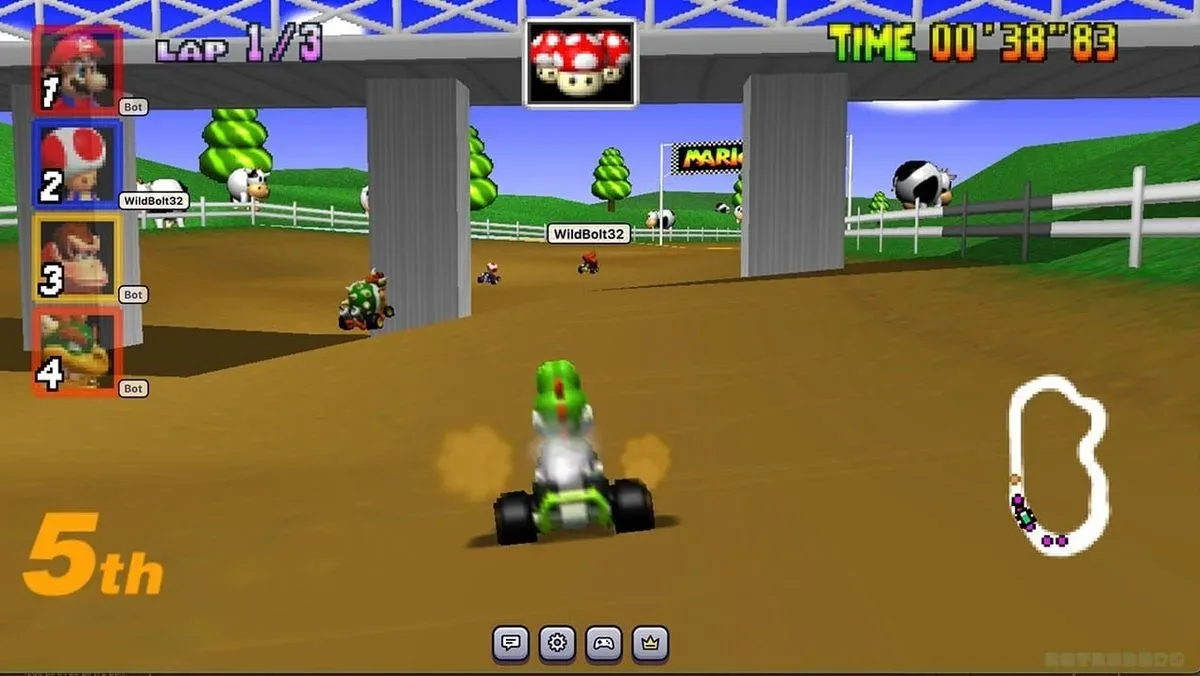
Mario Kart 64 has arrived in a format that would have sounded wildly implausible during the Nintendo 64 era: a browser-based version with real-time online races, private rooms, keyboard support and mobile touch controls. The project, credited to Oliver Sauter, is designed to start without an account-registration step or a conventional installation.
That simplicity is the headline. Rather than treating an older console game as something that must be accessed through original hardware, a downloaded program or a dedicated launcher, this version puts the familiar kart racer behind a web page. Pick a racer and a track, set a display name, and join a race. If a player does not select a character, the game assigns one automatically.
For a game whose competitive appeal has always depended on fast, chaotic rounds with other people in the same room, the practical promise is clear: it lowers the amount of coordination needed to get a race underway. The service rotates into new races every 30 seconds, and it supports both public online play and rooms for selected friends.
What the browser version says it offers
- Real-time online multiplayer races.
- Private rooms for playing with selected friends.
- Fresh race sessions every 30 seconds.
- No stated account registration or installation requirement.
- Character selection, track selection and player-name changes.
- An option to enable a camera.
- Bot opponents when there are not enough human racers.
- Keyboard inputs on desktop and touch controls on phones.
The inclusion of bots matters more than it may initially seem. Online retro-game projects can live or die on whether somebody happens to be waiting in the same queue at the same moment. Filling empty spaces with computer-controlled drivers means a player can still get a complete race rather than staring at a lobby that never becomes viable. It also allows public sessions to mix people and bots rather than presenting an all-or-nothing multiplayer proposition.
That does not mean bots make a private room equivalent to a full group of friends. They solve a participation gap, not the social part of local Mario Kart rivalry. Still, for anyone arranging a small session, the fallback removes one common obstacle: a missing fourth racer does not necessarily end the plan.
Controls are deliberately spare
On a keyboard, the stated control scheme is unusually lean: arrow keys handle movement, while X and Z are used to race and fire. That pared-down mapping is fitting for a game meant to open quickly in a browser tab. It also avoids asking users to configure a controller before they can find out whether the experience works for them.
On iPhone, the browser version presents an on-screen joystick plus four buttons for drifting, acceleration, braking and item use. Touch controls will naturally be a different proposition from physical buttons: fingers must share limited screen space, and steering through a virtual stick changes the physical feel of controlling a kart. But the important functional point is that the project has a mobile interface rather than merely loading a desktop-shaped game page on a phone.
The reported tests were carried out on a Mac and an iPhone, where the port was said to work smoothly. That is useful evidence that the project is not confined to one desktop browser setup. It is not, however, a guarantee about every browser, operating system, network connection or device. Browser projects can behave differently across hardware and software environments, so prospective players should treat broad compatibility as something to check rather than assume.
Related coverage includes Mario Kart 64 Browser Port Brings Online Races and Private Rooms.
Why WebAssembly is central to the pitch
The browser version is built with SpaghettiKart, libultraship and WebAssembly technology. Of those terms, WebAssembly is the easiest to explain in practical language. It is a web technology that lets browsers run code compiled into a compact format, allowing web applications to perform work that might otherwise be associated with installed software.
In this case, WebAssembly is part of what makes a technically demanding interactive experience plausible in a tab rather than a separately installed program. It should not be mistaken for a promise that every game will run identically everywhere, or that a browser has somehow become an N64. The relevant takeaway is narrower: it provides a route for a software project to run inside modern browsers with the responsiveness required for an action game.
libultraship and SpaghettiKart are also named as pieces of the project’s technical foundation. The available details do not describe precisely how responsibilities are divided between them, so it would be premature to attach extra features or claims to either tool. What can be said is that this is not presented as a simple video stream. The game is described as a browser port assembled using these technologies, with active control input and real-time races.
Private rooms may be the feature with the longest legs
Instant public matchmaking makes the project easy to sample, but private rooms may be the more meaningful feature for groups that already know whom they want to race. A private space changes the question from “Is anyone online?” to “Can we send one link and start?” For a short break, a remote catch-up or an impromptu challenge among friends, fewer onboarding steps can be more valuable than a long list of menu options.
Players can select a track and racer before getting started, which preserves an important part of Mario Kart’s ritual: the small negotiations and personal preferences that take place before the engines start. Character choice is not left entirely to chance either, although automatic assignment is available for people who want to enter a race without making every selection themselves.
There is a notable contrast here with the elaborate account systems that often surround online games. This project’s stated no-registration approach reduces friction, but it also means players should not infer features that have not been described. The supplied information confirms names, rooms, races, camera options and character or track choices; it does not establish persistent progression, rankings, moderation tools, cross-device records or any other long-term account-based systems.
A useful reminder about access versus permanence
A browser port’s convenience is real, especially when it can be saved as a shortcut on a phone’s home screen. Yet a shortcut is not the same thing as an installed, self-contained game, and an online service is dependent on the site and supporting infrastructure continuing to operate. The information available here describes how the game can be accessed now, not a permanence guarantee.
That distinction is worth keeping in mind for retro-game fans. The original Nintendo 64 cartridge and a browser-based online version answer different needs. One is physical hardware and software; the other prioritizes immediate access and remote play. Neither need invalidate the other. In fact, projects such as this one underline why the old game remains compelling: a straightforward race, a well-timed item and a wildly inconvenient opponent can still produce a memorable round with almost no setup.
It also fits a broader appetite for old games that can be revisited without turning an evening into a technical project. For another look at why old-game friction and chaos can remain part of the appeal, read our celebration of Dark Souls’ Bonewheels. Mario Kart 64 is obviously a very different game, but both make a case for mechanics that create stories faster than they create explanations.
What players should expect before joining
The sensible expectation is an accessible, quick-start way to race rather than a fully documented replacement for every way people have played Mario Kart 64. Public matches may contain a blend of human opponents and bots. Character assignment may be automatic if no selection is made. Mobile control means using a virtual joystick and buttons, while desktop play can use the keyboard layout described above.
For users who value a specific input method, the supplied details confirm keyboard and touch support but do not provide information about gamepad support. Likewise, the project offers real-time online competition and private rooms, but no further technical details are given about networking, regional matchmaking, performance requirements or the maximum number of players in a session. Those are practical questions, but they remain unanswered by the available description.
Even with those boundaries, the core proposition is unusually direct. A player can open a browser, enter a race, and potentially share a private room with friends without an installation or sign-up detour. For a game built around speed, rubber-band chaos and the eternal suspicion that someone deliberately saved an item for the final bend, that is an appropriately immediate route to the grid.