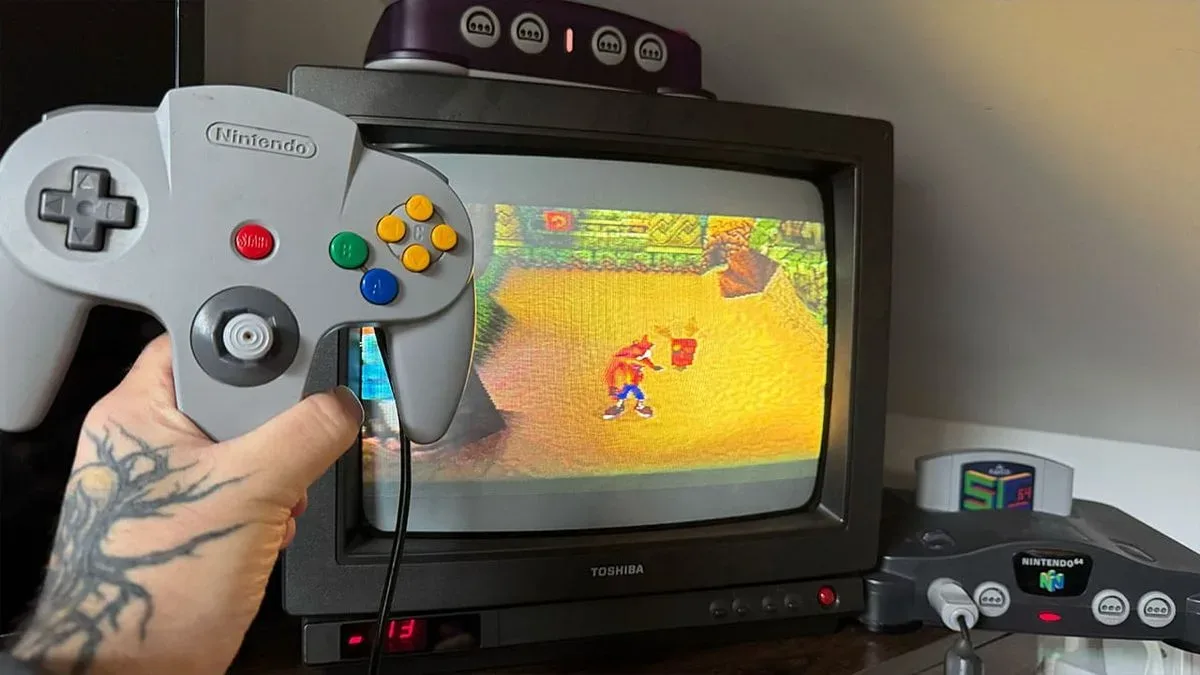
Crash Bandicoot has turned up somewhere the series was never expected to be: Nintendo 64 hardware. A work-in-progress fan port by developer old pirate has made an early playable demo available, bringing one level of the original PlayStation-era platformer to Nintendo’s 64-bit console.
This is not a finished conversion, nor is it a newly licensed N64 release. It is a small but notable technical demonstration: one level can be played, its two routes are accessible, and the build has been shown running on original Nintendo 64 hardware. For a character so closely associated with PlayStation’s first console generation, the sight of Crash operating on an N64 is precisely the kind of alternate-history oddity that retro-game fans cannot help but investigate.
What the current Crash Bandicoot N64 demo includes
The available build contains a single level. It is described as fully playable, including both paths through that stage. That matters because it indicates more than a static scene, model showcase, or brief movement test: the project has enough working game logic for players to progress through the level’s alternate routes.
There are important limitations. The demo presently has no sound effects and no music. Crash’s movement, hazards and platforming therefore arrive without the audio cues and soundtrack that help define the original game’s rhythm and personality. Performance is also not completely stable; lag can occur at times.
Those caveats put the project firmly in prototype territory. Still, a playable level is a meaningful threshold for a fan port. It gives the developer a practical test bed for movement, level flow and hardware behavior rather than merely showing that an N64 can render a familiar character.
At a glance
- Developer: old pirate
- Format: fan-made, work-in-progress N64 port/demo
- Playable content: one level with both routes
- Audio: no music or sound effects in the current build
- Performance: playable, with occasional lag reported
- Download: free via itch.io
Why “port” needs a little context here
A port is a version of software adapted to run on a different system. In common conversation, the word can suggest a complete game moving intact from one platform to another. In development terms, however, it can also describe a project at any stage of that adaptation process.
That distinction is especially useful here. The current N64 release is best understood as an early port demo rather than a full version of Crash Bandicoot. It demonstrates playable content, but it does not yet include the complete game, music, or sound effects. Calling it a finished N64 edition would overstate what is available.
Its appeal lies in its potential as much as its present feature set. Fans can see the core proposition functioning on hardware that never officially received Crash Bandicoot: an N64 running a playable slice of a game that is strongly identified with the original PlayStation.
Original hardware is part of the experiment
The demo has been run from an SC64 cartridge on an original Nintendo 64 connected to a CRT display. It has also been indicated as compatible with M64 and Analogue 3D setups when used through the same cartridge-based approach.
An SC64 is a flash cartridge: a cartridge-like device used to load game files on compatible Nintendo 64 hardware. For enthusiasts, that is different from treating the demo solely as an emulation curiosity. It makes the project relevant to people maintaining real N64 systems and modern N64-compatible hardware arrangements, not just those exploring the console’s library through software emulators.
Compatibility does not erase the project’s rough edges. The reported lag and absent audio remain central to what players should expect. But booting a fan build on original hardware is valuable evidence of the project’s direction. The N64 is not simply being used as a visual theme; the port is being tested in the environment it is intended to run on.
What would make the next version more substantial
The clearest priorities are already apparent. Sound effects and music would dramatically change how complete the demo feels. Platform games rely on audio for more than atmosphere: feedback can help players register movement, impacts and interactions. The original Crash experience is also remembered for its distinctive musical identity, so an audio-less build will naturally feel incomplete even when its platforming functions.
Performance is the other major area. Occasional lag is unsurprising in a work in progress, but it can affect timing in a platformer. A smoother build would make it easier to judge the game’s controls and pacing on their own terms, rather than through the lens of prototype performance.
Then comes scope. A single playable stage is a promising start, but turning that into a full conversion would require expanding the playable level set and maintaining consistent functionality throughout. There is no confirmed timetable or commitment for those additions, so the sensible expectation is simply that the current download is a snapshot of ongoing fan work, not a promise of a complete release.
An intriguing N64 “what if”
Crash Bandicoot on Nintendo 64 has an instantly understandable novelty. The character is culturally tied to a competing console family, while the N64 has its own landmark platforming identity. Putting Crash on Nintendo’s machine creates a playful counterfactual: not a rewrite of history, but a chance to glimpse a game running outside the system with which it is most closely associated.
That novelty should not obscure the real limitations of the demo. One level, missing audio and periodic slowdown are not the basis for declaring a new definitive way to play Crash Bandicoot. They are, however, enough to make the build worth watching for people interested in fan development, original hardware and improbable retro ports.
The wider Nintendo conversation continues to produce unusual projects and release plans; recent Nintendo news around The Duskbloods’ move to 2027 is a reminder that the platform’s present and its enthusiast-driven past can generate very different kinds of anticipation. This Crash demo sits squarely in the latter camp: an unofficial technical project whose charm comes from seeing an impossible-looking console pairing become playable.
For now, the practical takeaway is straightforward. Anyone downloading the free demo should approach it as an unfinished build. Expect a single level, expect silence where the soundtrack and effects should be, and expect that performance may not be flawless. In return, the demo offers a rare sight: Crash Bandicoot navigating an N64 level on the hardware that, officially, never hosted him.