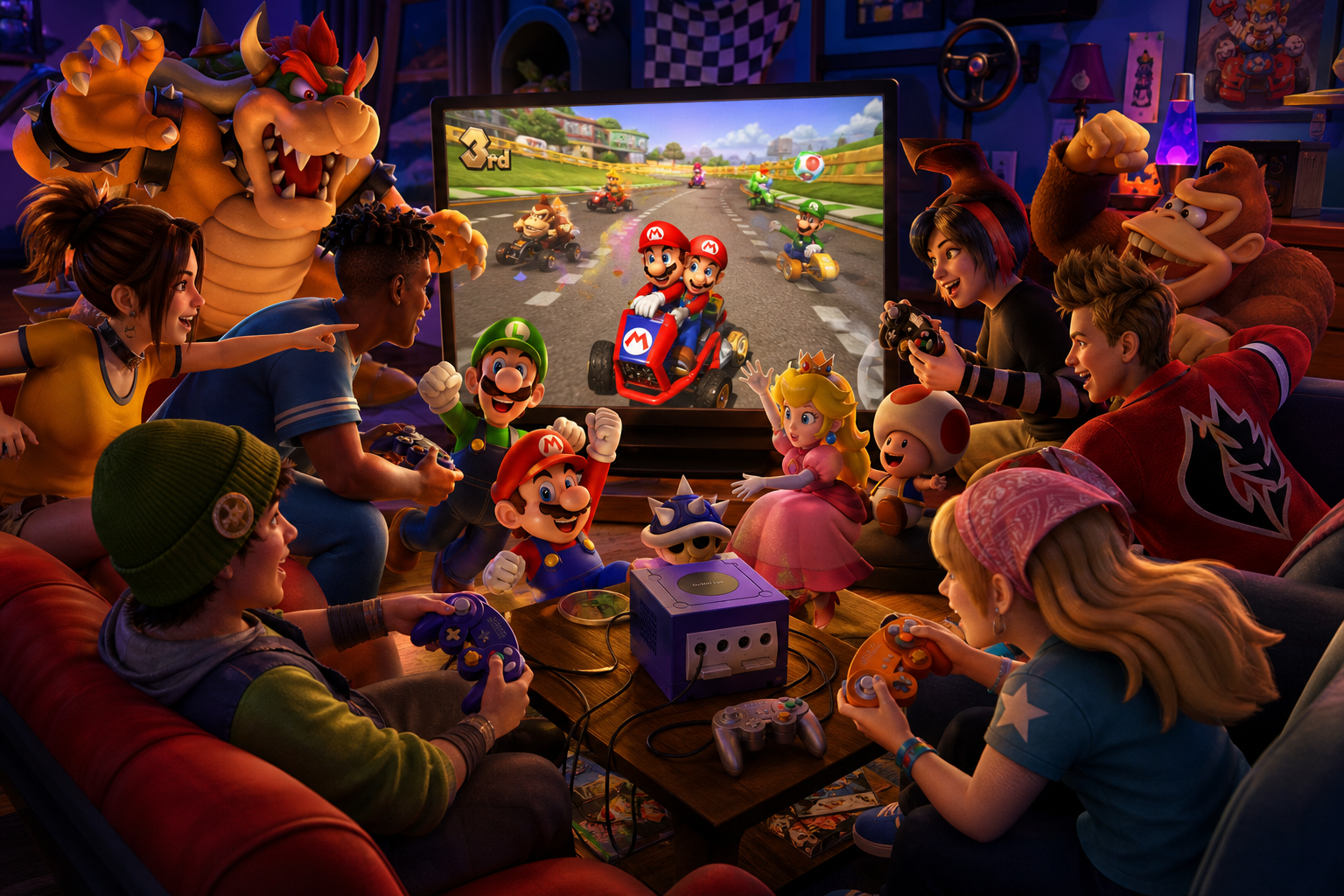
The best Nintendo GameCube party games are not simply the titles with the largest minigame counts. This ranking asks a more useful question: what does each game give a group to do together that feels different from ordinary competitive multiplayer? The selections are judged by accessibility, variety between rounds, strength of the local multiplayer identity, flexibility for different group sizes and the way each game uses GameCube hardware.
The list includes board games, rhythm contests, microgames and asymmetric multiplayer. It does not treat four Mario Party sequels as interchangeable, and it does not count every racing, fighting or sports game with a versus mode. A game earns its place when its group experience is central, substantial or unusually inventive. Accessory requirements are part of the decision, because DK Bongos, a Game Boy Advance, a microphone or a link cable can make a game more distinctive while also making it harder to assemble for a session.
10. Super Monkey Ball 2
Super Monkey Ball 2 earns the final place because its main attraction is not a conventional party collection. The story campaign is built around guiding rolling monkeys through obstacle courses, but its dedicated Party Games suite turns that same physics-driven identity into a varied local activity. The result is a useful choice for groups that want short competitive rounds without abandoning the unusual movement and balance of the main game.
Its strength is variety of tone. The Party Games offer a selection of competitive diversions rather than asking everyone to repeat the same basic race. That gives a group several ways to test control, timing and risk management. It also creates a natural progression for newcomers: players can begin with straightforward events, then try more demanding challenges once they understand how the rolling movement behaves.
The limitation is equally clear. Super Monkey Ball 2 is not structured around party play from its opening screen, so its multiplayer content can feel like a substantial companion to the main campaign rather than a fully unified party package. It is best for a group that enjoys learning a distinctive movement system together and does not mind a little friction before the controls become comfortable.
- Best fit: players who want party challenges built around physics and control.
- Strength: a dedicated Party Games suite with a range of local competitive activities.
- Tradeoff: the party content is part of a larger action game rather than the whole identity of the release.
9. Donkey Konga 2
Donkey Konga 2 makes the list by turning multiplayer into a rhythm performance rather than a standard controller contest. Its intended control scheme uses DK Bongos, with players striking the left or right drum and clapping into the controller’s built-in microphone. That physical vocabulary immediately gives the game a different social feel: participants are not merely selecting commands, but performing the same song through timing and coordination.
The sequel expands the formula with more than 25 songs, three difficulty settings, five play styles, freestyle play and unlockable minigames connected to its Street Performance mode. Multiplayer supports up to four players, so the game can work as either a cooperative music session or a competitive score chase. The added modes matter because they prevent the bongos from feeling like a single trick repeated for an entire evening.
The main cost is hardware. DK Bongos are supplied separately for this release, and without them the central idea loses much of its character. Donkey Konga 2 is therefore not the easiest recommendation for a standard-controller gathering. It suits groups ready to treat the living room like a tiny percussion stage, especially when the appeal comes from performance, mistakes and audience reactions as much as from winning.
- Distinctive hook: drum hits, claps and rhythm accuracy.
- Accessory note: DK Bongos are required for the intended control scheme.
- Best fit: rhythm fans who prefer performance and friendly embarrassment to board-game strategy.
- Tradeoff: the sequel’s hardware requirement makes it less convenient than a controller-only party game.
8. Pac-Man Fever
Pac-Man Fever is a North American GameCube party game built around a board-game structure, minigames and a cast drawn from several Namco properties. That crossover approach gives it a clear identity apart from Nintendo’s own party series. Players move through a shared competition, then use shorter events to settle disputes, change momentum and determine who gains the next advantage.
Its appeal is strongest for groups that enjoy the ceremony of a board game: taking turns, watching a lead change and treating each minigame as one part of a larger contest. The Namco cast gives the package a different flavor from the Mario Party entries, while the board structure makes the session feel like a complete competition rather than a loose collection of short challenges.
Pac-Man Fever is less compelling if everyone wants immediate action with minimal explanation. The board phase creates pauses and context, and its appeal depends more on the flow of a full match than on isolated minigames. Regional scope also matters. The relevant GameCube release for this discussion is the North American edition, so it should not be presented as a worldwide GameCube release without qualification. Its conventional structure makes it a credible alternative, but its hardware ideas are less adventurous than those of the higher-ranked games.
- Best fit: groups that want a Namco-themed board-and-minigame format.
- Strength: a crossover cast and complete board-game structure.
- Tradeoff: more turn-based pacing and less hardware novelty than the higher-ranked entries.
- Edition note: the North American GameCube release is the relevant regional reference.
7. Mario Party 4
Mario Party 4 is a strong early GameCube foundation because it makes the familiar board-and-minigame formula accessible without requiring unusual accessories. It includes 50 all-new minigames, multiple three-dimensional boards and one-to-four-player support. The minigame formats include free-for-all, one-versus-three and two-versus-two contests, so a player who excels at direct competition is not necessarily the same player who thrives when teams or temporary alliances matter.
Its Mini-Giant system adds a useful layer to the board game. Characters can shrink or grow, opening different areas of the boards and triggering special events. That gives the board phase more consequence than a simple movement race, because size can affect where a player can go and which situations become available.
Tag Battle is another important addition. Pairing players into teams gives cooperative players a reason to communicate while still preserving competition between pairs. Mario Party 4 ranks below later entries because its systems are comparatively straightforward and its accessory ideas are limited. That simplicity is also why it remains a dependable starting point: a mixed group can understand the basic rhythm quickly, then decide whether it prefers luck, minigame skill or board decisions.
- Best fit: first-time party groups and mixed-skill players.
- Distinctive system: Mini-Giant changes character size, routes and board events.
- Multiplayer range: one to four players with free-for-all and team-based formats.
- Tradeoff: less breadth and experimentation than later GameCube entries.
6. Donkey Konga
The first Donkey Konga deserves a higher position than its sequel in one important respect: it establishes the clearest hardware-to-game relationship in the ranking. DK Bongos are not an optional novelty layered onto an ordinary party game. Players hit the left or right drum and clap, making rhythm accuracy and physical timing the language of every session. That makes the game immediately legible to spectators and approachable for players with very different gaming backgrounds.
The package also reaches beyond song performance. It supports one to four players, includes competitive rhythm play, unlockable songs and minigames, and uses the bongo inputs for Mario Party-style activities. Nintendo’s description specifically identifies challenges in which the position of the drumbeats and the player’s clapping affect the result. That variety helps prevent the accessory from feeling like a single control trick repeated for an evening.
The drawback is that Donkey Konga depends heavily on having compatible controllers. A standard GameCube setup does not reproduce its intended appeal, and multiple players need access to the relevant hardware for the full group experience. For groups with the bongos, however, Donkey Konga offers a lively alternative to button-based competition. It demonstrates how a GameCube accessory could become the star of a party game rather than a peripheral that disappears into the background.
- Distinctive hook: DK Bongos turn rhythm into a physical multiplayer language.
- Best fit: groups with compatible bongos and a taste for performance games.
- Strength: songs, unlockables and bongo-based minigames support more than one type of session.
- Tradeoff: the accessory requirement narrows its convenience.
5. Mario Party 5
Mario Party 5 improves on the basic template with more than 60 new minigames, new boards, an expanded single-player mode and several ways to shape a session. Its board-event manipulation gives players more influence over what happens between contests, while duel, traditional and everyone-versus-Bowser formats help the game vary its tension instead of treating every round as the same kind of four-player race.
Compared with Mario Party 4, the fifth entry is more interested in changing the board’s rhythm and creating sudden reversals. Players can change the location of event spaces to improve their position, and the Koopa Kid Brigade takes turns simultaneously. That simultaneous structure is particularly useful in a group game because it reduces the amount of time spent watching the board move without making decisions.
The tradeoff is that added systems can make the overall experience feel busier, especially for players who prefer a clean board and a simple sequence of minigames. Mario Party 5 is therefore a good middle ground: broader than the early formula, but still recognisably a traditional party game rather than a hardware experiment. It works best for groups that enjoy a little manipulation and unpredictability between short contests.
- Best fit: groups that enjoy reversals, board events and varied competitive formats.
- Strength: more than 60 new minigames and multiple board-focused systems.
- Pacing idea: simultaneous Koopa Kid turns reduce some waiting between decisions.
- Tradeoff: the extra board systems may feel less immediate to newcomers.
4. WarioWare, Inc.: Mega Party Game$!
WarioWare, Inc.: Mega Party Game$! brings more than 200 microgames into a multiplayer format built around speed, recognition and sudden rule changes. Each microgame is brief, so players do not spend long waiting for a turn to end. That pacing makes it especially effective when a group has mixed experience levels: nobody needs to master a large control system before participating, and a failed attempt is quickly replaced by another challenge.
Most multiplayer modes support up to four players, while alternate-turn formats can accommodate groups of up to 16 people. That flexibility gives WarioWare a rare advantage over board-based games, which usually assume a smaller fixed group. A large gathering can rotate through challenges without requiring every participant to hold a controller at the same time, while a smaller group can play the simultaneous modes more directly.
The GameCube edition’s party identity is stronger than a simple port label suggests. It takes the rapid-fire WarioWare concept and reorganizes it around group competition, while a single-player mode provides unlockable extras. It ranks below the top three because its party identity is distributed across several modes rather than concentrated in one persistent board or asymmetric rule set. Still, for a crowded room that wants rapid reactions, loud cheering and minimal downtime, it may be the most practical game here.
- Best fit: larger gatherings and players who want very short rounds.
- Strength: more than 200 microgames and alternate-turn formats for groups of up to 16.
- Multiplayer note: most modes support up to four players simultaneously.
- Tradeoff: less persistent strategy than a board game or asymmetric contest.
3. Mario Party 7
Mario Party 7 combines the familiar board structure with one of the GameCube series’ broadest content packages: 86 minigames and six boards. That range matters because a party game has to survive repeated sessions with the same group. A large minigame catalogue gives players more room to discover favourites, while different boards change how movement, risk and short-term advantage are understood.
The microphone challenges add GameCube-specific content. Nintendo identifies ten microphone minigames, and each copy of the European release came with the Nintendo GameCube Microphone. Packaging and accessory availability can vary by region and edition, so players should not assume that every used copy includes the accessory. The microphone is a valuable addition, but it is not necessary to understand the game’s main board structure.
Mario Party 7 also supports up to eight players using four controllers through controller sharing. This does not mean the console has eight independent controller ports. Instead, two players share each controller in the relevant activities, creating a format that is unusual, cramped and socially distinctive. Mario Party 7 ranks third for breadth and group flexibility, but it falls just short of the top two because its most unusual ideas still sit inside the established board-game framework.
- Best fit: larger groups that want a traditional Mario Party session.
- Strength: six boards, 86 minigames and controller-sharing support for up to eight players.
- Accessory note: microphone content requires the Nintendo GameCube Microphone.
- Important limitation: eight-player support uses four shared controllers, not eight independent ports.
2. Pac-Man Vs.
Pac-Man Vs. is the most radically asymmetric game in the ranking. One player controls Pac-Man on a Game Boy Advance, while the ghosts are controlled from the television with GameCube controllers. The Pac-Man player sees the maze from the handheld screen, while the ghost players pursue the character through a different information structure. The manual describes the game as a two-to-four-player experience and confirms that it has no single-player mode.
That division turns hidden information into the central party mechanic rather than a side effect of the rules. The Pac-Man player can plan routes with a broader view, while the ghost players have to communicate and infer where the handheld player may be heading. Players can also trade the handheld and controller roles between rounds, making the social dynamic part of the match rather than a fixed division of skill.
The required Game Boy Advance, Game Boy Advance-to-GameCube cable and one to three GameCube controllers make Pac-Man Vs. less convenient than a four-controller game. They also make it far more distinctive. Four standard GameCube controllers cannot reproduce the full design, so this is not a substitute for an ordinary multiplayer Pac-Man mode. It ranks second because it creates conversation, bluffing and pursuit that board games and minigame collections rarely achieve. The hardware is demanding, but the social result is unusually memorable.
- Best fit: groups willing to assemble an asymmetric link-cable setup.
- Distinctive hook: one player uses the handheld screen as Pac-Man while the ghosts play on the television.
- Required hardware: one Game Boy Advance or Game Boy Advance SP, one GameCube-to-GBA cable, the game disc and one to three GameCube controllers.
- Important limitation: Pac-Man Vs. has no single-player mode and cannot reproduce its full design with standard controllers alone.
1. Mario Party 6
Mario Party 6 offers the strongest balance of traditional party accessibility and GameCube-specific invention. It includes more than 75 all-new minigames, five multiplayer boards and three solo boards, giving groups enough content to support both quick sessions and longer rivalries. Its day-and-night system changes the boards and minigames, so the board is not merely a decorative route between contests. Time becomes part of the decisions players make and the surprises they anticipate.
The game also addresses one of the most persistent problems in board-based party games: waiting. Nintendo specifically highlights reduced time between turns, which helps keep more players mentally involved even when they are not currently moving or playing a minigame. That pacing improvement matters in a group setting because a technically rich game can still lose a room if too much of the session is spent watching someone else act.
The Nintendo GameCube Microphone adds voice-command minigames, allowing the room itself to become part of the rules. The microphone is required for that content, while packaging and regional availability should be checked separately when considering a used copy. The accessory is not the sole reason for the ranking, but it reinforces the game’s willingness to add interaction beyond ordinary button inputs.
Mario Party 6 avoids relying on sheer quantity alone. Its strongest feature is the way board pacing, changing conditions, minigame variety and local conversation support one another. Players who want a conventional four-player party can begin with the standard controls, while groups looking for stranger interactions can add the microphone. That combination makes it the most complete party experience on the system.
- Best fit: groups wanting the broadest balance of board play, minigames and novelty.
- Strength: more than 75 minigames, five multiplayer boards and three solo boards.
- Distinctive system: day-and-night conditions change board and minigame behavior.
- Pacing advantage: reduced time between turns keeps the group moving.
- Accessory note: microphone-related content requires the Nintendo GameCube Microphone.
The GameCube’s party identity extends well beyond Mario Party. Its strongest group games use the hardware to change the social situation: DK Bongos turn players into performers, WarioWare keeps a crowded room moving, Pac-Man Vs. divides information between screens and microphones add a voice-driven layer to familiar board competition.
That variety is why the ranking does not simply reward the highest minigame count. Mario Party 6 is the best all-rounder, but the right choice depends on the group. Choose Pac-Man Vs. for bluffing and hidden information, Donkey Konga for rhythm performance, WarioWare for rapid rotations and Mario Party 4 or 5 for an approachable board-game foundation.
The practical lesson is that the most memorable GameCube party games often ask players to share more than a television. They may share a bongo controller, split information between a handheld and a screen, divide one controller between two people or let the day-night cycle reshape the rules. Those ideas give the system’s party library a personality that a simple list of four-player modes could never capture.