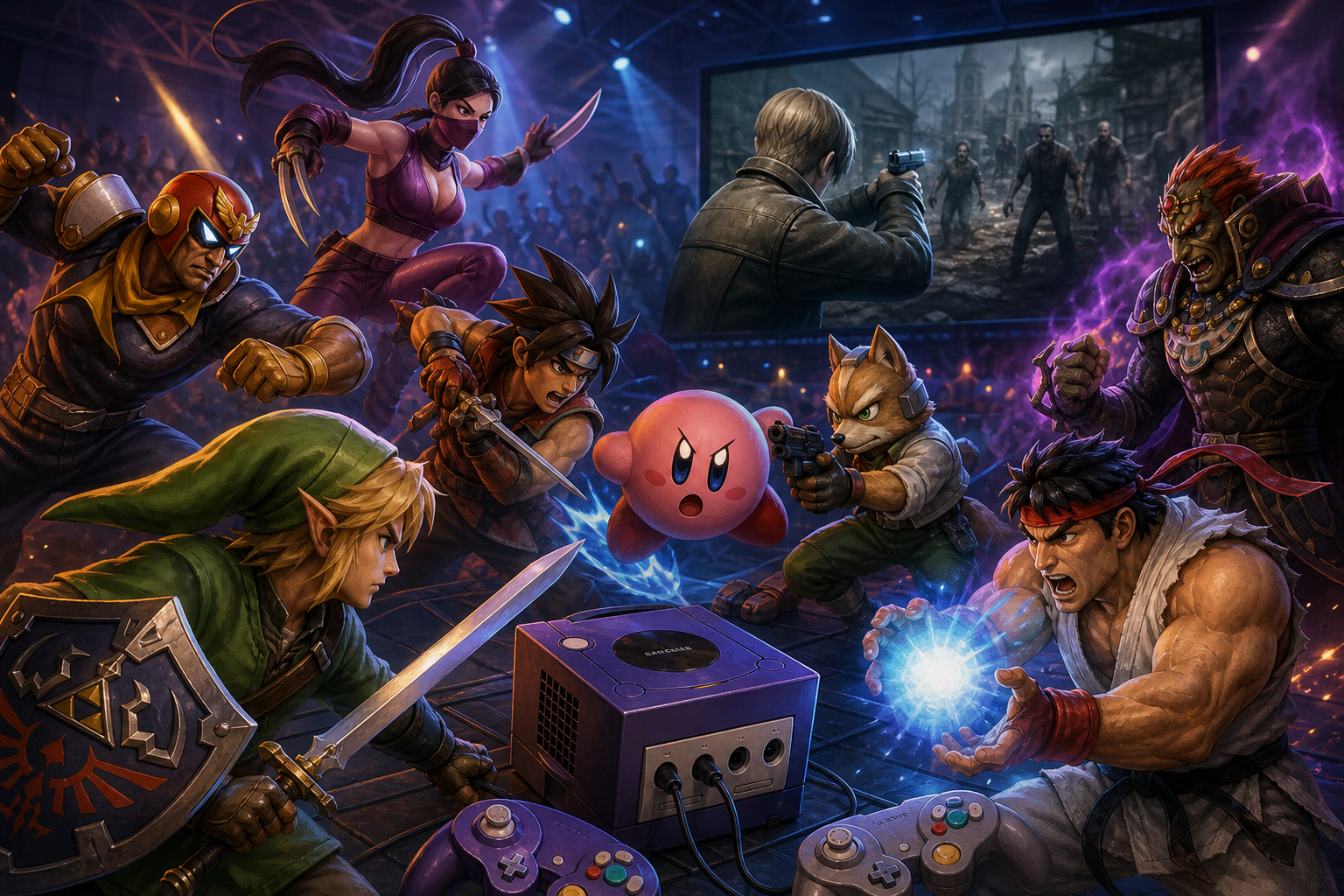
Nintendo’s purple console never built its reputation around fighting games, yet the GameCube library contains a surprisingly broad range of combat ideas. The system hosted a competitive platform fighter, a weapon-based arcade classic, a Capcom and SNK crossover, transformation-based martial arts, giant-monster arena battles, wrestling hybrids and several licensed anime fighters.
This ranking covers fighting games broadly, but it does not pad the list with ordinary action games, unrelated beat ’em ups or annual sports releases. The selections are ranked by combat variety, clarity of the central idea, local multiplayer identity, single-player content, roster personality, historical importance and regional accessibility. Technical complexity matters, but it is not the only measure. A game that creates a brilliant four-player party, a convincing monster battle or a strong licensed fantasy can earn its place beside a demanding arcade fighter.
Regional details also matter. Some GameCube fighting games changed names between Japan and the West, while others had territory-specific rosters or release patterns. The result is not a claim that the GameCube had the deepest fighting catalogue of its generation. It is a guide to the ten games that best demonstrate how much variety existed inside that comparatively compact library.
1. Super Smash Bros. Melee
Super Smash Bros. Melee is the strongest overall GameCube fighting game because it succeeds at several jobs at once. It is immediately readable in a group, supports up to four local players and offers a movement system with enough precision to reward long-term practice. Its platform-fighting rules separate it from health-bar fighters: players build damage, launch opponents and use stage position, recovery routes and edge control to win. That difference changes what spacing, defense and risk mean.
The roster gives Melee an unusually strong identity. Nintendo characters, items and recognizable stages make the game approachable, while directional attacks, shields, grabs, aerial movement and recovery options create considerable depth beneath the party-game surface. Single-player modes provide structure for players who are not arranging local matches, but multiplayer remains its defining strength.
Melee earns the top position because no other entry combines accessibility, competitive longevity and four-player flexibility so effectively. Choose it when the room matters as much as the matchup, or when you want a fighter where movement itself is the main attraction.
- Best for: four-player groups, Nintendo character appeal and movement-focused competition.
- Main tradeoff: its platform-fighting rules do not resemble conventional arcade fighters.
2. Soulcalibur II
Soulcalibur II is the GameCube’s best choice for a traditional weapon-based fighter. Its combat revolves around spacing, attack height, directional movement, throws, guarding, Guard Impact and weapon-specific reach. The eight-way movement system makes arenas feel more open than a simple flat lane, and each character’s weapon changes how distance is controlled. A fast fighter, a heavy weapon user and a character built around unusual range ask the player to solve different neutral-game problems.
The GameCube version has an especially memorable reason to exist: Link is its platform-exclusive guest character. He fits the weapon-focused design rather than feeling like a disconnected cameo, and his presence gives Nintendo players a distinct version of the game without replacing the broader roster.
Weapon Master mode gives Soulcalibur II a substantial single-player route. Players can travel through a structured series of challenges, earn rewards and unlock additional equipment, which makes the game more useful to solo players than a fighter built almost entirely around exhibition matches. Pick it when you want readable duels, strong fundamentals and a clear arcade structure.
- Best for: weapon spacing, one-on-one matches and solo progression.
- Main tradeoff: it is less naturally suited to chaotic four-player sessions than Melee.
3. Def Jam: Fight for NY
Def Jam: Fight for NY earns its high position by turning licensed spectacle into a flexible combat system. Its matches combine wrestling throws, striking, grappling, weapons and interactive environments, while the player’s selected fighting styles shape how a created character approaches a confrontation. Walls, tables, barriers and other stage elements are not merely scenery. They help define the rhythm of a match, creating opportunities for improvised attacks and dramatic reversals.
The game also gives its licensed cast a stronger mechanical identity than a simple celebrity showcase. Different styles encourage different habits, and the story-driven progression gives the roster and locations a purpose beyond exhibition bouts. Character creation adds another layer without overwhelming the central fighting system.
Def Jam: Fight for NY sits below Soulcalibur II because its hybrid design is less cleanly focused, but it offers more environmental personality and customization. Choose it when you want a fighter that feels physical, theatrical and deliberately louder than a conventional arcade duel.
- Best for: wrestling mechanics, weapons, environmental attacks and character creation.
- Main tradeoff: its hybrid design is less precise than a dedicated weapon fighter.
4. Capcom vs. SNK 2 EO
Capcom vs. SNK 2: Mark of the Millennium appears on GameCube as Capcom vs. SNK 2 EO, and it is the system’s richest traditional crossover fighter. The meeting of Capcom and SNK characters is only the beginning. Six Groove systems change the relationship between meter management, blocking, rolling, parrying, running and super moves. Selecting a Groove is effectively selecting a ruleset and a strategic vocabulary before the match begins.
The GameCube edition adds the EO, or Easy Operation, control option. The C Stick can be used to simplify the execution of certain special moves, making the game more approachable for players who find traditional motion inputs intimidating. That does not eliminate the deeper decisions about range, meter, team composition and matchup knowledge. Easier execution is not the same as shallow combat.
This ranks below the more immediately social games because its best qualities emerge in deliberate one-on-one play. It is the pick for players who want the GameCube’s most system-heavy arcade fighter and are willing to spend time understanding how the Grooves reshape each match.
- Best for: crossover rosters, multiple rule sets and strategic one-on-one play.
- Main tradeoff: its wealth of systems can overwhelm players seeking a quick party fighter.
5. Bloody Roar: Primal Fury
Bloody Roar: Primal Fury has one of the clearest hooks in the GameCube fighting catalogue: characters can transform into more powerful beast forms during a match. The transformation is not merely visual decoration. It changes the pressure of an exchange, giving players a reason to manage when they enter beast form and how they exploit the resulting offensive opportunities.
The cast’s animal identities help new players understand that different characters are intended to feel distinct. Breakable arenas and aggressive combo exchanges push the game toward a lively middle ground between formal arcade fighter and exuberant arena brawler. It is easier to approach than Capcom vs. SNK 2 EO, but still offers matchup differences and timing decisions.
Regional editions matter. Bloody Roar: Primal Fury is the name used for the GameCube release in North America, while related versions are associated with Bloody Roar Extreme. The PAL GameCube edition also omits Fang compared with other releases. That makes the game a poor subject for vague, region-free roster claims.
Choose Primal Fury for transformation mechanics, character-driven combat and a brighter alternative to the more serious arcade fighters above it.
- Best for: transformation systems, breakable arenas and approachable character variety.
- Main tradeoff: regional editions do not necessarily contain identical rosters.
6. Godzilla: Destroy All Monsters Melee
Godzilla: Destroy All Monsters Melee is not a conventional tournament fighter, and that is precisely why it belongs here. Its matches are built around giant-monster scale, ranged attacks, destructible buildings and urban arenas that can be damaged during combat. A kaiju battle is not simply a human fighter enlarged on screen. Distance, projectile use, environmental collapse and movement through a city change the shape of an encounter.
The licensed Toho roster gives the game immediate personality, while support for up to four local players makes it one of the GameCube’s strongest spectacle-focused multiplayer choices. Its central fantasy is easy to understand: choose a recognizable monster, throw hands, fire devastating attacks and turn the city into part of the fight.
Godzilla gives up some of the finely measured spacing and defensive precision associated with Soulcalibur II or Capcom vs. SNK 2 EO. That limits its appeal for players seeking strict tournament fundamentals, but it makes the game unusually successful as a group experience. Choose it when scale, destruction and recognizable monsters matter more than arcade orthodoxy.
- Best for: four-player kaiju chaos, destructible arenas and licensed spectacle.
- Main tradeoff: its arena design and ranged attacks make it unlike a standard one-on-one fighter.
7. Def Jam Vendetta
Def Jam Vendetta is the more focused predecessor to Fight for NY and deserves recognition on its own terms. Its combat leans heavily into wrestling, with throws, grapples, reversals and ring-style momentum forming the core of the experience. The licensed hip-hop roster supplies the visual identity, but the game’s strongest distinction is how it translates wrestling logic into a fighting-game format rather than presenting a standard punch-and-kick system with celebrity skins.
Its narrower design can actually be an advantage. Players who prefer a direct ruleset may find Vendetta easier to approach than the larger style framework and environmental emphasis of Fight for NY. Local multiplayer also gives it a useful group identity, although its mechanics are less expansive than those of its sequel.
Some databases place Vendetta near wrestling games, so its qualification needs explaining. Its matches are structured around fighting gameplay, not a simulation of an annual wrestling sports season. Pick Vendetta for a compact wrestling-first fighter with a distinctive licensed cast and a more straightforward rhythm than its successor.
- Best for: wrestling-flavored combat and licensed local multiplayer.
- Main tradeoff: Fight for NY expands its ideas with more styles, environments and customization.
8. One Piece: Grand Adventure
One Piece: Grand Adventure brings the series’ exaggerated cast and adventure tone into a licensed fighting game built around accessible spectacle. It is not a flat, conventional arcade fighter. Battles take place on 3D stages with live environmental hazards, including bombs, waves and sandstorms, along with items that can serve as weapons or temporary advantages.
That environmental emphasis gives Grand Adventure a different identity from Soulcalibur II and Capcom vs. SNK 2 EO. The game is less concerned with reproducing a carefully measured tournament system and more interested in making each battle feel like an animated One Piece set piece. The story mode follows the series’ adventure structure, while the broader cast gives fans a reason to learn different characters.
The GameCube version supports two-player battles rather than competing with Melee or Godzilla as a large-group centerpiece. Its value lies elsewhere: it is a welcoming choice for One Piece fans and for players who want a licensed fighter with hazards, items and a lively 3D arena. Choose it for anime personality and environmental combat rather than technical arcade precision.
- Best for: One Piece fans, licensed spectacle and hazard-filled 3D arenas.
- Main tradeoff: local play is more limited than the GameCube’s strongest group-focused fighters.
9. Naruto: Clash of Ninja 2
Naruto: Clash of Ninja 2 represents the GameCube’s compact anime-fighter side. Its cel-shaded presentation, character-focused matchups and straightforward controls make it easier to understand than a system-heavy traditional fighter. The appeal is not a giant competitive framework; it is the chance to use familiar Naruto characters in quick battles that emphasize readable attacks, movement and signature techniques.
The game is also more multiplayer-friendly than a casual description might suggest. Its GameCube release supports battles for up to four players, giving it a stronger local identity than many licensed anime fighters. That does not make it a replacement for Melee, but it does make Clash of Ninja 2 a useful choice for a group that wants a character-based anime fighter rather than Nintendo’s crossover rules.
Regional availability requires care. The Japanese game is known as Naruto: Gekitō Ninja Taisen! 2, while Western releases use the Clash of Ninja name. GameCube entries in the broader series do not all share the same international release history, so they should not be treated as one uniformly available catalogue.
Choose Clash of Ninja 2 for cel-shaded presentation, recognizable characters and accessible multiplayer battles rather than the extensive technical depth of Capcom vs. SNK 2 EO.
- Best for: Naruto fans, anime presentation and accessible local battles.
- Main tradeoff: regional naming and release differences make the wider series harder to compare across territories.
10. Dragon Ball Z: Budokai 2
Dragon Ball Z: Budokai 2 closes the ranking with an arena-based interpretation of anime combat. Its appeal comes from the license, cinematic presentation and the ability to stage battles between a broad selection of Dragon Ball characters. Compared with Soulcalibur II, it gives up weapon spacing and ring-oriented fundamentals. Compared with Capcom vs. SNK 2 EO, it offers a more streamlined character crossover and story structure rather than multiple competitive rule systems.
The arena format gives combat room for movement and spectacle, while recognizable transformations and attacks provide the personality. That makes Budokai 2 a sensible choice for fans who want the sensation of a Dragon Ball confrontation without approaching the game as a specialist arcade laboratory.
It ranks below the other entries because its systems are less distinctive as a GameCube fighting design, but it remains a legitimate part of the console’s anime-fighter story. The GameCube release followed the earlier PlayStation 2 version and belongs to the 2004 GameCube catalogue in the documented release listings.
Choose it when licensed cinematic battles matter more than tournament precision.
- Best for: Dragon Ball fans and cinematic arena combat.
- Main tradeoff: its system depth and competitive focus are less pronounced than those of the top traditional fighters.
The GameCube’s fighting catalogue is compact, but it is not one-note. Melee turns platform movement into a competitive language, Soulcalibur II builds duels around weapons and spacing, Capcom vs. SNK 2 EO offers layered arcade systems, and the Def Jam and Godzilla games show how far the format can move toward wrestling, environmental spectacle and licensed fantasy.
For a group, start with Melee, Godzilla or Naruto: Clash of Ninja 2. For weapon combat, choose Soulcalibur II. For traditional system depth, Capcom vs. SNK 2 EO is the strongest destination. For a louder licensed experience, Def Jam: Fight for NY is the broadest choice, while Bloody Roar, One Piece and Dragon Ball offer different anime-driven alternatives.
That variety is the real story. The GameCube did not need a huge fighting library to offer meaningful choices. It only needed enough games to make the player decide whether the next match should be a precise weapon duel, a technical crossover, a wrestling spectacle, a monster demolition derby or a four-player Nintendo free-for-all.