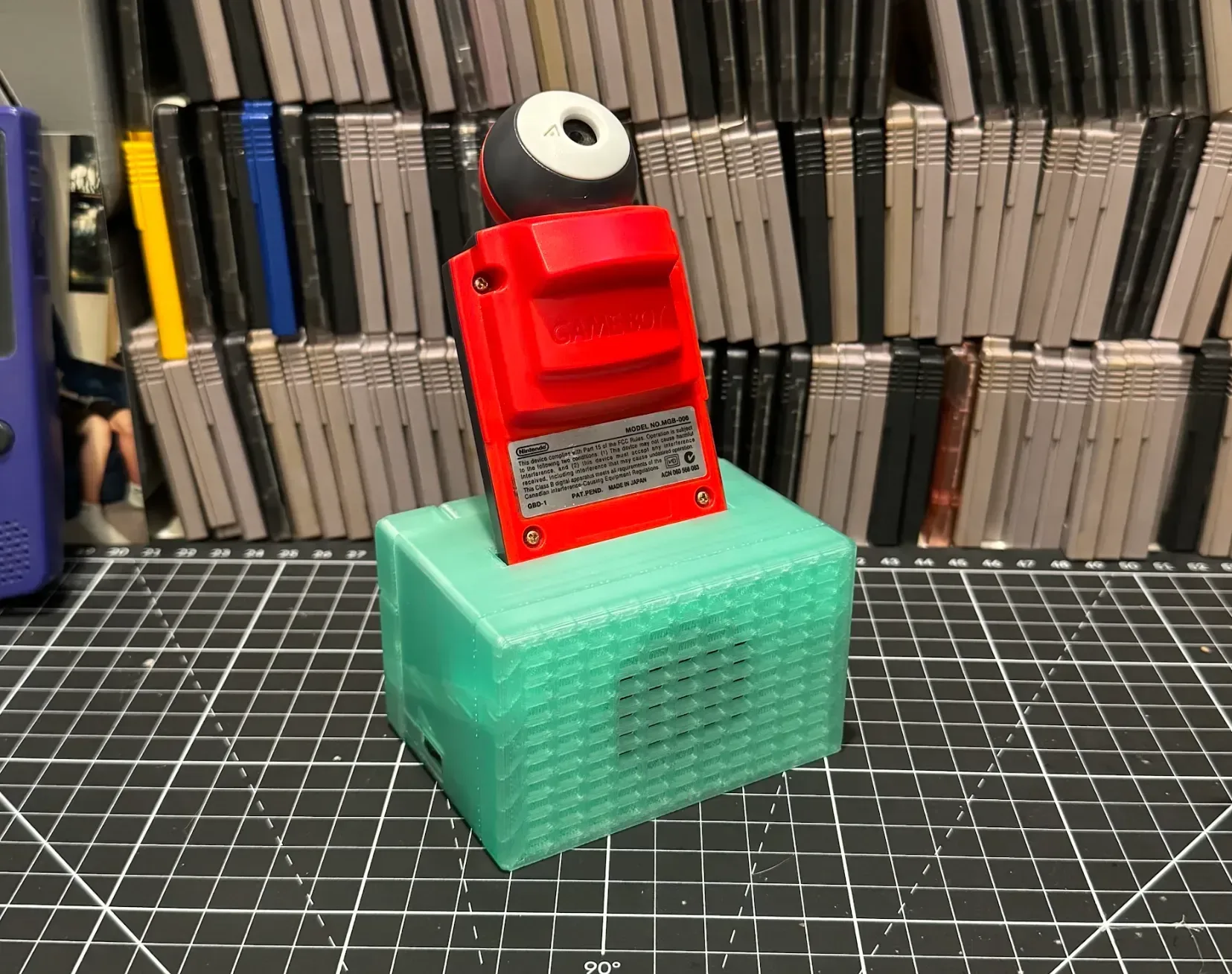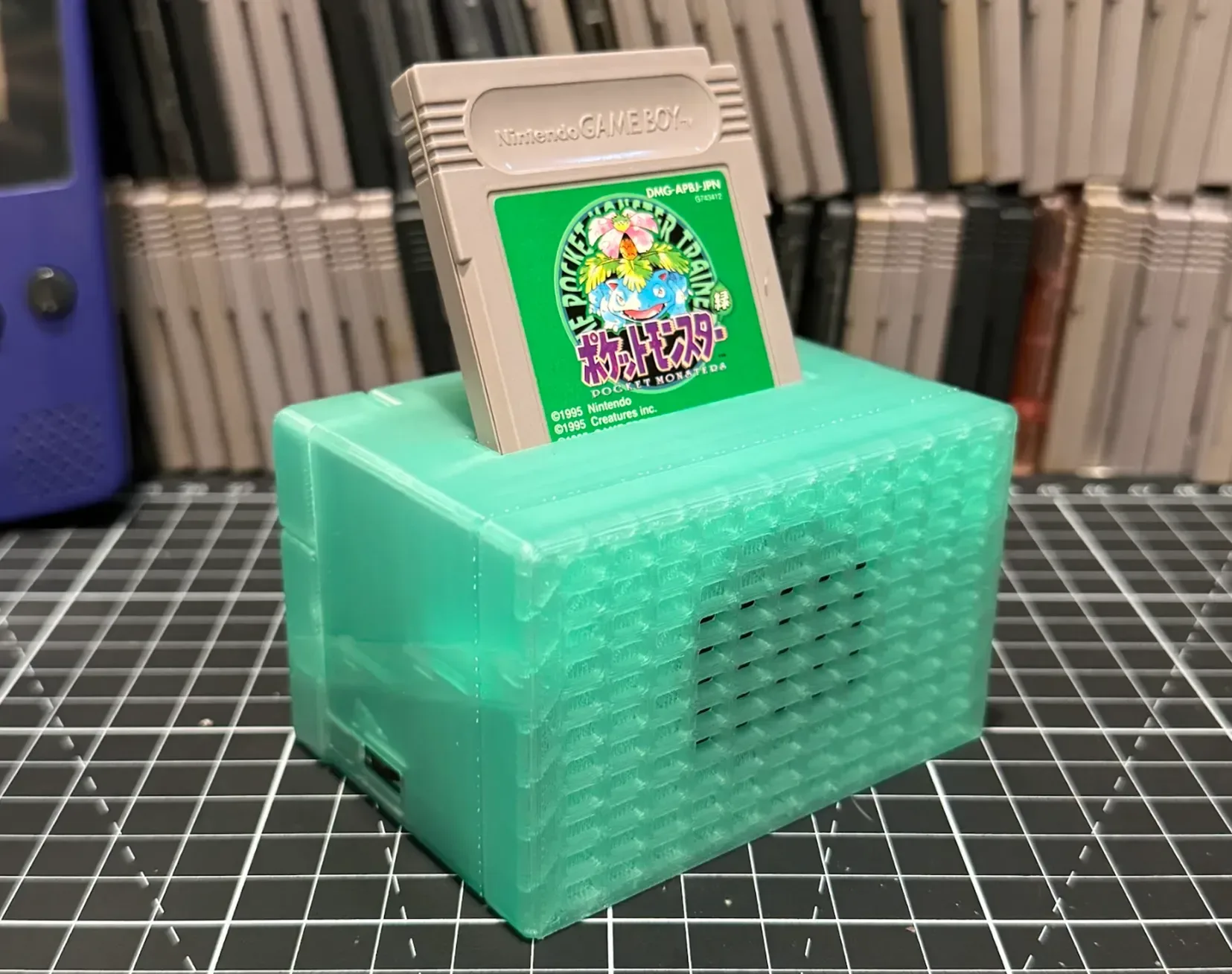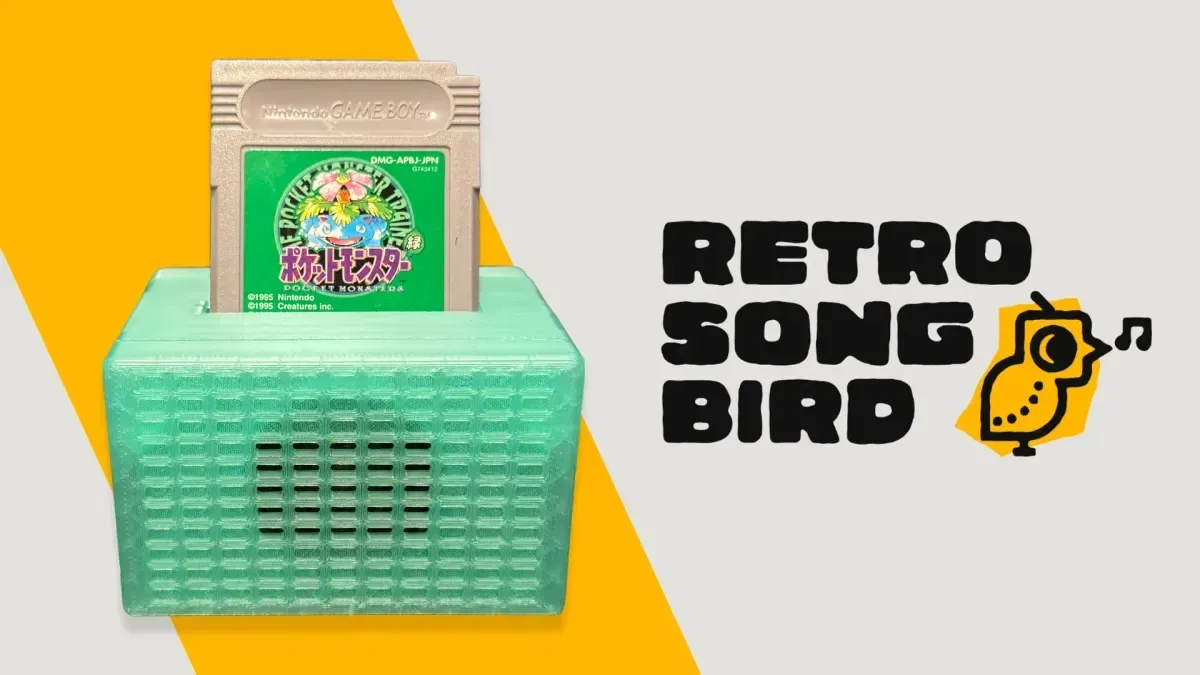
Game Boy cartridges may look like tiny, stubborn slabs of grey plastic, but they carry more than games. They also contain the musical identity of an enormous library: title-screen hooks, overworld loops, battle stingers, menu chirps and sound effects that have lived in players’ heads for decades. Retro Song Bird is a proposed device built around the idea that those sounds should be easier to hear, preserve and creatively reuse without treating a cartridge as merely a shelf ornament.
The prototype is a cartridge reader and music player intended to work with more than 1,900 Game Boy cartridges. Insert a cartridge into its top-mounted slot and Retro Song Bird is designed to let the user move through its music files in a manner closer to using a dedicated audio player than navigating a game. It is also intended to browse sound effects, a pleasingly dangerous feature for anyone whose idea of a relaxing afternoon involves repeatedly triggering a menu blip.
Importantly, this is not a retail product yet. Its creator, identified as BJ, has made only a small number of prototypes. A possible crowdfunding campaign or direct sale may follow after the hardware is finalized, but neither a release date nor a price has been established. For now, Retro Song Bird is an ambitious work in progress with a notably broad feature list.
A Game Boy soundtrack player, not just a speaker with a cartridge slot
At its simplest, Retro Song Bird is meant to make a physical game cartridge function as a browsable music source. The device has physical side controls for moving to the next or previous item and adjusting volume. A stereo line-out is planned for connection to hi-fi equipment, while the device itself is intended to play through a modern speaker.
The project also claims “register-level sound emulation.” In plain terms, sound emulation is the process of reproducing the way older hardware generates audio. “Register-level” describes an approach that seeks to model the low-level control values used by the original system’s sound hardware, rather than simply playing back a pre-recorded audio file. The practical goal is fidelity: the music should retain the character of its original Game Boy playback rather than becoming a generic rearrangement.
That distinction matters because Game Boy music is not normally packaged like a modern soundtrack album. It is produced by the game’s sound routines and audio hardware while the cartridge is running. A player made specifically to inspect and navigate that material could offer a focused way to hear the score and effects independently of the game itself.
Preservation functions are part of the pitch
Retro Song Bird is also being positioned as a utility for cartridge data. Its proposed functions include backing up and restoring save files and ROMs, flash-writing new cartridges, and exporting soundtracks to a PC as WAV files.
A save file is the player data held by a compatible cartridge: progress, settings, teams, records or other information that a game writes over time. Backing it up can be valuable because that personal data is often the least replaceable portion of a physical game. A ROM, in this context, is a digital copy of the game data stored on a cartridge. A flash-written cartridge is a cartridge whose writable memory can be loaded with new data.
Related coverage includes Retro Song Bird Could Turn Game Boy Cartridges Into a Playable Music Library.
WAV, meanwhile, is an audio file format commonly used when uncompressed or minimally altered sound is useful for editing and archival workflows. Exporting cartridge audio as WAV could make the device relevant to musicians and researchers as well as nostalgic listeners, provided the final implementation works as described.
The preservation angle is more interesting than a simple promise to make old jingles portable. Original cartridges combine physical hardware, saved play history and software. A tool that can interface with all three has the potential to be practical for owners who want to protect their own data while also exploring the music stored in the games they already have.
Four channels, separated for music production
The more unusual claim is Retro Song Bird’s planned ability to expose each of the Game Boy’s four sound channels as separate USB audio streams for use in a DAW. A DAW, or digital audio workstation, is software used to record, edit, sequence and mix audio.
The four stated channels are two square channels, a wave channel and a noise channel. These are the building blocks the device says it will make available independently:
- Two square channels: channels associated with electronically crisp, pulse-like tones, often central to melodies and harmonies.
- Wave channel: a channel capable of playing a programmable waveform, giving composers another tonal texture.
- Noise channel: a channel used for noisy, percussive or effect-like sounds.
Separating those elements is often described as working with stems. In conventional music production, stems are grouped or isolated parts of a mix that can be adjusted individually. The proposed USB output would let a creator route the Game Boy’s components into a DAW separately, rather than capturing one finished stereo result. That could make remixing, analysis and arrangement work considerably more flexible.
Retro Song Bird’s creator also describes a “mixcart” workflow: remix a game’s components, then flash the resulting material to another cartridge. It is a compellingly cartridge-native idea, even if it is still a proposed one. Rather than ending with a file trapped on a computer, a project could potentially return to a physical cart that runs on compatible hardware.
The device is also intended to support LSDj playback from an LSDj cartridge. LSDj is used for making music on Game Boy hardware, so that capability would place Retro Song Bird alongside an established form of Game Boy composition rather than treating the platform only as a historical artifact. GBAlbum support is planned as well, allowing an album to be turned into a ROM intended to play on real hardware and on Retro Song Bird.
That creative focus arrives at a moment when dedicated music hardware remains a lively, if uncertain, corner of technology culture. Questions around the future of standalone synthesizer hardware underscore why small-purpose devices can attract attention: their value is not only in raw capability, but in offering a particular way to work.
The Game Boy Camera bonus is wonderfully impractical
Retro Song Bird is also said to work with the Game Boy Camera, allowing it to be connected to a PC as a USB webcam. The stated image output is 0.014 megapixels at five frames per second. Those specifications are not being presented as a bid for modern webcam supremacy, and that is precisely the charm.
A USB webcam is a camera presented to a computer as a video input device, usable by software that accepts camera feeds. Using a Game Boy Camera in this way would turn the accessory into an intentionally lo-fi video option. Its significance is less about clarity than compatibility: it suggests the project is attempting to meet cartridges on their own odd, historically specific terms.
It also shows that the design is not exclusively about soundtrack extraction. The cartridge slot is envisioned as a bridge between Game Boy accessories and contemporary computers, with music being the primary application but not the only one.
Alarm mode, browser play and an open API broaden the experiment
Further planned features include an alarm mode that can wake the user with audio from whichever cartridge is inserted. The side buttons are intended to dismiss the alarm. It is a tiny feature with big potential for emotional mischief: an old game’s most urgent music cue is suddenly no longer confined to a boss encounter.
Retro Song Bird is also described as being able to play cartridges in a browser and work with apps and cheats. The details of how that browser functionality will operate have not been specified, so it is best understood as an announced direction rather than a fully defined feature.
Likewise, the project is planned to have an open API and over-the-air updates. An API, or application programming interface, is a documented way for software or other tools to communicate with a device. An open API can give developers and tinkerers a foundation for building their own integrations or features. Over-the-air updates are software updates delivered without requiring the user to manually connect the device for a conventional update process.
For a niche piece of retro hardware, that openness could be as consequential as the launch-day feature set. Game Boy enthusiasts tend to have highly specific ideas about what their equipment should do. A device that can evolve and be connected to custom tools has more room to serve uses that its original maker did not predict.
Why the prototype is worth watching
The appeal of Retro Song Bird is that it does not reduce the Game Boy to one identity. It treats cartridges as games, sound libraries, saved personal histories, creative instruments and curious peripherals. None of those roles is new on its own, but gathering them into one planned device makes the concept distinctive.
There are sensible reasons to reserve judgment. The hardware is not yet for sale, only a few prototypes exist, and its extensive promises will need to be demonstrated in a final product. Compatibility across a library of more than 1,900 cartridges, sound fidelity, data handling, browser functionality and production features are all meaningful technical commitments. Until the device is finalized, each should be viewed as a target rather than a guarantee.
Still, the central notion is easy to understand. Game Boy cartridges hold sounds people care about, and Retro Song Bird proposes a less cumbersome way to listen to, archive and create with them. If the project reaches production with its intended capabilities intact, it could become one of those rare retro accessories that respects the original hardware without freezing it in time.