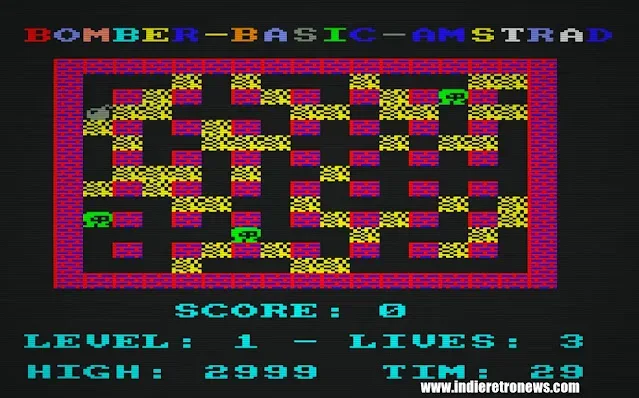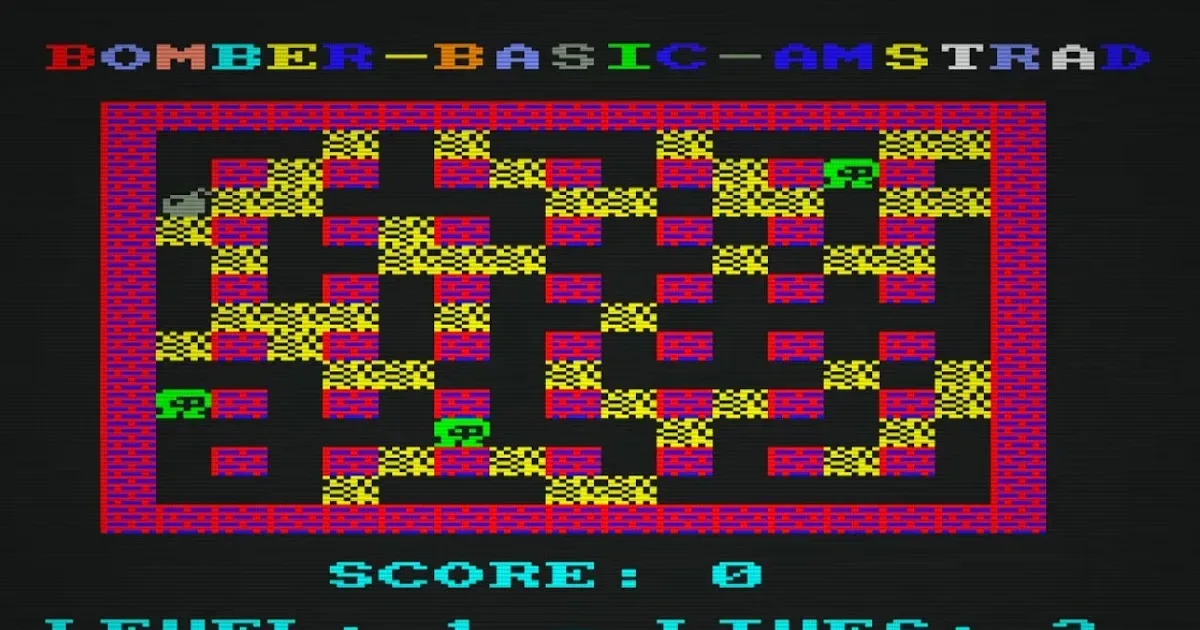
Bomber Basic Amstrad is a small game with a very specific ambition: make a recognizably Bomberman-shaped maze challenge on the Amstrad CPC using nothing but Locomotive BASIC, then see how far that constraint can be pushed. Created by Altanerus Dog, the result is a 6.3KB proof of concept that contains nine levels and an ending—not merely a single-room technical demonstration.
Its inspiration is Hudson Soft’s 1983 classic Bomberman, and the basic objective will be immediately familiar to anyone who knows the broad formula. A robot is trying to escape an underground bomb factory. The player navigates grid-like mazes, uses explosives to deal with guards, and has to finish before a countdown reaches zero. There are three lives available, while bombs themselves are unlimited.
Those fundamentals sound simple, but Bomber Basic Amstrad makes one important change to how the player must read the board. A placed bomb becomes a solid obstacle that can be used to hem in an enemy. Immediately after being dropped, however, the bomb disappears from view. It still detonates after three seconds. In practice, the game turns bomb placement into a memory test as well as a positioning puzzle: players need to remember exactly where the unseen hazard sits, what route it blocks, and whether their own escape path will remain safe when the blast arrives.
A Bomberman-style loop with a deliberately awkward twist
The central tension in a bomb-maze game is normally easy to explain but difficult to execute. A player wants an enemy close enough to be threatened by the explosion, yet needs enough room and time to retreat beyond the blast radius. Bomber Basic Amstrad keeps that tension, then makes placement less visually forgiving.
Here, an invisible bomb is not an absent bomb. It is a temporary piece of level geometry with a scheduled detonation. That means the decision to place one does at least three jobs at once:
- It creates a future attack.
- It can block a corridor or restrict a guard’s movement.
- It can also interfere with the player’s own movement and become a danger that must be tracked from memory.
That combination gives the concept a tactical identity beyond simply dropping explosives at approaching enemies. A guard can potentially be trapped by the bomb’s physical presence, but the same move commits the player to a mental note. Forgetting the bomb’s square—or misjudging where to stand when it goes off—can turn a clever setup into a self-inflicted loss of one of the game’s three lives.
The countdown timer sharpens that pressure. It prevents every room from becoming a purely cautious exercise in waiting for ideal enemy movement. Players must eliminate the guards and keep moving before the time limit grows stricter. The supplied description does not detail the exact timer values or how each level changes them, so the important takeaway is the intended rhythm: success relies on timing and route management rather than bombs alone.
What “100% Locomotive BASIC” means for this project
Locomotive BASIC is the programming language named by the project, and Bomber Basic Amstrad is described as having been built entirely in it. That is a meaningful part of the game’s identity, not just a footnote in its credits. The project is explicitly framed as a playful proof of concept working within an old-school system’s limitations.
The game uses traditional two-dimensional arrays and numerous code loops. A two-dimensional array is, in plain terms, a way of storing information in rows and columns—an intuitive fit for a maze laid out as a grid. Code loops are repeated instructions, useful for regularly checking or updating things such as positions, maze spaces, timers and bomb states. In this case, the design accepts that approach’s trade-off: the action is deliberately slow-paced.
“Slow-paced” should not be mistaken for a claim that the game lacks challenge. Its pacing instead sits at the center of the experiment. A slower moving bomb maze changes the emphasis from quick visual reaction toward deliberate decision-making. When explosives vanish from sight and have a fixed three-second fuse, a measured tempo can make remembering placements and planning exits feel like the real test.
It is also why the small size matters. At 6.3KB, Bomber Basic Amstrad is presented as a notably lean release. The number alone does not tell players everything about the finished game, but it does establish the scale of the exercise: Altanerus Dog has packed a complete nine-level progression, a premise and an ending into a compact BASIC project rather than pursuing a large feature list.
Nine levels make the concept more than a one-screen novelty
Nine distinct levels with an ending give the game a defined arc. The robot’s breakout from the underground bomb factory supplies a reason to keep advancing, while the level count suggests a sequence of maze challenges instead of an endless score chase. No detailed map layouts, enemy behaviors or level-by-level changes have been specified, so it would be premature to assume exactly how the difficulty develops. What is clear is that the game has a finish point.
That distinction matters for a proof-of-concept release. A technical experiment can demonstrate that a mechanic works in one confined scenario. A nine-level game must repeatedly ask that mechanic to carry the experience. Bomber Basic Amstrad’s answer is to rely on a compact set of interacting pressures: guards to remove, corridors to navigate, a countdown to beat, bombs that form barriers, and explosions that the player must survive.
The robot protagonist’s “self-aware” escape premise gives the otherwise abstract maze action a suitably strange retro-game hook. It is not simply clearing rooms for their own sake; the character is breaking out of the same bomb factory that provides the hazards. That is a concise setup, but an effective one for a game whose systems are already doing most of the storytelling work.
The practical lesson: limitations can define the game’s personality
Bomber Basic Amstrad is not presented as an attempt to erase the technical constraints of its approach. It makes them visible. The reliance on arrays and loops contributes to the intentionally slower pace, and the compact 6.3KB footprint emphasizes economy. Rather than treating those qualities as defects to hide, the project uses them to frame a nostalgic, systems-first challenge.
That makes it a useful reminder that retro-game appeal is not only about reproducing an older visual style or borrowing a famous template. The underlying implementation can influence the feel of play. Here, the small-scale BASIC construction, grid layout, constrained lives and memory-dependent bombs all point toward a design where the player is expected to think ahead.
For Amstrad CPC enthusiasts, the project’s appeal is likely to be twofold: there is a playable homage to one of the best-known bomb-maze formulas, and there is a concise example of what a focused creator can build within a restricted technical envelope. For players approaching it simply as a game, the key warning is equally direct: infinite bombs do not equal unlimited safety. A bomb placed to trap a factory guard can still leave its owner trapped by the same plan.
The wider game scene is often drawn to hardware power, new formats and bigger production promises. There is room for that, as seen in projects such as Woodo’s multi-platform launch and Switch 2 upgrade path, but Bomber Basic Amstrad makes the opposite case elegantly. A tiny, purpose-built game can find its hook by narrowing the rules: remember the invisible bomb, escape the blast, clear the guards, and beat the clock.
With nine levels and a proper ending, Bomber Basic Amstrad gives that idea enough room to become a compact escape mission rather than a fleeting programming curiosity.