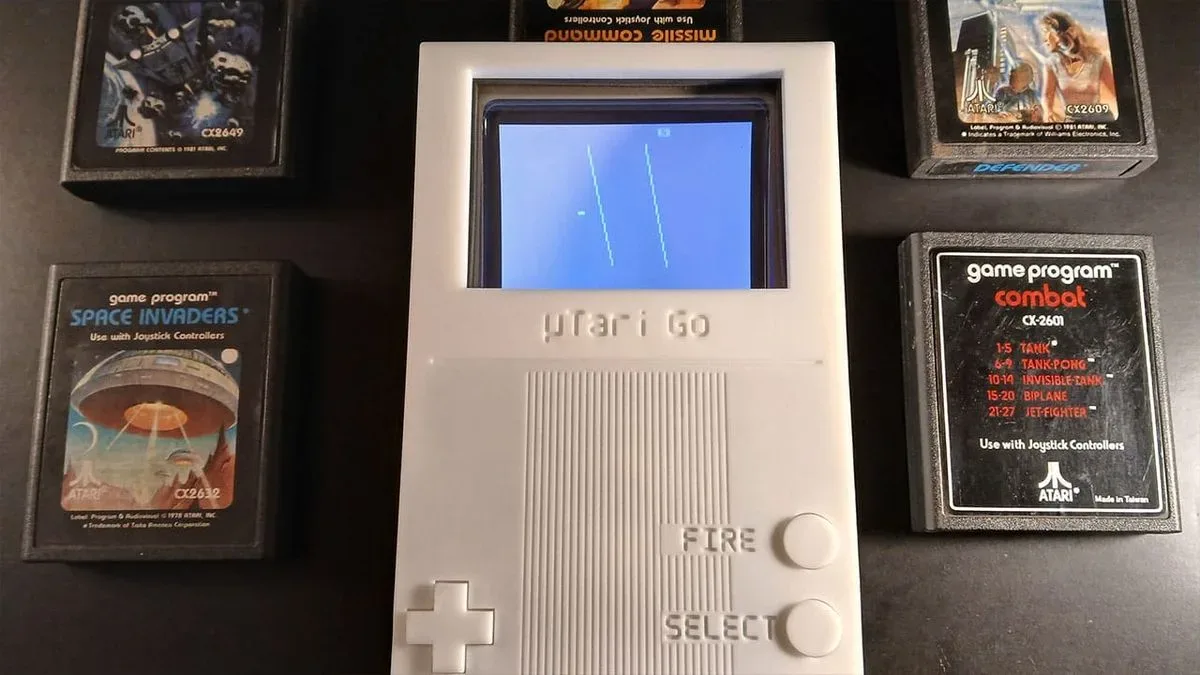
A handheld that plays Atari 2600 cartridges is already the sort of sentence that causes a retro-gaming brain to sit bolt upright. A handheld that does it with a 4-inch CRT, built-in controls and the 6507 processor associated with the original machine is something even stranger: a miniature, portable expression of the old console rather than a modern device impersonating one.
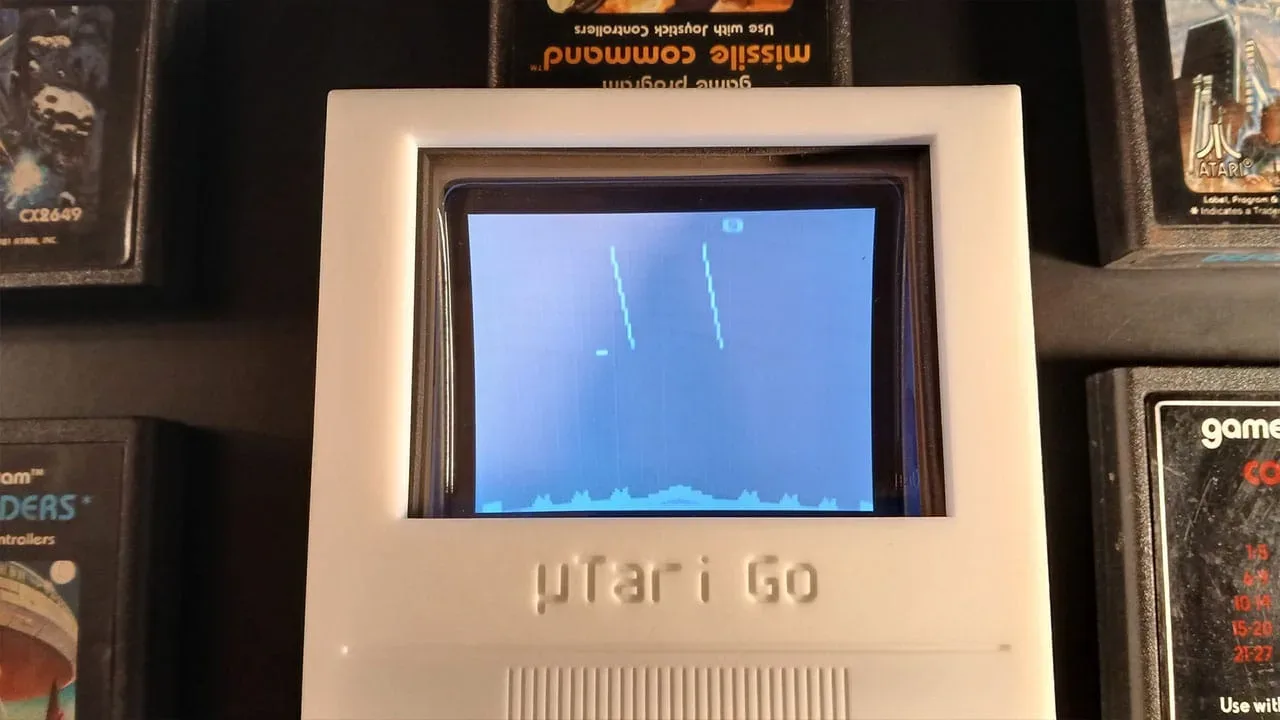
That is the premise behind Nick Bild’s µTari Go, pronounced “micro-Tari.” The project packages an Atari 2600-compatible hardware build into a 3D-printed handheld case with a cartridge slot, speakers, audio amplifiers and its own small cathode-ray-tube display. It is intended for actual Atari 2600 cartridges, not a software-emulation library loaded onto a contemporary handheld.
The result is delightfully impractical in precisely the way a serious retro-hardware project ought to be. It does not promise the thinness, battery convenience or enormous multi-system catalogue of a typical emulation handheld. Instead, it prioritizes a very specific experience: insert a physical cartridge into a machine whose core is built around original-style Atari processing hardware, then play it on a CRT that travels with the console.
A real-cartridge project, not a pocket ROM machine
The most important distinction is the µTari Go’s relationship with software. Its cartridge slot accepts Atari 2600 cartridges, making the game cartridge part of the experience rather than a collectible that stays on a shelf while a downloaded file does the work.
That matters to enthusiasts because the cartridge is not merely packaging. It is the physical connection between a game and the console. Loading a cart, dealing with its size, and selecting which one deserves a place in a travel bag are all constraints that contemporary all-in-one handhelds deliberately remove. The µTari Go restores them—and turns those constraints into the point.
This is also why the project lands differently from an emulation device. Emulation generally means software recreates the behavior of another system on newer hardware. It is a powerful, often convenient approach, but it is not what the µTari Go is designed around. Bild’s build uses the original 6507 processor and is described as using no FPGA.
What does that mean? The 6507 is the processor used in the Atari 2600. An FPGA, or field-programmable gate array, is a chip that can be configured to reproduce digital logic in hardware. FPGA-based retro systems can aim for highly faithful recreations of older circuitry, but they are still a distinct design path from using an original processor family. The µTari Go’s appeal is therefore not simply that it is portable; it is that its construction chooses old-school hardware at the center of the machine.
The screen is part of the statement
A built-in 4-inch CRT may be the component that makes the µTari Go immediately memorable. CRT, short for cathode-ray tube, refers to the display technology used by the televisions and monitors that defined the original home-console era. In an ordinary modern portable, an LCD or OLED panel would be the expected choice. Here, the CRT is not hidden behind a nostalgia filter or menu setting. It is physical hardware integrated into the device.
That choice carries consequences. A CRT is not the obvious route to a slim, featherweight handheld, and the project’s external power arrangement reinforces that it is not chasing the neat consumer-electronics formula. The µTari Go is powered through an external 12V jack, which can be connected to a portable power pack. In other words, portability is possible, but it depends on bringing external power along.
For the target audience, that is less a flaw than a clear declaration of priorities. A portable power pack and a protruding cartridge may make for a less elegant plane-seat setup than a current handheld with a USB-C cable, but the µTari Go is pursuing a version of portability that preserves the tactile identity of an Atari 2600 setup.
A smaller Atari, following earlier miniaturization work
Bild had previously worked on reducing the Atari 2600 hardware, including a fully functional board said to be three times smaller than the original. The µTari Go carries that miniaturization effort toward a complete handheld form factor.
It is worth separating “smaller” from “simple.” Shrinking legacy hardware into a portable enclosure is not just a matter of putting a board in a compact box. The finished µTari Go integrates the cartridge slot, display, controls, audio amplification and speakers. The case is 3D printed, allowing the enclosure to be shaped around the unusual combination of components rather than relying on a standardized shell.
That is also what gives the project its maker character. It is not presented as a newly launched mass-market Atari handheld. It is a build for people interested in the engineering and the resulting machine. Instructions and materials for those wanting to begin their own are available through Bild’s GitHub project.
Why physical media makes the idea more than a novelty
Atari cartridges are central to the µTari Go’s charm because they make this a hardware project with a collecting dimension—without turning the machine into a display-only curiosity. A cartridge library can be played on a device purpose-built to carry it somewhere else.
That connection between physical games and active use remains meaningful well beyond Atari. Modern disc releases still demonstrate that players value tangible software, as seen in the discussion around the continuing audience for physical PS5 games. The µTari Go points at an especially focused version of that impulse: the game object, the original-style processing hardware and the display technology are all part of one portable ritual.
There is no claim here that a handheld conversion will suddenly transform the Atari 2600 software ecosystem. But it does create an intriguing thought experiment. Hardware projects that make older formats feel newly usable can give people another reason to revisit their cartridges, show them to friends or take them outside a dedicated game room. In that sense, a device like the µTari Go is a reminder that retro gaming is not only about preserving old objects; it can also be about changing where and how those objects are used.
What portability means for the µTari Go
“Portable” should be understood on the project’s terms. The µTari Go has onboard controls, a screen, speakers and amplification, meaning it does not require a separate television or traditional console setup to play. Its external 12V input can run from a portable power pack. Those features make it viable away from a wall-mounted TV.
At the same time, its CRT, external-power requirement and cartridge-based design make it fundamentally different from a pocket device built around low-power modern components. This is not evidence of a compromise accidentally left unresolved. It is the premise: an Atari 2600 experience condensed into something carryable without replacing every old characteristic with a new convenience.
That distinction makes the µTari Go more interesting than a generic “retro handheld” label suggests. Many compact gaming devices offer thousands of titles through menus. This one asks a far more specific question: what if the Atari 2600 itself, with its real cartridges and CRT display, could leave the living room?
A very particular kind of DIY dream machine
The µTari Go will likely appeal most to people who enjoy the seams in the design: the 3D-printed housing, the external power lead, the cartridge jutting from the body and the unmistakably old display technology. Those details are not obstacles to be edited out. They are the visible evidence that this is a hardware preservation experiment, not an attempt to disguise 1970s-era console ideas as a slick modern gadget.
For players, it offers a compact way to put an Atari cartridge to work without a full home-console arrangement. For builders, it provides a project that joins miniaturized hardware, enclosure design, audio components and CRT integration. And for retro fans, it offers the rare sight of a handheld whose defining feature is not a giant digital library, but the ability to accept one small physical game at a time.
That is plenty of reason for the µTari Go to stand out. A CRT-equipped, cartridge-playing handheld Atari 2600 is not trying to be sensible. It is trying to make a beloved, famously home-bound console feel wonderfully, gloriously mobile.