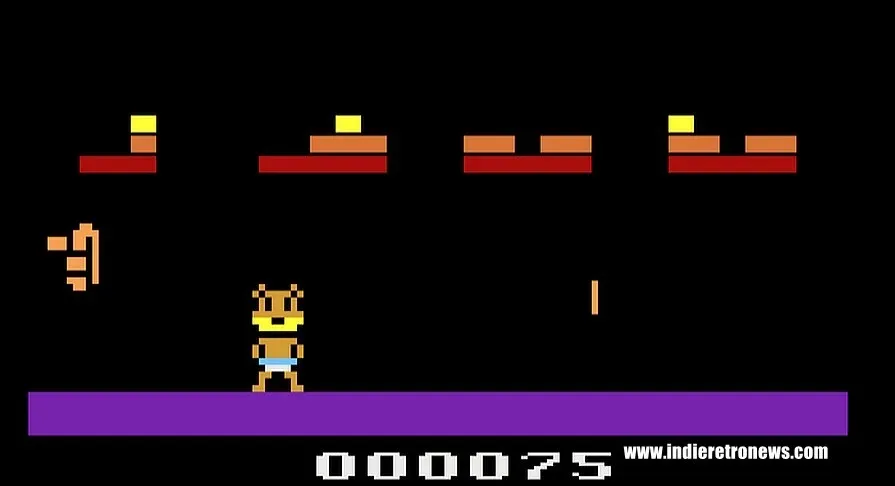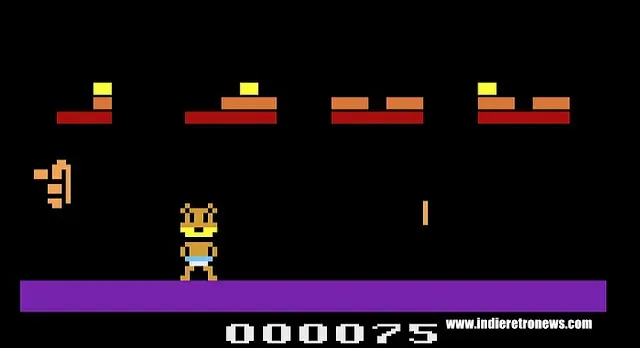
The Atari 2600 is receiving another new game, and No Quarter seems determined to make every pixel of its old-school playground feel hostile. Created by ArugulaZ, the platformer brings back Byron, now referred to as Kid Kodiak, for a four-level race through hazardous floors, falling acid rain and a distinctly arcade-minded hunt for money.
Kid Kodiak’s priorities have changed. Rather than continuing a previous pursuit of fruit, the character is now chasing coins. The objective is to collect $1.50 in order to move forward, which gives No Quarter an appropriately literal twist on a title that already sounds like it was shouted from the doorway of an arcade cabinet. The catch is that the cash is spread across levels built around gaps in the floor and a deadly rainstorm that becomes more intense as play continues.
It is a compact premise, but one that fits the Atari 2600’s enduring homebrew appeal. A clear goal, immediate movement, readable hazards and a progressively tougher structure are all the ingredients a cartridge-era-style score chase needs. No Quarter’s four playable stages put the emphasis on keeping Kid Kodiak alive long enough to gather the required coins, while navigating the increasingly unsafe space around him.
Four levels, one small fortune and a very bad forecast
The threat in No Quarter comes from two directions. Holes in the floor demand careful movement and timing; a fall through one of those gaps ends the attempt. Meanwhile, acid rain descends from above, turning the environment into a narrowing survival problem. The downpour reportedly ramps up quickly, so the player is not simply memorizing where to go. They are also dealing with mounting pressure to make each move before the storm takes over the screen.
That structure makes the coin target more than a collectible checklist. Each coin matters because $1.50 is the amount needed to advance, but going after it also means taking risks within an arena becoming less forgiving by the moment. The design sounds less concerned with leisurely exploration than with a simple question: can a player see a safe route, commit to it and finish the job before the hazards close in?
There are four levels in total, and the fourth is positioned as the real test. ArugulaZ describes it as brutally difficult, a description likely to be familiar to players who enjoy the sharp edge of games designed around repeating, learning and narrowly improving. The challenge is presented with a sense of humor, but the progression is a meaningful part of the game’s identity: surviving earlier stages is preparation for an ending meant to make victory feel earned.
Kid Kodiak is not after treasure in the abstract. He needs exactly $1.50, while a worsening acid-rain storm and a hole-filled floor attempt to turn every coin run into a disaster.
No Quarter’s failure gag leans into that same deliberately exaggerated attitude. A bad fall or contact with the toxic rain does not merely mean a conventional game over. The stated fate is an eternity at Earth’s core listening to Rick Wakeman concept albums. Whether that sounds like punishment, an unusually niche reward or an invitation to debate progressive-rock discographies is probably outside the game’s ruleset.
Related coverage includes No Quarter Brings Acid Rain Platforming to the Atari 2600.
An Atari 2600 project built with Batari BASIC tools
ArugulaZ built No Quarter from the ground up with Random Terrain’s Batari BASIC web guide and sprite editor. Batari BASIC has long been associated with helping creators make Atari 2600 software through a more approachable development route than writing everything directly in assembly language. That accessibility matters in a scene where developers continue to experiment with new ideas for hardware released decades ago.
The creator characterizes the process as “vibe-coding,” connecting it to the way sound-generation tools were used on later projects for the ColecoVision and Sega Master System. The phrase here describes a hands-on creative method and tool-driven iteration, not an automated production process. ArugulaZ specifically stresses that No Quarter was made entirely by a human and without artificial-intelligence assistance.
That point is part of the game’s story because the Atari 2600 remains an unusually tangible platform for independent development. Its technical limitations are inseparable from its appeal: the machine invites creators to think closely about screen space, sprites, controls and the immediate relationship between player input and what happens on the display. Even when modern browser-based guides and editors make the workflow more accessible, the destination is still software designed for a famously constrained console.
New releases for vintage machines are not simply exercises in nostalgia. They are also demonstrations of what developers choose to prioritize when the platform does not allow them to solve every design problem by adding more detail, more systems or more visual noise. No Quarter’s premise is a useful example. Its stated mechanics are direct: avoid rain, do not fall, collect money, progress. Yet the intensifying storm can turn that simple loop into a source of escalating tension.
Kid Kodiak’s new arcade obsession
Bringing Byron back under the Kid Kodiak name gives No Quarter a character hook without requiring the game to bury its platforming in lore. The shift from fruit to coins is a playful change of motivation, but it also matches the project’s arcade flavor. A cash objective is instantly legible, and a target of $1.50 gives the player a precise number to chase rather than a vague instruction to grab everything in sight.
The name No Quarter also suits a game built around pressure. In arcade language, a quarter is both currency and a unit of one-more-try optimism. Here, Kid Kodiak is collecting money rather than feeding it into a machine, while the game’s hazards suggest it may demand the same stubborn persistence from players. It is an economical joke that works especially well for a title arriving on a system closely tied to the early home-console era.
The project’s comic tone extends to its proposed prize for conquering the last level. Players who beat stage four are jokingly promised a bear patch, with the suggestion that a local Cub Scout may need to be outwitted to obtain one. It is not presented as a confirmed physical reward or a formal achievement program, but as another bit of flavor around a challenge intended to be exceptionally hard.
- Platform: Atari 2600
- Developer: ArugulaZ
- Playable levels: Four
- Progress requirement: Collect $1.50 in coins
- Main hazards: Floor gaps and intensifying acid rain
- Development tools cited: Random Terrain’s Batari BASIC web guide and sprite editor
- Final-stage boast: A jokingly promised bear patch for beating level four
Why small new 2600 games still matter
For retro-game players, the continuing arrival of original Atari 2600 projects is a reminder that a platform’s life does not end when major publishers move on. New software can give collectors, hardware enthusiasts and homebrew fans a reason to revisit an old console for something other than a familiar classic. It can also introduce an experience that was designed with the system’s particular character in mind, rather than merely imitating its look on newer hardware.
No Quarter appears to embrace that identity rather than soften it. The game’s danger is immediate, its goal is numerical and its four-level structure promises a concentrated challenge. There is no claim here of a sprawling adventure or endless progression. Instead, the stated appeal is the rising panic of trying to get Kid Kodiak through hazardous stages with enough coins to continue.
That makes the title a neat fit for the broader retro landscape, where contemporary players can still find radically different kinds of game design living side by side. A current PC hardware trend may be dominated by GPUs and large online releases, as seen in our look at the Radeon RX 9070 XT’s place in the Steam Hardware Survey; meanwhile, a new Atari 2600 platformer can build its entire identity around dodging acid rain for $1.50.
That contrast is not a weakness. It is exactly why projects like No Quarter stand out. ArugulaZ’s new game takes a familiar platforming foundation, gives it a cash-collecting protagonist and turns an acid storm into its clock. If the final level lives up to its fearsome billing, Kid Kodiak’s bear-patch bragging rights may prove considerably harder to earn than the game’s modest monetary target.