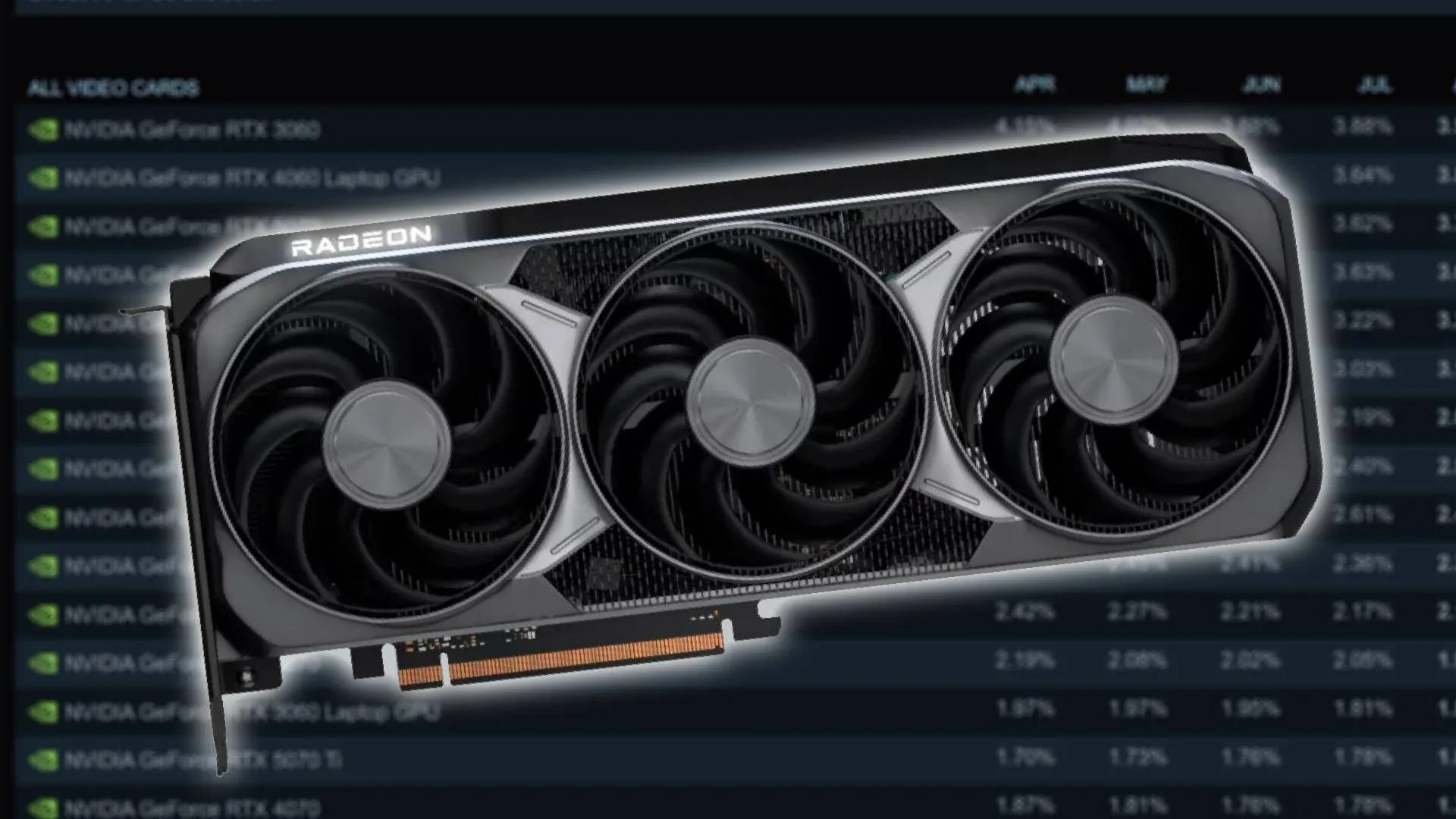
The Radeon RX 9070 XT has taken a notable step forward in Valve’s August Steam Hardware Survey: it is now the AMD graphics card with the largest share in the survey. That is a meaningful milestone for AMD’s upper-mid-range GPU, even if the broader chart still looks overwhelmingly green enough to make a GeForce mascot feel right at home.
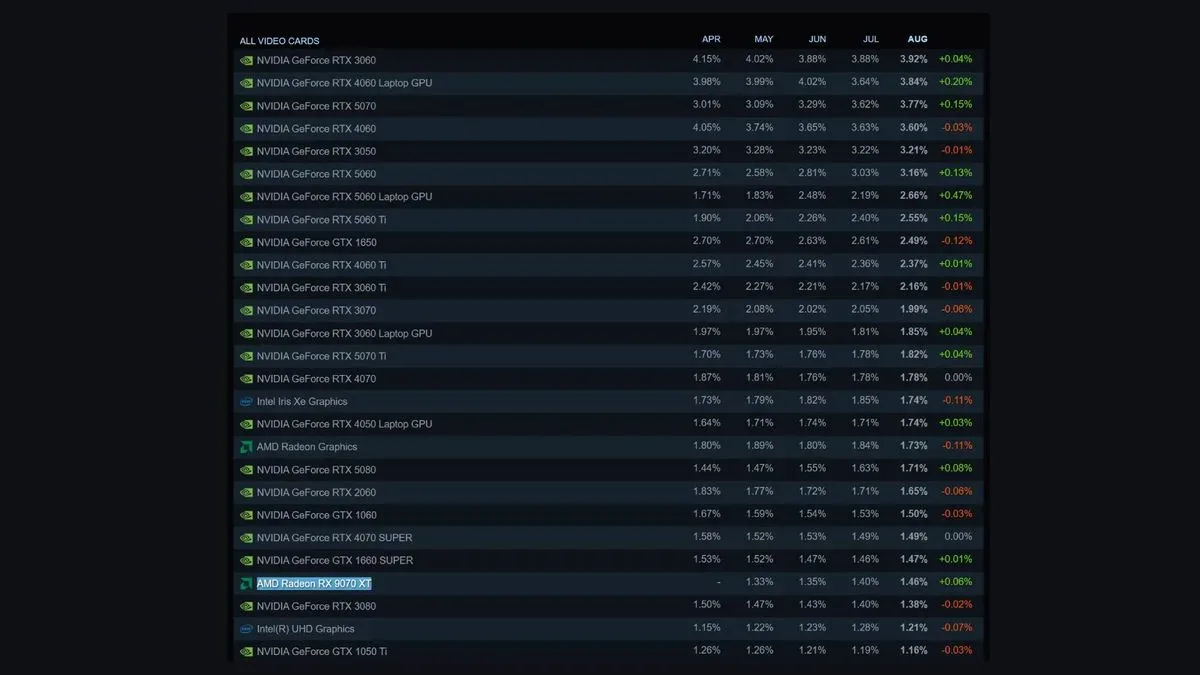
The RX 9070 XT placed 24th overall at a 1.46% share, an increase of 0.06 percentage points from the prior month. It now sits ahead of other Radeon entries, including the non-XT Radeon RX 9070, older AMD models, and Nvidia’s GeForce RTX 3080. For a relatively new card trying to establish itself in a market where upgrade cycles can move at the pace of a loading bar on questionable hotel Wi-Fi, that movement is worth watching.
There is an important asterisk, naturally. Steam’s Hardware Survey is useful as a large-scale snapshot of participating Steam users, not as a literal census of every gaming PC. Its percentages reflect the survey sample and can shift from month to month for reasons beyond a sudden shopping frenzy. A rise of 0.06 percentage points is evidence of momentum, but it is not enough on its own to declare a permanent reshuffling of the PC graphics-card pecking order.
Still, the specific achievement is clear: among AMD GPUs represented in the August figures, the Radeon RX 9070 XT is now the leading model.
AMD has a chart win, while Nvidia keeps the empire
The RX 9070 XT’s 1.46% share puts its position in perspective. The most prevalent GPU in the listed results is the GeForce RTX 3060, which accounts for 3.92% of surveyed systems. Nvidia’s newer GeForce RTX 5070 is close behind the leader in third place, with a 3.77% share.
Those numbers underline two related realities of the PC market. First, the RTX 3060 has enormous staying power. A graphics card does not need to be new to remain relevant on Steam; a huge installed base, a familiar value proposition, and years of availability can keep an older model lodged near the summit. Second, Nvidia’s newer products can gain ground quickly, but the company’s advantage is not restricted to any one generation. GeForce cards remain spread throughout the list.
That does not make the RX 9070 XT’s result unimportant. The survey is often dominated by hardware that has been available for years, sold in great volume, or occupied a particularly appealing price band. Breaking through that inertia is difficult. Becoming AMD’s top individual GPU within the sample suggests that the RX 9070 XT has found a meaningful audience, even if it has not yet approached the most common GeForce models.
A corrected category makes this month more useful
Reading the newest AMD numbers also requires remembering a prior reporting problem. Earlier survey data combined several Radeon products into a broader grouping, including the RX 9070, RX 9070 XT, and RX 9060. That made it difficult to determine how much of the recorded share belonged to any one of those cards.
Related coverage includes Steam Hardware Survey Puts Radeon RX 9070 XT Ahead of Every Other AMD GPU.
With that issue resolved, the August results offer a cleaner look at the RX 9070 XT as its own entry. That is particularly relevant when discussing the card’s position relative to the standard RX 9070 and older Radeon GPUs. A combined bucket can make a family look stronger while hiding which sibling is actually doing the heavy lifting. Now the XT model’s 1.46% can be treated as a more direct indicator of its standing within the survey sample.
It remains wise not to overread a single month. Hardware Survey results are best treated as a continuing trend line. The next several reports will be more revealing: if the RX 9070 XT continues to rise, stays steady, or gives back its gain, each outcome will say something different about its adoption. For now, it has the AMD crown in this particular data set, rather than an uncontested claim to the entire gaming-PC kingdom.
Price is likely to shape the next chapter
Graphics-card popularity is never only about performance. Pricing, regional stock, system-builder deals, retailer promotions, used-market supply, and game bundles can all move buyers toward one GPU or another. The RX 9070 XT launched with an attractive position for its class, but reported retail listings have climbed well beyond that early pricing in some cases.
At the time reflected by the available listings, a Gigabyte RX 9070 XT was listed at $749 on Amazon, while an ASRock Steel model was listed at $769.99 at Newegg with Onimusha: Way of the Sword included. Those examples are not a complete market survey, and prices can change rapidly, but they illustrate why the card’s upward movement in Steam’s data may not automatically accelerate.
When a GPU edges toward $800, buyers start comparing more than raw frame-rate potential. They look at competing new cards, discounted previous-generation options, prebuilt PCs, and second-hand listings. A used GeForce RTX 3070, for example, can become attractive to someone prioritizing an immediate lower entry cost over a newer architecture. The same logic helps explain why the RTX 3060 remains such a giant in the survey: affordability and widespread ownership have a habit of outlasting launch-day hype.
The market may also see continued interest around 12GB RTX 3060 models, including a newer version of the familiar card. Whether players choose those newer units or original RTX 3060 stock, the enduring visibility of the name reinforces a central lesson of the survey: practical budgets tend to beat spec-sheet drama for a vast number of PC players.
What the RX 9070 XT result does—and does not—tell us
The August ranking provides several useful takeaways without requiring any heroic leaps of interpretation.
- The Radeon RX 9070 XT is AMD’s top individual GPU in the August Steam Hardware Survey.
- Its 1.46% share and 24th-place overall ranking represent a 0.06 percentage-point monthly increase.
- It is ahead of the RX 9070, older Radeon cards, and the RTX 3080 in this sample.
- Nvidia remains far ahead overall, with the RTX 3060 at 3.92% and the RTX 5070 at 3.77%.
- A previous Radeon grouping issue has been corrected, making individual RX 9000-series readings more informative than before.
What it cannot tell us with certainty is why every participant bought their card, whether all regions are seeing the same availability, or whether the August bump will continue. It also cannot settle which GPU is “best” for every player. A gaming PC is a bundle of compromises involving resolution targets, existing components, power requirements, preferred games, price ceilings, and the stubborn human desire not to rebuild half a desktop just to run one more setting at Ultra.
For players considering a broader PC refresh, the GPU should be evaluated alongside the processor and memory rather than as a solitary superhero expected to rescue a mismatched system. That wider upgrade conversation matters just as much for giant, technical games as it does for expansive worlds such as No Man’s Sky Cosmos, where performance expectations can vary widely by configuration and settings.
The affordability battle is far from over
The RX 9070 XT has earned a small but concrete data-driven victory. It is now the most commonly reported AMD GPU in August’s Steam Hardware Survey, and it did so after the survey’s earlier Radeon-category confusion was cleared up. That makes the milestone more credible than a rise based on a mixed family entry.
Yet the distance to Nvidia’s leading cards remains substantial, and that gap reflects years of installed-base advantage as much as the current generation’s competition. The RTX 3060 is still the most common GPU in the results, while the RTX 5070’s 3.77% share demonstrates that Nvidia can occupy both the old-guard and current-generation parts of the list at once.
AMD’s next opportunity may depend heavily on the least glamorous variable in PC hardware: the price tag. If RX 9070 XT availability improves at lower prices, the card could plausibly build on this result, especially as promotional periods approach. If pricing stays elevated, many buyers may keep selecting older cards, used options, or competing models that better fit a fixed budget.
For now, the Steam data delivers a measured verdict. The Radeon RX 9070 XT is gaining visibility and has become AMD’s survey leader. But the overall GPU chart remains a reminder that popularity is won through availability, value, and time—not simply by showing up with a shiny new cooler and a very confident product name.
Shop the products
Check current price, model and availability at the retailer.