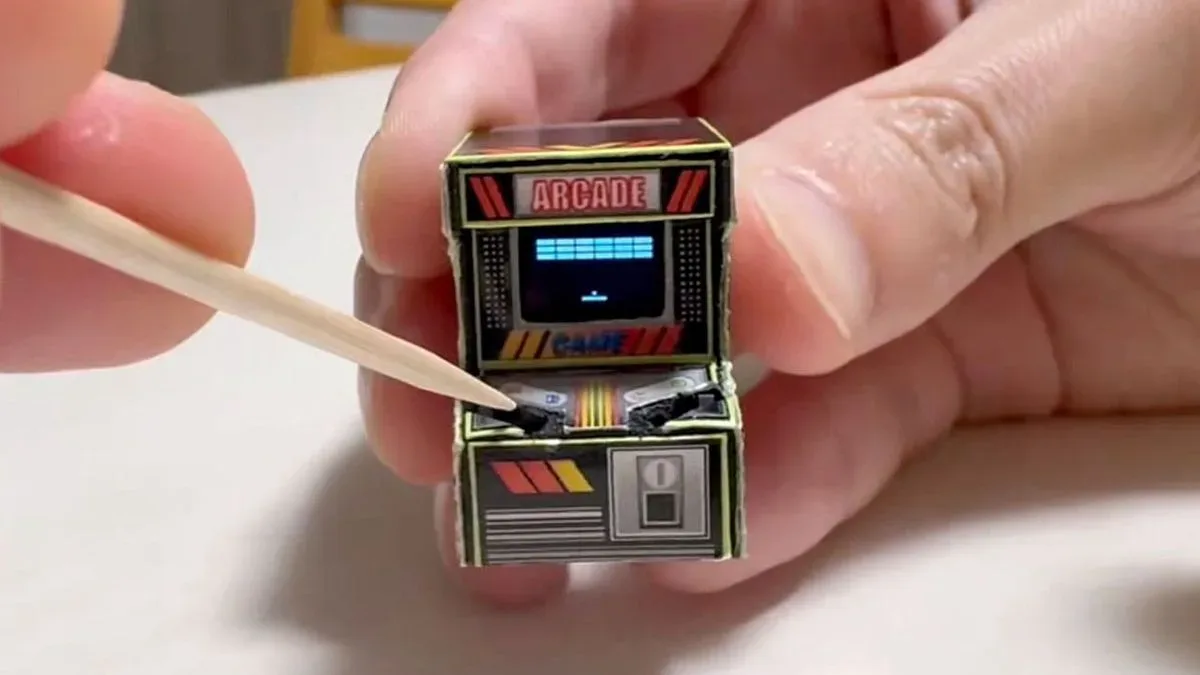
There are tiny game systems, and then there are game systems that seem determined to turn a player’s fingertips into an inconvenient design flaw. A miniature arcade cabinet shared by maker BitBlt_Korry sits firmly in the second category: it has a paper outer shell, a functioning display, and controls so small that a toothpick is used to operate them.
The project is more than a static model. Video of the device shows Brick Breaker running on its screen while the maker guides the game with the small wooden tool. A subsequent clip shows another game labeled Space Shooter, with an on-screen format that closely resembles the alien-blasting arcade template familiar from Space Invaders.
It is an immediately charming contradiction. The cabinet’s proportions evoke an arcade machine built for a tabletop, yet its controls demand much finer movement than a conventional joystick or button array. BitBlt_Korry has described those controls as “the absolute worst,” which is not so much a flaw in the project as an unusually honest specification sheet.
A tiny cabinet that is meant to run, not merely sit on a shelf
Miniature gaming objects often land in one of two camps: decorative replicas that capture the appearance of a beloved machine, or compact devices engineered to make playing comfortable at a reduced size. This papercraft arcade takes a more eccentric route. It preserves the visual language of an upright cabinet while visibly functioning as a playable game device, even if comfortable control was clearly not the chief objective.
That distinction matters. A working screen changes the appeal of the object from “small model” to “tiny interactive machine.” In the Brick Breaker footage, the player is not simply pressing a display prop’s button for a light effect. They are attempting the core interaction that gives the genre its tension: moving a paddle accurately enough to keep a ball in play.
Brick Breaker is especially revealing as a demonstration game because its demands are simple to explain but unforgiving in practice. The player controls a horizontal paddle, tracks a moving ball, and tries to send that ball into an arrangement of blocks. At normal arcade scale, the input is usually direct and quick. Shrink the physical interface to toothpick territory, however, and small movements become a larger share of the available control range. Precision becomes the whole point—and, presumably, the whole problem.
The Space Shooter clip makes a similarly clear case for the novelty. Fixed shooters generally ask a player to move across the bottom of the screen and fire upward at descending or arranged enemies. The basic rule set is readily understandable at a glance, which helps a tiny display communicate that it is playing a real game rather than showing a decorative animation. It also makes the cabinet’s extreme scale funnier: recognizable arcade action is happening, just behind an interface that appears to be actively resisting human hands.
Why the toothpick is the star accessory
The toothpick is not merely a visual gag. It is an accessibility workaround for the cabinet’s scale. Standard arcade controls are designed around broad, repeatable hand motions. Even a small joystick is normally intended to be pushed with a thumb or finger. Once the control area gets too cramped for a fingertip, a narrow tool can reach the input without blocking the player’s view or accidentally hitting neighboring controls.
That does not make the interface easy. It introduces a different kind of difficulty: the player must hold and position a separate object, approach the target accurately, and transfer motion through a thin point. The result is a setup in which the tool is smaller than the hand but demands more care from it.
There is also a practical visual benefit. A fingertip could obscure much of a screen this small while reaching toward the controls; a toothpick leaves more of the display visible. But the trade-off is obvious in the footage and in the maker’s own assessment. Fine input is possible, yet it is likely slow, fiddly and far less forgiving than a full-sized controller.
That tension is central to the project’s appeal. It is not a claim that every device should be miniaturized until ordinary play becomes absurd. Instead, it is a playful test of the boundary between something that works and something that is genuinely pleasant to use. Those are not the same achievement, and the tiny arcade gets credit for making both sides of that distinction visible.
Papercraft gives the cabinet its personality
The paper exterior is important, too. An arcade cabinet is a familiar silhouette: screen at the top, control area below, enclosure around the hardware. Recreating that shape in paper gives the machine the feel of a crafted object rather than a mass-produced micro-console. The material also amplifies the scale joke. Paper is associated with lightweight models, folded projects and display pieces; finding an operating screen inside that form makes the object more surprising.
It also suggests a kind of fragility that is part of the charm. A paper shell may look wonderfully precise in a close-up, but it does not project the same durability as a conventional plastic or metal enclosure. That contrast makes the toothpick control method feel even more theatrical. The player is simultaneously trying to guide an arcade game and trying not to overwhelm the cabinet with the basic force of their own hands.
None of that should be confused with a verdict on the underlying electronics or an invitation to assume construction details not shown. The available clips establish a working display, playable games and a paper outer casing. They do not provide a full hardware breakdown, instructions, dimensions, a parts list or a release plan. The compelling fact is the demonstrated result: a tiny functioning arcade form factor whose usability has been willingly sacrificed on the altar of miniature spectacle.
The appeal of deliberately impractical game hardware
Gaming hardware is usually judged on clear practical standards: display legibility, battery life, ergonomics, durability and price. A project like this flips that checklist around. Its strongest feature is exactly the thing that would normally be questioned first—its extreme smallness.
That does not mean it lacks value as a gaming object. It simply has a different purpose. The cabinet is best understood as a maker showcase and conversation piece, where the accomplishment lies in integrating an operational game experience into a form that looks implausibly small. Being able to play for a few minutes is part of the magic; being able to play for hours would be beside the point.
There is a useful parallel in other novelty-scale devices. Very small gadgets can make familiar technology feel new again because they force people to reassess what they take for granted. A normal arcade cabinet has enough physical room that the screen, controller and enclosure seem inseparable. This project separates those assumptions. The display can be tiny. The input can be mediated through a wooden point. The cabinet can be paper. And the game can still run.
The result is less a replacement for a traditional arcade setup than a concentrated celebration of its basic ingredients. There is a cabinet shape, a screen, an input method and a simple game loop. Everything is stripped down to the point where the player notices each component again.
What viewers should take from the demonstration
The clips make a persuasive case for craft and patience, but they should not be read as proof of a consumer-ready tiny arcade category. No purchase details, distribution plans or build instructions are established here. Nor is there any reason to pretend the toothpick interface is secretly ideal when the creator has plainly characterized it otherwise.
Instead, this is the sort of project that succeeds because it embraces its limitations. The control scheme is cumbersome. The shell appears delicate. The screen and cabinet are exceptionally small. Yet those constraints are also what give it identity. A more comfortable version might be a better handheld device, but it could lose the delightfully ridiculous image of someone playing Brick Breaker by carefully poking a paper arcade cabinet with a toothpick.
For players looking for a much more conventional way to spend time with games, the broader release calendar is naturally full of projects built around normal-scale controls, including Star Wars: Galactic Racer’s launch across modern platforms. But that is precisely why this miniature cabinet stands out. It is not competing on convenience. It is making an argument for the joy of making something improbably small, demonstrably functional and just awkward enough to be unforgettable.
BitBlt_Korry’s tiny paper arcade ultimately earns its attention by being both a technical object and a visual punchline. It runs games. It looks like an arcade cabinet. And it asks its player to bring a toothpick and a level of patience that most commercial hardware wisely never requires.