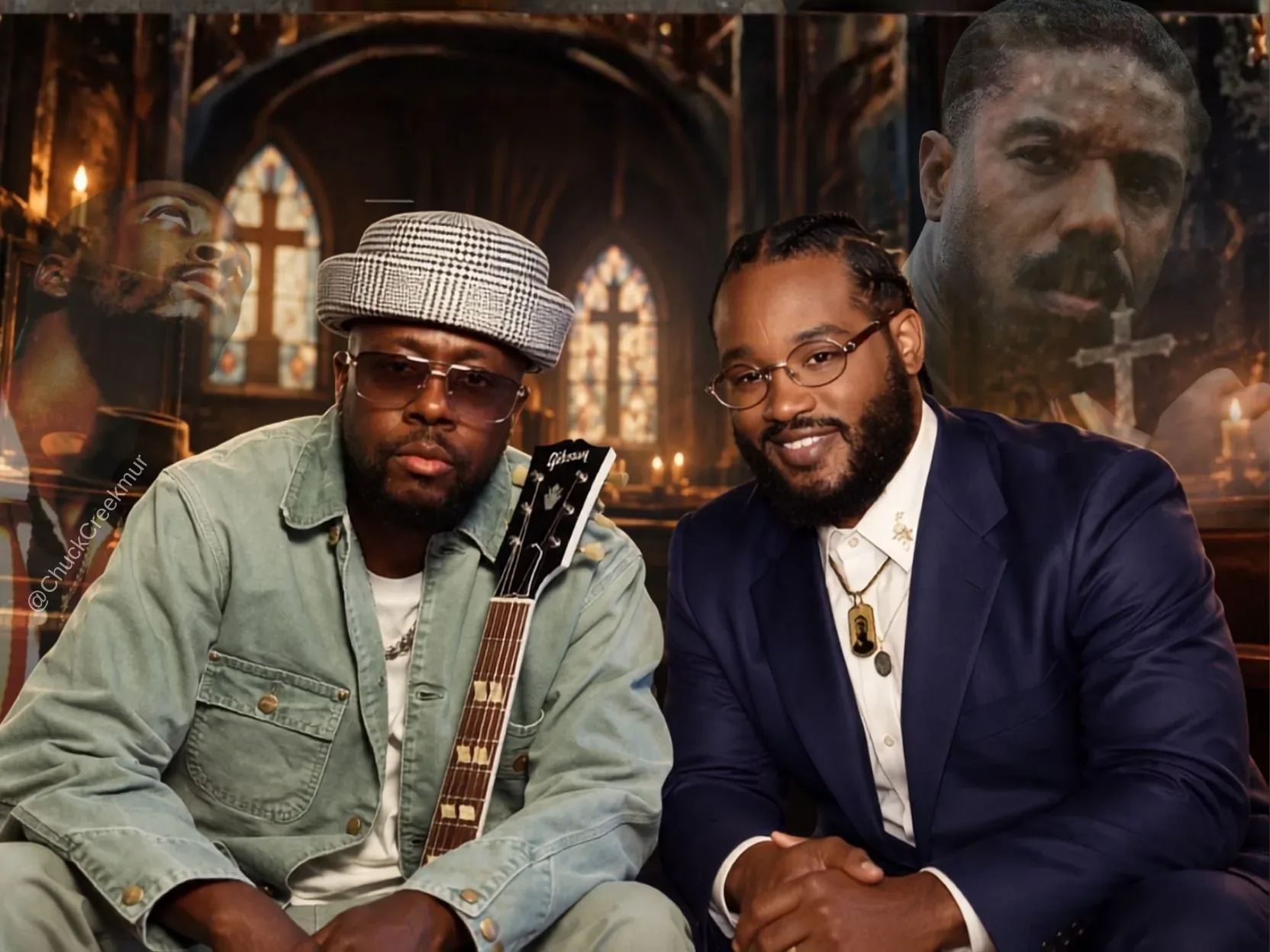
Wyclef Jean found a personal conflict inside Ryan Coogler’s Sinners, one that reaches beyond its horror imagery, its vampires and its Blues-driven musical tension. For the Fugees co-founder and three-time Grammy winner, the story of a young musician pushed between church expectations and a calling outside the sanctuary recalls his own upbringing as a preacher’s kid.
Sinners, written and directed by Coogler, stars Michael B. Jordan in dual roles as the twin brothers Smoke and Stack. The film follows the brothers as they return home to begin again, where a greater evil awaits. Its spiritual and musical focal point is Sammie “Preacher Boy” Moore, played by Miles Caton: a gifted young performer whose preacher father objects to him taking his talent into the world of the Blues.
Jean recognized that divide immediately. He said he was removed from church life because he pursued secular music, describing himself as someone who could relate “one hundred percent” to Sammie’s situation. His father had expected him to become a minister. Instead, Jean carried abilities cultivated in church into a career spanning Hip-Hop, reggae, pop and other styles.
That does not make Jean’s response to Sinners a simple rejection of religion. His point is more complicated, and more useful: a warning about temptation may have value, but the way adults communicate that warning can determine whether a young person can hear it.
What ‘preacher’s kid’ means in this context
“PK” is shorthand for “preacher’s kid,” a label Jean and the film’s Sammie share. In this story, it is more than a biographical detail. It identifies a young person whose family, religious community and future may all appear to be pulling in the same prescribed direction.
For Sammie, that direction is the church. His father views the Blues—and the life surrounding it—as a threat to his son’s spiritual well-being. The music is framed through a longstanding conflict between the Black church and Blues music, including the idea of secular sounds as “devil’s music.” Sammie’s own perspective, however, is shaped by the urge to follow a gift that does not stay neatly inside the sanctuary.
Jean’s own account gives that tension a contemporary resonance. He said his father saw ministerial qualities in him and expected that he would eventually enter ministry. Jean can still joke that he looks and sounds like a preacher, but the humor points toward an expectation with real weight behind it. A child can be praised for their gifts while also being told that there is only one acceptable place to use them.
That is why the term “calling” matters here. In a faith setting, it can mean a divinely guided life purpose. In artistic life, it may mean the pull toward making and sharing music. Sinners places those meanings in direct conflict for Sammie, while Jean’s experience suggests they do not always have to be treated as mutually exclusive.
Jean’s objection is to fear as a teaching tool
Jean did not argue that churches should stop discussing danger, temptation, discipline or spirituality. He specifically said he was not telling people to abandon religion or spiritual belief. Rather, he questioned a form of messaging built principally around fear, punishment and supernatural imagery.
In his view, the issue is not that elders warned young people about secular music and the situations around it. It is that the warnings were sometimes presented in a frightening, metaphor-heavy way rather than as an honest explanation of practical risks. “The conversation is given from a scary point of view,” Jean said.
His preferred alternative is directness. If a young musician is entering an industry or lifestyle where success can put drugs, pressure, manipulation or other destructive opportunities in front of them, Jean believes adults should say that plainly. A blanket declaration that something is sinful may communicate moral disapproval, but it may not equip a young person to recognize choices and consequences when they arrive.
That distinction is important. A metaphor uses one idea to represent another; in this case, religious language about evil can be intended to describe real-world temptation. Jean’s concern is that metaphor can become a barrier if listeners do not receive a clear explanation of what it is meant to warn them about. His request for “logic” is a request for specifics: explain the danger, explain why it is dangerous, and allow room for questions.
“If you gave me the message in a different way, I would have received it better,” Jean said.
That framing also avoids flattening the disagreement into “faith versus art.” Jean’s own career came from musical skills developed in the church, even though his eventual work moved through secular genres. The tension is instead about authority, trust and communication: who gets to define the purpose of a young person’s talent, and whether they are given enough information to navigate a path that their elders fear.
Why the Blues conflict carries the dramatic weight
Music is not a decorative detail in Jean’s reading of Sinners. It is the place where family duty, faith and individual expression collide. Sammie’s gift makes the conflict harder, not easier. If he lacked musical ability, there would be less reason for the question to exist. Because he is gifted, the decision has stakes for his identity and for the relationship with his father.
The film’s premise adds a horror framework to that human dispute. Smoke and Stack’s return home leads them toward an evil larger than they anticipated, while Sammie’s struggle remains anchored in the pressures within his own community and family. The result, at least in the elements Jean singled out, is a story where external monsters and internal fears can sit side by side without being the same thing.
Jean’s response puts a sharper edge on that contrast. Supernatural imagery can work powerfully in fiction because it gives unseen anxieties a visible form. But he is asking for something different in real conversations with young people. There, he says, adults should not hide hard subjects behind imagery when they can discuss substance use, mental-health crises, shame, pressure and self-destructive behavior plainly.
Jean referenced overdoses and suicide as reasons that the discussion must be grounded in the present rather than avoided through euphemism. Those remarks should not be read as a claim that a particular genre of music causes either issue; his broader argument is about better guidance and more candid support. The responsibility he places on elders is to explain risks in a way that a younger listener can understand before fear or temptation becomes overwhelming.
A middle ground rather than a surrender
Jean’s answer to the church-versus-secular-music divide is a “middle ground.” That phrase can sound vague, but his explanation is specific enough: keep faith and spirituality, while also making space for a straight conversation based in logic. It means that a young person can be warned without being silenced, and can ask what a warning means in their actual circumstances.
For families, mentors and community leaders, the practical implication is not to treat questions as proof of rebellion. A conversation is not an endorsement of every decision someone might make. It can be a way to make sure advice has been understood. Jean’s own story illustrates the difference: he did not leave music behind, but he still speaks about the potential dangers surrounding success and temptation.
For viewers, this perspective offers one route into Sammie’s role in Sinners. The character is not simply choosing between two genres, nor merely defying a strict parent. He is confronting an inherited definition of what his gift is for. Jean sees the pain in that choice because he lived an adjacent version of it—one in which a father expected ministry, a church rejected secular work, and music still became the course of his life.
That is also why Jean’s comments remain focused on delivery rather than condemnation. He acknowledges that warnings can be rooted in care. What he challenges is a method that makes fear the primary language. If young people are to be protected, his argument goes, they need a chance to understand danger in concrete terms and to speak openly before isolation, shame or pressure closes off the conversation.
Sinners gives that conflict a dramatic home through Sammie “Preacher Boy” Moore, his father and the pull of the Blues. Jean’s reaction brings the theme back to lived experience: faith need not be discarded, but it must be communicated with enough openness and clarity for a young person to respond. That enduring tension between a family’s hopes and an artist’s path is part of what gives the film’s music-centered struggle its force.
The wider pop-culture conversation often turns on how stories preserve a character’s identity while changing the path ahead, a question that also surfaces in discussion of the DCU’s Maxwell Lord. In Jean’s reading of Sinners, identity is precisely the issue: a young musician is trying to understand whether his gift belongs to the expectations placed upon him, or to the calling he feels himself.