Weekend Update used its Halloween edition to jump between horror-comedy, U.S. political material and a notably brief reference to Israel’s election. The result was a segment with very different kinds of punchlines: a Pennywise cameo from Ben Marshall, a broad riff on politicians’ comments about one another’s appearances, and a Michael Che joke whose entire mechanism rested on turning familiar political labels into a more uncomfortable phrase.
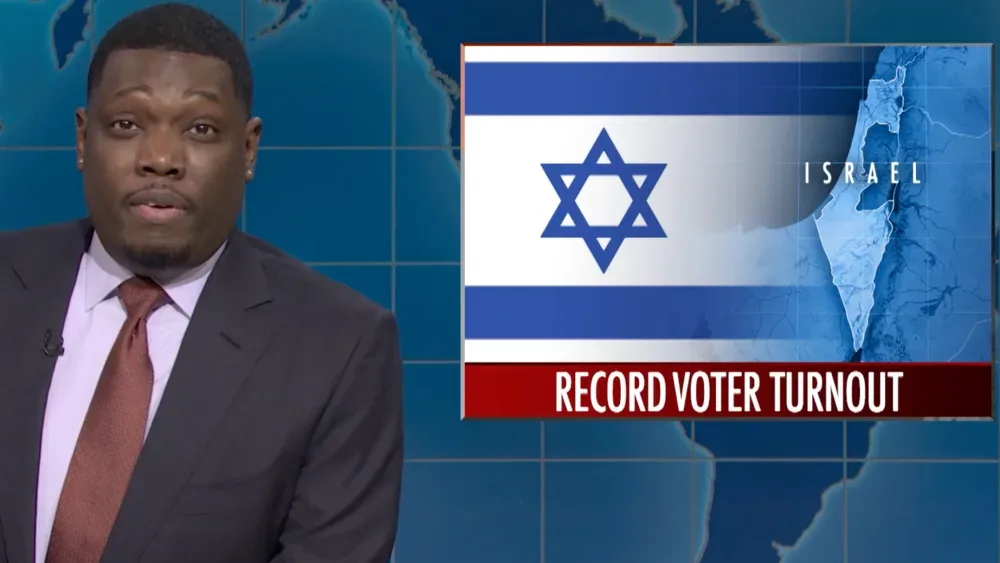
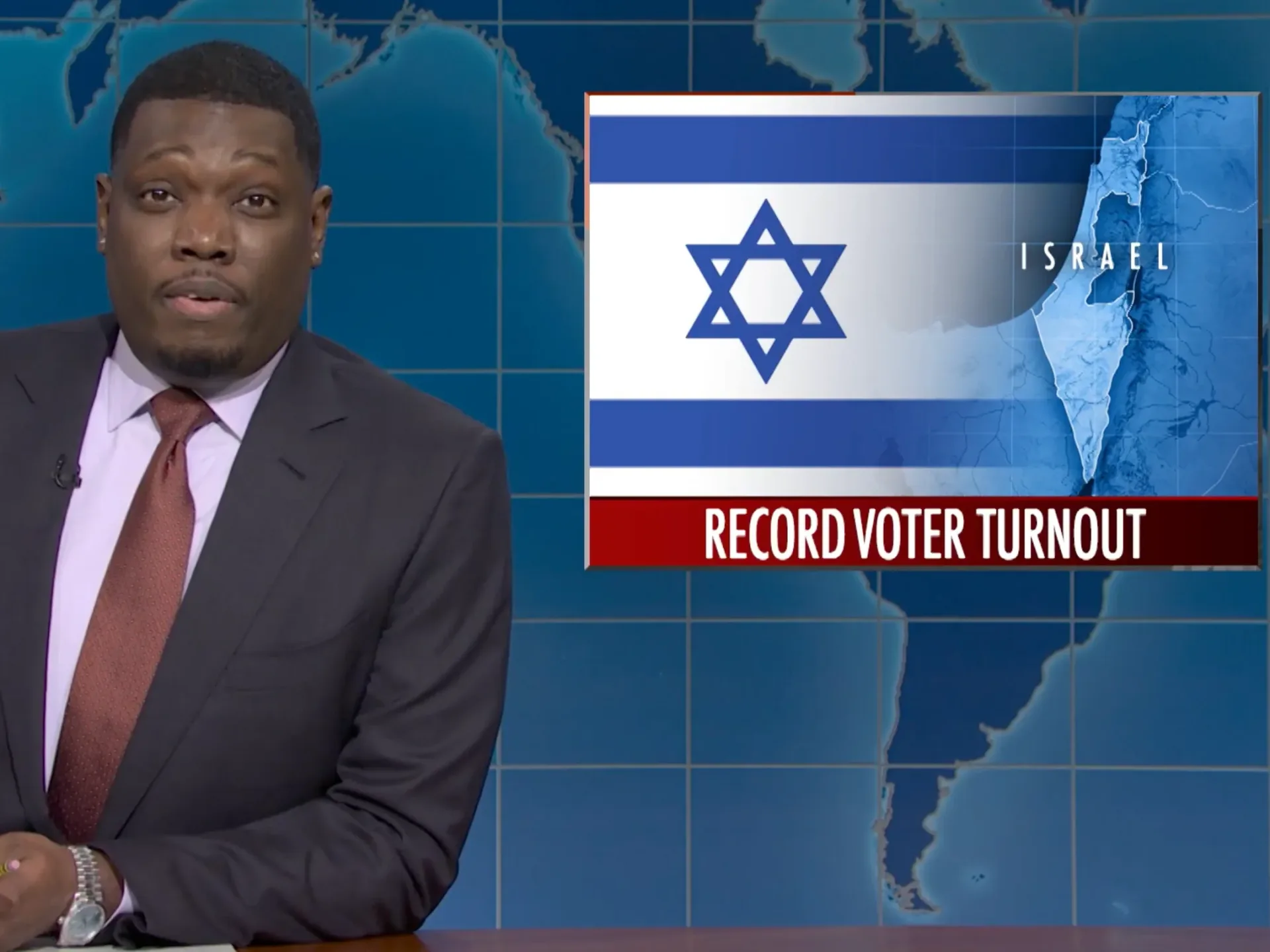
Che’s Israel line began with a positive-sounding premise: a record number of people voting in the country’s election. It then pivoted from “the right side” and “the left side” to “the gentle side.” That last phrase is the punchline. It is a phonetic turn on the political language that precedes it, while also pushing the audience toward an implication about the conflict surrounding Israel and Gaza.
Colin Jost’s grimace after the line mattered almost as much as the wording. On Weekend Update, reactions from the desk can function as a second punchline: they flag a joke as a risky swerve, acknowledge its sting, or create comic distance between the two hosts. Here, the response underlined that the material was not being treated like a routine election quip.
A short joke carrying a larger context
The segment did not turn into an extended discussion of Israel’s war on Gaza. It did not offer a policy argument, explain the election, or build a longer series of jokes around the subject. Instead, it made one compact reference and moved on.
That brevity is significant because political satire works differently from political commentary. A news-desk joke has limited time to establish a premise, find a turn and let the audience recognize why the turn is pointed. “Right” and “left” are efficient comic building blocks because they mean political positions as well as physical directions. Che’s use of “gentle” substitutes a word that sounds close enough to disrupt the expected sequence, then gains force from the serious context the audience is asked to supply.
In other words, the joke is less an explanation than an allusion. An allusion is an indirect reference that depends on audience knowledge rather than spelling out every detail. Its advantage is speed. Its limitation is that it can reduce a vast, painful and politically charged subject to a single verbal gesture. That tension is built into the format, particularly when the subject is an ongoing war and its public debate.
For viewers who have noticed how selectively major late-night comedy shows address this topic, even a one-line acknowledgment can become the central talking point. The material was neither a sprawling sketch nor a recurring bit. Its prominence comes from the decision to make the reference at all, and from the way Jost’s visible discomfort framed it as a moment the show expected viewers to notice.
The rest of the desk leaned into a different kind of absurdity
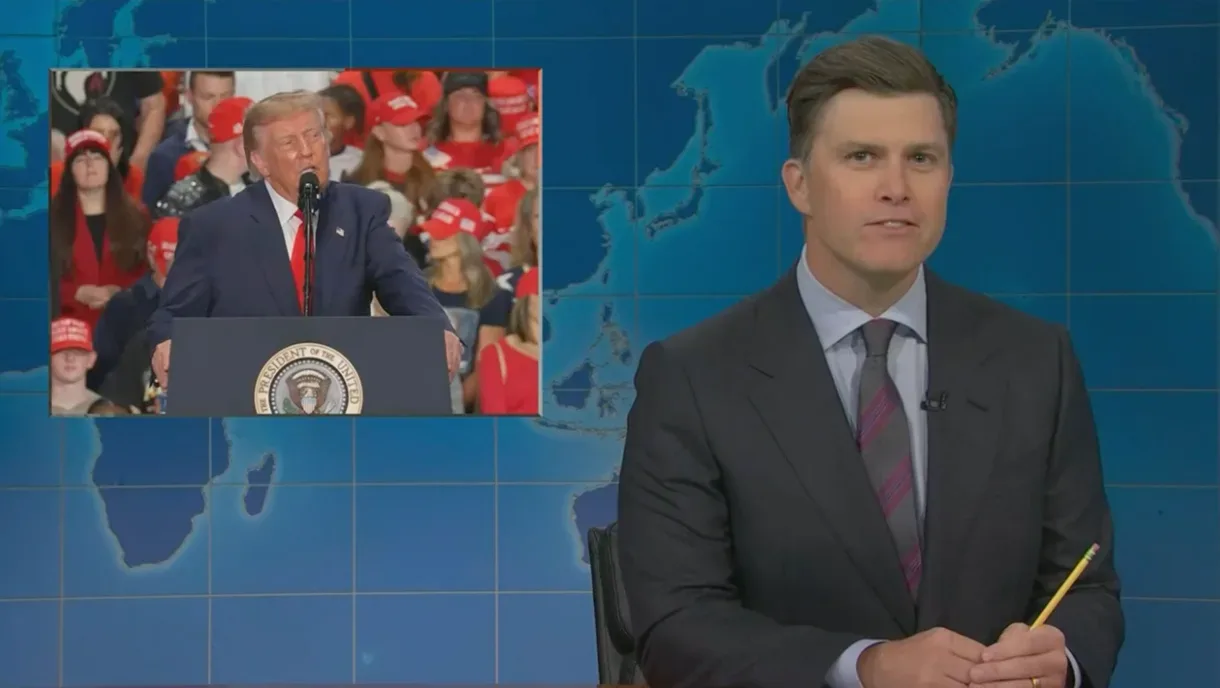
Earlier, Jost targeted President Trump’s apparent fixation on candidates’ posteriors, including a joke involving Vice President JD Vance. Jost’s angle was openly exasperated: rather than treat the remarks as serious political messaging, he cast the exchange as a bizarre “smash or pass” game occurring while the party faces an approaching midterm election.
Related coverage includes ‘SNL’ Weekend Update Takes a Brief Turn Toward Israel.
That joke uses incongruity, one of comedy’s simplest tools. The expected language around elections is strategy, policy, turnout and power. Jost instead recasts political figures’ public behavior using the vocabulary of a shallow dating-game choice. The laugh, ideally, comes from the mismatch—and from the host’s insistence that the people involved should focus on a more consequential political task.
Placed alongside Che’s later line, it shows the unusually elastic range of a Weekend Update desk. One joke treats political personality culture as embarrassing absurdism. The other reaches toward an international conflict with a compressed pun. Both are political, but their targets, stakes and comic temperatures are very different.
The Halloween framing supplied another tonal lane. Ben Marshall appeared as Pennywise, the horror character associated with It. A Pennywise cameo is fundamentally visual, character-based comedy: the performer arrives with a familiar frightening image that can be played for seasonal contrast or absurdity. It belongs to a different tradition from topical satire, but Halloween episodes often invite exactly that mix of costumes, topical material and quick-format surprises.
Why the phrase “gentle side” lands differently
Che’s structure matters. Had the line stopped at “right side” and “left side,” it would have been a generic observation about political division. Adding “gentle side” changes the sentence from a predictable list into a deliberately awkward third option. The phrase is not a conventional political category, so the audience has to ask why it has been introduced. The answer is not contained in an explicit explanation; it sits in the sound of the words and the conflict being invoked.
This kind of joke is often called a pun, but that label can make it sound simpler than its reception. A pun creates a collision between meanings or sounds. In lighter settings, that collision is the whole entertainment. In a reference to war, the same device can feel pointed, evasive, provocative or insufficient, depending on what a viewer believes comedy should do with the subject.
There is no indication here that the segment aimed to settle that argument. The joke’s scope was plainly small. Yet the choice of subject ensures that its interpretation will be larger than its runtime. That is a practical reality for topical comedy: a short line can invite an outsized response when it enters a debate that audiences already regard as emotionally and politically urgent.
A contrast with other versions of the format
The source material also draws a comparison with the U.K. edition of Saturday Night Live Weekend Update, which has taken a more direct satirical approach to public figures including Ed Sheeran and Macklemore in relation to conversation around Israel’s war on Gaza. The contrast is not simply about whether a joke is controversial. It is about how much comic attention a program devotes to the issue.
Che and Jost’s approach in this case was compact and oblique. The U.K. examples described in the material are framed as more sustained and specific, aiming at celebrities’ conspicuous places in the wider discussion. Neither method is automatically risk-free. A direct target can be clearer but more divisive; an indirect pun can be efficient but leave audiences unsure whether the joke has meaningfully confronted its subject.
For people tracking the changing boundaries of mainstream comedy, that distinction is more useful than treating every political joke as the same kind of statement. Format, target and degree of specificity shape what a bit can communicate. Weekend Update’s Israel joke chose economy: a familiar phrase, one altered word, an on-camera grimace and a rapid exit.
That economy is also why the moment is likely to be remembered. The Halloween desk segment had plenty of material designed for immediate laughs, from Pennywise to the crass political-body commentary. But the line about Israel carried a different kind of attention: not a lengthy editorial, not a detailed satirical attack, but a brief joke whose setup asked viewers to bring the difficult context with them.
For more coverage of entertainment figures and public-facing culture, see YG’s “The Gentlemen’s Club” spotlight.