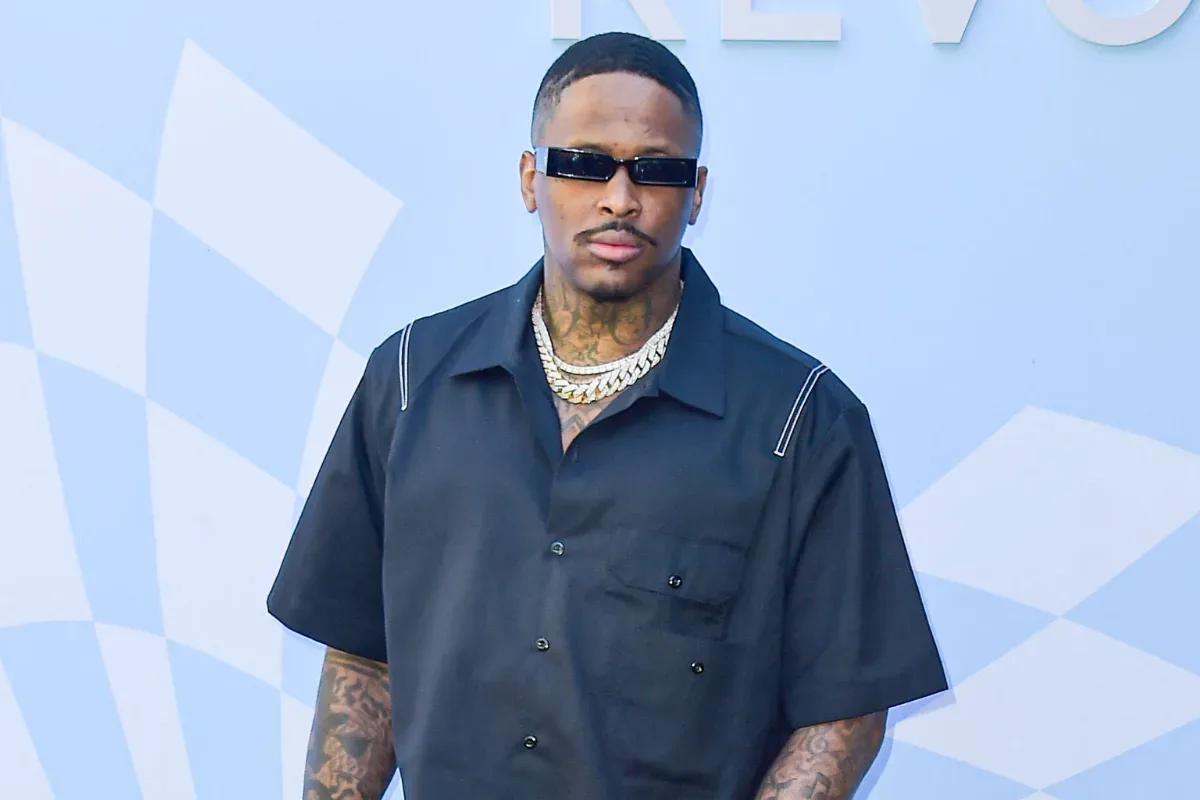
YG’s The Gentlemen’s Club is built around a difficult proposition: looking past the people, pressures and conflicts around you long enough to consider your own role in what has gone wrong. In a recent discussion about changing his behavior, the rapper connected problems involving family, the street and business to actions he now sees as his own responsibility.
“I realized a lot of my issues and problems come from within. Self-inflicted.”
That admission is the clearest available key to The Gentlemen’s Club, released June 19, 2026. The 15-track, 54-minute album places that personal reckoning beside the kind of high-profile collaborations and regional ties listeners may expect from YG. But its reported narrative emphasis is not simply on opponents, success or spectacle. It is on a protagonist whose most consequential target may be himself.
“Hitman” reframes the target
The central idea takes particularly direct form on “Hitman,” where the apparent target is ultimately YG. That is an effective reversal for a rap song title that might otherwise suggest a confrontation with somebody else. Instead of treating conflict as something located entirely outside the narrator, the premise turns the lens inward.
Tracks including “Ready to Die” and “Insecure” further place anxiety and doubt inside the album’s story. The word insecure matters here not as a genre label or a promotional hook, but as a plainly emotional term: uncertainty about oneself, one’s standing or one’s decisions. In the context of YG’s stated effort to improve, that theme makes the record’s self-examination more than a stray line between guest appearances.
There is an important distinction between self-reflection and a claim that every hardship has one cause. Self-reflection means examining one’s own decisions and patterns. YG’s comments identify what he views as self-inflicted elements in his problems; they do not erase the family, business and street contexts he named. That distinction gives the album concept some weight. The point is not that outside conditions vanish, but that accountability can become part of how a person responds to them.
For an artist, putting that tension into songs can also create a more specific kind of persona. The public image remains the person at the center of the music, but the writing can acknowledge blind spots, hurt and pressure instead of presenting control as automatic. The available details suggest The Gentlemen’s Club uses its title and its “Hitman” idea to stage exactly that conflict.
A formal presentation for an uneasy record
The album’s early stage presentation reinforced its title. At a June performance at the Roxy Theater in West Hollywood, YG and his crew wore suits while performing the album in full. Fans were also asked to dress up. A full-album performance differs from a conventional hit-focused set because it presents the release as a sequence rather than a menu of individual songs. That format can make a project’s narrative or emotional arc easier to foreground.
Related coverage includes YG Turns Inward on ‘The Gentlemen’s Club’.
The suits and dress request appear to have established a controlled, formal setting around music concerned with internal disorder. That is an interpretation of the staging rather than a confirmed explanation from YG, but the contrast is notable: a “gentlemen’s club” aesthetic, complete with coordinated attire, surrounding a record that confronts insecurity and self-inflicted problems.
Onstage, YG also spoke about feeling overlooked and about being urged to get better by people close to him. Those points connect the show’s presentation to the album’s underlying conflict. Feeling overlooked can lead an artist toward external validation; being challenged by one’s circle can demand a more uncomfortable form of growth. The project appears to hold both impulses at once.
What a full-album set can communicate
Performing an entire album does not, by itself, prove that a project is a concept album. Still, it signals that the artist is willing to present the work in its intended order and let its less obvious material share the stage with its more immediately recognizable tracks. For a release described through an internal “plot,” that approach is particularly suited to the material.
The Roxy event also kept the focus on the project before the larger announced tour schedule. A club setting can make a concept and its details feel more immediate, while an arena date on a wider route poses a different challenge: retaining that personal framing in a much bigger room. The available information does not establish how the later tour shows are structured, so it would be premature to assume the Roxy performance format will be repeated throughout the run.
Collaborators keep the West Coast in the picture
For all of the album’s inward-looking material, The Gentlemen’s Club is not presented as an isolated confessional. Its guest list keeps recognizable connections around YG’s work in view. Shoreline Mafia appears on “Hollywood,” Tyler, The Creator joins “On the Low,” and Pusha T appears on “OMG.”
Those collaborations matter because they place the personal material alongside shared performances rather than separating it into a completely solitary project. Shoreline Mafia’s participation maintains a clear regional connection. Tyler, The Creator and Pusha T extend the lineup beyond a single local lane while still fitting a rap album built around distinct voices and status-conscious storytelling.
Guest verses can serve several roles on an album: they can add contrast, offer a second perspective, raise a song’s profile or strengthen a musical community around the lead artist. The supplied details identify the features but do not describe the verses, production or track-by-track subject matter. It is therefore more accurate to say that the guests broaden the album’s frame than to claim they resolve or directly respond to its personal themes.
That balance is one of the more interesting aspects of the project’s outline. YG is not abandoning the collaborative, West Coast-facing side of his catalog. Instead, the record seems to put that familiar social and musical environment beside a candid examination of his own choices. The result, in concept, is a record where outward connection and inward scrutiny are meant to coexist.
A new release arrangement after the Def Jam period
The Gentlemen’s Club is credited to 4Hunnid Music under an exclusive license to 10K Projects. In straightforward terms, an exclusive license is a release arrangement in which one party has exclusive rights to use and distribute specified material under agreed terms. The credit identifies the business framework attached to this album; it does not, on its own, reveal the full scope of ownership, creative control or contractual terms.
The release follows YG’s Def Jam era, which ended with 2022’s I Got Issues. Between that album and The Gentlemen’s Club, he released a joint project with Tyga and added another installment to his Just Re’d Up mixtape series. That sequence provides useful context: the new record arrives after work in more than one format, including a collaborative release and a continuation of an established mixtape line.
It also creates a contrast with the rollout for 2014’s My Krazy Life. Ahead of that album’s March 18, 2014 release, Def Jam hosted a listening session in Atlanta at Patchwerk Studios for DJs, executives and media. Jeezy and DJ Mustard discussed the work involved in the project at the event and compared it with Dr. Dre’s The Chronic.
That comparison belongs to the historical context of My Krazy Life, not as a claim about the sound or quality of The Gentlemen’s Club. What can safely be said is that YG’s newer release has arrived through a different credited arrangement and with a different visible emphasis: an album-length Roxy presentation, a personal theme of accountability and an announced road run behind it.
The shift is worth noting without turning it into a sweeping claim about reinvention. Artists’ business credits and promotional approaches can change for many reasons, and the provided information does not establish why this particular arrangement was chosen. The clear facts are narrower: YG has moved on from the Def Jam period associated with I Got Issues, and The Gentlemen’s Club carries 4Hunnid Music and 10K Projects credits.
The announced tour brings the album to 19 cities
The album’s campaign also includes The Gentlemen’s Club Tour, announced July 21, 2026. The 19-city itinerary is set to begin September 10 in Boston and finish November 7 in Honolulu. It includes a Los Angeles stop at Crypto.com Arena, a particularly significant hometown-scale date within a route that begins on the East Coast and ends in Hawaii.
Mozzy and Chef Boy were named as support, while Kalan.FrFr and Natalie Nunn were listed for select dates. The lineup again suggests that the larger campaign is not limited to one tone or one guest configuration. Support acts can shape the atmosphere of an evening, introduce audiences to adjacent artists and give a tour a stronger sense of local or scene-based connection. But the announcement does not specify which select dates include Kalan.FrFr or Natalie Nunn, nor does it detail set lengths or show formats.
For attendees, the practical takeaway is simple: an announcement establishes the planned route, dates and named support, but it should not be treated as confirmation of every production detail or performance lineup at every stop. The album’s Roxy presentation showed one way YG has framed this era; the tour announcement identifies the broader planned reach of that era.
YG’s stated aim to change gives the project an unusual amount of thematic clarity. The Gentlemen’s Club is framed not merely around being judged by others, but around the harder task of judging oneself honestly. Its guests, formal live presentation, revised business context and nationwide tour plans all surround that core idea rather than replacing it.
That approach also places YG’s release in a wider music-news conversation that includes major album activity from other rap stars, such as Drake’s recent run of 11 albums on the Billboard 200. The circumstances are different, but both stories underline how an artist’s catalog, current release and public narrative can intersect at the same time.
With The Gentlemen’s Club, the most concrete narrative is YG’s own: a 15-track project that treats doubt, accountability and the demand to improve as central material, then carries those ideas from a dressed-up full-album theater set toward a 19-city tour.