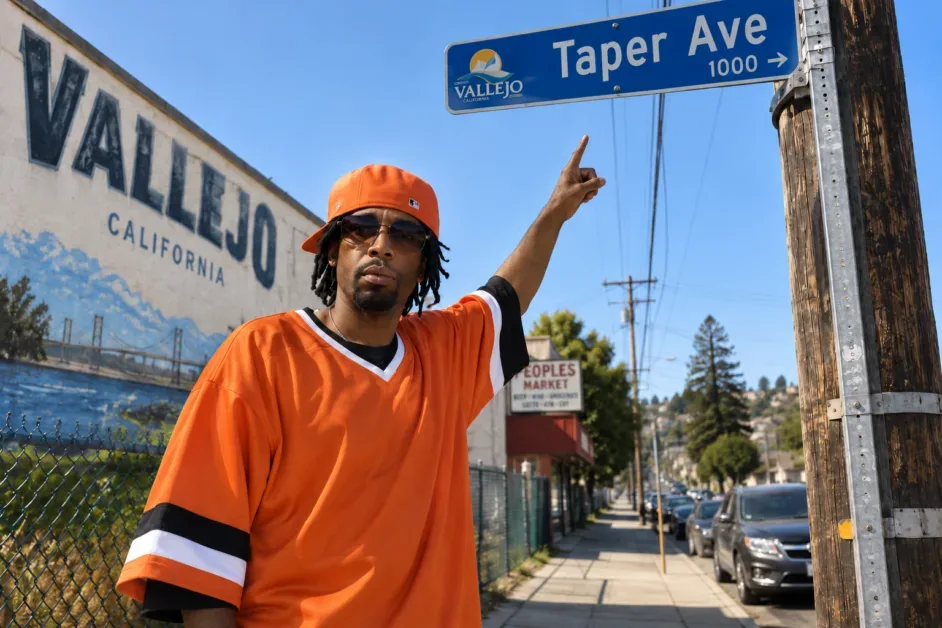
Vallejo has given one of its most influential musical figures a permanent place on the map. The Vallejo City Council voted unanimously to rename Taper Avenue as Mac Dre Way, honoring the late rapper whose work, regional impact and independent spirit remain closely tied to the city.
The decision turns an everyday piece of city infrastructure into a public marker of remembrance for Mac Dre, born Andre Louis Hicks. He was born in Oakland and raised in Vallejo’s Country Club Crest neighborhood, and his name became inseparable from Bay Area rap well beyond the city’s limits. More than a ceremonial change to a street sign, the vote recognizes an artist whose cultural footprint has endured for over two decades after his death.
For Vallejo, Mac Dre Way represents a local tribute with a much wider resonance. His music and persona were deeply rooted in Northern California, while the scene that formed around him helped establish a distinct voice in West Coast hip-hop. The street name now places that legacy into the physical landscape of the community that helped shape him.
A unanimous civic tribute
The council’s unanimous vote is significant not merely because it approves a new address designation, but because it makes the city’s recognition official and lasting. Streets are where civic memory becomes routine: residents see the name on signs, businesses use it in addresses, visitors encounter it while navigating the area, and future generations have a visible prompt to ask who Mac Dre was and why Vallejo chose to honor him.
Mayor Andrea Sorce described the gathering as the best council meeting Vallejo had held in years. Vice Mayor J.R. Matulac summarized the feeling more bluntly: “It’s about damn time.” Together, those reactions capture the sense that a formal city tribute had been a long time coming for an artist still widely associated with Vallejo.
Public commemorations can do something music alone cannot. Songs travel freely and often outlive the moment that produced them, but they can also be detached from their origins as audiences grow. A street named Mac Dre Way anchors the artist’s story to Vallejo. It signals that his career, however broadly celebrated, belongs in part to the history of this particular city and neighborhood.
Mac Dre’s place in Bay Area hip-hop
Mac Dre is widely regarded as a foundational figure in the hyphy movement, the energetic Bay Area rap culture that became a defining force in the early 2000s. His approach paired fast-moving rhymes with bass-heavy production and an unmistakable regional sensibility. The result was not simply a collection of tracks; it was an attitude and vocabulary that became part of the area’s musical identity.
Hyphy was built around motion, personality and communal energy. Mac Dre’s place within it helped make Vallejo and the Bay Area impossible to treat as an afterthought in conversations about West Coast rap. His influence reached performers who followed him and listeners who found in the music a sound that was proudly local without being limited to a local audience.
Related coverage includes Vallejo Unanimously Renames Taper Avenue as Mac Dre Way.
The tribute arrives in a broader moment when hip-hop’s regional histories are increasingly being preserved, revisited and debated. That means looking beyond the biggest commercial centers and acknowledging the independent scenes, labels and artists that forged their own routes. Recent music calendars continue to show how expansive the genre remains, as seen in the range of artists included in a busy September 11 hip-hop release lineup. Mac Dre’s story stands as a reminder that regional innovation is a central part of that larger history.
At the same time, a city street cannot reduce an artist’s legacy to a slogan. Mac Dre’s impact is bound up with his recordings, his business ambitions, the performers and audiences he influenced, and the Bay Area context that gave his work its particular flavor. Mac Dre Way offers a starting point for that fuller conversation rather than a replacement for it.
Thizz Entertainment and an independent model
Mac Dre founded Thizz Entertainment in 1999. The label became a key part of his legacy because it reflected an independent approach to music-making and business. In an industry frequently framed around major-label access, Mac Dre demonstrated that artists could build their own platforms and retain a greater degree of control over their work and direction.
That example matters as much now as it did then. Today’s artists have more distribution options and direct-to-audience tools than the late 1990s offered, but the underlying question is familiar: who owns the work, who shapes the release strategy, and who benefits when a local following grows? Thizz Entertainment represented an answer rooted in self-determination.
It would be simplistic to describe independence as easy or automatically liberating. It involves financial risk, operational demands and the challenge of reaching audiences without the machinery of a major label. Yet Mac Dre’s work showed that artists could reject the idea that major-label approval was the sole path to cultural relevance. The imprint’s importance is therefore both musical and structural.
For a tribute such as Mac Dre Way, that entrepreneurial history is part of the reason the honor carries weight. Vallejo is recognizing not only a rapper, but also an independent builder whose choices helped define a model for artists working outside conventional industry channels.
Remembering a life cut short
The street naming also carries the unavoidable context of Mac Dre’s death. On November 1, 2004, he was shot and killed after performing in Kansas City, Missouri. An unidentified gunman fired at the van in which he was traveling on U.S. Route 71 during the early morning hours. Mac Dre was pronounced dead at the scene after suffering a gunshot wound to the neck.
More than two decades later, his killing remains unsolved. That unresolved status makes the enduring public affection for Mac Dre especially poignant. The city’s decision does not settle the questions surrounding his death, but it does affirm that the circumstances of his loss have not diminished the importance of his life and work to Vallejo.
The investigation and its aftermath involved further violence. Kansas City rapper Jermaine “Cowboy” Aikens was at one point suspected in Mac Dre’s killing, though he was never charged in the case. On May 23, 2005, less than seven months after Mac Dre died, Aikens was murdered in Las Vegas in what authorities believed was retaliation connected to the still-unsolved killing.
In 2008, Bay Area rapper Mac Minister was convicted of two counts of first-degree murder for the killings of Aikens and another victim. He is serving life without parole in Nevada. Those events are part of the difficult history surrounding Mac Dre’s death, but they should not eclipse the reason Vallejo acted: the council vote is focused on honoring the artist’s legacy and his relationship with the community.
What Mac Dre Way means for Vallejo
The new name will make Mac Dre part of Vallejo’s permanent civic vocabulary. That is an important distinction from a temporary event, commemorative program or anniversary performance. A street designation is designed to remain, carrying its meaning through changing city leadership, shifting music trends and new waves of residents.
It also recognizes a truth familiar to fans of regional music: an artist’s hometown connection can be meaningful even when their reach becomes national or international. Mac Dre’s life began in Oakland, and he was raised in Vallejo. His artistic legacy belongs to a broad hip-hop audience, but the unanimous vote ensures that Vallejo’s role in that history is visibly acknowledged.
Mac Dre Way is, ultimately, a civic act of cultural memory. It honors a rapper associated with the development of hyphy, an independent label founder who built on his own terms, and a Vallejo figure whose influence continues to be felt long after his death. Taper Avenue’s new name ensures that legacy has a fixed place in the city that helped make it possible.