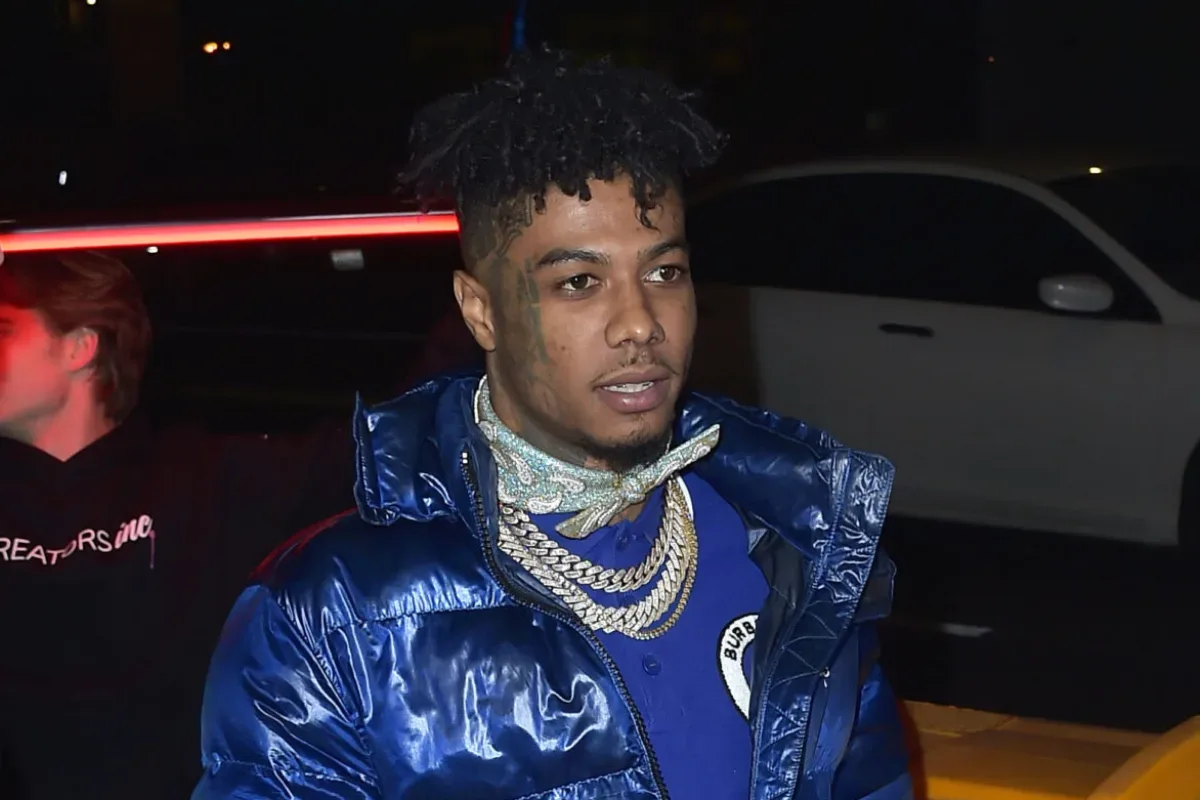
Blueface and Chrisean Rock have publicly indicated that they have broken up, with the pair taking to separate Kick streams to argue their respective versions of what happened. The fast-moving dispute followed a screaming match that had already played out publicly, turning a relationship development into another highly visible chapter in the couple’s online life.
Both creators reportedly framed themselves as the person who initiated the breakup. That is an important detail, not because it settles anything, but because it illustrates how little shared ground there appears to be in their immediate public accounts. Rather than issuing a joint statement or describing a mutually agreed separation, Blueface and Rock addressed viewers independently while placing responsibility on the other person.
The streams also included personal insults and claims that should be treated with care. Rock made a crude allegation involving Blueface, while Blueface insulted Rock and criticized how much she talks. Those are accusations and reactions voiced amid an argument, not independently established facts. The public can see that the pair are disputing the relationship’s end; it cannot reliably determine every private detail from dueling livestream remarks.
A breakup playing out in real time
There is a fundamental difference between a celebrity breakup discussed after the fact and one that unfolds while both people can immediately address an audience. Livestreaming removes much of the delay between conflict, response and reaction. A creator can make a claim, viewers can clip it, the other participant can respond elsewhere, and the dispute can rapidly become its own event.
That appears to be the setting here. Blueface and Rock’s separate broadcasts gave each person a direct channel to fans at the very moment curiosity around the split was highest. The result is a familiar online feedback loop: relationship news draws viewers; viewer attention makes the streams more consequential; the stream itself generates more discussion and more reasons for audiences to tune in.
Neither the breakup nor the engagement should be treated as a simple, settled endpoint based solely on these broadcasts. The pair had recently become engaged following years of public dysfunction in their relationship. Their latest statements present a breakup as real, but their competing accounts also underline the limits of trying to map a private relationship through volatile public content.
For audiences, the most responsible reading is narrower than the loudest clips: they have each said the relationship is over, and they disagree over why and who made that decision. Everything beyond that requires more evidence than an argument delivered on separate streams can provide.
Why Kick is central to this moment
Kick is the platform at the center of the latest dispute, not merely a place where fans happened to find the conversation. The service’s live format turns attention into an immediate part of the story. Unlike a pre-recorded video, a livestream offers a sense of proximity and urgency: viewers are invited to feel they are watching events develop rather than receiving a polished recap.
Related coverage includes Blueface and Chrisean Rock Split, Trade Claims on Separate Kick Streams.
That immediacy can be compelling, but it also leaves little room for reflection. Statements made in anger may remain available through clips long after the mood that produced them has passed. Audiences sharing those clips can spread them faster than the people involved can clarify, retract or contextualize them.
Blueface and Rock have become prominent on Kick, and reports have characterized their streaming income as six figures per week, with Blueface receiving the larger share. That revenue figure is presented as a claim rather than documented financial reporting, so it should not be read as independently verified. Still, the broader point is clear: their relationship content has attracted substantial attention on the platform, and public conflict is now entwined with a significant live audience.
This does not prove that the breakup is planned content, nor does audience interest invalidate the possibility that it is painful and genuine. It does mean viewers should resist an overly tidy interpretation. A livestream can be both emotionally real for the people involved and financially valuable as programming. Those realities are not automatically mutually exclusive.
Claims, clips and the need for restraint
Online relationship coverage frequently rewards certainty, especially when there is a dramatic clip attached. But the material surrounding this split is best understood as competing testimony. Blueface and Rock are describing the same relationship breakdown from different perspectives, and neither stream provides a complete record of what occurred privately.
That distinction matters when personal or degrading allegations enter the conversation. Repeating accusations as fact can amplify harm without adding reliable information. The more defensible takeaway is that both have made public claims against one another and that their remarks indicate a sharp, unresolved conflict.
It is also worth separating evidence from speculation. Some viewers may wonder whether a public reconciliation could follow soon, given the couple’s history and the audience interest around their streams. That possibility is speculative. No supplied information establishes that the split is a stunt, a scripted storyline or a temporary arrangement. Equally, no one outside the relationship can confidently predict whether the breakup will last.
The useful standard is straightforward: report what has been said, clearly label what has not been verified, and avoid turning uncertainty into a more dramatic narrative than the evidence supports.
The audience becomes part of the pressure
When major interpersonal conflict happens in front of a large audience, viewers are not passive observers in the usual sense. Comments, reposts, reaction videos and clip accounts all shape the temperature around the dispute. Fans may feel pressure to pick a side quickly, particularly when each person is explicitly assigning blame.
That can flatten a complicated situation into a contest over who appears more convincing in a short segment. It also creates incentives for the most provocative statements to travel furthest. The ordinary realities of a breakup—confusion, grief, regret, contradictory feelings and imperfect communication—rarely perform as well online as accusation and insult.
For people following along, restraint has practical value. Avoid presenting unverified claims as confirmed, do not treat engagement-driven clips as complete context, and recognize that the strongest reaction on a livestream may not be the final position either person reaches. Public visibility does not convert a personal dispute into a fully knowable story.
The episode also arrives amid a wider stream of hip-hop and pop-culture conversation, including a busy slate of upcoming releases covered in October 23’s hip-hop release roundup. But the attention surrounding Blueface and Rock is being driven less by music news than by the immediacy of their own competing live broadcasts.
What is known and what remains unclear
- Known: Blueface and Chrisean Rock have publicly said they broke up after a public argument.
- Known: They addressed the situation on separate Kick streams and each blamed the other.
- Known: Their broadcasts have drawn significant attention, and their relationship has previously played out publicly.
- Unclear: Which person formally initiated the breakup, if that distinction can be cleanly made at all.
- Unclear: The accuracy of the personal claims and insults exchanged during the streams.
- Unclear: Whether the separation will remain in place or whether either will offer a calmer, more detailed explanation later.
For now, the clearest account is also the most limited one: a recently engaged couple with a highly public history is saying it has split, and both parties are contesting the circumstances in front of live audiences. Until there is clearer information, that is enough to report without treating rumor, outrage or speculation as proof.