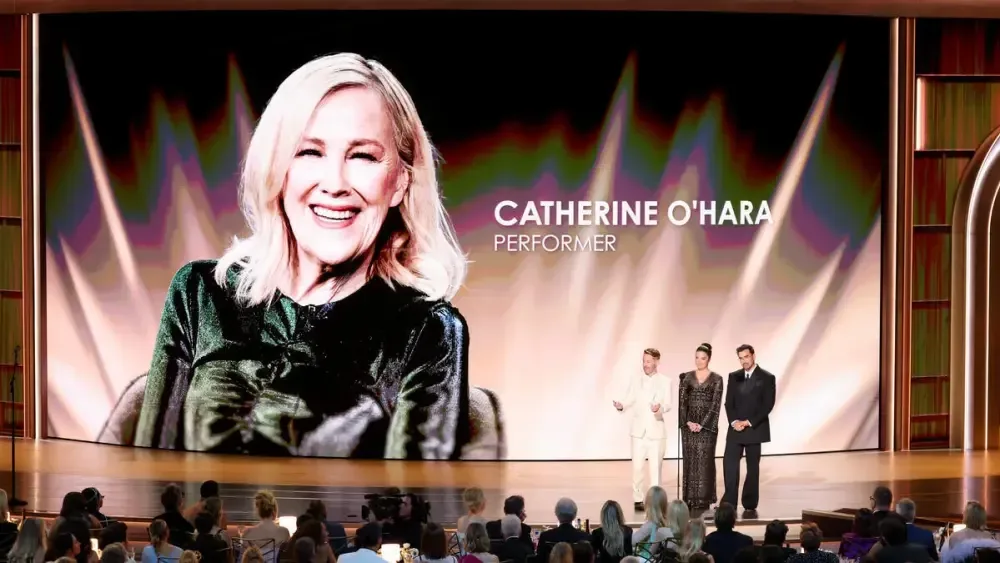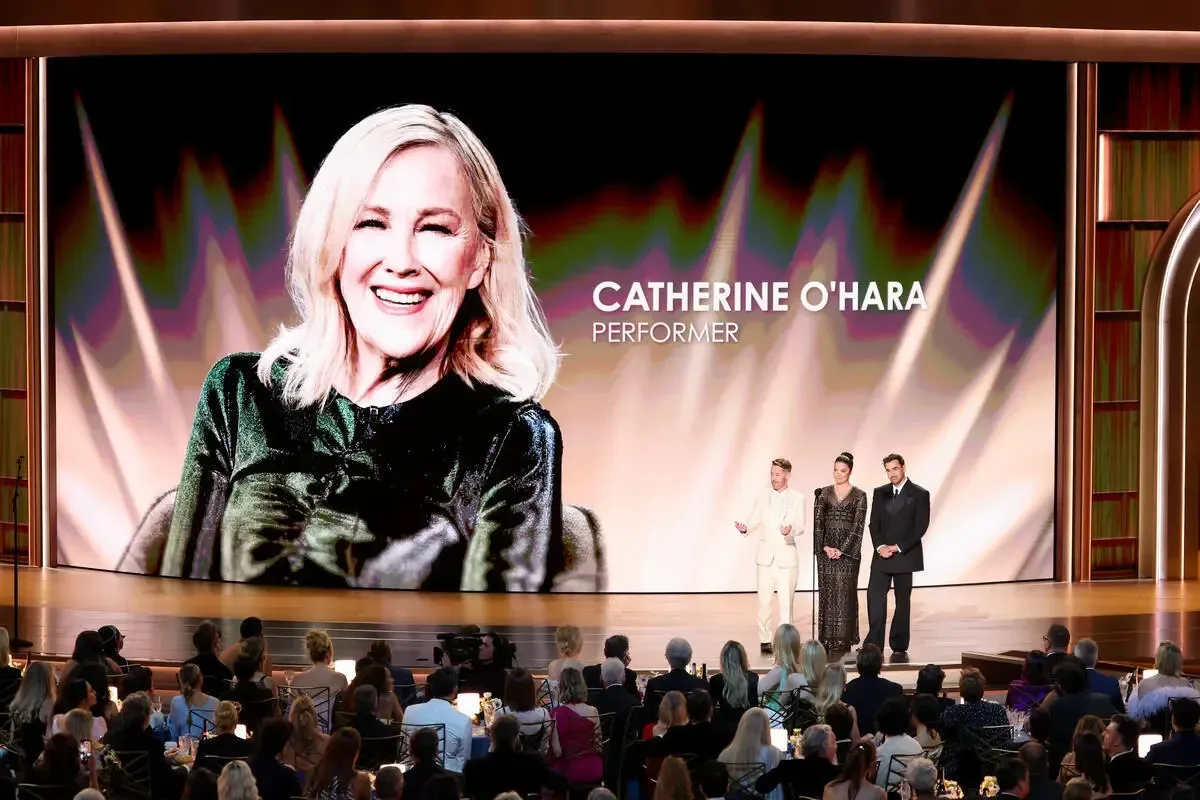
Catherine O’Hara was remembered at the 78th Emmy Awards in a tribute led by three of her most recognizable on-screen children: Macaulay Culkin, Annie Murphy and Dan Levy. O’Hara, who died in January at age 71 following a brief illness, left behind a body of work that moved easily between sketch comedy, broad studio hits, sharply observed mockumentaries and beloved television.
The format of the tribute made its point before a single memory was shared. Culkin knew her as Kevin McCallister’s mother in Home Alone; Murphy and Levy played Alexis and David Rose, the children of O’Hara’s Moira Rose, on Schitt’s Creek. Those roles span decades and wildly different styles of comedy, yet each performer returned to the same idea: O’Hara was someone whose warmth and invention were inseparable from her talent.
For audiences, that may be the clearest way to understand why the moment carried such force. O’Hara could build a character large enough to fill a room, then give that person a small, precise detail that made the comedy feel human rather than merely loud. Whether it was the controlled panic of Kate McCallister, the theatrical grandeur of Moira Rose, or the strange social rhythms of a Christopher Guest ensemble, she made eccentricity feel intentional.
Macaulay Culkin remembers his on-screen mother
Culkin opened the segment by speaking about O’Hara as his Home Alone mother. He described her as encouraging, warm and funny, then framed the relationship in more personal terms. While acknowledging O’Hara’s real family—her husband Bo Welch and sons Matthew and Luke—Culkin said she had become his mom, and “our mama,” too.
“Because that was Catherine,” Culkin said. “That’s what she did. She showed up.”
That sentiment is especially fitting for an actor whose familiar roles are woven into seasonal rewatching and shared family viewing. The first two Home Alone films made O’Hara a permanent part of a particular pop-culture household language: frantic parents, impossible kid logic, holiday stress, and a mother’s determination to get back to her child. Her performance gave the premise emotional footing. The chaos could be cartoonish, but Kate McCallister’s fear and relief were always played sincerely.
Culkin’s tribute also gave the night a gentle invitation to appreciate the maternal figures in people’s lives. His request to call one’s mother was simple, but it matched the broader tone of remembrance: O’Hara’s work was funny because it was generous about people, even when their behavior was ridiculous.
Annie Murphy on a laugh that welcomed people in
Murphy followed Culkin, speaking as the actor who played O’Hara’s daughter on Schitt’s Creek. She characterized O’Hara’s laugh as a continuing affirmation—a sound that encouraged everyone around her to share in her delight.
Related coverage includes Catherine O’Hara Honored by Macaulay Culkin, Annie Murphy and Dan Levy at 78th Emmys.
Murphy also recalled the responses she encountered from strangers after O’Hara’s death. A fellow traveler on an Air Canada flight passed her a note offering sympathy. A gas-station attendant embraced her while grieving O’Hara as well. And while buying wine at an LCBO, Murphy encountered a fan performing a lively hybrid of O’Hara references, including Moira Rose’s famous “Ew, David” and a physical nod to Best in Show.
Those stories matter because they illustrate the unusual durability of O’Hara’s characters. People did not merely recognize the titles. They carried around individual line readings, walks, reactions and vocal choices. In the case of Moira Rose, that kind of devotion makes immediate sense: the wigs, vocabulary, unplaceable accent and operatic self-regard made Moira an endlessly quotable creation. But the tribute’s details also point to a bigger truth. O’Hara’s funniest work invited people to participate in it.
That participatory quality is one reason television and movie memorabilia can mean more than a collectible label suggests. A prop, costume, autographed item or carefully preserved physical release can become a shortcut to a performance people know by heart. The item itself is not the entire memory; it is a tangible connection to the laugh, gesture or scene that stayed with someone. For more on how Emmy tributes can bring questions of television legacy into focus, see our look at the conversation around TV legacy tributes.
Dan Levy’s lesson: make room for greatness
Levy closed the tribute by describing the most important lesson he took from working with O’Hara: say yes. He applied that idea to creative work and to life outside it—say yes to her naming a wig, to giving her room to experiment, and to the invitations, stories, wisdom and generosity that came with knowing her.
Levy urged the audience to “always say yes to any opportunity to revel in the presence of greatness.”
It is a revealing memory because it identifies a crucial part of O’Hara’s comic method. Great character comedy needs a performer willing to take a strange idea seriously, but it also needs collaborators who know not to flatten the strangeness before it has a chance to become something special. A wig with a name is not just a gag if the actor understands what it says about the person wearing it. A bizarre phrase is not a random flourish if it has the rhythm, confidence and emotional logic of the character delivering it.
On Schitt’s Creek, that freedom produced a character who could seem extravagantly detached from ordinary life while remaining tied to a family viewers came to care about deeply. Moira’s scale was part of the fun; O’Hara’s discipline was why it worked. Levy’s remarks placed the emphasis not simply on O’Hara’s individual brilliance, but on the value of protecting an artist’s space to discover something unexpected.
A career built across comedy’s many formats
O’Hara’s career stretched across five decades. Her path began with the Canadian sketch-comedy series Second City Television, which she co-created with Eugene Levy, years before they would play spouses Johnny and Moira Rose on Schitt’s Creek. The series earned O’Hara an Emmy in 1982 and helped establish the comic foundation for a career defined by range.
Her later film roles included After Hours, Beetlejuice and the first two Home Alone movies. Each title highlights a different register: nighttime unease, supernatural spectacle and family comedy, respectively. That variety is worth noting because O’Hara never seemed constrained by one kind of funny. She could fit into a highly stylized world, ground a mainstream hit, or make the smallest interpersonal discomfort feel enormous.
She was also a defining presence in Christopher Guest’s mockumentaries, appearing in Waiting for Guffman, Best in Show, A Mighty Wind and For Your Consideration. These films depend on performers who can create the illusion of lived-in, often awkward personalities. The humor works best when the characters do not realize how funny they are. O’Hara excelled in that space, giving audiences performances filled with specificity rather than winking at the joke.
Her Emmy tribute naturally focused on the people who played her children, but its larger portrait was of a performer and colleague whose influence traveled outward. Culkin’s memories spoke to dependable affection. Murphy’s stories showed an audience still finding connection in O’Hara’s work. Levy’s advice highlighted a creative partner who made experimentation worthwhile.
Why O’Hara’s work remains so easy to revisit
Many actors become associated with one signature role. O’Hara’s legacy is more like a collection of distinct comic worlds, each with its own fans and recurring details. Someone may first know her from the holiday mayhem of Home Alone, then find her through the oddball communities of Guest’s films, then meet Moira Rose through Schitt’s Creek. The journey can happen in any order, and each stop reveals a different facet of the same performer.
That makes the 78th Emmys tribute feel less like a narrowing of her career to a single era and more like a meeting point for several generations of viewers. Culkin, Murphy and Levy represented three famous fictional family relationships, but their remarks shared an unmistakable theme: O’Hara made people feel seen, welcomed and encouraged to enjoy the absurdity of life.
For a performer whose work generated so many repeatable lines, unforgettable looks and extraordinarily committed character choices, the night’s most resonant memory may be the simplest one. Catherine O’Hara showed up—and audiences will keep showing up for her work in return.