Trust Me, I’m a Doctor has a premise built for uncomfortable ambiguity: a physician becomes closely entwined with one of the most scrutinized celebrities of her era, then finds himself under a brutal public and legal microscope after her death. It is a story about medical judgment, fame, addiction, private records, opportunistic media and the peril of becoming a supporting player in a headline larger than anyone involved.
But writer-director Thane Economou’s narrative feature repeatedly seems more interested in reproducing the chaos of that headline than in bringing the central dilemma into focus. Kal Penn gives the film a measure of pathos as Sandeep Kapoor, the doctor who treated Anna Nicole Smith, played by Abbie Cornish. Yet the performance has to battle a tone that swings from sympathetic drama to broad spectacle, plus a structure that packs its already sensational material with time jumps, direct address, staged-and-real-footage montages and explanatory detours.
The result is an uneasy film. It has a genuinely thorny subject and sporadic late scenes that give Penn room to show what Kapoor has lost. Its strongest dramatic material, however, arrives after the movie has spent too long teaching viewers to regard its world as a circus.
A doctor trapped inside a bigger celebrity story
Penn’s Kapoor is introduced as a closeted doctor taking over a retiring physician’s practice. Along with the office comes a high-profile patient treated under a pseudonym: Smith. Kapoor initially tries to hold onto professional distance, but Smith’s charm pulls him further into her orbit. The film makes that boundary erosion its central concern, even if it does not always investigate it with enough clarity.
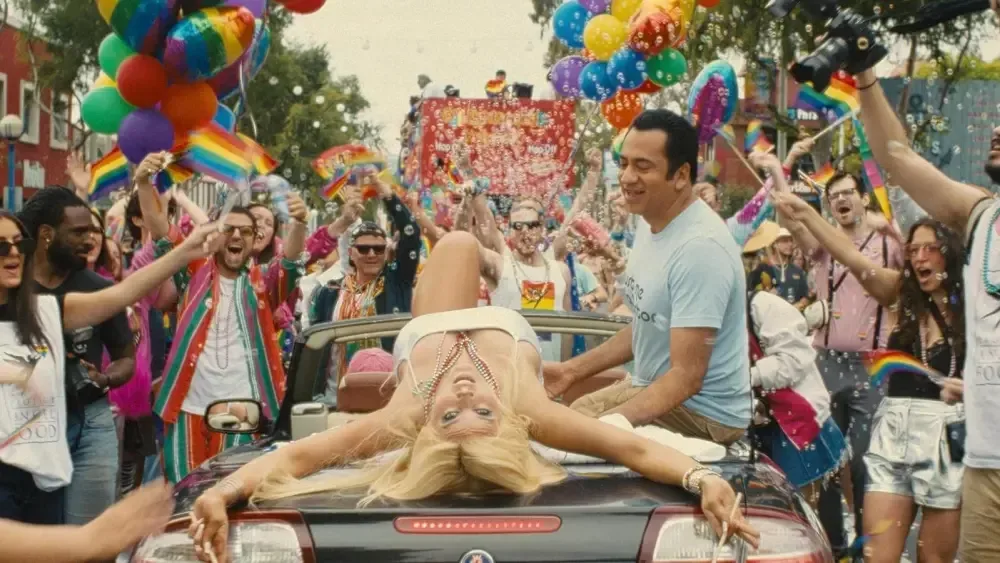
Kapoor accompanies Smith during a Los Angeles Pride parade and participates in what he calls an orgy. When Smith says she is pregnant, he does not know who the father is. He nevertheless makes a medical decision to prescribe methadone, believing that denying treatment for her severe drug addiction could endanger the pregnancy. A large supply goes with her on a trip to the Bahamas.
Those facts give the drama stakes beyond ordinary celebrity proximity. Methadone is a medication used in the treatment of opioid dependence; in this story, it becomes part of the question hanging over Kapoor’s care, his decision-making and his public reputation. The movie wants viewers to contemplate the difference between a doctor trying to manage a medically difficult situation and a famous patient’s perceived enabler. It also wants them to see the distortions that can come from a public desperate for an easy villain.
That is fertile ground. The film’s problem is that it often clouds rather than sharpens the central question. Kapoor’s relationship with Smith is portrayed as professionally compromised and personally confusing, but the storytelling does not settle on a sufficiently precise perspective from which to assess it. The audience is instead asked to juggle changing tones and layers of commentary.
The tragedy gives way to a legal-media drama
Smith gives birth to her daughter Dannielynn, and then loses her son Daniel, played by Jordan Kronis, to an overdose three days later. Months after that, Kapoor learns from news reports that Smith has overdosed. He rushes to secure her and Daniel’s medical files, concerned they might be stolen or leaked, only to find the press already waiting outside his practice.
Related coverage includes ‘Trust Me, I’m a Doctor’ Struggles to Escape the Tabloid Circus.
That turn changes the movie’s center of gravity. Smith dies roughly 25 minutes into the 111-minute film, leaving the much longer remainder to follow Kapoor’s struggle through legal jeopardy and public humiliation. At the urging of patient Margie, played by Jocelyne Zucco, Kapoor retains attorney Ellen Garofalo. Linda Hamilton plays Garofalo with a forcefulness the movie badly needs: her character has a strategy, a clear voice and the rare ability to make legal exposition feel like forward movement.
Kapoor’s position deteriorates when investigators find Smith’s medical records in his underwear drawer. The attorney general then brings criminal-conspiracy charges involving Kapoor, Smith’s lawyer Howard K. Stern, played by David Julian Hirsh, and psychiatrist Khristine Eroshevich, played by Virginia Cowan. With the case underway, Kapoor turns to a surprisingly useful ally: Harvey Levin, played by Elon Gold, the celebrity-news figure whose photos had helped intensify the scrutiny around him.
That development should be one of the film’s most compelling ideas. Going directly to a media figure who had helped fuel the story can be understood as a legal tactic, a public-relations gamble or Kapoor’s desperate decision to step into the machinery that had already consumed him. The film recognizes the potential drama in the encounter, then lessens it by surrounding it with so much explanatory material that its human tension dissipates.
A busy style without a stable register
Economou deploys a mixed-media approach, cutting together recreated scenes and real material. The actual footage shown over the closing credits, especially around Kapoor’s interview with Levin, apparently has a grounding effect the rest of the film lacks. It presents Kapoor as more composed and more naturally sympathetic than the heightened narrative scenes have often allowed him to be.
That contrast points toward a frustrating alternative version of Trust Me, I’m a Doctor. The film has archival material, an inherently contentious history and a protagonist whose account could be tested against a public record. A documentary form could have made the uncertainty a virtue. It could have separated first-hand memory, media narrative, legal maneuvering and available footage rather than making actors carry every shift between them.
A documentary is not automatically more truthful, of course. It still relies on selection, editing and a point of view. But this particular story appears especially suited to a format that could make its evidence and competing interpretations visible. In a narrative feature, broad performance choices and winking flourishes can turn a disputed, painful episode into something that feels more like a sketch than an inquiry.
The film’s fourth-wall breaks are a good example. Direct address can be an effective device when it establishes a character’s interior life or challenges the audience’s assumptions. Here, it adds another layer to a movie already straining to organize its perspective. Likewise, the movement through real and recreated imagery sometimes makes the film feel energized, but not necessarily more illuminating.
Penn finds the drama late; Hamilton supplies the discipline
Penn faces the hardest task. Kapoor is required to be naïve enough to be swept into Smith’s world, distressed enough to register the real damage of that closeness and credible enough to hold the viewer through a protracted case. The script gives him competing modes: he can seem disarmingly oblivious in one moment, then crushed by the stakes in another.
For long stretches, that inconsistency leaves Penn working uphill. But his later scenes land with considerably more weight. When the movie stops racing through gossip-shaped incident and lets Kapoor confront the cost to his family, practice and future, Penn brings a sorrowful, more grounded quality to the role. Those moments do not fully repair the tonal instability, but they demonstrate the stronger drama that was available within the premise.
Hamilton is the most reliably effective presence. Garofalo’s tough, practical manner gives the legal storyline a needed sense of purpose. Even when the plot veers toward exposition about strategy, motives and political implications, Hamilton helps make the situation feel immediate.
Cornish has an exceptionally difficult assignment in playing Smith, a person whose public image was itself filtered through years of relentless caricature. Unfortunately, the portrayal frequently pushes toward imitation and parody. That creates a damaging effect: a film that says it wants compassion for both Smith and Kapoor repeatedly places Smith inside a heightened performance style that makes her less like a person than the symbol everyone else is reacting to.
The supporting cast broadly follows that heightened register. Since the film is trying to examine how celebrity worship can scramble judgment, this stylization may be intended as commentary. But intention and effect are not the same thing. The treatment of several characters contributes to the very tabloid atmosphere the story is ostensibly trying to critique.
What the film says about celebrity, and what it cannot escape
The closing material traces what happened to the principal figures after the verdict in Kapoor’s case. The larger idea is hard to miss: celebrity can make every nearby person, object and decision seem more consequential simply because it is connected to a famous name. In that sense, the film is skeptical of the culture that transformed Kapoor into a national sideshow.
Yet Trust Me, I’m a Doctor cannot fully separate itself from the same attraction. Smith’s life is used as the film’s gravitational force, while Kapoor is the nominal lead. Once Smith’s death occurs, the narrative must convince viewers that the doctor’s ordeal can bear the full dramatic weight. Penn nearly gets it there in the final stretch; the screenplay and its restless presentation do not.
That tension is not unique to this film. Celebrity biopics and adjacent dramas often face a difficult ethical and artistic question: are they investigating the forces around a famous person, or merely finding a new route back to the famous person’s notoriety? A related question hangs over celebrity-documentary storytelling as well, including in the strange overlap of fiction and nonfiction explored in this look at Amanda Seyfried’s role in a documentary context.
Trust Me, I’m a Doctor is at its best when it acknowledges that Kapoor may have been neither the whole story nor an incidental footnote: he was a doctor whose choices, however he understood them, placed him inside an overwhelming tragedy and media frenzy. The movie never consistently gives that complicated position the sober treatment it deserves.
Verdict: Penn and Hamilton supply intermittent substance to a story with real moral and legal complexity, but the film’s frantic structure and cartoonish tabloid tone keep undercutting its bid for empathy. The real footage glimpsed near the end suggests a more compelling, more disciplined version was possible.
Trust Me, I’m a Doctor is rated R and runs 111 minutes. It is directed and written by Thane Economou, with cinematography by Bobby Shore, editing by Brian Berdan and music by Daniel Stockdale and Niles Hollowell-Dhar.