Halloween brought back one of Saturday Night Live’s most deliberately baffling recurring visitors: Tom Hanks’ David S. Pumpkins. The orange-suited lounge oddity, first introduced in 2016, returned during the show’s Halloween cold open—but the sketch did not stay a straightforward reunion lap for long. It used an amusement-park haunted ride as a framing device, then repeatedly derailed that ride with political parody, campaign anxiety and a final failed attempt at the program’s familiar opening declaration.
The central joke of David S. Pumpkins has always been that he is not a conventional fright. He is not a monster with lore, a murderer in a mask or even a particularly plausible attraction. He is an aggressively unexplained personality who appears with dancers and behaves as if the lack of explanation is itself sufficient entertainment. That quality made the character an unusually useful Halloween return: a mascot of seasonal nonsense positioned inside a sketch whose actual target was political spectacle.
A haunted ride with too many interruptions
The cold open begins with Grace Reiter and Jeremy Culhane as a young couple taking a ride through a downmarket Halloween amusement-park attraction. Kenan Thompson appears as the Grim Reaper, functioning as the ride’s guide through a series of scary images. That setup provides an easy visual grammar: passengers sit still, figures emerge to startle them, and the guide keeps the car moving forward.
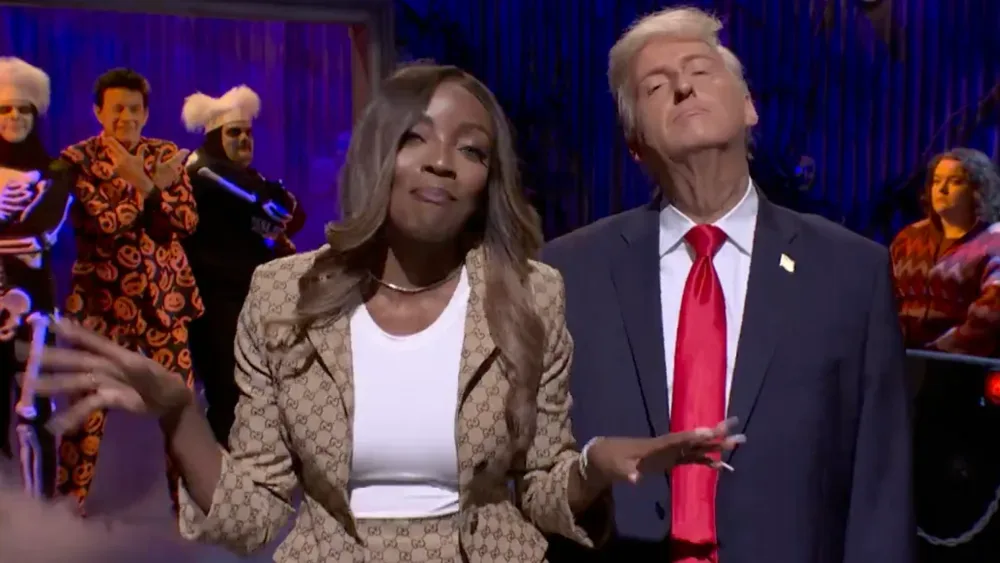
Then Hanks arrives as Pumpkins with Mikey Day, joined by former cast member Bobby Moynihan for the cameo. Day and Moynihan wear skeleton bodysuits and white face paint, recalling the character’s familiar arrangement of a brightly dressed oddball flanked by dancing skeletons. Pumpkins performs his knowingly goofy dance rather than explaining why he belongs in the attraction. In other words, the sketch initially honors the character’s old rule: David S. Pumpkins is present because David S. Pumpkins has decided he is present.
That deliberately thin premise is a feature, not a hole that needs repairing. A cold open is the comedy segment performed before the show’s title sequence. It often aims for immediate recognition, especially when it is built around current events. By putting a recognizable Halloween character in a ride that can admit virtually any figure, the sketch creates a flexible pathway from nostalgia to topical satire without needing Pumpkins to become a political character himself.
James Austin Johnson’s Trump takes over the attraction
James Austin Johnson then enters as President Trump and interrupts the haunted-ride progression. His version of Trump frets about Republicans’ prospects in the Nov. 3 midterm election and turns the scene toward jokes about the President’s comments on candidates’ appearances, especially their physiques and backsides.
The performance’s comic mechanism is escalation. Johnson’s Trump begins by comparing himself and Pumpkins as 2016 arrivals who are loud, orange and annoying. He then pivots from the comparison into remarks about Hanks’ body. The scene continues with the character complaining about poor polling while displaying a conspicuous bruise on his hand, then shifting to the Texas Senate contest between Republican Ken Paxton and Democrat James Talarico. Rather than treating the campaign as a policy disagreement, the parody filters it through vanity, insult and attraction.
That is the important distinction in the sketch’s approach. It is not presenting a realistic campaign message or trying to resolve an election argument. It exaggerates a public-facing political style into an absurd haunted-house interruption: every major subject becomes another prompt for Trump to talk about himself, appearances or his preferred candidate. The effect is to make the ride feel stuck. The passengers and performers are meant to be moving through a controlled Halloween routine, but political chatter keeps barging in and refusing to leave.
Related coverage includes Tom Hanks Brings David S. Pumpkins Back for an ‘SNL’ Halloween Cold Open.
Thompson gets a small but sharply positioned release valve during this stretch. While the other performers remain frozen in the ride tableau, his Grim Reaper breaks character, hurries past Johnson’s Trump and answers a remark about a donation with an insult. The beat matters because it acknowledges the sketch’s own structure. Even the supernatural employee assigned to keep the attraction on track has had enough of the interruption.
Why David S. Pumpkins works as the silent counterweight
Hanks’ role here is less about delivering the sketch’s topical material than about supplying a visual and tonal alternative to it. Pumpkins is loud, theatrical and dressed in pumpkin-themed orange, yet he does not need a campaign point. His absurdity is purposeless. Johnson’s Trump is also played as loud and attention-seeking, but his absurdity is tied to a constant hunger for attention and appraisal.
The sketch explicitly makes that comparison, but its construction reinforces it. Pumpkins appears, dances, and remains an object of confused delight. Trump appears and converts the space into an extended monologue. One character’s intrusion is the expected Halloween gag; the other is a disruption that overruns the format. The comedy depends on viewers recognizing that those are two very different kinds of obnoxiousness.
That also explains why a Pumpkins return does not require a new mythology or a bigger twist. The character works best when the show resists over-explaining him. A detailed backstory would turn the joke into lore-management. Placing him next to a political impersonation instead lets the established mystery do practical work: he is a ready-made symbol of television’s most festive, baffling nonsense.
Nicki Minaj parody arrives near the end
Saidah Belo-Osagie enters late in the sketch as Nicki Minaj. The segment frames her as a supporter of Trump and the MAGA movement, then imagines her as his prospective next press secretary. The premise follows the sketch’s broader pattern of treating the administration as a revolving, unstable performance space: a new spokesperson is proposed immediately after Katie Zacharia’s exceptionally brief tenure in the job.
Belo-Osagie’s Minaj undercuts the supposed political partnership by joking that Trump is damaging her career. Johnson’s Trump, meanwhile, once again redirects the exchange toward an appraisal of somebody’s body, only to explain that his interest would be different if the body belonged to a man. The repetition is intentional. It does not open a separate subject so much as underline the cold open’s main satirical target: a public persona imagined as incapable of passing up a chance to turn politics into a rambling comment on physical appearance.
Political celebrity cameos and impersonations can make a cold open feel crowded, particularly when a familiar fictional character is already in the mix. Here, the amusement-ride concept does enough organizational work to keep the collection of figures legible. The couple are passengers, Thompson is the guide, Pumpkins is an expectedly inexplicable scare, and Trump and Minaj are interruptions. The joke is not that all these people naturally belong together. The joke is that the ride is powerless to stop them from arriving.
The final line is another part of the joke
The closing beat gives Zacharia the task of delivering the signature line that launches the broadcast: “Live from New York, it’s Saturday night.” She flubs it. In a conventional cold open, that statement cleanly hands the program over to the opening titles. Here, the botched delivery extends the sketch’s theme of institutional malfunction by a few more seconds. The haunted attraction has been overwhelmed, the press-secretary succession is treated as chaotic, and even the basic television cue does not land correctly.
It is a compact ending, but it suits the piece. The scene has moved from a small Halloween attraction to electoral panic, candidate commentary, celebrity politics and a breakdown at the threshold of the show itself. There is no need for a final explanation of David S. Pumpkins. His presence has already done what it needed to do: make the increasingly crowded scenario feel like an October fever dream rather than a standard political sketch.
What the Halloween format adds
Seasonal episodes give recurring comedy characters a natural excuse to reappear, but this return is more than a costume-party callback. The haunted-house frame gives the cold open a clear visual premise and a way to distinguish each comic role. It also lets the performers use physical stillness, sudden entrances and dance as much as dialogue. Day and Moynihan’s skeleton costumes, Thompson’s Grim Reaper, and Hanks’ orange suit establish the Halloween rhythm before the political parody arrives to break it.
For viewers following the show’s ongoing mix of political caricature and entertainment-world satire, the segment also fits alongside the kind of concise topical construction seen in other recent discussion of the program’s topical comedy. The difference is scale and delivery. This cold open uses a full sketch premise, recognizable guest energy and visual callbacks; its satire comes through disruption and repetition rather than a single desk-style punchline.
The Halloween episode is hosted by Obsession actor Inde Navarrette, with Gracie Abrams as musical guest. But before the show reaches its host and music portions, the cold open makes room for a returning Hanks, a former cast member, current players and multiple political impressions—all crowded into one shabby amusement-park ride. David S. Pumpkins may still offer no explanation for who he is. This time, though, the sketch has a clear answer for why he is there: even a haunted ride needs something less frightening than the news.