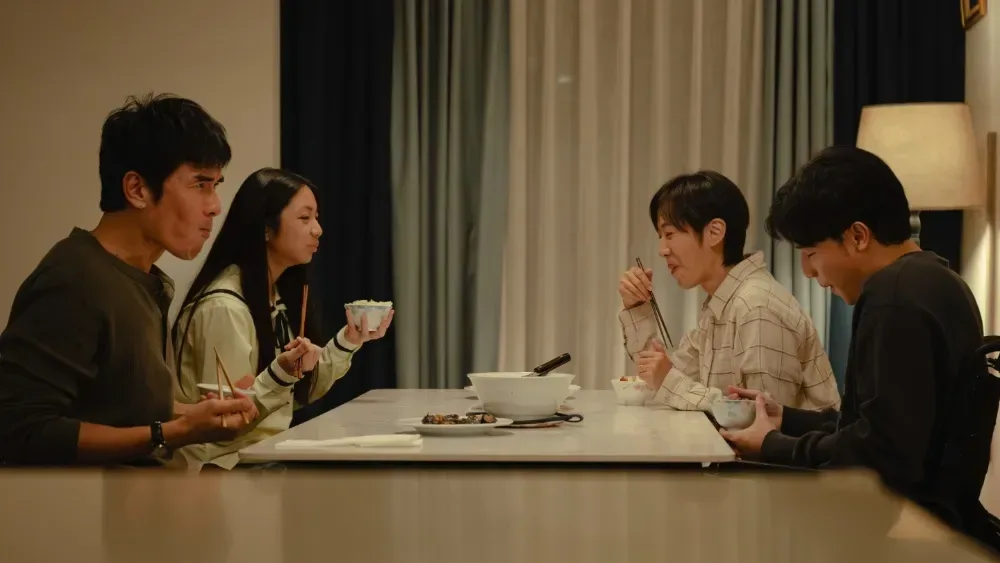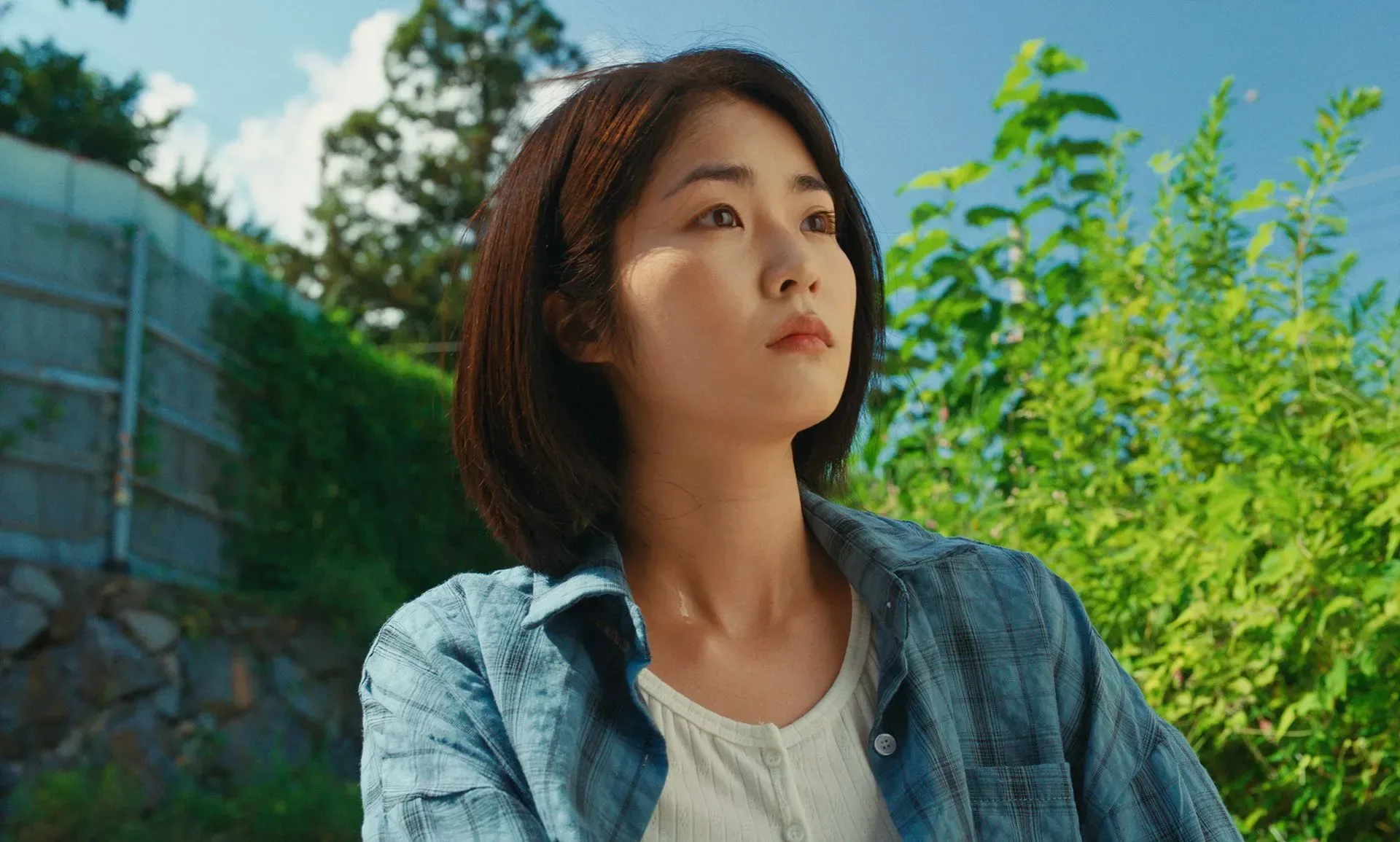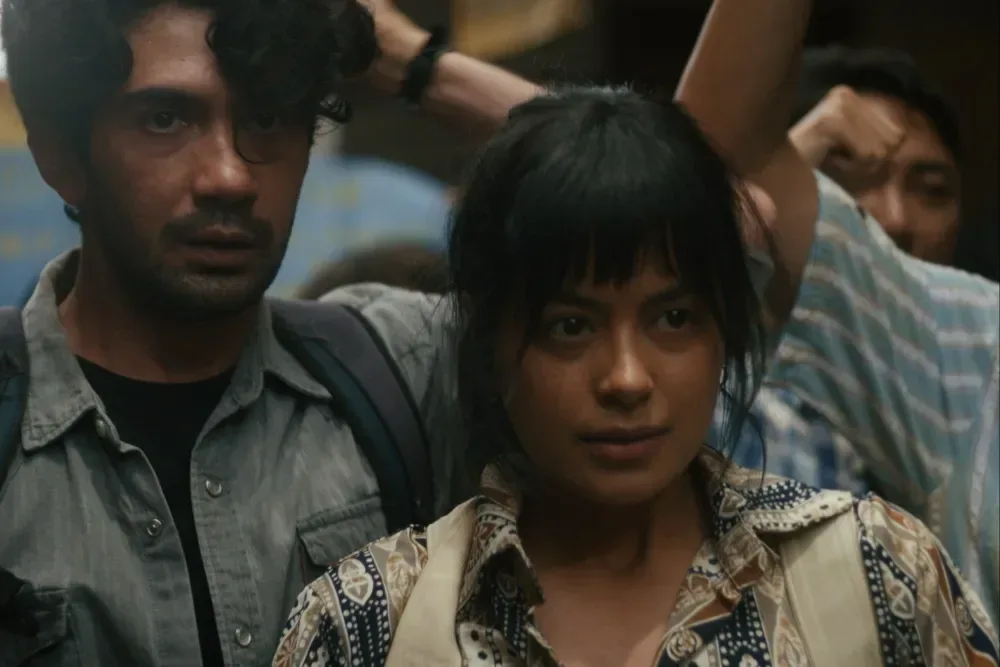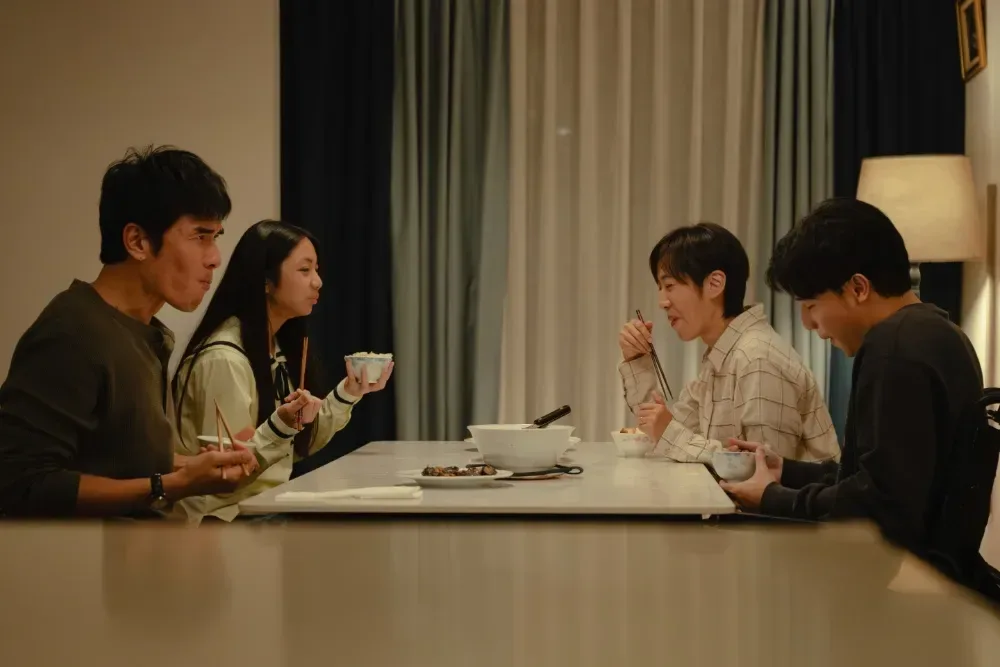
To Be Ordinary begins with movement and ends up studying what happens when movement is taken away—not only from one young man, but from everyone whose future had been quietly arranged around him. Lee Yun Chan’s Taiwanese family drama opens with 22-year-old Yu-jie riding his moped through rain-slicked suburban Taipei at night. The camera glides with him and Cicada’s score lends the trip an outsized calm. Then, at an intersection, a car strikes him.
Yu-jie survives, but learns in hospital that he will not walk again. A premise like that can invite a narrow, inspirationally packaged story of individual endurance. Lee and co-writer Ginger Wang instead use it as the first rupture in an 11-year family chronicle. The accident is permanently consequential, but To Be Ordinary is less interested in declaring Yu-jie a tragic symbol than in watching a group of people live through the administrative, emotional, financial and relational aftershocks of catastrophe.
That broader perspective is the film’s considerable strength. It makes room for grief, resentment, care, shame and guilt without turning any one character into a simple moral function. The result is a sober melodrama with real compassion for a household that can no longer pretend its old tensions were not already there.
A life-altering event, not the whole story
Junior Hsieh plays Yu-jie, a college student who has already started a web-design business. His response to the hospital news is notably steady. He adapts to using a wheelchair, continues searching for a productive and self-directed life, and begins a relationship with Yi-Han, a young physiotherapist played by Phoebe Chu.
That characterization matters. Yu-jie is not framed solely through despair, nor is he made into an uncomplicated emblem of perseverance. He has goals and a practical sense of what he wants from life. The film’s title points toward that desire: the wish to be ordinary, to work, love, make choices and move through the world without having every interaction reduced to the accident.
The story’s most revealing decision, however, is to recognize that a person’s resilience does not magically resolve the strain placed on the people around him. Yu-jie’s mother, played by Chang Shih Ying, and father, played by Weber Yang, had reached a difficult stage in their marriage before the collision. His father’s long-term unemployment compounds the pressure. The family crisis does not create every fracture; it exposes and deepens the ones that were already present.
Lee’s script treats this as a family system rather than a set of isolated character arcs. A system, in this context, means that one person’s changed needs alter the responsibilities and emotional options available to everyone else. A medical emergency becomes a housing issue, a marriage issue, a work issue and a parenting issue. The drama’s scale comes from tracing those linked consequences across years rather than racing toward a tidy moment of recovery.
The sister refuses to stay in the background
Pin Hsuan Chen’s Yu-ching is central to the film’s emotional texture. Still in early adolescence when Yu-jie is injured, she becomes both overlooked and relied upon: expected to manage herself because her parents have more urgent concerns, yet drawn into supporting adults who are struggling to cope.
Related coverage includes To Be Ordinary Review: A Family Drama Shaped by Long-Term Loss.
That contradiction gives Yu-ching’s anger a painful logic. She is not merely the rebellious younger sibling placed onscreen to generate conflict. She is a young person reacting to diminished attention, unstable parental support and the unnerving sense that her home has become organized around a crisis she did not cause. Chen’s performance is especially volatile and affecting because it captures the way unmet needs can emerge as behavior adults are tempted to dismiss.
To Be Ordinary is, in this respect, a coming-of-age story as much as a drama about disability or a family’s economic survival. Yu-ching grows up in the shadow of an event that has rearranged the emotional hierarchy of her household. The film understands that this does not make her brother an antagonist. It simply gives her a different kind of loss to carry.
For viewers interested in how screenwriting can draw on character perspective rather than plot mechanics alone, our coverage of how Inde Navarrette studied anime while developing her screenwriting skills offers another, very different example of creators discussing story craft.
Mr. Ma’s guilt makes the moral picture harder
Hsiu Shen Liang plays Mr. Ma, the wealthy elderly driver whose car hits Yu-jie. The film does not minimize his responsibility, but it resists treating him as a disposable villain. He is overcome by guilt and provides more than the legal settlement: he transfers ownership of his house to Yu-jie and continues contributing to medical and living costs.
Those actions create material security where there might otherwise be none, but the film recognizes that financial help cannot erase harm. Nor does generosity automatically simplify the emotional relationship between the person who caused the injury and the people enduring its consequences. Mr. Ma’s assistance is a lifeline, yet it also remains inseparable from the event that makes it necessary.
This is where the film’s even-handedness has its greatest dramatic value. Mr. Ma’s conscience is not a shortcut to absolution. As he moves into old age and poorer health, his own frailty complicates the situation further. The story grants him humanity without confusing empathy with exoneration.
That distinction is essential. Melodrama is often used loosely as a term for excessive emotion, but at its best it is a mode that takes domestic stakes seriously: homes, marriages, debts, obligations and private disappointments can carry enormous force. Lee works in that tradition while declining the blunt division between innocent sufferers and obvious monsters. The collision connects lives that cannot simply be disentangled.
Formal restraint carries the film through its long timeline
Lee’s fourth feature is her first since 2010’s Dancing Without You. In the intervening years, she worked largely in television, including directing the 2022 Disney+ series Women in Taipei. That small-screen experience can be felt in the film’s expansive storytelling and occasionally emphatic melodramatic beats, but the presentation has a controlled cinematic seriousness.
Cinematographer Ming Lee establishes an important visual contrast in the opening. The free-flowing nighttime tracking shot follows Yu-jie on the moped before the collision sharply alters his world. The movement is not merely decorative; it sets a visual baseline the narrative can no longer return to. Afterward, the drama concerns itself with constraint—not just physical constraint, but the limitations imposed by money, care work, frayed patience and obligations that nobody fully chose.
The consistently overcast imagery and emotionally solemn writing suit much of the material. At times, though, the accumulated heaviness leaves room for more tonal variation. Hard times do not eliminate absurdity, laughter or small domestic pleasures; those moments can sometimes make sorrow feel sharper, not less serious. The film’s restraint prevents it from becoming glib, but a few more disruptions to its grave mood could have made the family’s daily life feel still more textured.
There are also some convenient narrative moves along the way. Yet the closely connected ensemble gives the central family enough credibility to withstand them. The performances feel less like isolated showcases than like parts of a shared, uneasy rhythm—one person withdrawing, another overcompensating, a third acting out, all while trying to keep ordinary routines intact.
Why its compassion lands
The clearest achievement of To Be Ordinary is its refusal to turn suffering into a contest. Yu-jie’s changed life is not downgraded because other people are also struggling. His parents’ marital problems are not presented as selfish distractions from his needs. Yu-ching’s loneliness is not treated as a betrayal of her brother. Mr. Ma’s guilt is not mistaken for sufficient repair. Each person receives attention without the film declaring one pain more legitimate than another.
That fair-minded approach has practical dramatic consequences. Instead of asking who deserves blame in a situation where blame is already legally and morally apparent, the film asks what people do after blame has failed to make life manageable. How does a young man preserve autonomy? How do parents care for a child while their own relationship buckles? What happens to the sibling who learns to need less because the family cannot give more? How does a person responsible for irreversible harm live with the knowledge that material assistance cannot restore what was lost?
None of those questions requires a sensational answer. Lee’s film finds its emotional force precisely in allowing them to remain difficult over time. At 112 minutes, it gives its characters the room to reckon with sorrow rather than rushing them into healing that would feel narratively convenient.
Festival path and key credits
To Be Ordinary premiered in the main competition at Busan as the only Taiwanese production in that lineup. It is also set to play at the Tokyo Film Festival, with a theatrical opening in Taiwan planned for mid-November. Its patient, accessible family-drama approach could suit further festival programming, while specialist streaming services may be a natural fit beyond Taiwan.
- Director: Lee Yun Chan
- Screenplay: Lee Yun Chan and Ginger Wang
- Cinematography: Ming Lee
- Editor: Su Ling Tu
- Music: Cicada
- Cast: Weber Yang, Chang Shih Ying, Hsiu Shen Liang, Junior Hsieh, Pin Hsuan Chen and Phoebe Chu
- Running time: 112 minutes
- Language: Mandarin
Its title may sound modest, but the film makes a quietly ambitious argument for ordinary life as something worth protecting. Not perfection, not miraculous redemption—just the chance to make a home, preserve dignity and continue being seen as more than the worst thing that ever happened to you.