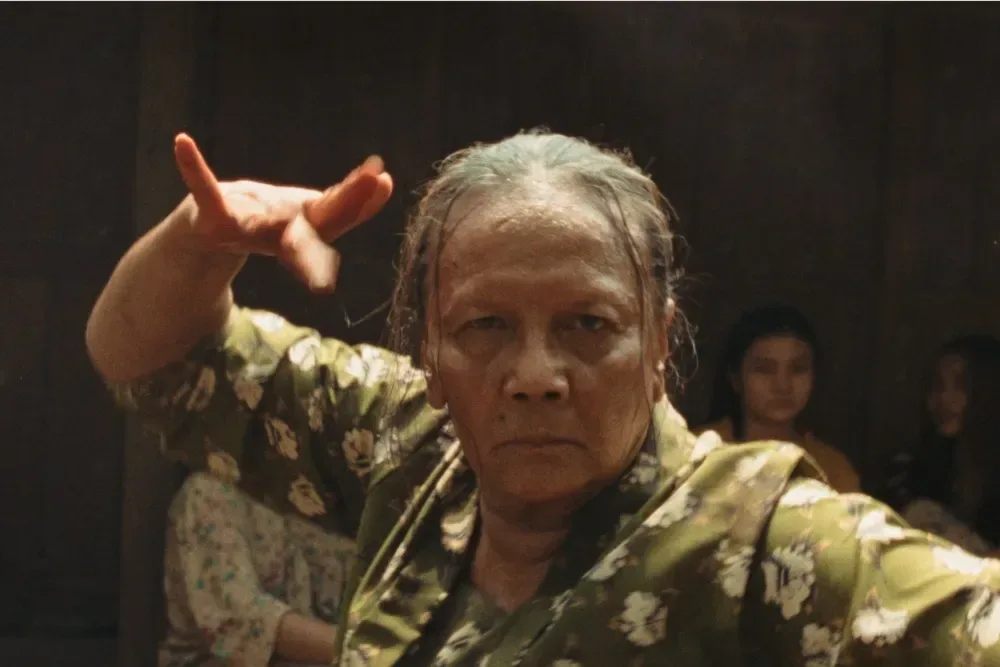
Yosep Anggi Noen’s The Sea Speaks His Name begins at the point where many political dramas would deliver their most frightening turn. In 1998 Jakarta, Laut is making dinner during a blackout when government operatives enter his apartment, restrain him and take him away. His neighbours watch anxiously. He has no opportunity to explain himself. The men call him Amir Zein, an alias that immediately signals how thoroughly the state’s pressure has altered his life.
That opening gives the film the taut shape of a thriller, but its real concern is the human cost of disappearance: the cost to the person taken, certainly, but also to the people forced to live with uncertainty afterward. Adapted by Noen from Leila S. Chudori’s novel of the same English title, the Indonesian drama looks back to student resistance under Suharto’s New Order regime and traces the path that brings Laut from university discussion circles to clandestine activism and eventual capture.
The film screened in competition at the Busan Film Festival and runs 134 minutes. Its Indonesian-language story is historically rooted in the 1990s, yet its central questions have immediate force: what can protest demand of an individual, what happens when a government treats dissent as a threat, and how do families sustain a search when institutions have made answers almost impossible to find?
A personal route into a wider repression
Reza Rahadian plays Laut, who is introduced not as an experienced underground operative but as a university student in Yogyakarta in 1991. He encounters Kinan, played by Dian Sastrowardoyo, a compelling campus figure who leads conversations around books banned by the state. The significance of those meetings is clear. Reading and discussing literature becomes more than an academic activity in an environment where the authorities regard certain ideas as dangerous.
Laut is not wholly insulated from that reality. His father, played by Arswendy Bening Swara, works as a journalist and knows how the government operates. Still, the story follows Laut’s developing recognition that private alarm and conversation alone cannot answer entrenched violence. Alongside Kinan and other students, he commits to a more active resistance movement.
This is an important distinction in the film’s dramatic design. Laut is not framed as someone who simply stumbles into danger. His choices emerge from a growing political consciousness, even as the film makes clear that conviction does not protect anyone from the power directed against them. The response to the activists pushes Laut and others to adopt new identities and hide. His alias is therefore not a genre flourish; it represents the narrowing space in which he is able to exist.
What “epistolary narration” means here
A substantial portion of the film is driven by epistolary narration: storytelling delivered through letters. After his detention, Laut writes to his sister Asmara from prison, and that letter carries viewers back through his earlier experiences. The approach places a deliberate layer of distance between the audience and the past. Laut is recounting his story from confinement, while Asmara receives it from outside the prison walls.
That structure matters because The Sea Speaks His Name is not only about action in the moment. It is about testimony, remembrance and the struggle to assemble a life when a person has been taken away. The letter gives Laut a voice under conditions designed to remove it. At the same time, it prepares the film for its emotional shift: once Laut disappears from the narrative, the people who knew him must hold onto that voice while searching for evidence of what happened.
The disappearance changes the film’s center
The first portion of the story builds Laut’s world: his university life, political awakening, fellow activists and the increasing danger surrounding all of them. After the 1998 arrest, however, Noen moves the focus to Laut’s family and their effort to find him, or at minimum reconstruct his fate.
Yunita Siregar plays Asmara with a restrained, grief-stricken steadiness. She becomes the relative who inherits Laut’s cause, a burden that is emotional as much as political. Christine Hakim plays Laut’s mother, while Swara’s journalist father brings his own awareness of official power to a situation that nevertheless remains devastatingly beyond the family’s control.
This change in perspective gives the political thriller its most enduring dimension. The disappearance is not treated as a plot twist that leaves the missing man behind. Instead, absence becomes the subject. Laut’s family feels the void left by his force of personality, and the audience is meant to feel it too. Their search turns the film into an ode to activists who did not necessarily live to see the changes they sought.
There is no easy uplift in that premise. The people in the film suffer for their principles, and the story does not present resistance as clean, glamorous or consequence-free. Yet it also refuses to reduce activism to futile sacrifice. The collective effort of students, relatives and supporters suggests a measure of hope: even where one person is silenced, the people left behind can continue to seek truth and keep a cause visible.
Thriller language without losing the political stakes
Noen’s sixth feature uses the visual language of a thriller to make a historical drama feel immediate. Cinematographer Batara Goempar photographs faces and bodies amid pools of darkness, reinforcing the sense that the characters are surviving in shadows. The approach aligns form with circumstance: secrecy is not a stylistic game for Laut and his cohort but a condition of survival.
“Political thriller” can be a broad label, but in this case it describes a story where suspense grows from institutional power. The threat is not merely whether a protagonist can evade pursuit in a single sequence. It is the larger system that can monitor, intimidate, detain and erase people while making ordinary public life feel unsafe. A blackout dinner, a campus discussion group and a family home are all charged by the possibility that state power can intrude.
Dinda Amanda’s editing keeps the long running time moving with agility, while the film eventually gives way to archival footage. That closing material places the fictional drama in conversation with the historical reality behind its subject. Rather than allowing the audience to treat Laut’s experience as a sealed-off narrative, the film points outward toward the wider record of repression and disappearance.
Ofel Obaja composed the music, and the film’s technical team supports a tone that is somber rather than sensational. The darkness in Goempar’s imagery and the controlled momentum of Amanda’s cutting work together to maintain tension without displacing the pain at the heart of the story.
A return to familiar territory for Noen
The Sea Speaks His Name returns Noen to an era and political environment he explored in his 2016 feature Solo, Solitude, a film about protest poet Widji Thukul, who lived in exile because of anti-Suharto activism. The new film expands the canvas from an individual biographical focus to a broader community of students, relatives and allies.
Rahadian is reunited with Noen after appearing as the lead in the director’s 2024 Netflix crime drama 24 Hours With Gaspar. Here, Rahadian’s performance supplies Laut with the emotional engagement necessary for the latter half of the film to work: viewers need to understand what his family has lost before the story can fully occupy their perspective. Sastrowardoyo’s Kinan helps establish the political and intellectual charge of the student movement, while Siregar bears much of the drama after the narrative’s devastating pivot.
The supporting cast also includes Eva Celia, Kevin Julio, Ben Nugroho and Dewa Dayana. Chudori serves as a producer alongside Gita Fara and Budi Setyarso, in addition to being the author of the novel on which Noen based the screenplay.
Why this story’s perspective remains urgent
The film is specific about its setting: Indonesia in the final years of Suharto’s military dictatorship. Its details of banned literature, aliases, state operatives and families searching for the disappeared emerge from that context. But its relevance does not depend on flattening that history into a generic lesson.
Instead, the drama insists that political change has a human ledger. There are the activists who take risks, the friends who share their underground work, the parents who worry, and siblings who are asked to carry on when a loved one is gone. The film’s modest but meaningful thread of hope comes from that community-minded view. It recognizes that people may act without knowing whether they will ever witness a better outcome.
For viewers seeking politically engaged international cinema, this is also a reminder that the most effective suspense need not rely on elaborate conspiracies. The dread here comes from recognizable human conditions: speaking, reading, organizing, waiting and searching under a regime that can punish each one. Its archival finish makes the historical stakes explicit, while its family-centered second half makes them intimate.
For more coverage of film releases and their cultural footprint, see our report on recent box-office developments around Zach Cregger’s Resident Evil.
The Sea Speaks His Name is ultimately a political drama built around remembrance. Its thriller mechanics draw viewers into Laut’s vulnerability, but the deeper achievement is its attention to those compelled to live after a disappearance. Through Laut’s letter, Asmara’s persistence and the film’s turn toward archival material, Noen frames memory itself as a form of resistance.