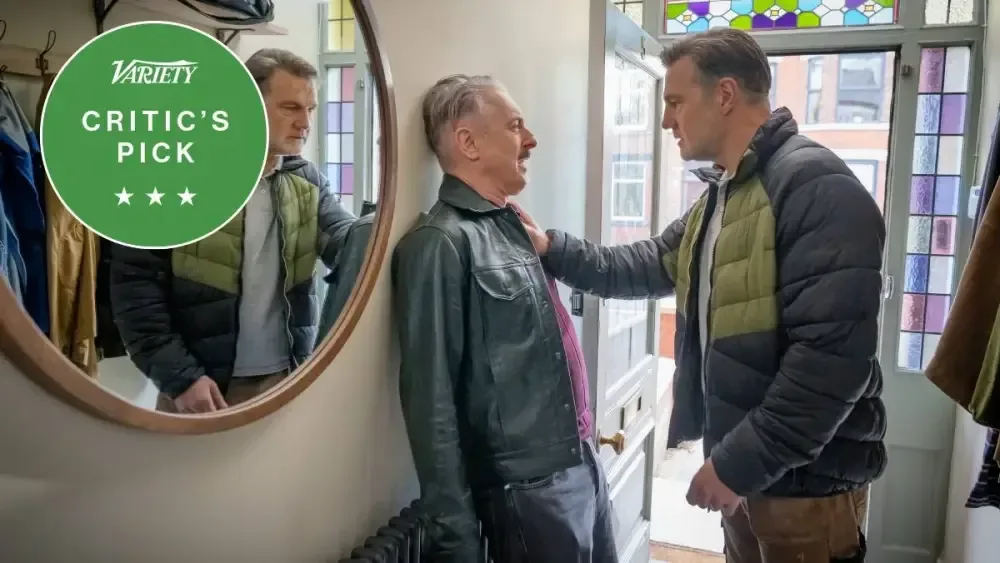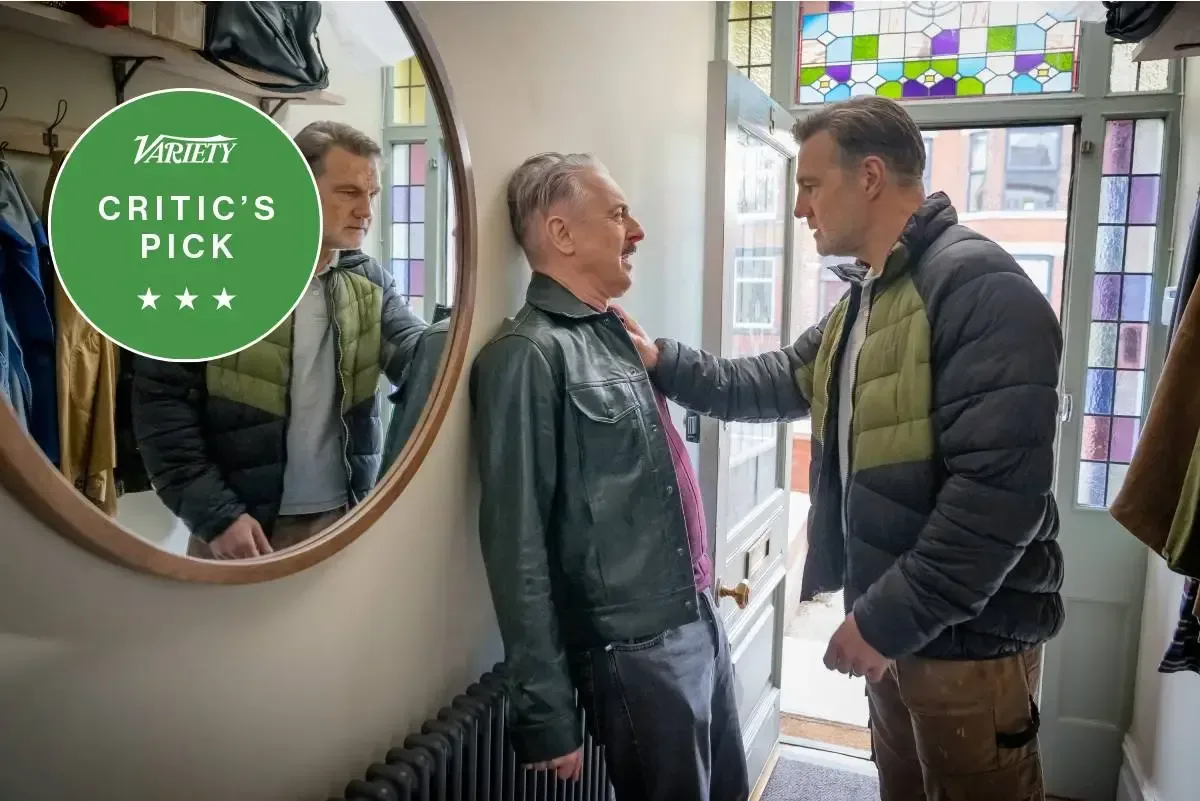
Tip Toe does not arrange its argument as a mystery. Its opening image already establishes the cost of the hatred at its center: Leo, a Manchester gay-bar owner played by Alan Cumming, is seen dead, hanging from a lamppost, while neighbor Clive looks on. The five-episode limited drama then works backward into the social, personal and political forces that put the two men on that path.
That is an intentionally bruising premise, and creator Russell T Davies does not soften it. The show is set in a Britain strained by post-Brexit disappointment, xenophobia and increasingly hostile rhetoric toward queer and trans people. Leo and Clive, played by David Morrissey, live beside one another but occupy radically different emotional realities. Leo owns a bar on Manchester’s Canal Street; Clive is an electrician whose sense of failure has hardened into resentment. Their collision is personal, but it is also plainly designed as a larger parable about what happens when prejudice is normalized, repeated and made to feel like common sense.
For a similarly character-led television critique, read our review of Kill Jackie.
A drama that refuses to disguise its alarm
The phrase “you lot” becomes a recurring verbal weapon in Tip Toe. Clive directs it at queer and trans people; he is also on the receiving end of it from a voter angry about the consequences of Brexit. The repetition matters. Davies uses the phrase to show how easily broad groups of people become targets for blame, stripped of individual lives and recast as a problem someone else must solve.
The approach is direct to the point of confrontation. Leo and Clive often function as people in their own right, but they also carry the weight of competing social positions. Leo is an HIV-positive gay man nearing 60 who remembers earlier battles for visibility and civil rights. Clive is a man whose unhappy home life and employment frustrations become fuel for anti-immigrant and anti-queer anger. The show’s symbolism is not subtle, and it is not trying to be. Its force comes from Davies treating bluntness as the appropriate register for a story about rhetoric that has real-world consequences.
Post-Brexit malaise, as depicted here, is not presented as a tidy economic diagnosis. It is the atmosphere of disappointment, grievance and social mistrust in which Clive’s anger spreads. Rather than accepting responsibility for his own unpleasant behavior or the condition of his marriage, he looks for convenient culprits. Immigrants are one target. Queer people are another. The drama’s concern is not that every frustrated person becomes violent; it is that a culture of scapegoating gives private resentments a political vocabulary and a target.
That vocabulary is reinforced by Clive’s online life. His doomscrolling and the material pushed toward him by an algorithm feed his suspicion of Leo and amplify the false, dehumanizing idea that gay people are groomers. An algorithm is a system used by digital services to select and recommend material to users. In the dramatic context of Tip Toe, it is not a magical device that invents Clive’s prejudices. It is a mechanism that can repeatedly validate them, making conspiracy and hostility appear ubiquitous and urgent.
Leo’s fear is shaped by history, not nostalgia
Leo’s central question is devastating because it comes from someone who has already lived through long fights to be acknowledged: if queer people fought to be seen, what does it mean if they are visible and still despised? The show does not frame visibility as a simple victory. It considers the possibility that acceptance can feel conditional, fragile and vulnerable to political reversal.
Related coverage includes ‘Tip Toe’ Review: Alan Cumming Leads a Blunt, Urgent Drama.
That tension is voiced most explicitly by Melba, a retired drag performer and a regular at Leo’s bar, played by Paul Rhys. Melba has adopted caution as a survival strategy. The title Tip Toe comes from his conviction that staying guarded may be safer than trusting a period of apparent social acceptance. His pessimism suggests that the openness of the 2010s may have offered a false sense of security to people who had spent years expecting hostility.
Davies does not allow that warning to become an argument for disappearance. Younger characters cannot simply return to a closet they never chose. Zee, a trans woman who works at the bar, has had her access to estrogen stopped by her GP amid a more restrictive climate around trans healthcare and identity. Zee’s story grounds the show’s political anxiety in a practical reality: an abstract debate can affect a person’s autonomy, health and daily safety.
Stephanie, Leo’s close friend, adds another complication. She is otherwise presented as liberal, yet rejects self-identification in discussions of gender. Self-identification here refers to the principle that a person’s stated gender identity should be recognized without making them prove it through external gatekeepers. By placing resistance to that idea in a character who is not otherwise coded as Clive’s ideological twin, the drama makes a sharper point. Harmful assumptions need not arrive only in overtly hateful language; they can also appear in the limits people place on their own empathy.
Alan Cumming gives Leo theatricality and hurt
Cumming’s performance reportedly avoids leaning too heavily on the heightened, flamboyant public persona viewers may associate with his work as the host of The Traitors. Leo remains theatrical, but the theatricality is part of how he copes. His recent divorce has left him wounded, and his charisma can read as both a genuine source of warmth and a protective screen.
That combination is important for a character who could easily have become nothing more than a symbolic victim. Leo is connected to a community, a business and a particular emotional history. He is not merely there to be endangered. He is funny, wounded, exasperated and capable of choices that place him in further danger. The series uses his pride and compassion as strengths, even as its plotting sometimes makes his inability to disengage from Clive feel less like character behavior than an imposed requirement of the tragedy.
Morrissey, meanwhile, makes Clive frightening precisely because the role is specific rather than monstrous in a cartoonish way. Clive is stuck in a marriage with Marie, played by Pooky Quesnel, and projects his failures outward. He is not shown as an unknowable embodiment of evil. He is shown as someone who chooses cruelty, absorbs misinformation and converts insecurity into an entitlement to police his neighbor’s life.
That distinction is crucial. Explaining the contours of Clive’s resentment is not the same as excusing it. Tip Toe traces how a person can find emotional comfort in a worldview that turns other people into threats. The more Clive blames outsiders for what hurts in his own life, the less he has to confront the parts of himself that make him miserable.
George and Zee make the stakes immediate
Clive’s 16-year-old son George, played by Jackson Connor, is beginning to understand his sexuality. His interactions with Leo ignite Clive’s suspicion, intensifying a story that is already dangerous. George’s presence clarifies what is at stake beyond the adult feud: queer young people do not stop existing because a parent, an online feed or a political movement finds their identity inconvenient.
Zee takes a strong interest in George’s welfare, a choice that speaks to the show’s belief in informal community care. At the same time, it is one of the places where the drama’s machinery becomes visible. The narrative needs Leo, Zee, George and Clive to keep moving toward one another, and that need can produce behavior that feels unusually risky or predetermined. Leo repeatedly has chances to step away from escalating conflict. Zee’s involvement with George can feel outsized. Those choices may test viewers who want the story’s cause-and-effect to be as persuasive as its anger.
Still, the issue is not that the show fails to understand its danger. It understands it too well, and sometimes pushes characters into position to ensure nobody can overlook it. Tip Toe is built less like a puzzle than a warning siren. Its early flash-forward means the audience knows that ordinary interactions are moving toward irreversible harm. The storytelling asks viewers to sit inside that dread rather than wait for a surprise.
Humor is not an escape hatch
For all its severity, the series retains the comic irreverence associated with Davies’ work. A striking sequence at the end of the premiere intercuts the private lives of several characters: George and Leo masturbate alone in their rooms, Clive scrolls through his phone, and Marie reads explicit Slow Horses fanfiction involving River Cartwright and Jackson Lamb.
The scene is bawdy, awkward and deliberately leveling. It reminds the audience that these people have bodies, desires and embarrassing inner lives beyond the political categories that increasingly define their public conflict. The joke does not dissolve the threat around them. Instead, it emphasizes the ordinary humanity that bigotry denies. Sexuality is not evidence of danger or moral decline; it is simply part of private life, represented here with a mix of tenderness, absurdity and discomfort.
That tonal flexibility also prevents the bar from becoming only a site of impending violence. It is a workplace, a refuge and a space where generations of queer people exchange anxieties, jokes and memories. Leo’s community has disagreements within it, including Melba’s retreat into caution and Stephanie’s rejection of self-identification, but it remains a community. The series’ call for empathy is strongest when it recognizes that solidarity does not require perfect agreement or spotless heroes.
From private conflict to political parable
Tip Toe extends concerns Davies has explored in prior work set around queer life in northern England. Earlier series such as Queer as Folk and Cucumber examined sexuality, friendship and adulthood through different generations of gay men, while 2021’s It’s a Sin looked back at the AIDS crisis. His 2019 drama Years and Years used speculative fiction to heighten contemporary fears. Here, the warning no longer requires a speculative setting.
That is the show’s most forceful creative decision. There is no need to invent an unfamiliar dystopia when hateful language, misinformation and public hostility can be placed in a recognizable present. The drama’s England is not defined only by policy or electoral labels; it is defined by the fear that public acceptance can rapidly turn into surveillance, suspicion and punishment.
The result is not a delicate social drama, nor is it intended to be. Its plotting can feel deterministic, particularly where Leo’s choices and Zee’s concern for George keep the conflict in motion. But its bluntness is closely tied to its purpose. Tip Toe argues that the boundary between everyday prejudice and catastrophic violence is not safely abstract. By the time a warning becomes comfortable, the show suggests, it may already be too late.