Kill Jackie arrives on AMC+ with an immediately appealing elevator pitch: Catherine Zeta-Jones plays Jackie Prince, a former drug queenpin who has traded her dangerous old life for the rarified world of luxury art dealing. Then a group of killers known as the Seven Demons is hired to murder her, forcing Jackie back into survival mode.
It is the kind of setup that promises sharp black comedy, glamorous mayhem and a hard-edged central performance. The series has much of the surface equipment for that job: international locations, expensive art, a well-dressed protagonist, gunfire, knives and a supporting cast full of eccentric underworld figures. Yet across its eight-episode first season, the show’s visual flair and Zeta-Jones’ star presence are not enough to give its increasingly busy plot a clear emotional or narrative center.
The result is a thriller that often looks ready to become a deliriously entertaining revenge-and-survival story, but keeps getting buried under its own cast of characters, detours and mechanisms.
A dangerous past interrupts a polished new life
The series is adapted from Nick Harkaway’s 2018 novel The Price You Pay. Its television adaptation was created by Conor Keane, Tom Butterworth, Peter Lawson and Damon Thomas, with Butterworth serving as writer and showrunner and Thomas as lead director.
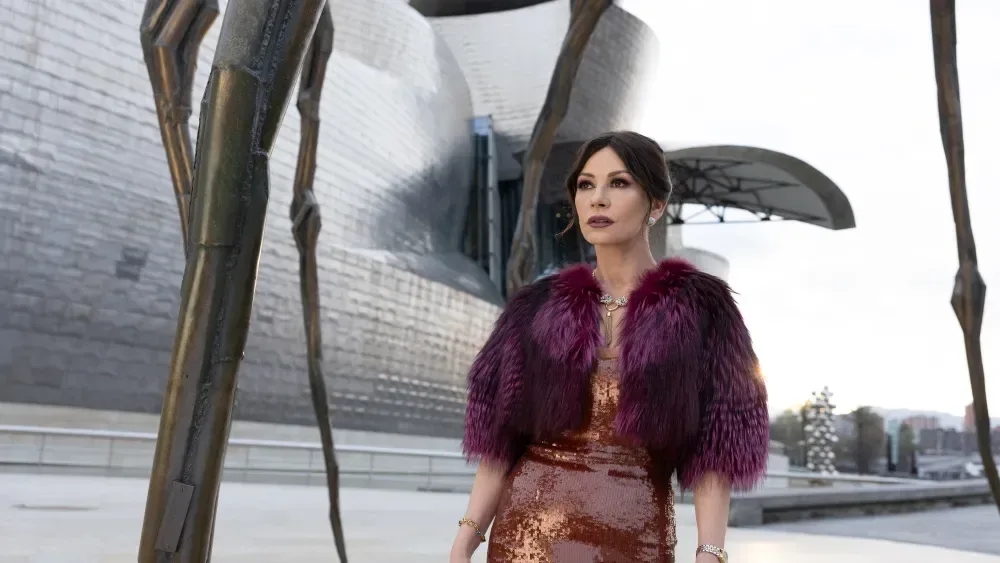
Jackie’s opening situation establishes both the show’s preferred aesthetic and its central contrast. In Bilbao, Spain, she and her assistant and protégé Charlie, played by Hattie Hook, oversee a secret $60 million art purchase. Jackie appears almost numb to the extravagance and risk of the transaction. Her casual failure to ensure that their burner phones have been discarded becomes consequential once they return to London.
A burner phone is a disposable or difficult-to-trace mobile phone, often used in crime fiction to reduce the evidence trail linking callers to an operation. Here, the detail signals that Jackie has not entirely escaped the habits and vulnerabilities of her previous criminal life.
Back in London, gunmen attack Jackie in her apartment. She escapes and discovers that the Seven Demons, a group of mercenaries, have been contracted to kill her. Jackie takes Charlie and Sam, her reluctant tax attorney played by Daniel Ings, to a safehouse while she begins working out who wants her dead and how to strike back.
That foundation gives the show a practical engine: an endangered woman with a violent history must identify the person behind a contract killing before the killers reach her. It is a sturdy framework for a suspense series because every new piece of information should either narrow the suspect pool, escalate the immediate danger or reveal why Jackie’s past remains inescapable.
Related coverage includes ‘Kill Jackie’ Brings Style, Catherine Zeta-Jones and a Crowded Assassin Plot to AMC+.
Kill Jackie reportedly begins by efficiently sketching Jackie’s drug-smuggling history and the steps she took to get out. The problem is less the premise than what happens after it is established. By the third episode, the story becomes tangled in a growing number of people, locations, assassination-business details and tonal shifts. Instead of making Jackie’s search more gripping, the accumulating information makes it harder to identify what deserves the audience’s attention.
Style is not the same thing as momentum
There is no shortage of visual attitude in Jackie’s world. Zeta-Jones gets to move away from the tightly controlled Morticia Addams look associated with her recent television work and into glittering gowns, high-end surroundings and a wardrobe that includes weapons. The contrast suits the character concept: a woman trying to maintain the immaculate poise of a legitimate art dealer while being pulled back toward the ruthless life she supposedly left behind.
But a strong costume concept cannot substitute for character development. Jackie has the outline of a compelling antihero: a former kingpin with blood on her hands, a younger associate to protect and a secret history that might explain the lethal attention around her. The series does reveal deeper aspects of that past, connecting old secrets to the present crisis. Those revelations, however, do not consistently produce the intended emotional force.
That distinction matters. A plot twist answers a question about what happened; an emotional revelation changes how viewers understand a person. In a successful character-led thriller, the latter gives action scenes added weight. Jackie should not merely need to survive because armed pursuers are firing at her. The audience should also feel the cost of what survival asks of her relationships, identity and attempts to build a quieter life.
Zeta-Jones is not the issue. The role gives her ample opportunity to project confidence, icy composure and flashes of alarm beneath a polished exterior. The series simply does not give Jackie enough depth and texture for that performance to anchor every turn in the convoluted story.
The Seven Demons need more menace
The assassin unit at the center of the threat should be one of the show’s chief attractions. A named group of hired killers immediately suggests a gallery of distinctive antagonists, each bringing a different style, motive or philosophy to the pursuit. Instead, the Seven Demons are portrayed as unevenly threatening and, at times, too cartoonish to sustain real dread.
Two members are ex-special-forces brothers whose similarity makes them feel less like individually memorable opponents than a paired gag. Another dances in bowling shoes to James Brown songs. Even the group’s most intimidating member, The Doc, played by Christine Adams, has a heightened quality that works against the danger the series wants to convey.
There is a place for exaggerated assassins in a black comedy. Black comedy uses humor to approach grim subjects such as violence, crime, death or moral collapse. The genre works when the jokes and the threat sharpen one another: laughter becomes nervous because the danger still feels real, and the violence exposes something absurd about the characters or their world.
Kill Jackie appears caught between approaches. It is not consistently witty enough for its absurdity to become a comic advantage, yet it is not grounded enough for the violence to become engrossing on purely thriller terms. The result can make scenes with flying bullets and thrown knives feel decorative rather than urgent.
Óscar Jaenada’s Zigor, a former member of the Seven Demons who has an uncertain friendship with Jackie, makes a stronger impression as a threat than the group pursuing her. That is a telling imbalance. A series can absolutely use an ally or wildcard as its most unsettling figure, but the central antagonists still need to create a sustained sense that the hero is being hunted by a formidable force.
Too many moving parts, not enough payoff
The show’s crowded ecosystem includes The Poltergeist, a bank and concierge service capable of carrying out Jackie’s requests at speed, as well as Karenina, played by Sidse Babett Knudsen, one of the figures who helps organize the Seven Demons’ contracts. These details are meant to make the criminal world feel elaborate and unusual. Instead, they contribute to a sense that the narrative keeps expanding when it needs to become more precise.
World-building is useful when it clarifies the rules of a story. In an assassin thriller, viewers need to understand enough about how contracts are issued, how information travels, and what resources the protagonist can access to follow the tactical stakes. World-building becomes a drag when every new institution or personality creates another thread without improving Jackie’s immediate objective.
This is the practical issue facing viewers who are drawn in by the premise. The series offers spectacle and a recognizable lead in an eight-part format, but it may demand patience with a plot that becomes more confusing rather than more rewarding. The increasingly bloated supporting cast and cameos further diffuse attention from Jackie’s investigation and escape.
There is a broader small-screen appetite for crime stories that blend polished surfaces with dark humor, and the streaming landscape continues to make room for returning and new scripted series alike, including Netflix’s renewal of A Different World. But a fashionable genre frame is only a starting point. A black-comic assassin story requires control: control of tone, information, character motives and escalation. Without it, stylish excess starts to feel like narrative noise.
Release details and cast
Kill Jackie debuted on AMC+ on October 2, with subsequent episodes scheduled weekly on Fridays. The first season consists of eight episodes.
Alongside Zeta-Jones, Ings, Hook, Knudsen, Jaenada and Adams, the ensemble includes Darci Shaw, Raff Law, Enzo Cilenti, Julian Rhind-Tutt, Karlis Arnolds Avots, Set Sjöstrand, Tadashi Ito, Sebastian Armesto, Julian Barratt, Gavin Spokes, Jonathan Cake, Bamshad Abedi-Amin, Bill Paterson and Ron Perlman.
The key appeal remains easy to see: Zeta-Jones in the role of a chic former crime boss facing a contract on her life is a compelling image, and the show surrounds her with substantial production gloss. For viewers looking specifically for that aesthetic, there may be enough in Jackie’s wardrobe, arsenal and escalating chaos to justify curiosity. But the series’ defining weakness is that its parts do not cohere. Beneath the glamor and bloodshed, its central mystery lacks the clarity, emotional pull and tonal precision needed to make the journey feel worthwhile.