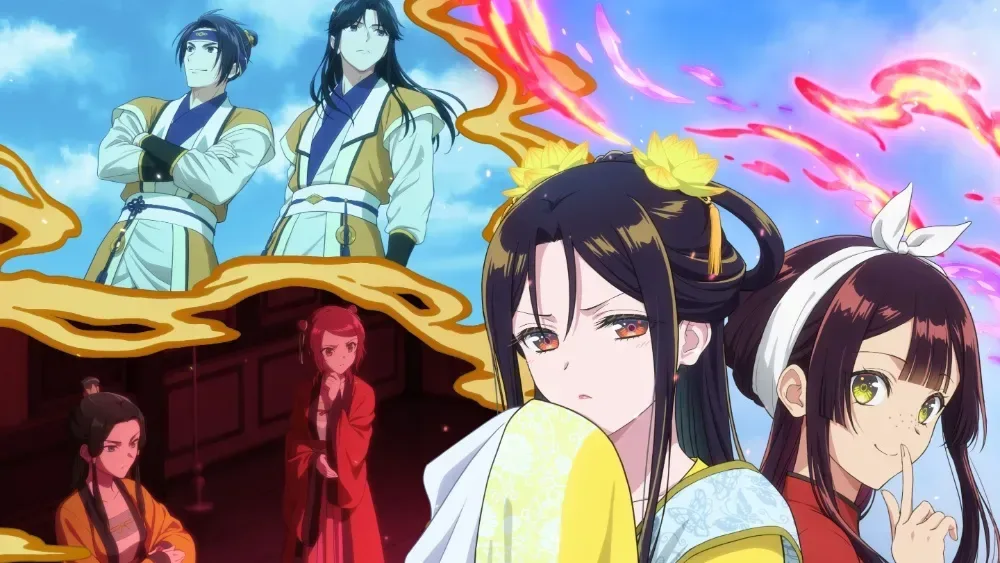
Though I Am an Inept Villainess is set to resume in January 2027 with its second cour, titled “The First Royal Outing” Arc. The next broadcast block brings a new key visual and three additions to the Japanese voice cast, while moving the story away from the immediate aftermath of its original body-swap crisis and into a royal festival that goes spectacularly sideways.
The series began as a TV anime in July 2026 and adapts the light novel series by Nakamura Satsuki. Its initial storyline established a dangerous exchange between Reirin and Keigetsu: Keigetsu, ostracized by those around her, uses forbidden sorcery to switch bodies with Reirin. What seems intended as an escape or advantage instead forces both women to live with the consequences attached to the other’s identity.
By the end of the first part, the disruption connected to the curse had largely been dealt with. Just as importantly, Reirin and Keigetsu had reached a greater understanding of one another after experiencing the worlds, reputations and burdens each had been carrying. That does not mean the central magical problem has been permanently filed away in a suitably labeled palace drawer, however. The new arc will put the pair back in a situation where the swap returns at the worst possible time.
Three characters join the royal outing
The returning arc adds three named roles to the cast:
- Nakamura Yuichi will play Keikou, Reirin’s eldest brother.
- Toki Shunichi will voice Keishou, Reirin’s second-eldest brother.
- Kobayashi Chiaki joins as Unran, a young chief from a southern village whose role grows as events unfold.
Keikou and Keishou are not simply family introductions for the sake of expanding a character sheet. The brothers become directly involved when Reirin is abducted during the coming crisis. Their arrival gives the story a fresh set of personal stakes: Reirin’s predicament will be viewed not only through court politics and Keigetsu’s public standing, but through relatives who have reason to act when she disappears.
Unran’s placement is equally notable. The story shifts to the Shu clan’s southern territory, making a village chief a natural figure in the local setting. With his part said to expand as the plot progresses, he appears positioned to matter beyond a brief ceremonial welcome.
What “second cour” means
A cour is a Japanese television programming block generally running for about three months. Anime productions may use the term to describe a season-length section of episodes, and a series can split its run into separate cours rather than releasing its full episode count in one uninterrupted stretch.
For viewers, the key point is that “The First Royal Outing” Arc is a continuation, not a separate adaptation or a newly announced spin-off. It follows the first portion of the TV anime while pivoting into a distinct storyline with a new setting, additional characters and a new immediate threat.
An exact January premiere date has not been confirmed. The current information only establishes a January 2027 streaming start for the arc, so viewers should treat the month as the confirmed window rather than assume a specific day, episode count or release pattern.
A harvest rite becomes a political and magical disaster
The new storyline opens in early fall as the Shu clan’s southern lands prepare for the Harvest Festival. The ritual brings together the Crown Prince and the Maidens to pray for an abundant harvest. In a series built around social roles, status and the high cost of being judged by a name, a public ceremony of this scale is an especially precarious place for anything to malfunction.
Keigetsu is making preparations despite not having a consort acting as guardian. Reirin supports her efforts and is also eager for what will be her first outing in an official royal capacity. That premise gives the title of the arc a deliberately upbeat surface: it begins as a milestone for Reirin and an opportunity for Keigetsu to move forward in a visible role.
Then the event is interrupted by an accident. Keigetsu loses her balance, her magic gets out of control, and the two women are sent back into each other’s bodies. The reversal is more than a repeat of the initial hook. The first body swap forced Reirin and Keigetsu to confront how little they understood of one another. This time, they enter the exchange with that hard-won knowledge already in place—yet now amid a major public ceremony, an apparent attack on Keigetsu’s reputation, and an abduction.
Reirin is taken in the ensuing chaos, while an unknown figure works to frame Keigetsu. Keikou and Keishou join the search as the situation develops. The arc therefore stacks three pressures at once: the physical danger facing Reirin, the political and social danger facing Keigetsu, and the practical difficulty of investigating events while identities have again been scrambled.
The body swap remains the story’s sharpest complication
The series’ first arc made clear why switching bodies is not a convenient fantasy escape hatch. Before the curse, maidens of the Five Clans competed for the Crown Prince’s attention. Keigetsu’s jealousy of the widely admired Reirin led her to forbidden magic. Yet the exchange did not place Keigetsu into an easy life. She inherited Reirin’s frail body, which was already close to death.
Reirin, meanwhile, landed in Keigetsu’s body and had to endure the damage already done to Keigetsu’s public image. She faced a trial over misconduct she had not committed. The swap placed each woman under a different kind of threat and exposed the gap between surface-level perception and lived reality.
That background matters for “The First Royal Outing” because it establishes that identity is both personal and political in this world. Reirin and Keigetsu may know who they are, but the court and the wider public respond to the body in front of them, the title connected to it and the history associated with it. A renewed swap during a festival involving the Crown Prince and the Maidens gives any attempt to pin wrongdoing on Keigetsu extra weight.
Analysis: the arc’s setup points toward a mystery structured around trust. The evidence available to characters may conflict with who is actually inhabiting which body, while the person being framed already carries a reputation that makes accusations easier to believe. Reirin’s kidnapping raises the stakes beyond embarrassment or court intrigue, and the introduction of her brothers supplies allies with a direct personal reason to challenge the official narrative. Those are implications of the announced premise, rather than confirmed details about how the investigation will unfold.
Why the setting change matters
Moving the action to the Shu clan’s southern territory broadens the series’ stage without abandoning its core tensions. The Harvest Festival is not described merely as local color; it is a ritual involving the Crown Prince and the Maidens. That makes the location a point where family, regional leadership, ceremonial duty and royal expectations meet.
It also changes the shape of danger. The original conflict grew from rivalry among women connected to the Five Clans and the Crown Prince. The second cour carries that legacy into an external event where an accident can disrupt a formal rite and create room for someone else to exploit the confusion. With Unran introduced as a young southern village chief, the arc has another character linked directly to the area in which this crisis begins.
For fans waiting on the continuation, the clearest confirmed expectations are a January 2027 return, a Harvest Festival setting, a new round of body-switching trouble, Reirin’s abduction and a search for the person framing Keigetsu. Everything beyond those stated story points—including exactly who is responsible and how the new cast members fit into the resolution—remains for the episodes to reveal.
The anime’s continuation arrives as screen adaptations continue to draw attention across genre entertainment; for another adaptation-related update, see the latest on the theatrical version of Resident Evil. For Though I Am an Inept Villainess, though, the immediate question is considerably more courtly: can a first royal outing survive a disrupted harvest ritual, another unwanted switch of bodies and a kidnapping before the palace turns suspicion into a verdict?