Markus Lehmusruusu’s The Squirrel imagines a future that has optimized nearly every inconvenience out of daily life—and made the people living in it considerably less alive. The Finnish-language sci-fi dramedy centers on Pasi, played by Miro Lopperi, a mild-mannered man in his early 30s whose routine is so frictionless that it has also become emotionally airless. His society promises comfort, health and collective happiness. In exchange, it monitors behavior, discourages undesirable language, decides whether citizens should have caffeine and polices the messier parts of human attachment.
That setup could have led to a broad dystopian satire or a lore-heavy future thriller. Instead, Lehmusruusu keeps the film small, quiet and deadpan. The central disruption is not a revolution, a supercomputer or a grand conspiracy. It is a squirrel.
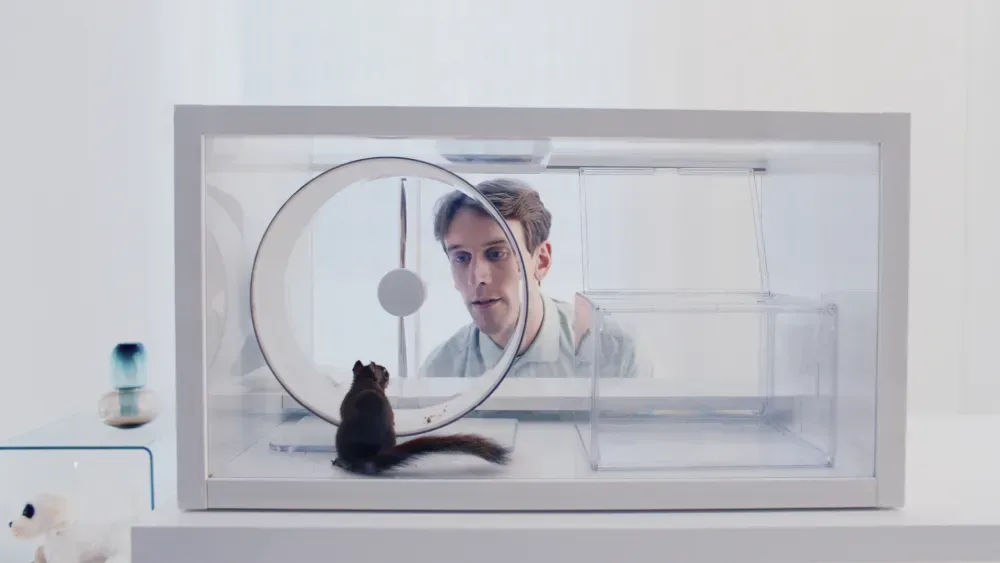
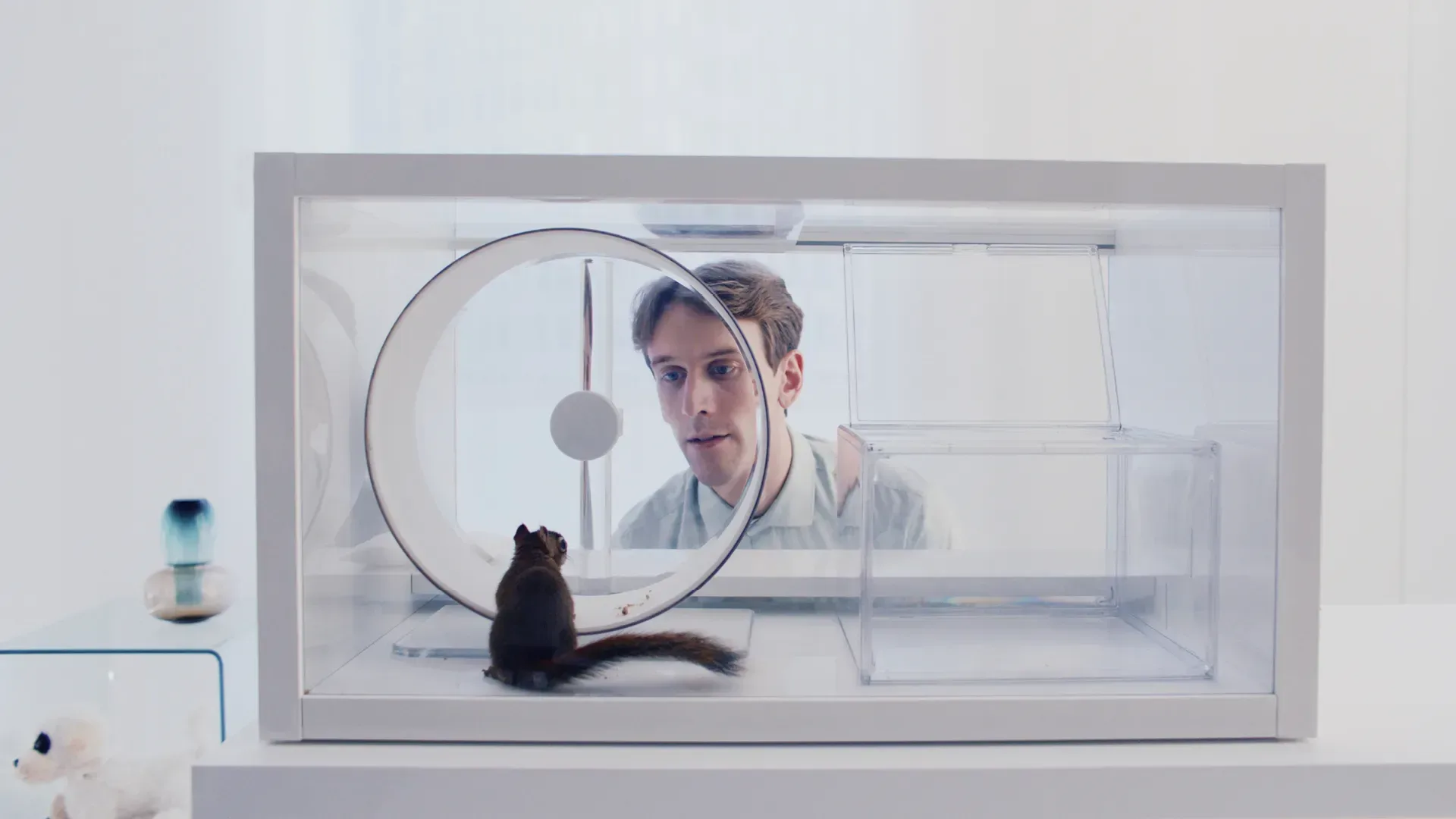
Pasi’s accidental encounter with the animal starts a chain of discoveries about spontaneity, companionship and risk. His decision to secretly care for a living creature becomes significant precisely because it is such an ordinary, intimate action. In a world where unpredictability has been engineered away, a squirrel’s instincts, needs and occasional distress amount to a radical presence.
A future built to remove friction
The Squirrel opens with an unusually direct sign of just how far this society’s automation reaches: Pasi enters a rose-colored room where a machine is used to “regulate his hormones.” The moment establishes the film’s matter-of-fact comic register. Nobody needs to announce that this is strange; the characters’ total acceptance of it makes the scenario both funnier and more unsettling.
Lehmusruusu, who also wrote the screenplay, avoids an opening data dump. There is no lengthy history lesson explaining how the system arose, no introductory crawl mapping its rules and no character positioned solely to lecture Pasi or the audience. Information arrives through the unremarkable details of a workday and a commute. Pasi works on a robotic pet dog, a product that suggests a carefully managed substitute for the uncertainties of real animals.
The distinction matters. A robotic pet can presumably be designed to be responsive, appealing and safe. But it is also predictable. The squirrel Pasi finds is the opposite: a creature with its own impulses, vulnerable to harm and unconcerned with fitting into a person’s schedule. The film’s conflict grows from that difference rather than from an elaborate technological mystery.
This makes its use of science fiction especially approachable. The genre’s future-facing tools are present, but they are not the point on their own. Wearable health tracking, automated recommendations and constant listening are recognizable extensions of systems already familiar in contemporary life. The film asks what happens when tools ostensibly built for wellness and convenience stop assisting people and begin defining the acceptable limits of their choices.
What “sanitized” means in the film’s world
The society in The Squirrel is emotionally sanitized as well as physically orderly. An artificial voice discourages swearing. Bending machines can determine whether a person should consume caffeine. Health bracelets record information about their wearers. Any one of those details might sound benign in isolation, much like real-world devices that measure activity or sleep. Together, though, they depict a culture where data collection has become an instrument of social control.
Related coverage includes ‘The Squirrel’ Review: A Wild Animal Upends an Automated Future.
The system’s stated aim is collective comfort and happiness, but the film draws a clear line between being protected from every error and being able to live freely. Mistakes may be painful, embarrassing or inconvenient. They can also be part of choosing a relationship, caring for another being or discovering what matters to you. Pasi’s life has been arranged to eliminate surprise, which means it has also left little room for personal desire.
That idea gives the film a practical relevance beyond its stylized future setting. Tracking technology does not automatically equal oppression, and the story does not need to claim that it does. Its sharper concern is the transfer of authority: who gets to interpret a person’s data, decide what behavior is healthy and impose a definition of happiness? In Lehmusruusu’s future, those questions have already been answered by the system, not the individual.
For a related look at a screen-free wearable built around personal tracking, see this overview of the Whoop MG Life Membership Bundle. The Squirrel takes the basic notion of monitoring far beyond a consumer product, using it to explore the stakes when measurement becomes permission.
Order is part of the joke—and part of the threat
Cinematographer Max Smeds gives the future a restrained visual discipline. Symmetry, parallel lines and homogenized infrastructure recur in spaces such as subway escalators, workplace stairways and apartment complexes. Pasi’s home is mostly white, bright and antiseptic, a space that appears to have no tolerance for disorder. Muted costuming extends that feeling, helping make the world look simultaneously comfortable and drained of character.
This formalism is more than set dressing. It gives the comedy weight. The film’s deadpan approach depends on a society that has made its odd rules look normal through repetition and clean design. Pasi does not initially recognize the absurdity of his world because he has never known anything else. The audience, meanwhile, is invited to notice how carefully every surface and interaction seems to deny chaos.
The approach recalls the stoic humor often associated with Finnish filmmaker Aki Kaurismäki, while the premise places its own modest spin on dystopian science-fiction traditions. Yet The Squirrel is not presented as a showpiece of towering architecture, aggressive action or lore encyclopedias. Its scale is domestic. A flat, an office, transit spaces and a small animal can carry the argument because the film is interested in the texture of a controlled life rather than the machinery behind every institution.
Pasi, Emilia and the cost of managed intimacy
Pasi’s encounter with the squirrel also brings him into contact with investigator Emilia, played by Mimosa Willamo. He is required to report the animal, and their meeting produces an immediate attraction. Neither acts on it. The hesitation is not merely shyness: the film establishes that adultery can be punished by a procedure that erases the offender’s memory. That punishment suggests a society willing to intervene directly in identity to enforce its rules around intimacy.
Memory erasure is a familiar speculative-fiction concept, but here it works as an extension of the story’s central anxiety. If feelings and choices can be removed after the fact, then a citizen’s inner life is no longer entirely their own. The threat is not simply that romance is forbidden. It is that a person can be made unable to retain the experience that led them to make an unacceptable choice.
Emilia’s presence gives Pasi’s arc a human counterpart. His bond with the squirrel teaches him something that an artificial pet and a fully scheduled lifestyle cannot: care is not valuable because it is efficient. It has value because another living being is separate from you, unable to be perfectly programmed and sometimes difficult to understand. That lesson naturally opens the way toward a human connection rooted in physical closeness and emotional vulnerability rather than compliance.
Lopperi’s performance appears central to the film’s delicate tonal balance. Pasi is not framed as a swaggering rebel suddenly prepared to overthrow the world. The faint smile he shows while playing with the squirrel is a much smaller but more meaningful shift. It signals that the character is recognizing an experience his ordered life has failed to provide. When the animal shows signs of heartache, the pleasure of that discovery is complicated by responsibility and worry.
The animal is not merely a symbol
The production’s treatment of the squirrel reinforces the story’s preference for the organic over the simulated. Four real rescue squirrels, working with a trainer, portray the animal for most of the film; a puppet and minimal CGI provide additional assistance where needed. That choice aligns with the narrative without turning the creature into a purely decorative metaphor.
A real animal carries an element of contingency. Its movements do not possess the perfectly polished rhythm of a wholly digital creation, and that unpredictability is exactly what Pasi’s world has rejected. The filmmaking method therefore echoes the subject: the squirrel feels like a small interruption from a more complicated, less manageable reality.
Hannu-Pekka Björkman plays Jimi, a longtime employee at Pasi’s workplace who retains knowledge of animals that once inhabited the Earth and of what may exist beyond the human bubble. Jimi serves as a bridge to a past that the current order has either forgotten or sealed off. Crucially, the film does not appear to use him to supply a comprehensive explanation of the world. Its decision to leave history and institutional details partially unspoken is a strength, keeping attention on Pasi’s immediate awakening rather than treating every unanswered question as a puzzle to solve.
An intimate case for imperfection
At 93 minutes, The Squirrel makes its case through compact, offbeat situations instead of exhaustive world-building. Lehmusruusu’s future is recognizable enough to provoke unease but spare enough to preserve the film’s gentle absurdity. The result is a dramedy where a covert animal adoption can feel as consequential as an act of resistance.
The film’s argument is not that technology itself is inherently hollow. Pasi’s problem is a culture that has elevated regulation above individual fulfillment and predictability above all forms of discovery. A machine may provide a service. A wearable may record a measurement. A robotic pet may mimic affection. But none can fully replace the reciprocal uncertainty of caring for something alive—or choosing another person without a system approving the choice.
The Squirrel premiered at Fantastic Fest in September and has North American distribution through Obscured Releasing. It is a Finland-Germany-Netherlands-Sweden production, directed and written by Lehmusruusu, with editing by Florian Miosge and music by Freya Arde. Alongside Lopperi, Willamo and Björkman, the cast includes Roderick Kabanga, Pirjo Heikkilä and Eero Ritala.
Its most memorable provocation may be its smallest one: a genuinely living animal, acting according to instincts no system has authorized, can expose the limits of a perfectly comfortable world. In Pasi’s hands, the squirrel becomes less a disruption to be reported than proof that discomfort, surprise and attachment are not flaws in life. They are part of what makes it worth having.