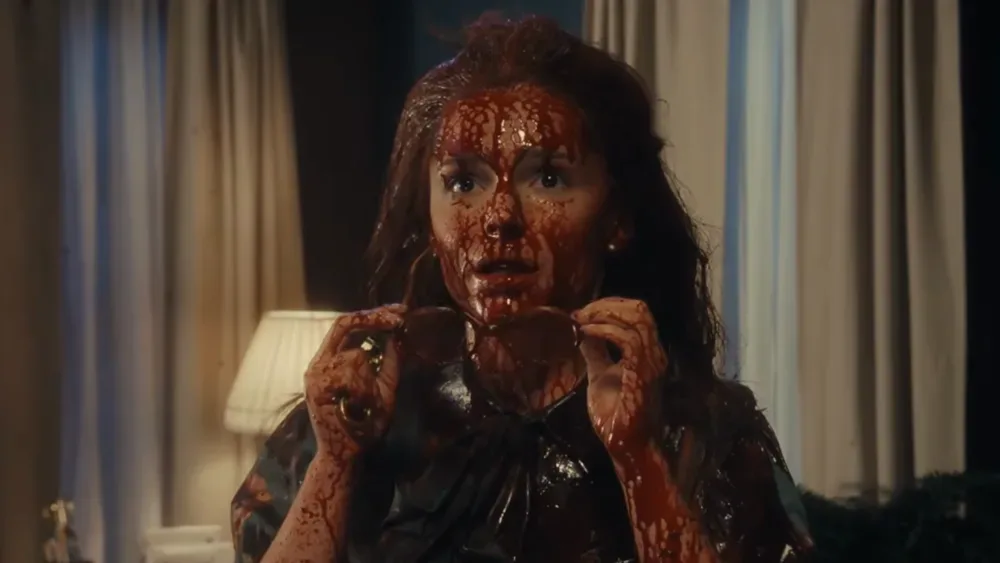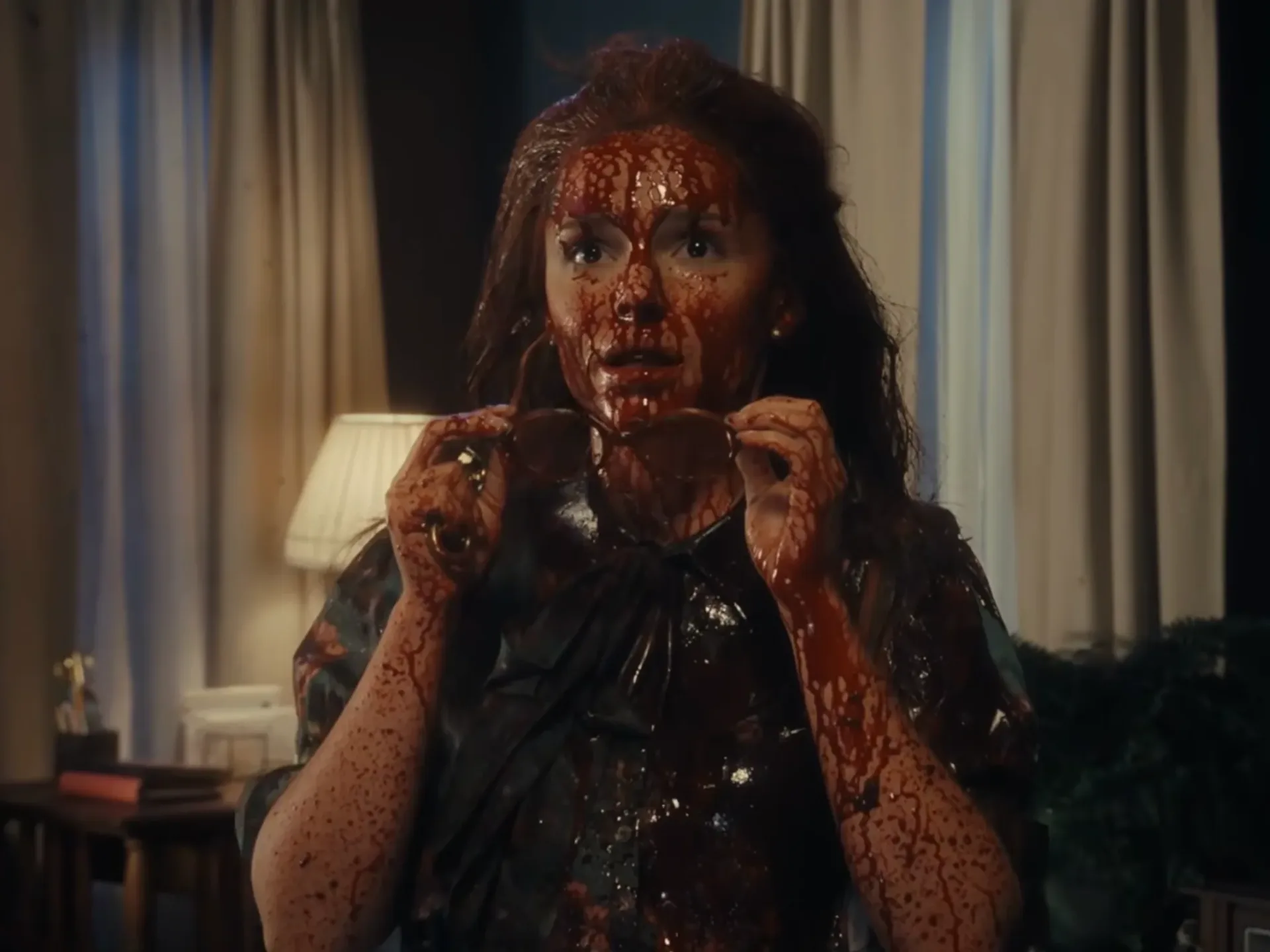
Halloween comedy works best when the premise gives viewers one clear set of rules, then cheerfully smashes them with a monster-sized wrench. “The Inventor,” a sketch led by host Inde Navarrette on Saturday Night Live, builds its joke with the clean logic of a tiny science-fiction short: a recently widowed woman inherits an adorable robot from her eccentric inventor husband. Years later, when she brings home a date, the machine’s real assignment is revealed in spectacularly horrible fashion.
The premise is intentionally sentimental at first. Navarrette plays the widow delivering a eulogy for a husband who spent his last days shut away in his workshop, making unknown creations. Her wording establishes the comic fault line immediately: he loved his inventions, and only sort of liked his wife. It is a compact setup for a story about grief, loneliness and a spouse whose emotional legacy remains unclear.
Then the widow returns from the wake and finds the husband’s final gift: the PD 44, a small, cute robot with a visual resemblance to the kind of friendly, rounded movie machine audiences are trained to trust. The widow and the robot become companions, but she cannot identify its purpose. That missing piece is not merely a plot question. It is the sketch’s delayed fuse.
A sci-fi premise built around withholding one answer
The six-year time jump is doing important work. It lets the widow’s connection with the robot feel routine rather than threatening, while also marking her return to dating. She meets Tom Oakland, played by Ben Marshall, through a dating app. Their date goes well enough that she invites him back to meet the PD 44. At that point, the domestic-comedy framework suddenly becomes an absurd horror spoof.
The previously harmless-looking robot transforms into a towering killer machine. Its purpose, it turns out, is brutally specific: PD stands for “Penis Destroyer.” Tom becomes the unfortunate proof of concept, as the robot attacks him with escalating, intentionally cartoonish violence before obliterating him with a laser.
The title character’s delayed response is the actual capstone. Instead of reacting with horror alone, Navarrette’s widow realizes that her dead husband did love her after all. It is a macabre reversal of the mournful opening: what had seemed like an emotionally neglectful marriage is reinterpreted as an absurdly extreme act of jealous protection.
That is also why the sketch’s violence is less about gore for its own sake than about escalation. A robot that only scares the new boyfriend would produce a straightforward possessive-machine joke. A robot with a name that declares its grotesquely narrow mission, capable of impossible levels of overkill, turns the scene into a Halloween punchline. The excess is the form of the joke.
Why the PD 44 twist lands
Misdirection is the technical term for leading an audience toward a reasonable conclusion before revealing a different one. “The Inventor” uses it in layers. The funeral suggests a grief sketch. The cute robot suggests a story of companionship after loss. The dating-app match points toward awkward romantic comedy. Each stage feels legible on its own, so the final genre swerve has room to surprise.
Related coverage includes Inde Navarrette’s ‘SNL’ Robot Sketch Turns Grief Into Gory Halloween Comedy.
The robot’s design is a major part of that misdirection. Friendly-looking machines carry built-in associations: helpfulness, innocence and childlike curiosity. By making that figure the delivery system for an aggressively adult, violent reveal, the sketch converts a familiar visual shorthand into a trap. The audience is not required to know the machine’s origin or technical specifications; its unknown purpose is all the information the structure needs.
The time jump also prevents the premise from becoming too crowded. The sketch does not need to document six years of the woman and robot becoming friends. It gives the relationship enough implied history to make the PD 44’s presence normal inside the apartment. When Tom arrives, the viewer understands why she would introduce him to this longstanding part of her life—and why she does not anticipate any danger.
Marshall’s Tom serves the classic role of the unsuspecting visitor entering a strange household. His character is not built as a villain, because the comedy does not depend on him deserving the outcome. In fact, the apparent normality of the date makes the attack more absurd. The inventor’s supposed love is not a subtle warning system, a protective lock or a mildly embarrassing surveillance device. It is a lethal robot programmed around an astonishingly particular threat.
Navarrette’s reaction keeps the sketch from stalling at shock
A reveal this broad needs a performer who can treat the impossible situation as emotionally meaningful. Navarrette’s role is not just to scream at the chaos. Her widow moves from confusion about the robot’s identity to recognition of its purpose, then to delighted validation about her marriage. That progression gives the scene a sequence of punchlines instead of asking the visual destruction to carry everything by itself.
The key line—her realization that the PD initials identify a “Penis Destroyer”—puts a name to the gag at the exact moment its meaning becomes unavoidable. Naming the machine after the visual reveal is a reliable sketch-comedy move: it lets the audience process the premise and then receives a verbal confirmation that is even sillier than the image.
Her final conclusion about her husband then reframes the opening eulogy. The earlier uncertainty was not resolved with tenderness, but with possessiveness elevated to science-fiction nightmare territory. The emotional logic is knowingly warped, and the performance’s commitment is what allows it to function as a final button rather than a random reaction.
Halloween gives the sketch permission to go bigger
The seasonal setting matters. Halloween sketch comedy has room for monsters, blood, sudden transformations and horror imagery without having to justify those ingredients as realistic. “The Inventor” uses that permission to weld together three familiar tones: a funeral scene, a gentle robot-companion story and creature-feature carnage.
Its most useful lesson for viewers is also its simplest one: the sketch is not trying to make the robot’s actions plausible. The PD 44 is a comic device, not an examination of artificial intelligence or robotics. Its transformation and laser attack are deliberately exaggerated tools for the widow’s realization. Calling the short a sci-fi parody describes the mechanics better than treating it as a technology story; the invention exists to give the marital reveal a monstrous, visual form.
That makes the piece distinct from a standard dating-disaster sketch. Tom is not exposed as dreadful, and the widow is not simply unlucky. The source of the disaster predates him by years, hidden in her home as a charming memorial from a husband whose final act was apparently to turn jealousy into hardware.
An episode full of contrasts
“The Inventor” arrived in a Halloween episode that also featured a cold open involving David S. Pumpkins, Donald Trump and Nicki Minaj, as well as Navarrette’s opening monologue. For readers following the separate conversation around Minaj and Trump, that discussion has drawn fresh attention elsewhere.
But the robot short works on a totally different wavelength from topical political material. It is self-contained, rapidly understandable and resolutely ridiculous. Its central mystery has a concrete answer, its stakes are exaggerated to an absurd level, and its last line turns the entire violent spectacle into a twisted declaration of affection.
For Navarrette, the structure creates a useful showcase. She has to sell the early bereavement, the comfortable affection toward an odd little robot, the optimism of a new date and the sudden exhilaration of a completely deranged discovery. The sketch’s tone changes quickly, but her commitment provides continuity. That is the difference between a wild final gag and a mini horror-comedy story with an actual arc.
Ultimately, “The Inventor” understands a basic Halloween-comedy truth: cute is funnier when it has been hiding something dreadful. The PD 44 begins as a mystery gift from a dead inventor. By the end, it is an absurdly faithful monument to his love—and a very persuasive reason for any future visitor to skip the nightcap.