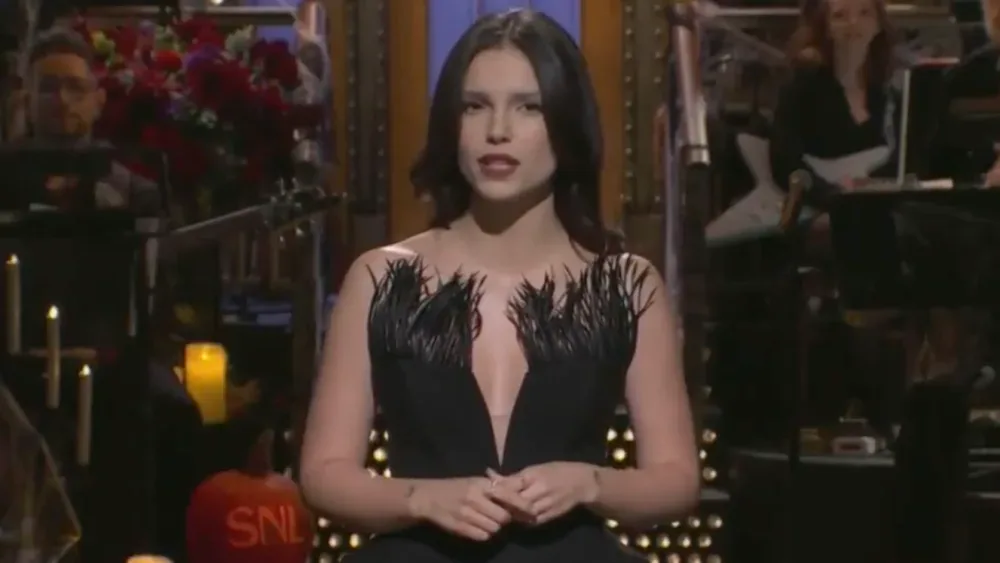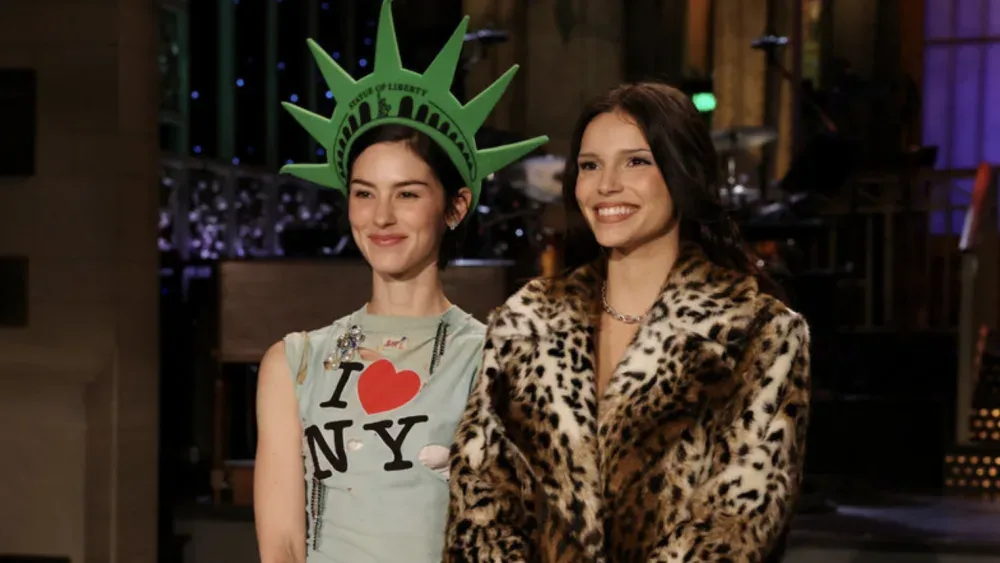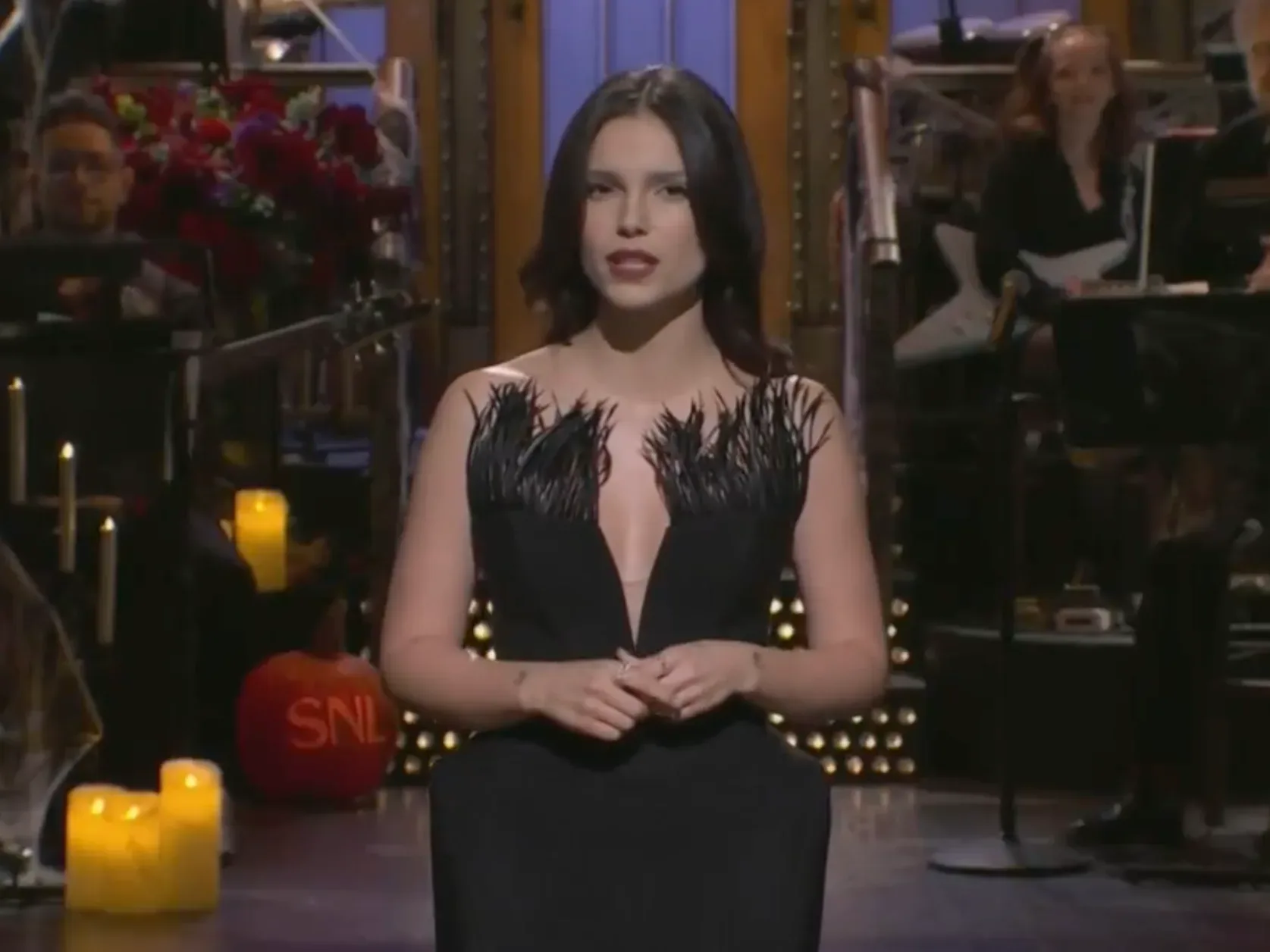
Inde Navarrette made her first Saturday Night Live monologue count, using a compact sequence of escalating jokes to introduce herself, play off her horror role in Obsession, and redirect a recent punchline about women’s gym clothes back at the comedian who made it.
The Halloween-night episode opened with a Trump-focused sketch that also brought back Tom Hanks’ David S. Pumpkins, as covered in this look at the David S. Pumpkins return. Navarrette then took the Studio 8H stage with the difficult but useful task of a debut host: tell viewers who she is, establish a comic point of view, and give the live audience a reason to trust the next several minutes.
Her material did not try to make that introduction overly grand. Instead, it relied on three clear turns: the gap between performer and character, an absurd visual confirmation that the character may have bled into real life, and a self-aware Marvel setup that delivered the night’s sharpest reference.
Starting with the character people think they know
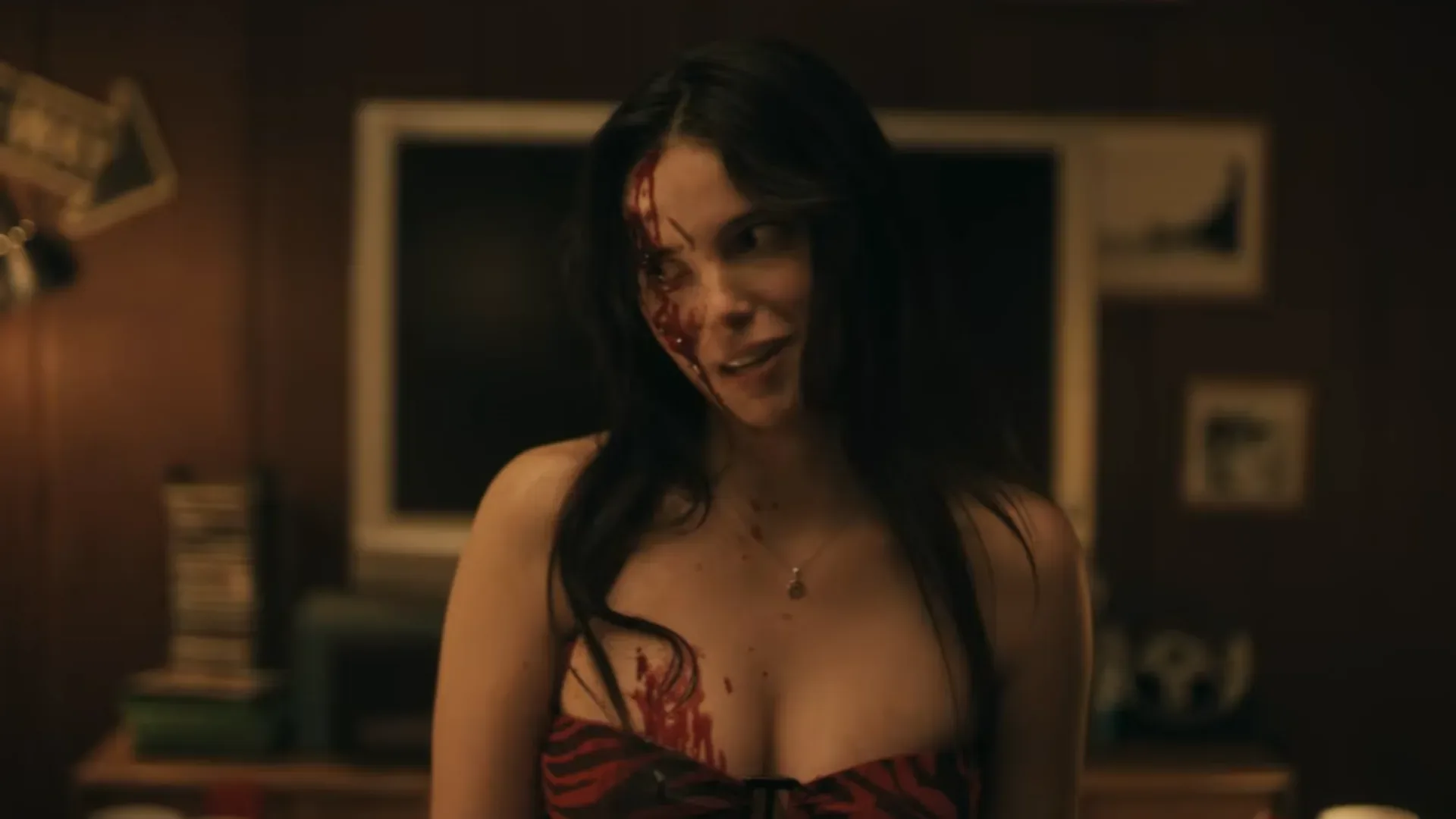
Navarrette began with the most direct piece of context available: many viewers know her from Obsession, where she plays Nikki. She joked that people ask whether she resembles the character, immediately warning them not to make that assumption before briefly slipping into Nikki’s cadence.
That is an efficient monologue device. A host does not need an audience to arrive with a complete biography; they need one recognizable hook. By raising the question of whether she is like Nikki herself, Navarrette created a familiar celebrity-monologue premise—“the character is not me”—and left enough room to undermine it a moment later.
She described her relationship as calm and healthy, pointing out that her boyfriend, Nick Aiello, was in the audience to support her. The camera then revealed Aiello tied to a chair and gagged. The joke’s structure is deliberately simple: the spoken claim says “chill,” while the image says the exact opposite.
More importantly, the cutaway lets the monologue borrow the unsettling energy associated with Navarrette’s screen role without requiring the audience to know more of Obsession than the premise she has already supplied. It turns a character-comparison bit into a visual gag, then clears the runway for material about a very different kind of performance pressure.
The Marvel announcement becomes the setup
Navarrette said she will play Rogue in a new X-Men movie, framing the role as something she still cannot quite believe is real. That news became the foundation for a joke about physical preparation: because Marvel roles place a premium on being fit, she said she has been working out.
The key wording arrives when Navarrette says that, each morning, she puts on her “little whore outfit” and goes to the gym. In isolation, the phrase is provocative. In context, it is a pointed callback to Shane Gillis’ monologue earlier in the month, in which he joked about women dressing “like whores” for gym trips and singled out bright shorts.
Navarrette’s version changes the target and the ownership of the line. She is not standing outside the subject and judging what women wear. She is playing a performer with a demanding superhero role who is voluntarily adopting the outfit in question as part of her workout routine. The laugh comes from knowing precisely what she is echoing—and from the fact that her delivery makes the prior observation look smaller, stranger and less insightful.
What a callback does in live comedy
A callback is a joke that gains force by referring back to a prior line, event or shared piece of context. Sometimes that context comes from earlier in the same monologue. Here, the reference point is a recent moment from the same program. The audience does not need a long explanation, because the reused phrasing supplies the connection.
That brevity matters. Navarrette does not pause to litigate Gillis’ routine or turn the monologue into a speech about it. She uses a single repurposed phrase, attaches it to an unmistakably different perspective, and keeps moving. It is comedy criticism executed as comedy rather than commentary.
The approach also puts the emphasis on construction rather than mere insult. A direct attack would ask the crowd to agree with a complaint. The rewritten gym joke instead demonstrates the complaint’s limitation: women’s workout clothes can be viewed through the demands of exercise, comfort, style, or—as Navarrette’s Marvel premise adds—training for a major screen role. Treating the wardrobe as an automatic moral category is the assumption she punctures.
Why the Rogue detail changes the joke
The announced Rogue role gives Navarrette’s gym material a practical narrative purpose. “Getting fit” is not simply a generic celebrity aspiration in this setup; it is connected to preparation for an upcoming Marvel appearance. Whether audiences are drawn to the superhero news, the Obsession reference, or the jab at Gillis, all three beats point toward one common idea: Navarrette is moving into a bigger public spotlight and understands how to make that spotlight part of the joke.
Rogue is also an especially recognizable name to use as shorthand for that leap. Navarrette did not need to explain the whole new X-Men project onstage. Saying she will play Rogue is enough to establish why the prospect of studio-driven fitness expectations feels like a credible premise for the audience.
There is a useful distinction here between the reported casting fact and the monologue’s comic framing. The fact is that Navarrette said she is playing Rogue in the new X-Men movie. The joke is her exaggerated, blunt description of the outfit she wears to train. The second is not a production detail or a statement of Marvel policy; it is a line built to turn a recent cultural jab back on itself.
A debut monologue built for momentum
For a first-time host, Navarrette’s material is notable for how quickly it establishes a tone. She starts with the persona viewers may associate with Obsession, brings in her real-life boyfriend for a physical punchline, then pivots to the scale of a future Marvel role and uses that reveal to land a topical swipe.
Each section has a different comic mechanism:
- Character contrast: Navarrette says she is unlike Nikki, creating an expectation that she will be more grounded.
- Visual reversal: The cut to Aiello, bound and gagged, destroys that expectation without needing extra dialogue.
- Contextual callback: The gym-clothes line echoes Gillis’ recent material, but switches the perspective and purpose of the outfit.
That progression prevents the monologue from becoming only a plug for a horror hit or only a response to another comedian. The Obsession material gives Navarrette a personal comic identity; the Marvel reveal gives the segment forward-looking stakes; the Gillis reference gives the closing line immediacy.
It is also a useful reminder of how the monologue slot can function within a long-running sketch show. The cold open and the host’s entrance have different jobs. The cold open can address politics, current events or a holiday spectacle. The monologue is where a host can make a case for their own presence. On this episode, the handoff was especially stark: an elaborate Halloween-flavored opening was followed by an actor presenting herself in terms of a breakout horror film, a relationship gag, and a forthcoming superhero part.
The practical effect of keeping it short
Navarrette’s line works because it leaves the audience to complete much of the argument. The prior gym-clothes routine had already received criticism. Repeating its language in a new setting avoids a lengthy recap while making the target legible to viewers who saw or heard about it.
There is little room for ambiguity in the choice of phrase, but the monologue does not over-explain the point. That is an advantage in a live setting, where pacing is part of the joke. The audience gets the Marvel-training setup, recognizes the borrowed wording, and can register the reversal before the segment moves on.
For Navarrette, it is a strong early example of a host using a public-facing project without allowing the promotional obligation to flatten the comedy. Obsession supplies the opening identity. Rogue supplies the news hook. And the “little whore outfit” line ensures the monologue is remembered not as a list of credits, but as a deliberate, concise punchline aimed at a recent SNL moment.