There are movies that use a single setting as a pressure cooker, and there are movies that make that setting feel like another member of the cast. Andrea Pallaoro’s The Echo Chamber clearly reaches for the latter. Nearly every beat of this 123-minute drama unfolds inside the extraordinary London apartment of Leonardo, a successful music producer played by Luca Marinelli. It is an expansive, elegant place filled with books, glass, music equipment, a grand piano and enough carefully shaped light to make every room seem emotionally complicit in what happens there.
That flat is the great achievement and, eventually, the limitation of The Echo Chamber. It beautifully embodies the life Leo has built: cultured, expensive, creative and insulated. When Anne, the doctor played by Alicia Vikander, arrives to treat his chronic back pain and admires the home, the observation naturally doubles as flirtation. The movie understands the ambiguity. Is Anne responding to Leo himself, to the aura of his success, or to the inviting environment through which he has arranged his identity? For a while, it is productive that the film does not rush to settle the question.
Pallaoro directs a screenplay credited to Bernardo Bertolucci, Ilaria Bernardini and Ludovica Rampoldi. Bertolucci had been developing the project with Bernardini and Rampoldi when he died in 2018. That history gives the film an interesting point of entry, though the result stands on its own as a restrained, somber chamber piece about need, grief, desire and the uneasy boundaries people cross when a relationship breaks apart without truly ending.
A relationship told through aftermath
The Echo Chamber begins around the couple’s most serious rupture rather than at their first meeting. Anne has a key to Leo’s place despite the two not sharing it as a home. Returning one day, she finds him injured, medicated and in a wildly euphoric mood, turning the living room into a private dance floor with music played at overwhelming volume. Her alarm is briefly displaced by his infectious energy. They share the moment, until the scene turns frightening: Leo becomes unresponsive, and Anne must call for help.
The film moves through time in fragments, allowing the audience to assemble the romance and the damage around it. Leo’s back pain has resisted other treatments. Anne had reluctantly prescribed opioids, and following his medical emergency and an apparent spell in rehabilitation, the connection between her and his addiction becomes impossible for him to ignore. A sponsor’s guidance also appears to influence Leo’s decision to withhold contact from Anne. Their separation is therefore not simply a lovers’ quarrel. It is caught up in questions of recovery, responsibility and whether care can become destructive when it is mixed with longing.
Vikander and Marinelli are well matched in these shifting registers. They make the attraction credible without relying on big declarations, and they communicate their characters’ tangled attachment through pauses, routines and a sense that neither knows how to leave the other alone. Marinelli gives Leo an outward assurance that makes his collapse more unsettling. Vikander gives Anne an intense watchfulness, a quality that can read as concern, devotion or something much more troubling depending on the moment.
Anne’s response to Leo’s absence becomes the film’s central, uneasy device. She begins returning to his apartment whenever he goes out. At first, the visits have an element of welfare-check vigilance: she searches for evidence that he is using again. But the behavior gradually becomes less practical and more intimate. Anne sleeps in his bed, washes in his shower, handles the objects that populate his days and reads in his rooms. She initially attempts to erase every trace of her presence. Eventually, she begins leaving signs behind.
This is where The Echo Chamber finds its most poetic idea. The apartment becomes a conduit between two people who cannot manage direct contact. It keeps their relationship alive in the intervals when they are apart. Leo’s possessions and spaces retain a memory of Anne; Anne uses the home to preserve a version of closeness she cannot otherwise access. The problem is that the movie treats this setup primarily as romantic melancholy, where a sharper exploration of privacy, compulsion and intrusion could have added substantially more weight.
Related coverage includes ‘The Echo Chamber’ Review: A Beautiful London Flat Holds a Fragile Romance.
Gorgeous spaces, limited horizons
The movie is undeniably handsome. Cinematographer Diego García photographs the apartment in Academy-ratio images that turn faces into portraiture and furnishings into still-life compositions. The home’s modular illumination and glass divisions create shifting visual planes, so that characters can be separated even while occupying the same frame. Production designer Gaspare de Pascali gives the space both warmth and museum-like precision. Its many rooms prevent the single-location premise from becoming visually static, while the view onto a cobbled, colonnaded street suggests an outside world that remains persistently out of reach.
The visual design also supports the movie’s strongest thematic thread: a home can be an expression of its owner, but it can also become a trap. Leo’s apartment is a seductive extension of his taste and accomplishment. For Anne, it offers a refuge, a shrine and a stage for obsessive behavior. The distinction between those meanings keeps narrowing as the story advances.
Pallaoro’s measured approach is often a good fit for this material. He avoids turning every emotional exchange into a dramatic showdown, and the film’s quieter rhythms allow glances, music and physical distance to register. Viewers interested in his earlier features, including Medeas, Hannah and Monica, will recognize a filmmaker drawn to interior states and controlled presentation.
Yet restraint cannot entirely solve the script’s recurring issue: the characters are more fully defined by their mutual fixation than by the lives they lead beyond it. A film can be enclosed in one apartment and still feel expansive if its people bring a vivid sense of the wider world into the rooms with them. Here, the story sometimes circles the same emotional ground for too long. Anne’s secret entries and departures establish their mood early, then repeat with diminishing returns. The movie has many rooms, but its dramatic movement can feel restricted.
That same issue makes the two-hour-plus running time seem demanding. The film has enough atmosphere to sustain its premise for a considerable stretch, but not always enough discovery. The late movement toward heightened melodrama further strains the delicate tone Pallaoro has cultivated. A final-act escalation may give the narrative a more emphatic shape, but it feels less necessary than the patient, ambiguous drama that came before it.
Susan Sarandon gives the film its sharpest spark
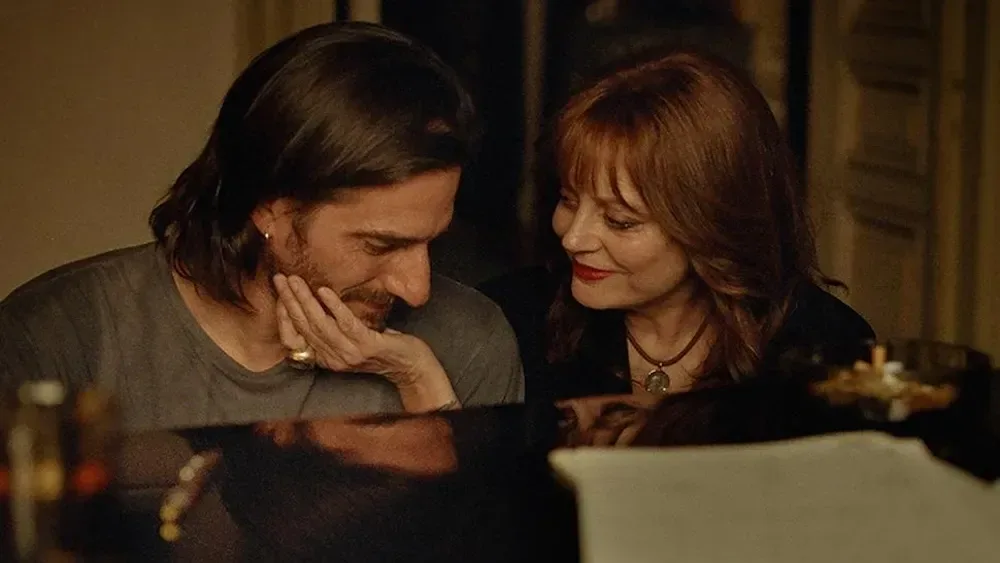
Susan Sarandon provides a welcome jolt as Ava May, a celebrated singer coaxed out of semi-retirement by Leo to make a new record. The songs, written by Clément Ducol and Émilie Gassin, suit Sarandon’s weathered vocal presence and lend the film a smoky, nocturnal musical texture. Ava May is not merely a famous visitor to the apartment; she is Leo’s creative partner and an older figure whose relationship to regret, love and survival has more texture than the central romance is always afforded.
Sarandon plays Ava May with wit, weariness and a merciless eye for self-deception. Her scenes suggest another, richer film running alongside this one: a story about an artist returning to her voice and the surprising intimacy of a friendship built in the studio. The character’s perspective also punctures some of the angelic framing surrounding Anne. Ava May sees enough to understand that idealization is rarely a harmless thing.
There is a compelling movie in The Echo Chamber about how people make mythologies of one another through the rooms, songs and objects they share. Pallaoro gets close to that film repeatedly. The apartment’s beauty is not superficial; it is central to the story’s seduction and its emotional architecture. And the actors make Leo and Anne’s connection sufficiently fragile and sincere that their inability to let go has genuine ache.
Still, the drama is most affecting when it trusts the apartment to hold contradiction: comfort and surveillance, memory and trespass, affection and avoidance. When it reaches for more conventional late-stage intensity, the spell weakens. Like the enclosed romances explored in other recent festival dramas, including the uneasy creative tensions of Agata the Writer, this is a film most alive when its characters’ private rituals reveal the larger stories they cannot articulate.
What to know about ‘The Echo Chamber’
- Director: Andrea Pallaoro
- Screenplay: Bernardo Bertolucci, Ilaria Bernardini and Ludovica Rampoldi
- Cast: Luca Marinelli, Alicia Vikander, Susan Sarandon, Ann Akinjirin, Peter Coonan and Aomi Muyock
- Cinematography: Diego García
- Editor: Paola Freddi
- Music: Clément Ducol
- Languages: English and Italian
- Running time: 123 minutes
- Festival context: Screened in competition at the 2026 Venice Film Festival on September 5
The Echo Chamber is an Italy-Belgium production from Indigo Film and Rai Cinema, co-produced with Versus Production. Its finest qualities are its performances, visual control and the haunting notion that a beloved place can continue a relationship after the people in it have stopped speaking. It simply spends too long repeating that idea, and asks a last-minute melodramatic turn to supply an impact that the apartment, the music and the actors had already been quietly earning on their own.