Company arrives dressed like a severe, melancholy period drama, then slowly reveals a far stranger set of teeth. Casey Affleck’s second feature as writer-director, following 2019’s Light of My Life, is a 96-minute tale constructed from stories inside stories: a visitor is welcomed in from the cold or rain, a host hears an unsettling account, and that account opens onto another household receiving another enigmatic outsider.
It is an inherently promising format for a horror film. Repetition can turn a harmless gesture into an omen. A door opening can become a ritual; hospitality can feel like a mistake being made again and again through history. Yet Company has a central problem: it keeps asking its audience to wait for the pattern to acquire force, only to arrive at a thematic destination that feels more muted than menacing.
The film screened in competition at the Venice Film Festival on September 8, 2026. Affleck directs from a screenplay co-written with Ron Hansen, whose earlier work includes the source novel for The Assassination of Jesse James by the Coward Robert Ford and the screenplay for The World to Come. That creative combination helps explain the film’s frontier sensibility: its landscapes, homes and characters are burdened by silence, weather, old wounds and the uncomfortable obligations of living near other people.
A nesting-doll structure with a very long wind-up
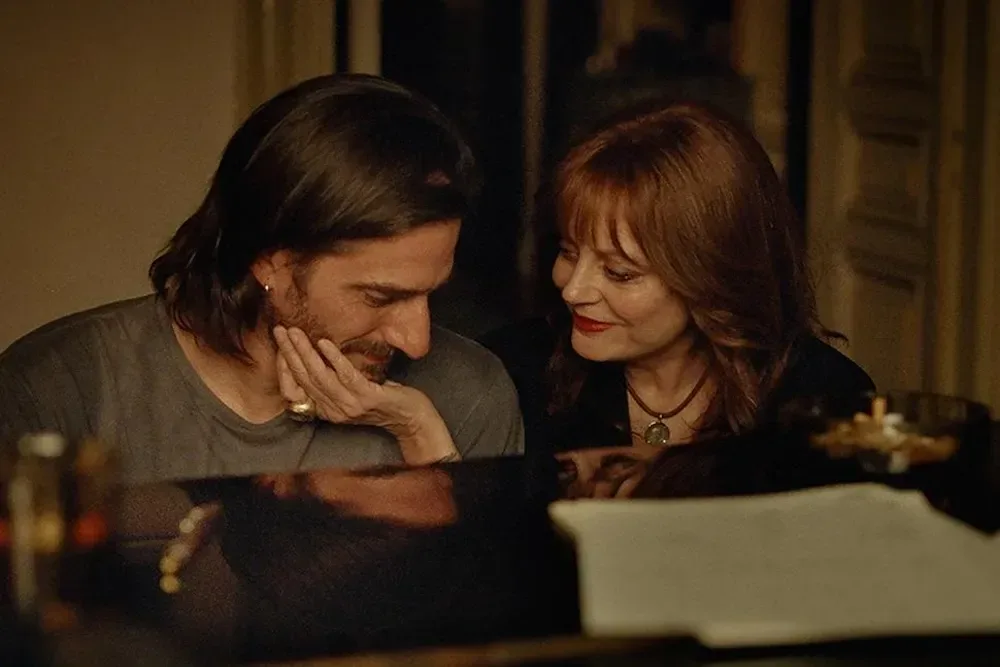
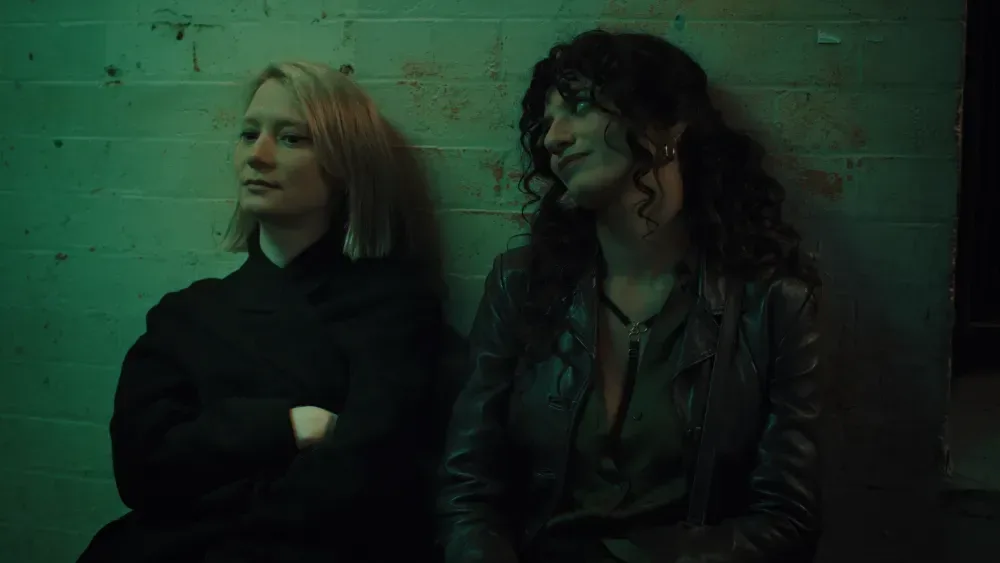
Company begins in 1975 during a storm. Evelyn, played by Emily Alyn Lind, arrives at the home of a man who does not recognize the person she has asked to see. He nevertheless invites the drenched stranger inside, where a Christmas party is underway. Evelyn is self-contained, formally dressed and captivating enough to persuade the gathering to hear her story. Bob Dylan’s “Shelter From the Storm” introduces the film, a choice that signals both its literal weather and its deeper fixation on the risks of offering refuge.
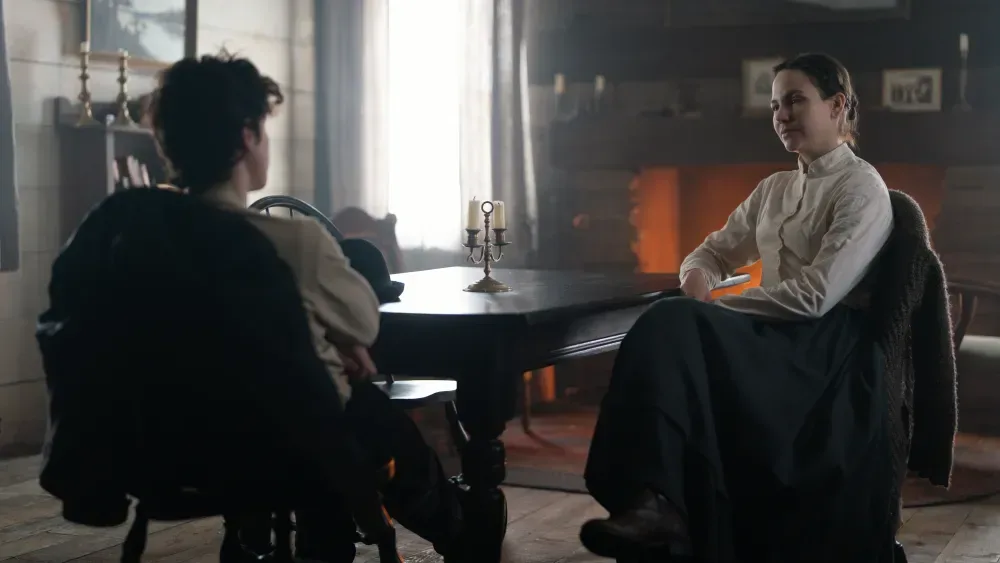
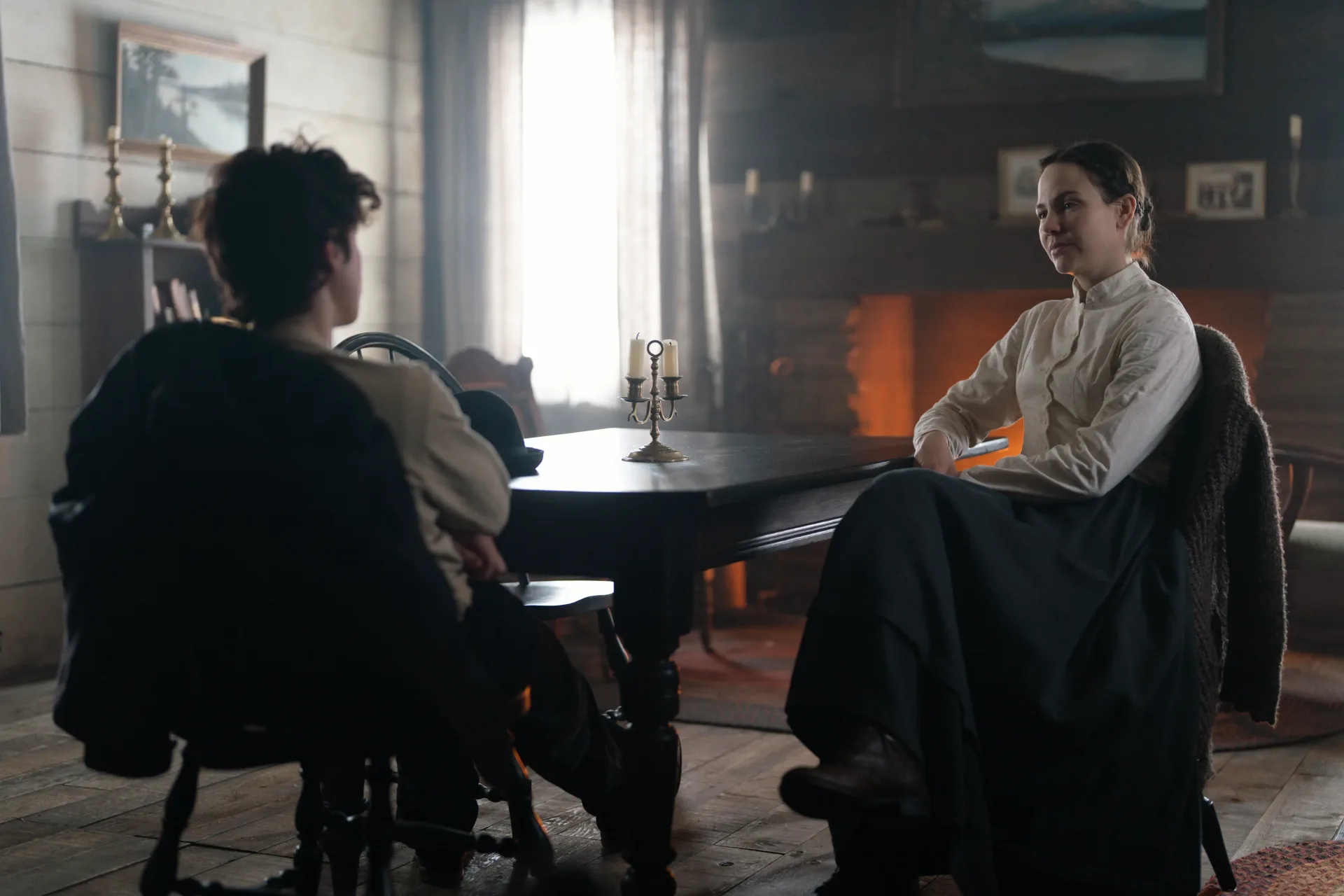
Her story moves to Colorado in 1953. Tom, an elderly widower played by Nick Nolte, discovers a young woman named Alice, played by Caylee Cowan, collapsed in the snow near his remote cabin. Tom takes her in and helps her recover. Alice, in exchange, begins a story of her own, set in 1903 and centered on Colorado farmers Rebecca and Emmett. Adelaide Clemens plays Rebecca, while Scoot McNairy plays Emmett. They find an unconscious young drifter named Caleb in the snow and carry him back to their farm.
By the third arrival, the movie’s recurring design is unmistakable. Each episode depends on the friction between decency and self-protection. The people with warm homes and limited resources must decide whether they can live with the consequences of turning someone away. The strangers know that need can be a potent form of leverage. There is compelling material in that equation, particularly in a historical setting where survival can hinge on a single night of shelter.
But the first two movements function mostly as extended preludes to the 1903 story, which becomes the film’s main arena. The result is a deliberately unhurried opening that withholds too much momentum. The script treats the audience’s awareness of repetition as suspense, though repetition alone is not escalation. The film sets a table three times before serving its real dramatic conflict, and the wait is difficult to justify.
Spoiler warning: the genre hiding in the snow
The next section discusses the film’s major genre reveal.
For much of its running time, Company can pass for a mournful revisionist Western or a rural Gothic drama about violence spreading through isolated communities. Its ultimate identity is that of a period-set vampire story. In all three time periods, an unnervingly composed outsider in stark clothing gains access to a household. Bloody violence and accumulating details clarify that these are not simply cautionary tales about misplaced trust.
The reveal reframes the film’s sequence of stories, though it does not radically transform the stakes. Rather than unleashing a more propulsive horror picture, it leads toward a vampire mythology built around reciprocity. These vampires are not presented as creatures incapable of grace. Kindness shown to them can be answered with mercy; cruelty invites a far less forgiving response. That is a distinctive variation on familiar lore, and it gives the film a fable-like interest in whether people and monsters are defined by what they take or by what they return.
There is room in that idea for a sharp meditation on community, American isolation and the moral weight of welcome. Instead, the movie’s seriousness often stiffens into inertia. The dialogue aims for grave lyricism, and the filmmaking gives the land a spare, tactile beauty, but neither quality consistently translates into dread. Company is not short on frost, shadow or portent. It is short on a reason for each new revelation to feel urgently connected to the last.
That conceal-and-reveal rhythm can work beautifully when the eventual turn sends viewers back through the preceding scenes with fresh energy. Players accustomed to hidden identities and carefully planted clues may see a useful point of comparison in a recent look at Danganronpa 2×2’s hidden-character tease: the trick is not merely concealing information, but making the clues feel charged once they are recognized. Company has clues, but its post-reveal momentum remains subdued.
Atticus Affleck and Ben Mendelsohn supply the film’s sharpest edge
Caleb is played by Atticus Affleck, the director’s teenage son, in a demanding and pivotal role. Caleb is pale, guarded and insolent in a way that makes Rebecca’s interest in helping him feel both compassionate and hazardous. He does not explain himself easily, and the performance’s reserve becomes an asset. Even when the film drifts, Caleb’s presence carries a suggestion that something hostile may be quietly measuring the room.
There are moments when Atticus Affleck’s relative inexperience shows, but he brings genuine mystery to the character. His stillness gives the picture some of its few sustained pulses of danger. The role requires him to be emotionally withholding without becoming inert, and he often achieves that uneasy balance.
McNairy gives Emmett a practical, increasingly alarmed skepticism. He understands immediately that the drifter’s arrival may impose a cost his household cannot afford, while Clemens gives Rebecca the patient moral conviction that keeps Caleb near the farm. Their conflict is straightforward but effective: Rebecca sees a person who needs help; Emmett sees a threat he cannot name but cannot ignore.
The standout among the ensemble is Ben Mendelsohn as the neighboring farmer Kleinschmidt. In a sustained confrontation with Caleb, Mendelsohn brings speed, acidity and alertness to the film’s otherwise hushed dialogue. The exchange finally makes Affleck and Hansen’s stylized language feel dangerous rather than merely solemn. Mendelsohn’s character senses the wrongness at the heart of the situation, and his performance makes that suspicion bracingly tangible.
Handsome images, unclear authorship
Affleck remains a filmmaker capable of imposing a distinct mood. Company looks austere and earthbound, with snowy landscapes, weathered interiors and period clothing lending its three eras a consistent palette of muted textures. Daniel Hart provides the music, while the camera credits are unusually expansive: Affleck is among eight credited cinematographers, alongside Masanobu Takayanagi, Lachlan Milne, Adam Arkapaw, Marcell Rév, Hoger Jungnickel, Joaquin Baca Asay and Noah Fallis.
Such a large group of directors of photography invites curiosity, especially given the film’s multiple historical frames. The nested design might suggest that each era would receive its own visual character. Instead, the three periods largely share the same sober, dusty, wintry aesthetic. That consistency is not unattractive; it reinforces the notion of history repeating under different roofs. Still, it leaves the reason for the unusually broad camera credit difficult to discern from the finished film itself.
Company is therefore more interesting as a description than as an experience: a Colorado-set vampire fable spanning 1903, 1953 and 1975, made with a serious eye for landscape and a patient devotion to moral allegory. It has a memorable premise, a persuasive sense of place, an engagingly elusive performance from Atticus Affleck and a particularly lively turn from Mendelsohn. Yet its layers do not produce corresponding depth. The film’s invitation into the storm is intriguing; once inside, the conversation goes on too long without finding enough bite.
Key details
- Title: Company
- Director: Casey Affleck
- Screenplay: Casey Affleck and Ron Hansen
- Running time: 96 minutes
- Cast: Atticus Affleck, Adelaide Clemens, Scoot McNairy, Emily Alyn Lind, Ben Mendelsohn, Caylee Cowan, Nick Nolte and Indiana Affleck
- Language: English
- Festival screening: Venice Film Festival competition, September 8, 2026