The Avalanches have long made music that treats recorded sound as a vast toy box. On No Bad Memories, that instinct remains intact, but the focus appears to be less about overwhelming the listener with the sheer density of the construction and more about making a large, quick-moving set of songs feel buoyant, melodic and welcoming.
The new album is a 31-track collection that runs for nearly an hour, and its scale matters. That is a lot of titles, transitions, voices and ideas to place into a relatively compact runtime. Rather than suggesting a sequence of long, sprawling compositions, that framing points to an album built from concise bursts of color and momentum. The result is described as especially happy-sounding: energetic beats, humorous snippets and effervescent melodies give its title a fitting emotional character.
For a group whose identity is entwined with sampling, that emphasis on mood is significant. Sampling is the practice of incorporating portions of existing recordings into a new work. At its most basic, a sample might supply a drum break, a vocal phrase or a tiny melodic detail. The Avalanches’ work has historically pushed the idea much further, assembling fragments of music and non-musical audio into densely layered arrangements. Yet the samples are not simply there as a technical flex. Their role on No Bad Memories is to help shape songs with a sense of lift, playfulness and memorable melody.
From maximal collage to song-centered construction
The contrast with the group’s landmark 2000 debut, Since I Left You, helps explain where No Bad Memories sits in their catalog. That earlier record was reported to have been made from roughly 3,500 samples, with no live instrumentation. Its material ranged from Madonna’s “Borderline” and old soul recordings to obscure tracks, advertisements, film-score passages and dialogue from movies or television. “Frontier Psychiatrist,” in particular, made the line “That boy needs therapy” into an unforgettable piece of musical punctuation.
That approach can be called plunderphonics: music constructed through the creative reuse and transformation of existing audio. In the Avalanches’ hands, it has meant more than stacking recognizable references. Their arrangements can be deliberately chaotic, with multiple textures seeming to compete for attention, but melody and songwriting have been central to why the records connect. The collage is not the destination; it is the environment in which the hooks live.
After a long gap, the group returned as a duo with 2016’s Wildflower, followed five years later by We Will Always Love You. Both records retained expansive sampling and sound bites, while shifting the balance toward more conventional song forms and a broad set of featured performers. Guests across those albums included Biz Markie, Karen O, Danny Brown and Mick Jones. That progression is the clearest lens for the new album: the sound design is still elaborate, but it works in service of individual songs rather than permanently claiming the foreground.
No Bad Memories continues that guest-driven model. Its contributors include Jamie xx, Panda Bear, Karen O, Mike Patton of Faith No More and Carly Simon, alongside Portraits of Tracy, John Glacier, Barry Can’t Swim and others. The lineup alone suggests that the record is not designed around a single vocal character. It can change shape from track to track, using different performers as another part of its palette.
That flexibility is one reason a 31-track album can feel purposeful rather than merely overstuffed. A guest vocalist does not only provide a name on a track listing; a different voice can alter the perceived era, genre and emotional temperature of a composition. In a sample-based setting, a singer may become one more element that connects disparate sounds into a recognizable whole.
Key songs and a deliberately short-form pace
The lead singles “Together” and “Every Single Weekend” are among the record’s named highlights. So is “Final Credits,” featuring Loaded Honey, which is said to evoke an early-1970s soul record. That description speaks to an enduring Avalanches strength: the ability to summon the feel of a musical period without making the album read as a museum display. Soul’s warmth and vocal richness are useful colors in a wider collage, especially on a record whose prevailing mood is celebratory.
“One More Fantasy” may be the sharpest example of the album’s fusion of reference points. It combines a Kraftwerkian loop with a soaring melody and a high vocal from Carly Simon. “Kraftwerkian” here means a style associated with precise, repeating electronic patterns: machine-like in structure, but capable of becoming hypnotic and emotionally evocative through repetition. Pairing that kind of loop with Simon’s vocal creates a productive tension between cool electronic architecture and human expressiveness.
It is also notably brief. That brevity is not incidental on an album with 31 tracks in almost an hour. The format favors motion. A striking idea can arrive, make its impression and yield to another before it becomes routine. For listeners, the practical implication is that No Bad Memories may reward a complete, uninterrupted listen as much as it does selective playback of the singles. Its effect is likely tied not only to individual songs but to the momentum of changing voices, sounds and tiny details.
The album’s fast-moving design is also a reminder that maximalism does not always mean length. A dense production can use dozens of small components in the space of a few minutes. The Avalanches’ particular version of abundance is about concentration: many cultural and sonic ideas compressed into a pop-oriented frame.
Y2K-era sounds are part of the album’s world
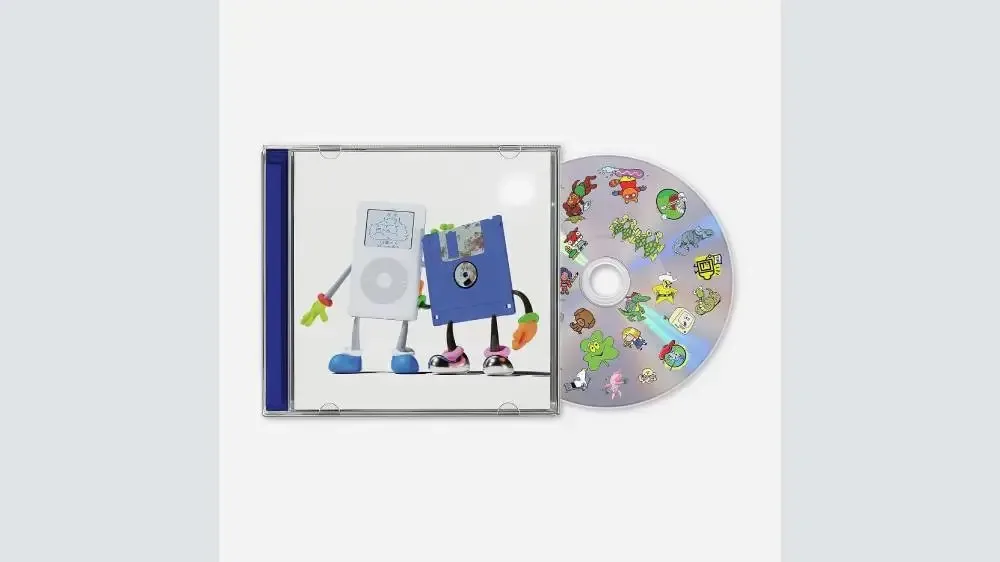
A recurring motif on No Bad Memories is the sound of 1990s and 2000s video games, consumer technology and advertising. Those references are reinforced by the cover image, which depicts an iPod and a floppy disk as characters standing beside one another. The image is playful, but it also outlines the record’s aesthetic territory: a period when physical media, early portable digital devices, game interfaces and highly recognizable commercial sounds overlapped.
This is not simply nostalgia deployed as wallpaper. Technology sounds have a special musical utility because they tend to be short, percussive and instantly legible. A startup tone, an alert-like chime, a menu sound or an advertising fragment can act like rhythmic punctuation. Even when a listener cannot identify its origin, it may evoke the habits of using computers, listening devices or games from a particular period.
For gaming audiences, this is where the album’s references may feel especially immediate. The texture of older game and technology audio is not only about primitive hardware or pixel-era visuals. It is about interface language: repeated loops, crisp effects, reward-like stings, menu cues and the peculiar cheerfulness of sounds designed to grab attention in a second or two. Folding that vocabulary into dance-oriented, melody-forward music can make the past feel tactile rather than distant.
The reference point is broad enough to include advertising snippets as well. Commercial audio and game audio share a useful quality for a sample-based act: both are often made to deliver a clear impression immediately. In a collage, those fragments can bring humor, familiarity or sudden changes of scale. They also help explain why the album’s upbeat presentation need not be simplistic. A humorous sound bite can disrupt a polished passage; a digital tone can make a soulful vocal feel newly strange; an old-format object on the cover can become a visual shorthand for a whole era of media use.
That sensibility makes No Bad Memories relevant to a culture in which retro technology remains a powerful aesthetic language. The album does not need to be a historical document about any one device or platform to use those sounds effectively. It instead treats them as emotional triggers and compositional materials, much as earlier Avalanches work treated records, dialogue and found audio.
Why the album’s guest list matters
The performers on No Bad Memories represent distinct musical identities, and that variety strengthens the premise of a record built from contrast. Karen O has appeared in the Avalanches’ later work before, while Carly Simon’s contribution to “One More Fantasy” introduces a striking vocal presence over electronic repetition. Mike Patton, Panda Bear, Jamie xx, John Glacier and Barry Can’t Swim further signal an album comfortable moving among different voices and sensibilities rather than settling into one lane.
Still, the record’s reported strength is not merely that it has a substantial list of collaborators. A guest-heavy album succeeds when the participants serve the songs, and the Avalanches’ post-debut approach has increasingly been described in those terms. Sampling, snippets and guests support the arrangement; they do not erase the central melodic idea. That is a useful distinction for listeners approaching the group for the first time. Expect elaborate surfaces, but do not expect an exercise in obscurity for its own sake.
There is a wider music-world context for that balancing act, too. Sampling can turn listening itself into a form of composition, connecting recordings that might otherwise never share space. But the emotional payoff still depends on songcraft: the placement of a chorus, the rise of a melody, the timing of a beat and the way a voice enters. The Avalanches’ reputation was built on astonishingly deep crate-digging and adventurous editing, yet the enduring appeal of their work comes from its sense of joy.
For another current music-industry story, see this report on Cordae, MMMG and a planned Anderson .Paak project release.
An album built to brighten the room
At nearly an hour, No Bad Memories is not small. At 31 tracks, it is not modest. Yet its defining feature is not presented as heaviness or excess, but brightness. Its numerous contributors, retro-tech gestures, advertising fragments, energetic beats and carefully placed vocal moments all feed a cheerful, high-motion atmosphere.
That makes the album’s title feel less like a claim of amnesia than a statement of intent. The Avalanches’ new record looks backward at the media debris of recent decades—floppy disks, iPods, video-game-like tones, commercial snippets and inherited musical forms—then reorganizes it into something warmly immediate. The machinery of sampling is still visible, but the melodies are doing the inviting.