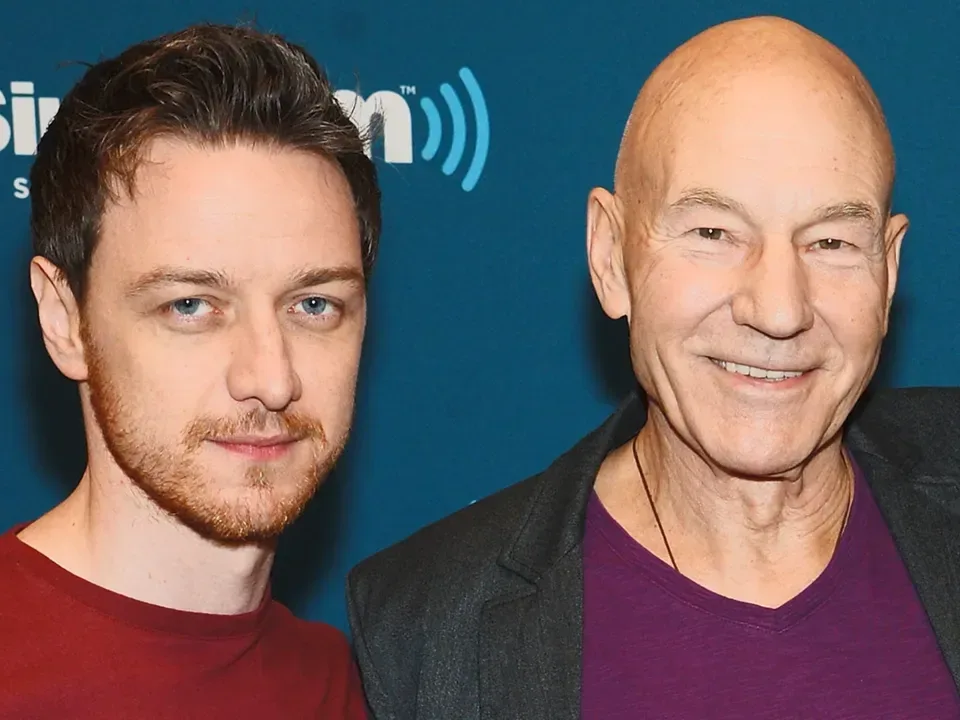
James McAvoy has revealed that he once pitched a Star Trek limited series in which he would have played a younger Jean-Luc Picard — another younger incarnation of Patrick Stewart, following McAvoy’s years as Charles Xavier in the X-Men films.
The proposed show had a working premise and a very specific setting: Mutiny on the Stargazer. McAvoy described it as a one-season, standalone story set when Picard first became captain of the Stargazer. Its central dramatic hook would have involved a mutiny and a secret the character had apparently carried through the rest of his career.
“It was like a one-off standalone season when he took over as captain of the Stargazer, and what actually happened and the secret he's been holding his entire career,” McAvoy said.
McAvoy said he pitched the idea to the people overseeing Star Trek, and that the project came close enough to being made that it was seriously considered. It ultimately did not happen because of logistical issues. No details were given about those issues, the proposed episode count, other prospective cast members, or how far development progressed.
That distinction matters. This is not confirmation that a young-Picard series is now in development, nor does it reveal a currently planned Star Trek production. It is a look at an unrealized pitch that McAvoy still clearly remembers fondly.
A prequel built around Picard’s earliest command
Jean-Luc Picard is one of the defining captains in the franchise, but much of the character’s major screen history has focused on later chapters. Patrick Stewart introduced Picard as captain of the USS Enterprise in Star Trek: The Next Generation. The character’s story subsequently continued through films including First Contact, Insurrection, and Nemesis, before Stewart returned for Star Trek: Picard, which ran from 2020 to 2023.
McAvoy’s concept would have looked in the opposite direction. Rather than revisiting an experienced Enterprise captain or continuing the story of Picard in later life, it would have centered on a pivotal earlier promotion: his arrival as captain of the Stargazer.
That makes the title more than a dramatic flourish. A mutiny is a refusal by a crew to accept the authority of a ship’s commander. In a story about a newly installed captain, it would immediately put Picard’s authority, judgment, and ability to hold a crew together under pressure at the center of the series. The reported “secret” provides a second layer: the event would not merely be an early-career crisis, but something intended to reframe parts of the Picard audiences already know.
The proposal’s limited-series form is also significant. A standalone season is designed to tell a contained story rather than requiring an indefinite multi-season plan. For an origin-period drama about one consequential command, that structure could have offered a defined beginning, conflict, and resolution without turning every unknown part of Picard’s past into a long-running prequel.
Why McAvoy saw himself in the role
McAvoy’s enthusiasm for playing young Picard is inseparable from his professional relationship to Patrick Stewart’s screen legacy. McAvoy portrayed the younger Charles Xavier in X-Men: First Class, Days of Future Past, Apocalypse, and Dark Phoenix. Stewart had previously made the older Xavier a central figure in the earlier X-Men films.
McAvoy summed up the connection with a deliberately playful line: “All I really want to do in my career is play young versions of Patrick.” It is a joke with a serious creative premise behind it. An actor returning to a character previously associated with another performer has to create a performance that is recognizably connected while still working as a person at a different point in life.
That is particularly true with Picard. The role is not only defined by plot events. Audiences associate the captain with Stewart’s voice, composure, precision, moral seriousness, and the accumulated perspective of a veteran officer. A younger version would need room for uncertainty and inexperience, but would also need to suggest the person Picard becomes. McAvoy’s Xavier work gave him experience navigating exactly that kind of interpretive balance.
For readers tracking the wider superhero side of McAvoy’s career, there is more on the current swirl of X-Men role speculation.
What is known — and what remains unknown
The available information supports a compelling outline, but not a full production history. McAvoy had a story. It was called Mutiny on the Stargazer. It was imagined as a one-off season about Picard assuming command of the Stargazer, an onboard mutiny, and a long-held secret. He says the idea nearly went forward, before logistical obstacles ended the effort.
Everything beyond that should be treated cautiously. There is no disclosed timeline for when the pitch was made, no confirmation of a script, no public account of whether the story was formally commissioned, and no indication that it remains active. Likewise, the nature of Picard’s proposed secret has not been revealed. It is tempting to fill that space with franchise lore or theories, but McAvoy has not provided enough detail to establish any particular answer.
There is also no reason to assume that a concept being “well into” discussion guarantees it was close to cameras rolling. Film and television development has many stages, and a project can have a strong premise, interested creative parties, and substantial internal discussion without becoming a finished series. McAvoy’s comments are best read as evidence that the pitch had momentum, not as evidence of an unproduced season sitting fully formed in a vault.
The appeal of leaving some history unexplained
Picard’s long career creates a natural attraction for prequel storytelling: there are earlier commands, relationships, and decisions that viewers did not see unfold in full. But an early-Picard story comes with a built-in creative challenge. The more explicitly a prequel explains, the more it must coexist with what later stories have already established and with the audience’s own sense of the character.
McAvoy’s pitch appears to have addressed that challenge by focusing on one episode of consequence rather than trying to chronicle every formative year. A mutiny during the first Stargazer command would be a concentrated test of leadership. It could examine how a young officer deals with fractured trust, without requiring the premise to become a comprehensive biography.
The “secret” element would make that approach riskier as well as potentially richer. Retrospective revelations can deepen a character when they clarify an emotional or ethical burden that was always plausible. They can feel less satisfying when they exist only to add surprise. Without more plot detail, there is no way to judge where this particular story would have landed. What can be said is that McAvoy was aiming for a tale with consequences that extended beyond its own season.
A missed pairing, not a promise of one
The strongest immediate appeal of Mutiny on the Stargazer is easy to understand. McAvoy has already taken on one younger version of a character famously played by Stewart, and Picard’s early captaincy is a portion of the character’s life that has far less screen focus than his Enterprise years or his later return in Star Trek: Picard.
Still, the project remains a missed opportunity rather than an announced return. McAvoy has said that he continues to think about the story, which suggests how personally important it remains to him. But fondness for an idea and present-day production plans are not the same thing.
For now, fans have an intriguing alternate-history pitch: a contained Star Trek drama about the captain before the Enterprise, led by an actor with unusual prior experience in carrying forward Patrick Stewart’s character legacy. The Stargazer mutiny, the buried secret, and McAvoy’s take on young Picard are all possibilities that never reached the screen — but they are now a little less mysterious than they were before.