The Assassin(s) takes a real and still-sensitive 1974 assassination attempt in South Korea and refashions its gaps, contradictions and unanswered questions into a full-throttle political mystery. Directed by Hur Jin-ho, the 131-minute film centers not on a single gunman, but on the people trying to understand what happened after an attack on prime minister Park Chung-hee leaves first lady Yuk Young-soo and a young bystander dead.
That setup carries obvious historical weight. It also calls for a crucial distinction: this is not presented as a documentary reconstruction or a settled account of the event. The film reportedly opens with a disclaimer acknowledging its fictional elements, and its plot develops elaborate conspiratorial explanations. Its interest lies in the suspense generated by official obstruction, compromised evidence and dangerous questions—not in offering a definitive historical solution.
That framing lets Hur build a story about the machinery around a national crisis. The film’s protagonists are journalists and a police detective operating under severe censorship, where asking the next obvious question can become a professional or personal risk. The resulting shape is that of a cover-up thriller: each clue promises clarity, while institutional power makes the truth harder to reach.
A mystery built around reporters, not omniscient heroes
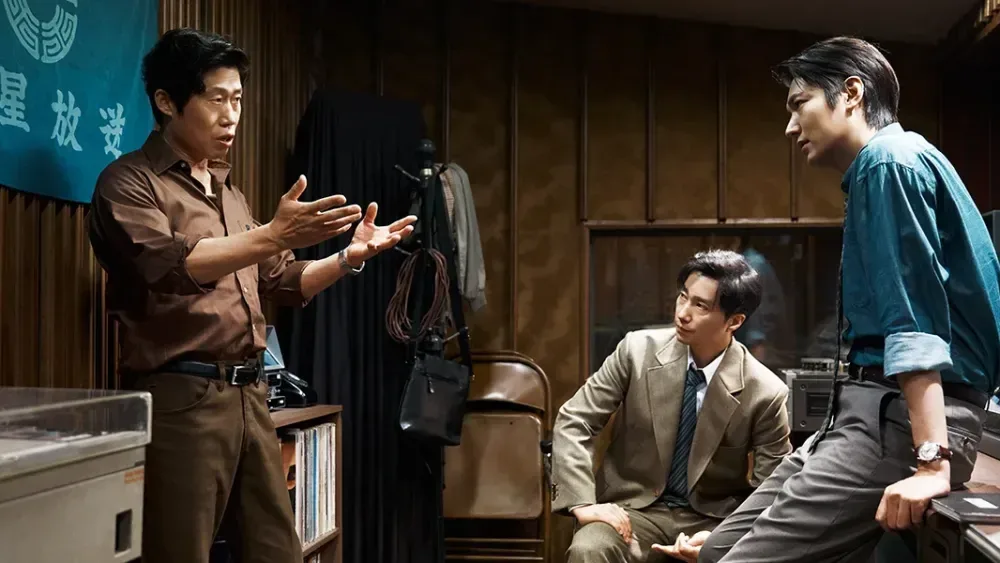
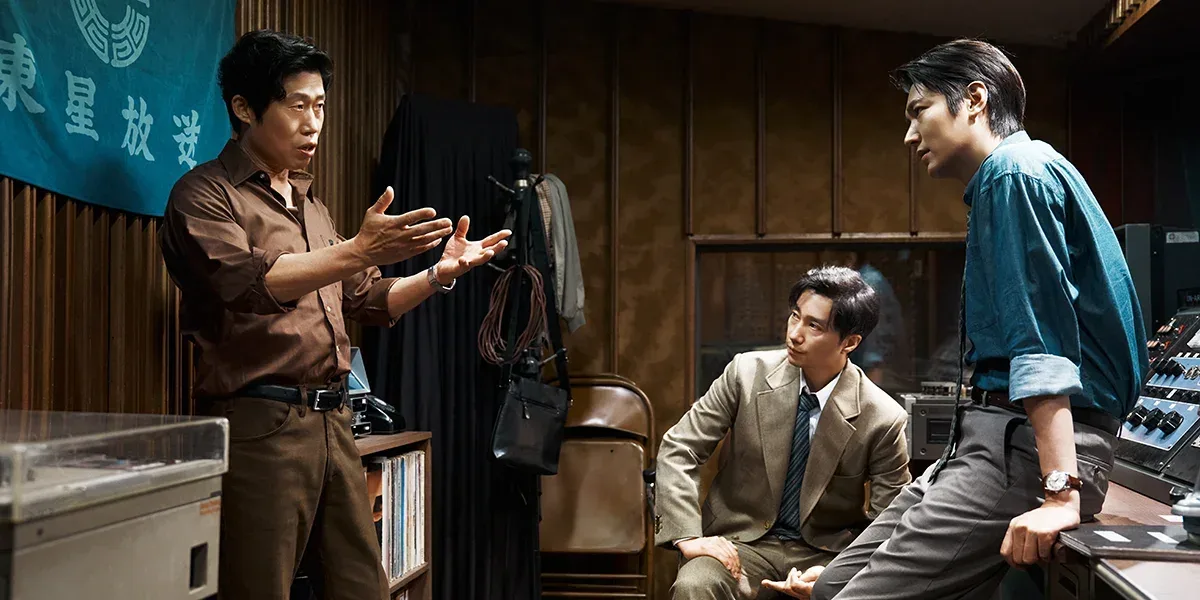
Lee Min-ho plays Young-il, a fiery young reporter at the Dong-sung Daily. He has a family connection to official power through his older brother, but that proximity does not insulate him from the implications of what he witnesses. Assigned to cover Park’s Liberation Day speech, Young-il is present when the shooting goes wrong. His position gives the film an on-the-ground perspective: he sees the rupture first-hand, then confronts the pressure surrounding the story afterward.
Park Hae-il’s Jae-hwan offers a different investigative angle. He is the older, more weathered City Desk lead at the same newspaper, pursuing the case from a distance and working through sources. The pairing gives the movie two journalistic energies: Young-il’s immediacy and anger alongside Jae-hwan’s experience of how institutions bury inconvenient details.
Their essential ally is detective Cheol-goo, played by Yoo Hai-jin. Cheol-goo’s stake is especially sharp. He tries to block the eventual assassin from entering the auditorium, only to be overruled by senior authority. He is subsequently punished by officials who decline to listen to his account. In a thriller, that kind of reversal does more than establish a possible plot. It illustrates a system in which following procedure is no protection when powerful people have already decided what the story must be.
These three figures make the film’s investigation more than an abstract puzzle. Their separate routes into the same event—eyewitness reporting, newsroom digging and police procedure—allow the narrative to repeatedly test whether facts can survive contact with authority.
What the film means by a cover-up thriller
A cover-up thriller is less concerned with simply identifying a culprit than with tracking the forces that control evidence, testimony and public perception. The Assassin(s) appears to embrace that approach. The KCIA, or Korean Central Intelligence Agency, pressures the Dong-sung Daily after it publishes troublesome reporting in the lead-up to the assassination attempt. At the paper, the stakes become immediate: report freely and invite reprisals, or retreat from the work and enable the official version of events.
Related coverage includes ‘The Assassin(s)’ Builds a Tense Political Mystery Around 1974 South Korea.
Bae Seong-woo plays the newspaper editor caught between those obligations. Park Hoon plays a particularly aggressive KCIA operative who harasses the paper’s staff. Their roles place the conflict squarely within the newsroom. Freedom of the press is not merely a theme discussed from a safe distance; it is dramatized as an everyday decision about what gets printed, who is intimidated and which facts are permitted to remain visible.
The film’s momentum reportedly comes from process: reporters cultivating sources, investigators questioning witnesses and characters examining documents that someone would prefer stayed unseen. Those are modest actions on paper, but political thrillers turn them into set pieces by making access itself the danger. A closed door, a missing file or an instruction from a superior can carry as much menace as a chase scene when the central question is whether the state is shaping the evidence.
Hur’s film also expands beyond the immediate scene of the attack. Its fictional mystery involves a Zainichi assassin—an ethnic Korean in Japan—and tensions between North and South Korea. The investigation becomes a follow-the-money trail that approaches the country’s centers of power. That widening scope is a familiar thriller device, but it has a clear dramatic purpose here: the further the protagonists go, the less plausible it becomes that the truth can be contained within a lone-assailant explanation.
Fictional conspiracy versus historical certainty
The most important way to approach The Assassin(s) is to keep its entertainment and historical claims separate. The real attack and its victims supply the film’s emotional and political charge. The movie’s elaborate collusion, forensic wrongdoing and conspiracy architecture, however, belong to a deliberately imaginative framework.
That does not make the film’s concerns weightless. A fiction can explore a society’s distrust, its frustration with secrecy and its anger at authoritarian control without presenting itself as an answer key. But the disclaimer matters. It signals that viewers should not confuse a gripping causal chain—especially one constructed with the clean escalation of commercial cinema—with proven history.
The distinction is particularly valuable in stories about public trauma. A conspiracy narrative is designed to make disparate details click into place. Real investigations are often messier: evidence can be incomplete, witnesses can conflict and some questions may remain unresolved. A film can transform that uncertainty into drama, but drama’s satisfying shape is not the same as historical confirmation.
By leaning into this tension, The Assassin(s) seems to make its own premise part of the experience. It offers the pleasures of a tightly engineered revelation while acknowledging that it is inventing around a real wound. The question for audiences is not whether every twist should be treated as factual, but whether the invented mystery clarifies the emotional stakes of suppression, censorship and institutional self-protection.
Why the cast and pacing matter
Political thrillers can become schematic if their characters function only as delivery systems for information. The reported strength of The Assassin(s) is that its central trio remains sympathetic and distinct while the case accelerates. Young-il has the combustible urgency of a junior reporter thrown into history. Jae-hwan brings a more fatigued but disciplined perspective. Cheol-goo carries the humiliation of being right about a threat and then treated as disposable.
That combination gives the mystery several kinds of pressure. Young-il can chase an immediate truth; Jae-hwan can judge what a newsroom can responsibly publish; Cheol-goo can see the direct consequence of hierarchy overriding warning signs. The supporting characters intensify the conflict by representing the institutional forces surrounding them, from a fearful editor weighing the cost of resistance to an intelligence operative enforcing it.
The film moves at a quick clip, shifting its investigators closer to and farther from an answer. That push-and-pull is the engine of the genre. A useful clue must create danger; a discovery must introduce another layer; an apparent breakthrough must be vulnerable to official interference. Rather than treating political repression as backdrop, the film uses it as the mechanism that keeps the mystery alive.
Its action therefore has a broader purpose than spectacle. Physical danger is tied to a larger conflict over who has the authority to define a national event. When identities are concealed and records are vulnerable, the characters are not merely trying to protect themselves. They are fighting for the possibility that an inconvenient account can enter the public record.
A festival reception and a larger pop-culture context
The Assassin(s) premiered at the Toronto Film Festival in the Gala Presentations program and finished as second runner-up for the International People’s Choice Award. That response fits a film calibrated as accessible, propulsive entertainment as much as a meditation on political repression. It is positioned as a crowd-facing thriller with a serious historical frame, rather than a dry procedural.
That balance matters in a film landscape where genre is often the route by which difficult subjects reach broad audiences. The industry conversation can also look very different when a movie is measured at the box office; for a contrasting example, see the recent report on Resident Evil’s worldwide opening. The Assassin(s), by contrast, is defined here by its festival unveiling, political premise and the immediate critical attention around its fictionalized investigation.
Behind the camera, Hur Jin-ho directs from a screenplay by Gwon Gi-jun and Lee Ji-min. Lee Mo-gae is credited as cinematographer, Kim Hana and Kim Woo-hyun as editors, and Cho Young-wuk as composer. Kim Won-kuk serves as producer and executive producer. The film is performed in Korean and Japanese.
Ultimately, The Assassin(s) appears designed to make viewers feel the seduction and peril of connecting the dots. It takes a real assassination attempt, treats the uncertainty around it as dramatic fuel and sends reporters and a detective into a world where the powerful may be writing the story before anyone else can. The result is a political thriller whose most responsible reading is also its most interesting one: a forceful work of fiction about what secrecy does to a public searching for truth.