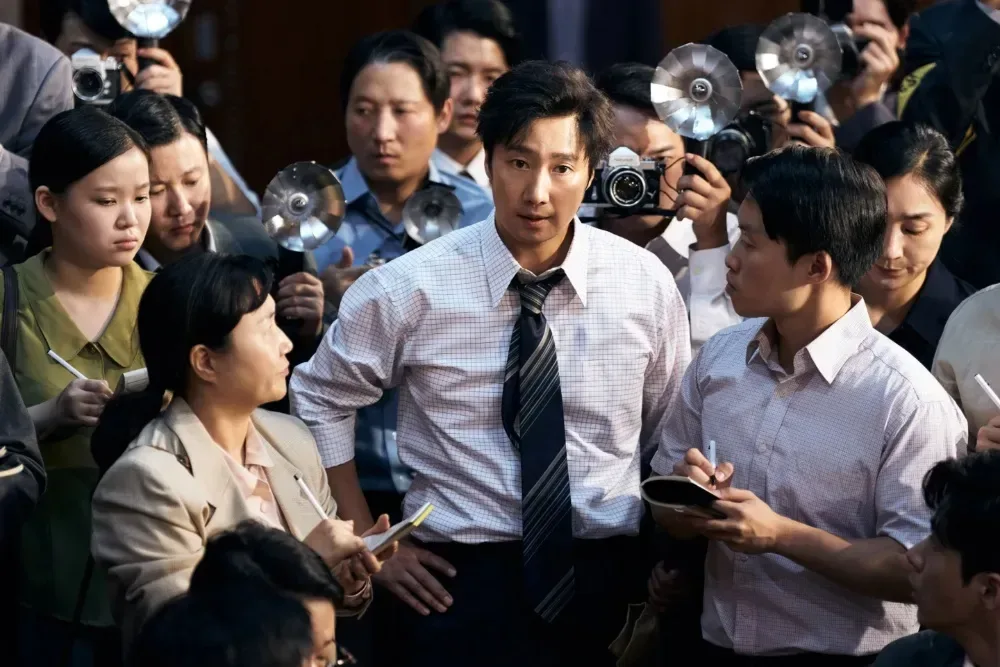
The argument around The Assassin(s) has moved far beyond whether audiences like Hur Jin-ho’s historical thriller. The Directors Guild of Korea (DGK) has publicly backed the people who made the film, warning that criticism of the picture has escalated into attacks on individuals’ livelihoods and demands that the film should never have been made.
That intervention arrives while the movie remains a major commercial success in Korea. It opened on September 23, passed 1 million admissions within four days, and led the national box office again over the October 2–4 weekend. Across 1,129 screens, it sold 412,012 tickets during that frame, grossing KRW4.07 billion (about $3 million). Its reported total stood at 2.23 million admissions and KRW21.9 billion (about $16.3 million).
The commercial result does not settle the historical or political dispute around the movie. But it does establish an important part of the story: the debate is happening around a widely seen work, rather than a fringe title with limited cultural reach.
What the film dramatizes
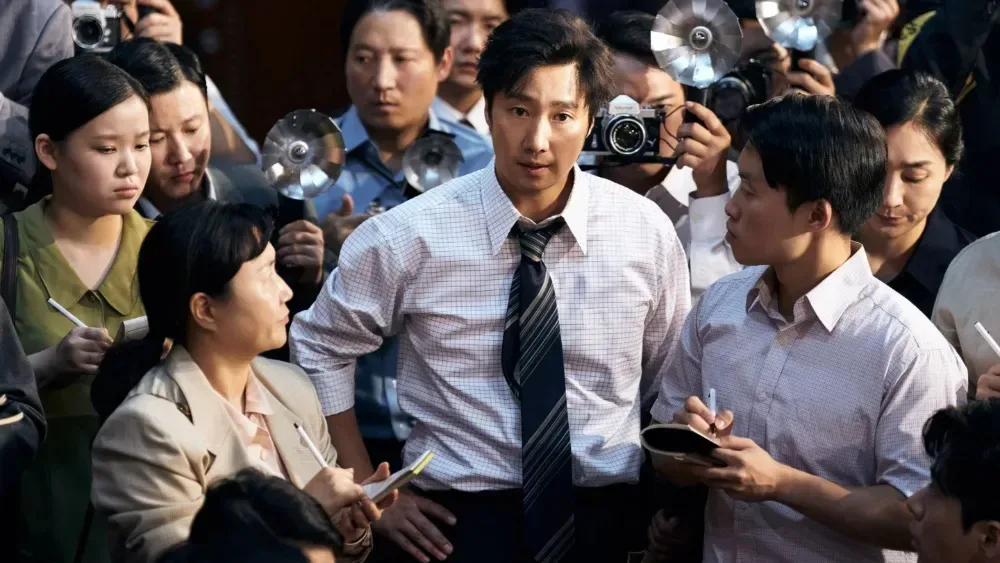
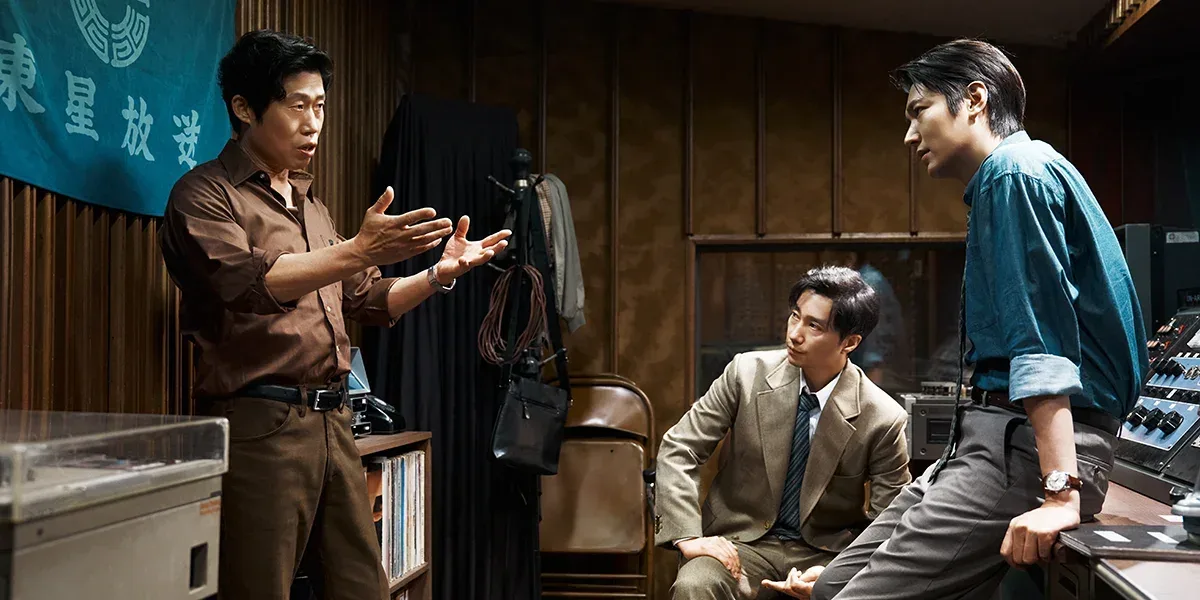
The Assassin(s) concerns the August 15, 1974 shooting at Seoul’s National Theater during Liberation Day celebrations. Yuk Young-soo, the wife of then-President Park Chung-hee, was killed. Yoo Hae-jin plays a police inspector who witnesses the shooting and subsequently leads an investigation. Park Hae-il plays the head of a newspaper social-affairs desk, while Lee Min-ho portrays a rookie reporter.
The official inquiry identified Mun Se-gwang as the sole killer and concluded that he acted under instruction from Pyongyang and Chongryon, the pro-North Korean residents’ association in Japan. Hur’s film, however, does not name a culprit. Its refusal to provide a definitive answer is central to the controversy.
Critics of the film argue that its open ending encourages viewers to suspect Park Chung-hee or his government. The producers have rejected the claim that the movie presents such an accusation as fact. In a September 28 statement, they said no specific individual is identified as being behind the incident and that its hypotheses and dramatic settings are not offered as historical fact.
That distinction matters because a historical drama and a historical account are not automatically the same thing. A drama can use a real event, real public figures and an unresolved or contested atmosphere to create a fictionalized investigation. The creative choice at issue here is not merely that the film revisits a tragic event; it is that it leaves room for uncertainty where the official inquiry offered a firm conclusion.
The complaint is about implication, not an explicit on-screen accusation
Lee Jong-bae, a former Seoul city councilor for the People Power Party, has asked Seoul police to investigate Hur, Hive Media Corp. CEO Kim Won-kuk, and writers Kwon Ki-jun and Lee Ji-min for defamation. The complaint contends that the plural title, The Assassin(s), leads audiences to infer the existence of another culprit beyond Mun.
Related coverage includes Directors Guild Defends ‘The Assassin(s)’ Team as Political Backlash Escalates.
That makes the title itself part of the political dispute. The parenthetical “s” does more than provide an eye-catching name: detractors view it as an invitation to question the official conclusion. The filmmakers’ position is that the movie does not designate any particular person as responsible. Those are materially different claims. One concerns a suggested interpretation that viewers may draw; the other concerns whether the film expressly alleges wrongdoing by an identifiable person.
There is also a parliamentary dimension. People Power Party lawmakers sought to summon Hur to testify at the annual parliamentary audit, but the effort was blocked by the Democratic Party on creative-freedom grounds. The attempted summons and police complaint demonstrate how quickly a disagreement over a movie’s framing can enter formal political and legal channels.
None of that determines the merits of the complaint, the film’s historical interpretation, or how audiences should read its ending. It does show that the public fight is no longer confined to reviews, social platforms or ordinary box-office conversation.
The DGK draws a line between critique and personal targeting
The Directors Guild of Korea did not argue that a film should be insulated from negative reactions. Its statement explicitly acknowledged that all films receive both praise and harsh criticism. Instead, the guild focused on the point at which condemnation of a work becomes pressure placed on the people connected to it.
“Creators can be criticized for their work, but that criticism must not lead to the collapse of the creator’s personal life and livelihood,” the DGK said.
The organization said the hostility had gone beyond criticism of creative decisions and had reached the daily lives and livelihoods of people involved in the production. It also objected to demands that a movie like this should never be made at all. Its broader argument is prospective: filmmakers must retain the possibility of making another work after a disputed one, rather than seeing controversy close off that opportunity.
That is a more specific concern than a blanket request for favorable coverage. A filmmaker can be challenged over accuracy, perspective, ethics, storytelling or political implications. The guild’s warning is about the personal consequences that can follow when disagreement turns into mass targeting, intimidation, or efforts to remove someone’s ability to keep working.
The distinction is particularly relevant to collaborative art. A feature film is not the work of one person alone. It involves performers, writers, producers, technicians and many other contributors. When anger spreads indiscriminately, people whose role was limited to acting in, recommending or discussing the movie can become targets of the same campaign.
Backlash has reached performers, reviewers and supporters
The reported response around The Assassin(s) has included a wave of one-star ratings on review sites and abusive comments on cast members’ social-media accounts. Kim Go-eun and Lee Young-ae, who had posted handwritten recommendations of the film, also received targeting. Critic Lee Dong-jin, who discussed the title in a video review, was likewise caught up in the backlash.
One YouTube film reviewer with 4.17 million subscribers removed a video about the movie. That detail is significant not because it reveals why the video was pulled, which has not been established here, but because it illustrates the spillover from the film itself into the broader ecosystem that surrounds a release: recommendations, criticism, audience discussion and cultural commentary.
Reviewing a film, endorsing it or appearing in it are separate activities. Treating each as proof that a person owns every possible interpretation of a movie narrows the space for criticism and recommendation alike. The DGK’s statement is fundamentally concerned with preserving that space, even where the work in question provokes a serious dispute.
Screen stories have always generated competing readings, especially when they engage with political memory. The stakes rise when the narrative deals with a national tragedy and a prominent political figure. Yet interpretation is not a one-way process controlled by creators: audiences bring their own assumptions and conclusions to an ambiguous ending. The current fight over The Assassin(s) is in part a fight over whether a film can leave that interpretive work to viewers without being treated as having made an explicit historical declaration.
Why ambiguity is at the center of the fight
Ambiguity is a storytelling technique in which a work deliberately withholds a final answer or leaves multiple readings open. It can be used to create suspense, represent uncertainty, or encourage an audience to weigh competing explanations. In this case, the technique is controversial precisely because the real-world event had an official finding.
For opponents, an open conclusion concerning an assassination can seem to undermine or cast doubt on that finding. For the producers, the absence of a named culprit is evidence that the film does not assert an alternative culprit. The same narrative choice can therefore be understood either as an implication or as an avoidance of assertion.
This does not mean every interpretation is equally grounded in the film; it means the central disagreement concerns interpretation rather than a reported line in which the movie declares that Park Chung-hee or his government ordered the killing. The producers’ statement is direct on this point: the film’s speculative elements are not presented as history.
That is also why the plural title has become so prominent in the complaint. A title can establish a mood, frame a mystery or plant a question before a viewer sees a scene. Here, the complainant argues it communicates more than the producers say the narrative explicitly does. The eventual handling of the complaint, if it proceeds, will be relevant to the named individuals. It should not be mistaken for a settled judgment at this stage.
A successful release still faces an unsettled public debate
Acclaim and commercial momentum have accompanied the controversy. Park Chan-wook praised the film as intelligently conceived during a September 26 audience Q&A. The movie is also set to open the 37th Singapore International Film Festival on October 21, with Hur scheduled to attend alongside Shim Eun-kyung and Park Sung-hoon. The festival runs through November 1.
Its festival selection gives the work another international setting in which viewers may engage with it as cinema, while the Korean debate remains intensely tied to domestic history and politics. Those contexts need not produce the same reading. A film about a historical incident can be watched as a thriller, a media-and-police investigation, a provocation about uncertainty, or an unwelcome reframing of a known event. The strength of the reaction shows that, for many, those categories cannot be neatly separated.
The DGK’s intervention does not ask people to abandon criticism. It argues that cinema should remain a place where conflicting ideas and voices can meet, including when the result is unsettling or divisive. That principle has a practical application in this case: challenge the film’s choices, debate its implications and scrutinize its treatment of history, but do not turn every actor, reviewer or supporter into a permissible target.
There is a useful parallel in the way screen culture constantly invites arguments over who controls a character’s meaning, a plot’s answer or an ending’s implications. Even the resolution of a fictional mystery can reshape a franchise’s discussion, as seen in the debate around a major television finale. With The Assassin(s), however, the subject is not an invented universe but a real assassination and a still-politicized part of Korean history. That difference gives the interpretive dispute far greater consequence.
For now, the facts are clear enough to separate: The Assassin(s) is drawing substantial audiences; some conservative politicians and online critics accuse it of distorting history; its creators face a request for a police investigation; and the Directors Guild of Korea says the reaction has crossed from film criticism into attacks on people. Whether audiences accept the movie’s ambiguity or regard it as an unacceptable insinuation, the argument over its limits is likely to remain as visible as the film itself.