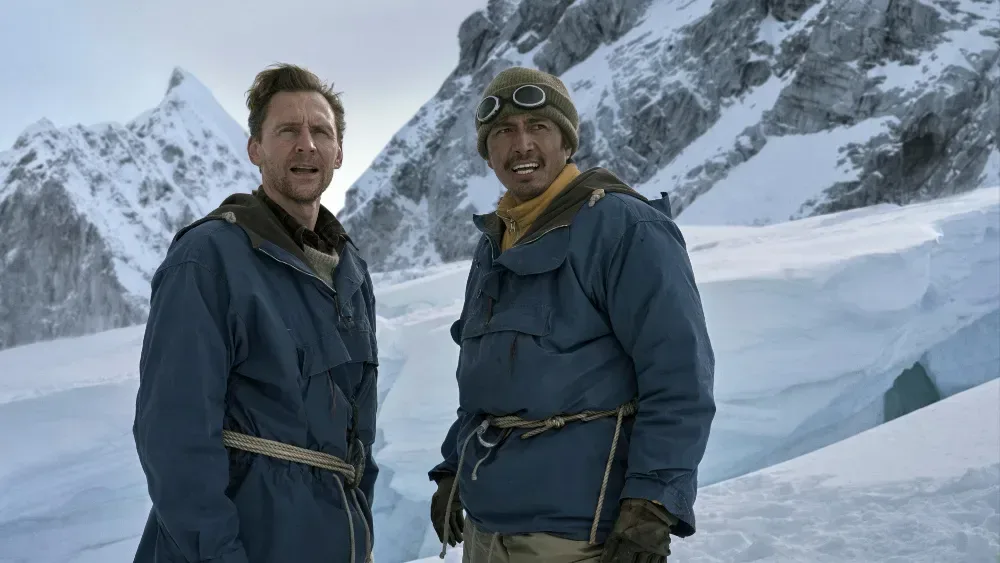
There is a particular kind of movie tension that does not need a villain, a twist, or even a loud score to work. Put people in a place where one bad decision, a sudden shift in weather, or a simple shortage of breathable air can undo everything, and the setting does the antagonizing for you. Tenzing takes that premise to Mount Everest and gives it historical weight: the 1953 expedition that produced the first confirmed climb to the summit, undertaken by Edmund Hillary and Tenzing Norgay.
Jennifer Peedom’s film is not a documentary, though its sense of terrain and process is central to its power. It is an old-fashioned historical adventure drama, built around preparation, personal will, institutional friction and the relentless narrowing of possibility as climbers get higher. Yet the film’s stated purpose is more pointed than merely recreating a famous achievement. It places Tenzing, the Nepalese-Indian Sherpa whose role was too often reduced in popular history, at the center of a story that could easily have defaulted to British expedition mythology.
That shift makes a material difference. Everest is not presented as a blank white prize awaiting an outside power’s flag. It is Chomolungma, the Tibetan name used by Tenzing, a mountain with spiritual force and a presence larger than the ambitions brought to it. The expedition’s objective remains unmistakably dangerous and dramatic, but Tenzing repeatedly asks audiences to examine who gets called a leader, who gets framed as support, and who is allowed ownership of a triumph.
A summit story with a corrected point of view
The facts at the heart of the drama are formidable enough to sustain a film without embellishment. By 1953, eight earlier attempts to reach Everest’s summit had failed. The landscape imposed its own brutal rules: crevasses, steep faces, storms, wind and dangerously thin air. “Thin air” is more than a vivid expression in a climbing story. At altitude, the reduced oxygen available to the body makes every task more exhausting and turns judgment, pace and endurance into matters of survival.
Britain led the 1953 operation at a moment when imperial authority still shaped the expedition’s assumptions and hierarchy. John Hunt, the British colonel in charge, views the undertaking through a military lens: discipline, structure and a defined chain of command. Willem Dafoe plays Hunt with a forceful stiff-upper-lip energy that fits a leader determined to keep an enormous, hazardous operation under control.
Order is useful when a team is moving through lethal conditions. The film does not treat logistics as trivial, nor does it argue that coordination is unnecessary. Its conflict lies in what such a hierarchy chooses to recognize. The Sherpa climbers are formally positioned as guides, even though their knowledge and mountaineering ability are indispensable to the expedition. Tenzing finds its political charge in that imbalance: expertise is present in plain sight, while status is allotted elsewhere.
Tenzing Norgay is not depicted as a passive figure awaiting recognition from the visiting climbers. He wants a place on the expedition and must press for it. Genden Phunstok plays him with contained authority: courteous in dealings with the British, but neither compliant nor diminished. The performance gives Tenzing patience, humor and resolve without making him a saintly symbol. He has an iron determination and an understanding of the mountain that is not simply technical.
That outlook is one of the film’s strongest distinctions. Where an imperial expedition can speak the language of conquest, Tenzing sees a relationship with the mountain rather than a war against it. The difference is not cosmetic. It changes the emotional meaning of the climb. The summit is not just an achievement to be claimed; it is the culmination of a lifetime spent in Everest’s shadow.
Related coverage includes ‘Tenzing’ Gives Everest’s Overlooked Pioneer His Place at the Summit.
From childhood awe to expedition politics
The drama begins with Tenzing as a boy looking toward Everest across a valley. The mountain’s scale is a formative presence rather than a distant travel-poster image. This early material ties the adult climber’s ambition to a deeper reverence, establishing why Chomolungma occupies such a singular place in his imagination.
The film also brings in George Mallory, played by Johnny Flynn, the famed British alpinist associated with the first three Everest expeditions in the 1920s. His appearance helps place Tenzing’s personal story inside the longer international effort to reach the summit. Everest has drawn climbers from beyond the Himalayas for years, but the film does not let that global endeavor erase the people for whom the mountain is home territory.
Some of the narrative steps away from the 1953 push through flashbacks to Tenzing’s earlier life, including his youth and his meeting with the woman he will marry. These passages broaden the character beyond the expedition, though the film is at its most urgent once the question becomes whether Tenzing will be given the role he has earned. The institutional obstacles are not abstract. They determine whose strength is trusted, whose judgment counts and who is permitted to stand in the official record of the mission.
That makes Tenzing a historical drama about credit as much as it is one about risk. Hillary and Tenzing became the first two people to reach the summit, but Tenzing’s contribution was long treated as that of a noble assistant rather than an equal mountaineer. Peedom’s film takes the corrective seriously. It does not achieve this by belittling Hillary; it does so by giving Tenzing a full interior life, expertise and agency.
Hillary and Tenzing: partnership under pressure
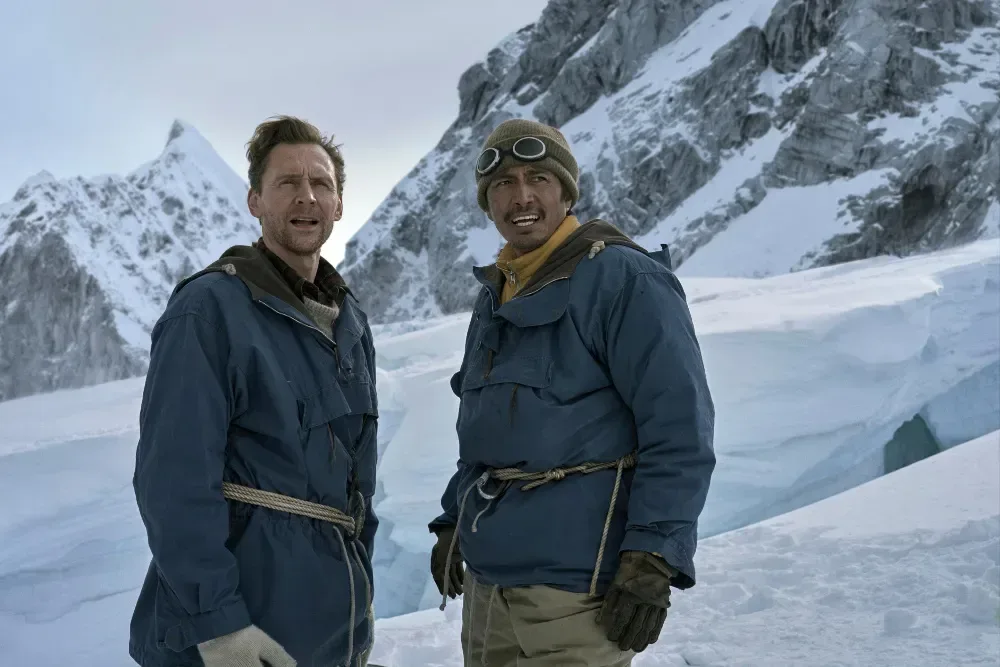
Tom Hiddleston plays Edmund Hillary with a cool, empathetic restraint. As the expedition develops, Hillary and Tenzing find common ground: both are brave, capable and notably modest. Their bond is not presented as an effortless movie friendship forged by a montage. The wider team has prickly dynamics, and every personal disagreement matters more because the work is so interdependent.
This is where the movie’s approach to adventure pays off. It understands that climbing logistics are drama. Deciding who proceeds, who carries responsibility, who has the strength for another leg, and when a changing weather window makes progress impossible are not administrative side plots. Those decisions shape the life-or-death stakes as surely as a collapsing snowfield or an exposed rock face.
Eventually, Tenzing is promoted to official team-member status. When he and Hillary are selected to make the final attempt, the choice is not framed as ceremonial. They are sent because it has become clear they are the two climbers capable of completing it. The closer they get to the summit, however, the more precarious success becomes. Conditions harden, weather threatens, and the available window contracts.
That escalating contradiction is the engine of the last stretch: proximity does not mean safety. In fact, the approach to the goal makes retreat, fatigue and uncertainty more frightening. A summit is visible as an idea long before it is realistically attainable.
Immersion without mountaineering spectacle for its own sake
Peedom arrives at dramatic filmmaking with extensive experience making climbing documentaries, and that background is evident in the movie’s confidence around physical space. The film seeks an immediate, on-the-mountain texture without turning every risk into a trailer-ready stunt beat. A snowfield’s sudden collapse carries force because the filmmaking does not need to announce how terrifying it is. The viewer understands the danger in the abrupt loss of solidity beneath the climbers.
The distinction matters. Many survival stories manufacture scale by continually raising the volume: more speeches, more ominous music, more characters loudly explaining that conditions are bad. Tenzing relies instead on accumulation. Cold, exhaustion, terrain and time press inward. The image of a team moving through snow becomes tense because every step has been earned through the film’s attention to process.
Its style is fundamentally classical. Rather than chasing documentary-style showmanship or reducing the events to disaster spectacle, Peedom builds a clear adventure narrative with a sense of gravity. The result has the sturdy shape of a traditional expedition picture while maintaining an immersive physical intensity.
Stefan Duscio serves as cinematographer, with Simon Njoo editing and Rebekka Karijord composing the music. Luke Davies wrote the screenplay. Their work supports a story that must hold two scales at once: an intimate account of Tenzing’s aspiration and a vast environmental ordeal in which individual desire can be made to feel very small.
Why its historical framing matters
It would be easy to describe the film as a retelling of “the first Everest summit,” but that shorthand risks reproducing the very imbalance the film confronts. The more revealing description is that it dramatizes the achievement of Hillary and Tenzing while restoring Tenzing’s place as a central visionary and climber.
That is not an argument that historical dramas should turn complicated expeditions into simple morality plays. The story’s strength comes from acknowledging multiple kinds of competence. Hunt’s ordered approach has value. Hillary is a vital partner, not a rival to be diminished. But the expedition cannot be honestly understood if Sherpa knowledge is treated as background labor while British command receives the laurels.
The film’s focus also makes its suspense more meaningful. Audiences are not only waiting to see whether two men can survive an impossible final ascent. They are watching whether the narrative itself will recognize what Tenzing brings to that ascent: lived connection to the region, formidable climbing ability, strategic judgment and the refusal to be confined to the status others assign him.
For viewers drawn to screen stories about exploration, Tenzing offers a rewarding counterpoint to the more immediate rush of modern climbing documentaries. The tension is no less sharp, but the dramatic format creates room for a wider examination of empire, identity and historical memory. It is an adventure movie that understands the summit is only one part of the story.
Tenzing was screened at the Telluride Film Festival on September 6, 2026. It is rated PG and runs 128 minutes. The cast also includes Caitríona Balfe, Tenzin Dalha, Thinley Lhamo, Tenzin Jigmey and Samdrup Dorje Lama. For another recent drama review, read our look at Ibuku.