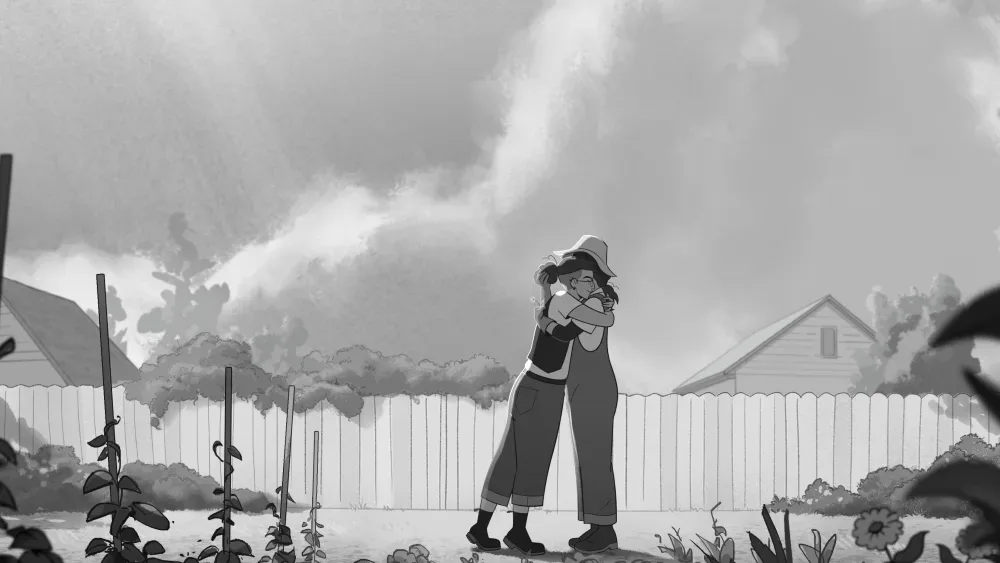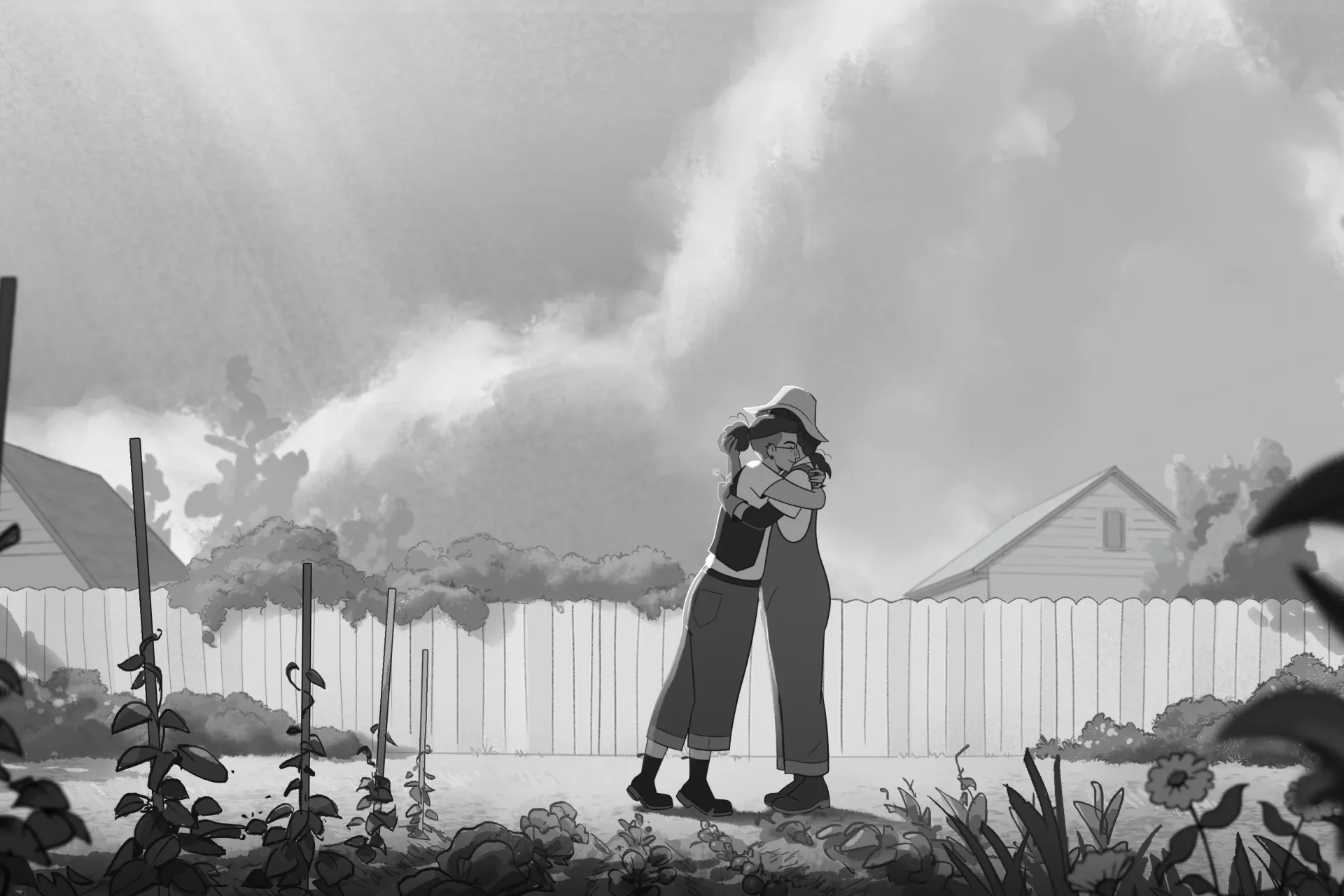
Tangles, directed by Leah Nelson, has won the Grand Jury Prize at the ninth annual Animation Is Film Festival. The 2D animated feature centers on a family living with the effects of their mother’s dementia, adapting Sarah Leavitt’s graphic novel with a visual approach the features jury described as fluid, starkly monochrome and emotionally attentive.
The award gives the festival’s top feature honor to a film tackling a difficult family subject through animation rather than treating animation as a shortcut away from serious material. The jury specifically praised Nelson and the voice cast for preserving the qualities of Leavitt’s book: beauty, honesty and restraint in a story about pain and memory. It also pointed to the film’s return to 1990s San Francisco as an important part of its setting.
Louis Clichy’s Iron Boy received the Fumi Kitahara Special Jury Prize as well as the Features Audience Award. In the short-film competition, Don Hertzfeldt’s Paper Trail won the Shorts Jury Grand Prize, while Anna Mantzaris’ Please earned the Shorts Special Jury Prize.
Tangles brings a graphic novel to the screen in monochrome 2D
The jury highlighted several parts of Tangles that clarify why it stood apart in the feature competition. It praised the film’s “fluid” 2D animation and its stark monochrome framing. In plain terms, 2D animation is imagery built on a flat visual plane rather than modeled to create a three-dimensional appearance. Monochrome framing means the presentation is organized around a very limited color treatment, here used to shape how the story is seen and felt.
That approach is especially notable because the story concerns dementia’s impact on a family. The supplied festival remarks do not detail individual scenes or the precise form of the adaptation, so it would be a mistake to infer plot points from the visual description alone. What is clear is that the jury saw a close relationship between the film’s aesthetic choices and its personal subject: the artwork is not being recognized merely as decoration, but as a way of bringing a family experience to the screen.
Nelson’s film is based on Sarah Leavitt’s graphic novel. Adaptation fidelity can mean different things in different contexts: retaining plot mechanics, matching an original’s visual style, preserving its tone, or carrying over its emotional perspective. The jury’s comments emphasize the latter qualities, celebrating a version it considered faithful to the book’s treatment of a painful subject while also recognizing the work of the director and voice ensemble as specifically cinematic contributions.
The reference to 1990s-era San Francisco also suggests that place and period have a meaningful role in Tangles, not simply a background function. The jury called it a flashback to that era, though no further production or narrative information was provided. For viewers interested in animation that draws from graphic storytelling, the film’s win signals a work distinguished by adaptation craft, a restricted visual palette and character-focused drama.
Iron Boy claims both jury and audience recognition
Iron Boy, directed by Louis Clichy, was the other major feature winner. It received the Fumi Kitahara Special Jury Prize, an honor named in memory of publicist and supporter of the festival’s mission Fumi Kitahara, who died in 2025. The film also took the Features Audience Award, placing it in the unusual position of being recognized both by a festival jury and by attendees.
The jury singled out Iron Boy for visuals resembling watercolor and Chinese ink-brush work. Those descriptions point to an impressionistic mode: an artistic approach concerned less with highly literal rendering than with conveying a mood, sensation or emotional state. The jury’s response connects that look directly to the film’s storytelling, saying Clichy uses the imagery to communicate a broad emotional world.
The film is inspired by Clichy’s memories of growing up in rural France. Its story involves a young boy’s struggles with a physical handicap and a difficult relationship between father and son. The jury found that portrayal heartfelt without becoming sentimental, and praised the film for avoiding the more familiar pitfalls of a conventional coming-of-age narrative.
That distinction is useful. A coming-of-age story generally traces a young person’s movement through formative experiences toward a changed understanding of self or the world. The jury’s remarks do not say that Iron Boy abandons that territory; rather, they suggest the film finds a less predictable emotional route through it. Its awards therefore recognize both its stylistic execution and the care taken with material involving disability, childhood and family strain.
Paper Trail and Please lead the shorts winners
Don Hertzfeldt’s Paper Trail won the Shorts Jury Grand Prize. The jury characterized it as distinctive and deeply moving, but the available information does not provide further story details or a description of its animation technique. The award nevertheless places it at the top of a broad short-film competition that included 18 works.
Anna Mantzaris’ Please received the Shorts Special Jury Prize. The jury called it funny and tender, and praised the way it captures both absurdity and the human wish for connection. Those two elements can coexist in animated shorts particularly effectively: an offbeat or comic premise can create distance at first, while the underlying need for contact gives the film emotional weight. That is an interpretive observation based on the jury’s description, not a claim about specific scenes in the film.
The four winning films collectively represent notably different kinds of animated storytelling. Tangles is a feature-length adaptation about a family confronting dementia. Iron Boy is rooted in personal memory and shaped by painterly imagery. Paper Trail was identified as uniquely affecting, while Please was celebrated for balancing humor, tenderness and longing. The results make a strong case for judging animation by the range of experiences it can express rather than by a single house style or audience expectation.
A feature field with a wide range of filmmakers
The 2026 feature competition consisted of nine films: Cherry and Virgin by Masanao Kawajiri; Ghost — End of Night by Shingo Natsume; Iron Boy by Louis Clichy; Jim Queen by Nicolas Athané and Marco Nguyen; Julián by Louise Bagnall; O Filho Da Puta (Son of a Bitch) by Otto Guerra, Érica Maradona, Tânia Anaya and Sávio Leite; Tangles by Leah Nelson; The Violinist by Ervin Han and Raúl García; and Viva Carmen! by Sébastien Laudenbach.
Although awards naturally put attention on the eventual winners, that lineup matters because it frames the scale of the Grand Jury Prize. Tangles was selected from a compact feature group containing solo directors as well as multi-director teams, while Iron Boy emerged with two honors from the same field.
The short competition was larger and included Acid City, Because Today is a Saturday, Blessed, Core Dump, Daughters of the Late Colonel, God is Shy, Hag, It’s Not a Phase Mom, Living With a Visionary, Paper Trail, Paradaïz, Please, Saba, Tuna Tartare, Ultra Strong, What We Leave Behind, With Tapes and Toasts in the Car and Winter in March.
Four days of presentations beyond the competitions
Over four days, the event also hosted the first big-screen presentation of Dana Terrace’s Knights of Guinevere; a special screening of Laika’s Wildwood with director Travis Knight; a behind-the-scenes look at Disney’s Hexed; and a work-in-progress presentation for Clara and the Below.
A work-in-progress presentation refers to material shown before a project is complete. It differs from a finished screening because it can focus attention on a production while its final form is still developing. Likewise, a behind-the-scenes presentation is distinct from a competition screening: its emphasis is on the process of making a film rather than an award judgment of the completed work.
For animation followers, that wider program complements the prize list. Awards identify films that a jury or an audience has already singled out, while presentations for projects at different stages offer a snapshot of the medium’s ongoing pipeline. Readers looking for more animation-related process material can also see how another project has foregrounded creative materials in this look at Dispatch’s commentary and storyboards.
At the center of this year’s results, however, is Tangles: a monochrome 2D adaptation recognized for the sensitivity of its treatment of dementia, its voice work and its translation of Sarah Leavitt’s graphic novel to animation. Alongside it, Iron Boy, Paper Trail and Please show a prize slate defined by intimate subjects, distinctive visual approaches and an emphasis on emotional clarity.