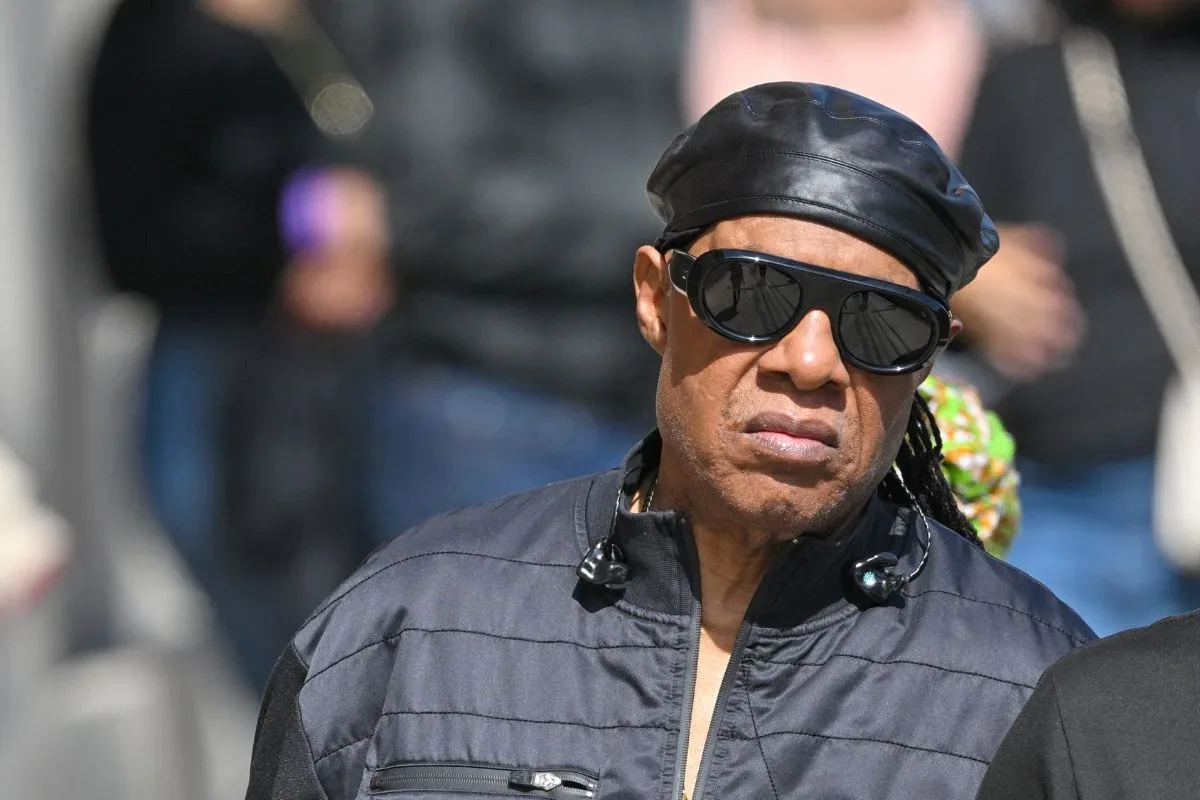
Stevie Wonder found a brisk, funny way to handle a long-running and plainly exhausting public rumor during his November 21 show at Chicago’s United Center: he offered doubters a ride.
Between songs, Wonder told anyone who questioned whether he is blind to get in a car with him and find out how that day would end. The line drew laughter, turning an intrusive claim into a joke with an obvious punchline: no one should take him up on it.
It was not the first time Wonder has addressed the subject, but it was an especially pointed setting for it. The sold-out Chicago performance was built around the 50th anniversary of Songs in the Key of Life, the 1976 double album that brought Wonder his third Grammy Award for Album of the Year. The evening was therefore about an artist’s work, collaborators and continued command of a stage—not an internet-era rumor that has followed him for years.
Wonder had previously spoken about his blindness in Cardiff in 2025, telling an audience that he lost his sight soon after birth and describing it as a blessing. That sincere statement and the Chicago gag are different responses to the same question. One offers personal perspective; the other refuses to give nonsense more gravity than it deserves.
A joke with a familiar setup
The driving bit also fits a piece of Wonder’s established comic language. In a 2015 Carpool Karaoke sketch with James Corden, Wonder initially appeared in the driver’s seat before Corden took over. During that segment, Wonder called Corden’s wife and sang a version of “I Just Called to Say I Love You” for her on Corden’s behalf.
That matters because the Chicago remark was not presented as a claim that Wonder would actually drive. It was a deliberately absurd reversal of a familiar visual gag, delivered to puncture a false premise. In the concert context, the laugh came before the music moved forward.
There is a useful distinction here between stage banter and the centerpiece of a performance. Banter is the conversation around the songs: a moment that can establish intimacy, relieve tension or react to the room. The centerpiece in Chicago was the music of Songs in the Key of Life and the people who helped bring it to life originally. The rumor joke was brief; the concert’s broader framing was monumental.
An anniversary show anchored by the record
The response to the first song made that clear. Wonder opened with “Love’s in Need of Love Today,” and the crowd greeted it with a standing ovation. It was an apt starting point for a show revisiting an album whose title alone signals scope: Songs in the Key of Life is a double album, meaning it was originally issued across two records rather than one. In practical performance terms, an anniversary presentation of material from a project that large gives the artist room to build a long-form evening rather than simply collect familiar hits.
Related coverage includes Stevie Wonder Jokes About Driving at Chicago Anniversary Show.
The Chicago show ran for three hours, and it did not treat the anniversary as a museum exercise. Wonder brought material from the record into the present, changing the final line of “Village Ghetto Land” to include the year 2026. That is a small alteration, but it underlines a major point about live performance: a song can retain its identity while responding to the moment in which it is being played.
“Pastime Paradise” carried another contemporary and historical layer. During the song, the audience saw images of Emmett Till, the Chicago teenager murdered in Mississippi in 1955. The inclusion connected the performance to a specific history associated with the city while making the visual component part of the song’s presentation. It was not simply a recital of recorded tracks in their original form.
Why arrangements matter in a retrospective concert
An arrangement is the way a song’s musical elements are organized for a particular performance—who plays which part, how instruments enter, where emphasis falls and whether a section is reshaped for the stage. A recorded version is one arrangement preserved at a moment in time; a concert can revise that framework without replacing the underlying song.
Some music at the United Center sounded different from the original recordings. That detail is central to what separates an anniversary concert from an archival replay. Wonder was revisiting the material, not freezing it. Updating a lyric, presenting historic images during another song and using a different instrumental color all point to an active interpretation of the catalog.
The people onstage strengthened the connection between past and present. Bassist Nathan Watts, who helped make the original album, joined Wonder. Keyboardist Greg Phillinganes, also a contributor to the original record, served as musical director for the show. A musical director is the person responsible for leading and coordinating the musical side of a live production, helping the ensemble execute its arrangements as a unified performance. In a show with a large body of material and room for changes from the recordings, that role is especially meaningful.
Wonder’s daughter Aisha Morris was also part of the night. Her birth inspired “Isn’t She Lovely,” giving the performance a direct family connection to one of the album’s best-known songs. The presence of original collaborators and family did more than provide anniversary symbolism. It placed the music among people tied to its creation and personal history.
More than one album, and more than one sound
Although Songs in the Key of Life supplied the occasion, Wonder made space for songs from beyond that album. “My Cherie Amour” appeared in the three-hour set, as did a rendition of Michael Jackson’s “Billie Jean.” The show ultimately closed with “Superstition,” returning to Wonder’s 1972 album Talking Book.
That final choice gave the night a recognizable finishing point while also broadening the concert beyond a strict anniversary sequence. For listeners, it meant the show could honor the scale of the 1976 album without suggesting that Wonder’s creative identity begins and ends there. The selections named from the evening span different points in his recording career, with the cover of “Billie Jean” adding another artist’s material to the program.
Wonder also played a blues number on a harpejji, described as a stringed instrument. Its appearance is notable because it added a distinct instrumental focus to an event otherwise remembered chiefly for a landmark album and its vocal songs. The supplied details do not specify the exact blues piece or how the instrument was used in the arrangement, but its place in the program reinforces the variety of the set.
For a live production, that variety has practical value. A long show needs shifts in mood, pacing and texture so that an audience is not asked to absorb every song in the same way. Chicago’s program moved among the anniversary material, songs from other albums, a Jackson interpretation, video imagery and an instrumental blues moment. Those components made the evening feel structured around a body of work rather than limited to one nostalgic premise.
The lasting point of the Chicago moment
Wonder’s quip may travel furthest online because it is concise, provocative and easy to clip. But the fuller account of the night is more substantial. A crowd gathered for a 50-year look at Songs in the Key of Life, rose for “Love’s in Need of Love Today,” heard songs altered for 2026, saw an acknowledgement of Emmett Till, and watched musicians connected to the original album return to its material.
That context changes the weight of the joke. Wonder did not allow a tired claim to define the night; he dismissed it on his own terms, then delivered a concert centered on the work. The line about driving was funny precisely because the stage evidence pointed elsewhere: an artist with a deep catalog, a carefully led ensemble, longtime collaborators and the freedom to keep changing how old songs speak in the present.
For more coverage of entertainment figures working across music and television, see Kandi Burruss bringing food entrepreneurs to OWN’s “Bank on Her” pitch panel.