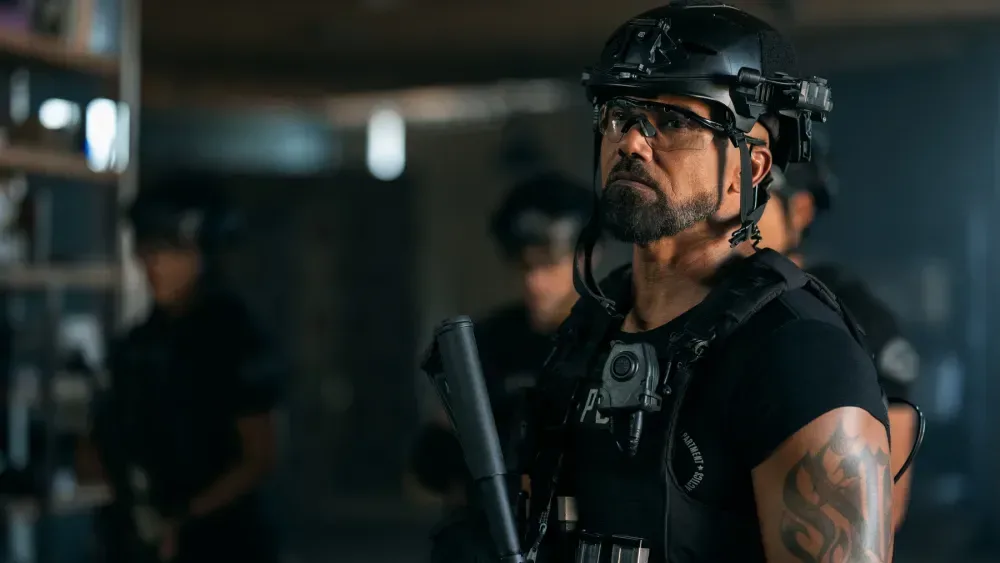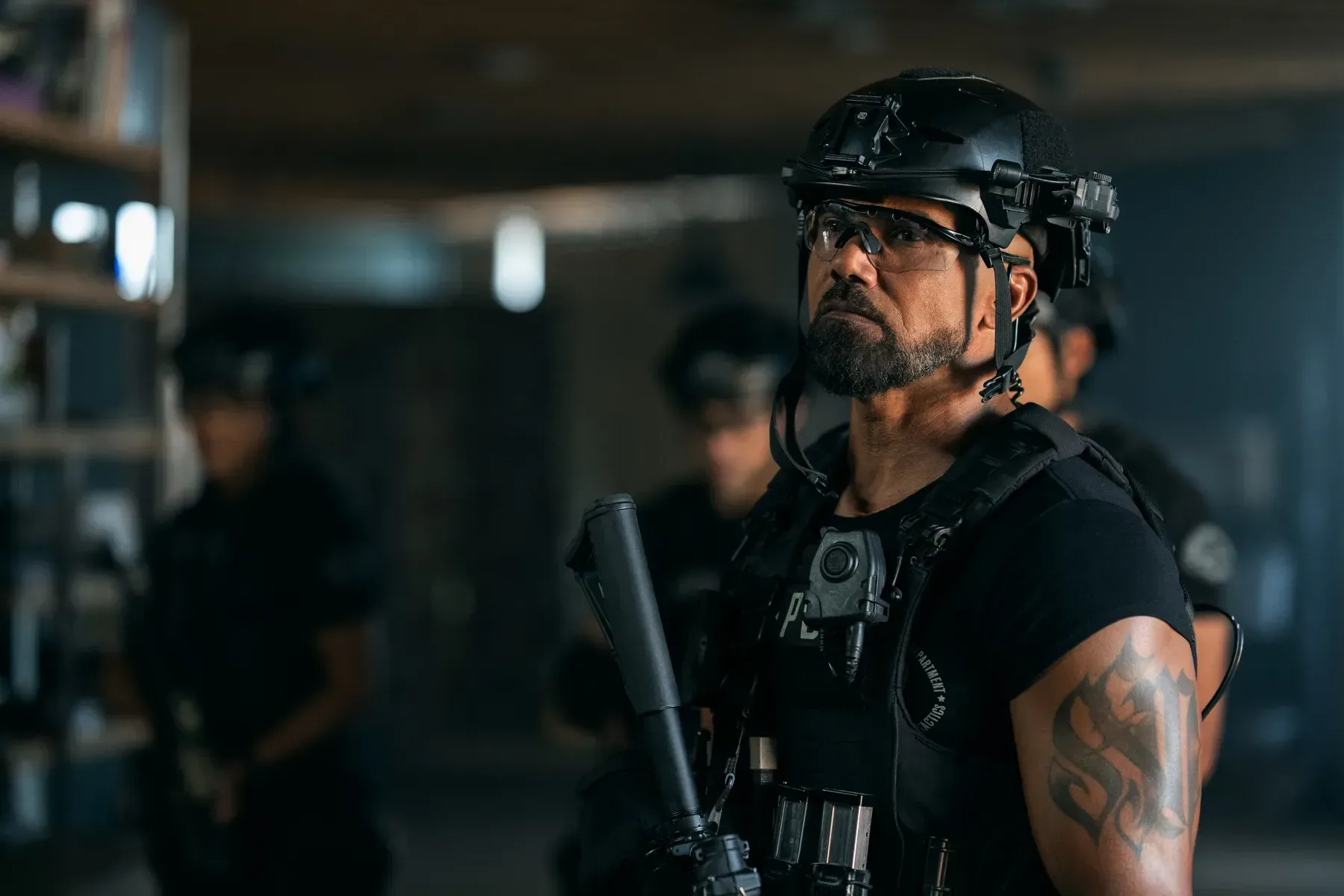
S.W.A.T. Exiles brings Daniel “Hondo” Harrelson Jr. back to the field, but it does not pretend that putting the badge back on will solve what happened before. The new Starz action drama picks up two years after the prior series ended, with Shemar Moore returning as the LAPD sergeant. Hondo is divorced, isolated and bitterly removed from the department after a failed raid resulted in the death of a younger member of his squad.
That is a more damaged starting point than a standard franchise handoff. Before Commander Robert Hicks offers him another path into the LAPD, Hondo is working protection for wealthy Los Angeles technology figures. His home, marked by accumulated mess and reminders of his daughter, establishes a man functioning on routine rather than purpose. When he gets the chance to lead again, he takes it reluctantly. The job is not simply a comeback, though. It is also an institutional pressure test.
The department has an image problem, and Hondo appears to have been selected as part of its response. He is handed a new unit, 44 Squad, made up of recruits who do not naturally fit together and who soon earn Hondo’s nickname: the Exiles. The title is therefore doing more than branding a sequel. It captures the uneasy position of both its leader and the officers he is supposed to mold into a team.
A familiar procedural engine, with useful pressure on it
Created by Jason Ning and based on characters by Robert Hamner, S.W.A.T. Exiles retains the basic machinery viewers expect from an action procedural. A procedural is a series structure in which individual episodes commonly center on a discrete case or operation, allowing a season-long storyline and character arcs to develop around it. Here, missions involve gun smugglers, cartel assassins and kidnappings.
That dependable format can be an advantage for a franchise continuation. It gives Hondo a practical arena in which to demonstrate why he belongs in command while avoiding the need to rebuild the entire show from zero. Moore remains the stabilizing force. Hondo is stern, principled and understandably impatient, but the performance has to accommodate a character who is not at his peak. He is rusty as a leader and visibly skeptical of the assignment he has accepted.
The stronger question is not whether he can clear another operation; it is whether the LAPD wants him to succeed at all. Hondo comes to believe that people inside the department are working against his team, with information being passed to the mayor’s office to damage him. That suspicion supplies the first season with a larger, continuing mystery. It moves the show beyond a weekly sequence of arrests and rescues without discarding the clarity that makes the procedural form accessible.
The first season runs for 10 episodes, though only four episodes were available for assessment. That limited window matters: there is enough material to see the central setup and the shape of the conspiracy, but not enough to treat every apparent trajectory as settled. What is clear is that the identity of the person undermining Hondo is not presented as a simple or obvious answer.
The new 44 Squad has distinct reasons to clash
A sequel series lives or dies on whether its new ensemble feels like more than a replacement roster. S.W.A.T. Exiles gives each member of 44 Squad a recognizable skill set, personal tension and a different relationship to Hondo’s old-school expectations.
- Sammy Bishop, played by Lucy Barrett, is a firearms specialist and social-media figure whose willingness to livestream from headquarters immediately clashes with Hondo’s instincts about discipline and operational boundaries.
- Malik Henderson, played by Adain Bradley, is a Marine veteran, husband and father. Hondo considers him the most naturally prepared recruit and appoints him Scout, the squad’s point person during missions. Malik also has undisclosed complications in his past.
- Ethan Cole, played by Freddy Miyares, is a neurodivergent technology expert whose observations are frequently underestimated by those around him.
- Cassidy Han, played by Zyra Gorecki, is highly focused and determined not to be reduced to her prosthetic leg. Her guarded personality leaves the rest of the team struggling to know her.
- Jude Callan, played by Ronen Rubinstein, arrives with confidence, charm and bad-boy energy, while the series signals more depth beneath that surface.
This lineup does not just provide a checklist of capabilities for missions. It puts Hondo in charge of people whose habits and identities resist the streamlined unit cohesion he wants. Sammy’s comfort with public-facing content is especially revealing: her behavior may read as reckless to Hondo, while also reflecting a generation that does not automatically separate personal visibility from professional life in the same way.
Malik’s role as Scout deserves a little clarification. In the context of the series, it means Hondo has made him the point person for operations: a position that requires trust, quick judgment and an ability to help guide the unit through uncertain situations. Assigning that responsibility shows Hondo recognizing Malik’s strengths even while the team as a whole is still finding its footing.
There is potential value in the ensemble’s differences because they make the central leadership story more specific. Hondo is not merely teaching recruits tactical coordination. He is trying to understand how to lead officers with very different priorities, communication styles and histories while his own authority is being questioned from above.
“Get Clear” gives the season’s conflict a moral weight
The fourth episode, “Get Clear,” is where the series most clearly shows it can bend its formula. Rather than staging another conventional mission, it brings Hondo and the unit before the Force Review Board over a past operation. The episode moves between the hearing and the incident being scrutinized: a hostage situation that became an ICE raid and ended with Hondo shooting an unarmed civilian.
The structure is significant because it changes the dramatic task. A typical action episode asks whether the officers can stop an immediate threat. A review-board episode asks viewers to reassess a completed operation through testimony, memory and consequence. Each account of the event can reveal both operational detail and how a character understands responsibility after the fact.
It also gives real stakes to the wider mole plot. Hondo is investigating who is feeding information upward and how he should respond, but he is doing so while facing an event that cannot be waved away as a misunderstanding. The earlier raid that cost a young squad member’s life already burdens his return to the LAPD; “Get Clear” adds another situation in which the use of force and the department’s choices are under examination.
That does not mean the series abandons its entertainment-first action framework. It means the show uses a familiar cop-drama engine to address questions of accountability, public perception and internal politics. The result is more compelling than an attempt to make every case merely bigger or louder than the last.
Why Hondo remains the franchise’s essential advantage
Moore’s return is the clearest continuity between this show and its predecessor, but S.W.A.T. Exiles wisely treats that continuity as emotional baggage rather than a victory lap. Hondo is still the person who can command a room and make a hard call. Yet the show begins with him alone in an empty-feeling home, angry at the institution he once served and uneasy about becoming useful to it again.
That contradiction gives the series its best material. Hicks, again played by Patrick St. Esprit, offers Hondo an opportunity, but the circumstances suggest the offer may also be a calculated use of his public stature. Hondo sees quickly that he may have been brought back to repair a problem for the department rather than because the department has repaired its relationship with him.
For returning viewers, that premise offers a reason to revisit the character beyond nostalgia. For newcomers, it makes the premise easy to understand: an experienced officer has been placed in charge of a difficult unit under conditions designed to test him. The show does not need to reinvent action television to make that work. It needs credible interpersonal conflict, well-defined cases and a season-long threat that earns attention. On the evidence of its opening run, it has those components.
There is also a broader franchise lesson in this approach. A sequel does not have to erase its predecessor’s format in order to justify existing. It can retain the case-of-the-week foundation while changing the team, the institutional stakes and the emotional condition of its lead. That balance is the reason S.W.A.T. Exiles feels positioned as its own show instead of simply a delayed extra season.
The entertainment landscape is full of different ways established characters can be extended; another recent development in family filmmaking involves an AI-assisted family film under discussion with Rob Minkoff. S.W.A.T. Exiles, by contrast, makes its expansion case through a conventional but sturdy television proposition: a proven lead, a newly assembled team and unresolved institutional trouble.
Release details and early verdict
S.W.A.T. Exiles debuted on Starz on September 25, with remaining episodes scheduled weekly on Fridays. Starz has already renewed the series for a second season, a sign that Hondo’s next chapter is intended to continue beyond this initial 10-episode arc.
The early verdict is encouraging rather than revolutionary. The series uses much of the familiar action-procedural playbook, and it does not attempt to disguise that fact. Its appeal lies in the assured return of Moore’s Hondo, the friction inside 44 Squad and a conspiracy that gives the season a reason to build from episode to episode. “Get Clear” in particular suggests the show can find tension in scrutiny and aftermath, not only in field operations.
For viewers who want the directness of a police action drama but also want its characters to carry consequences forward, S.W.A.T. Exiles has a credible foundation. The Exiles have not yet become a polished unit, which is exactly the point. Their struggle to do so is where the sequel finds its identity.