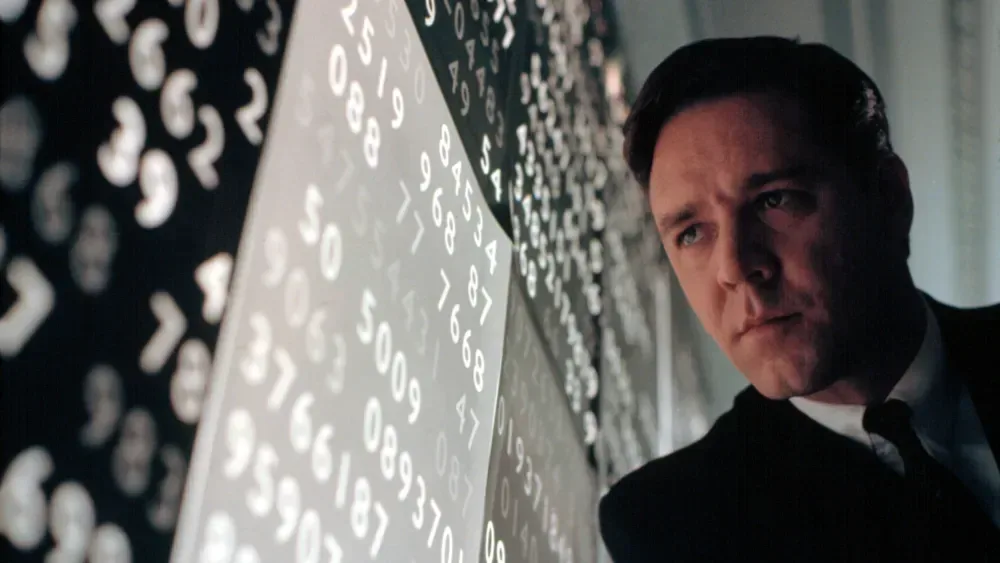
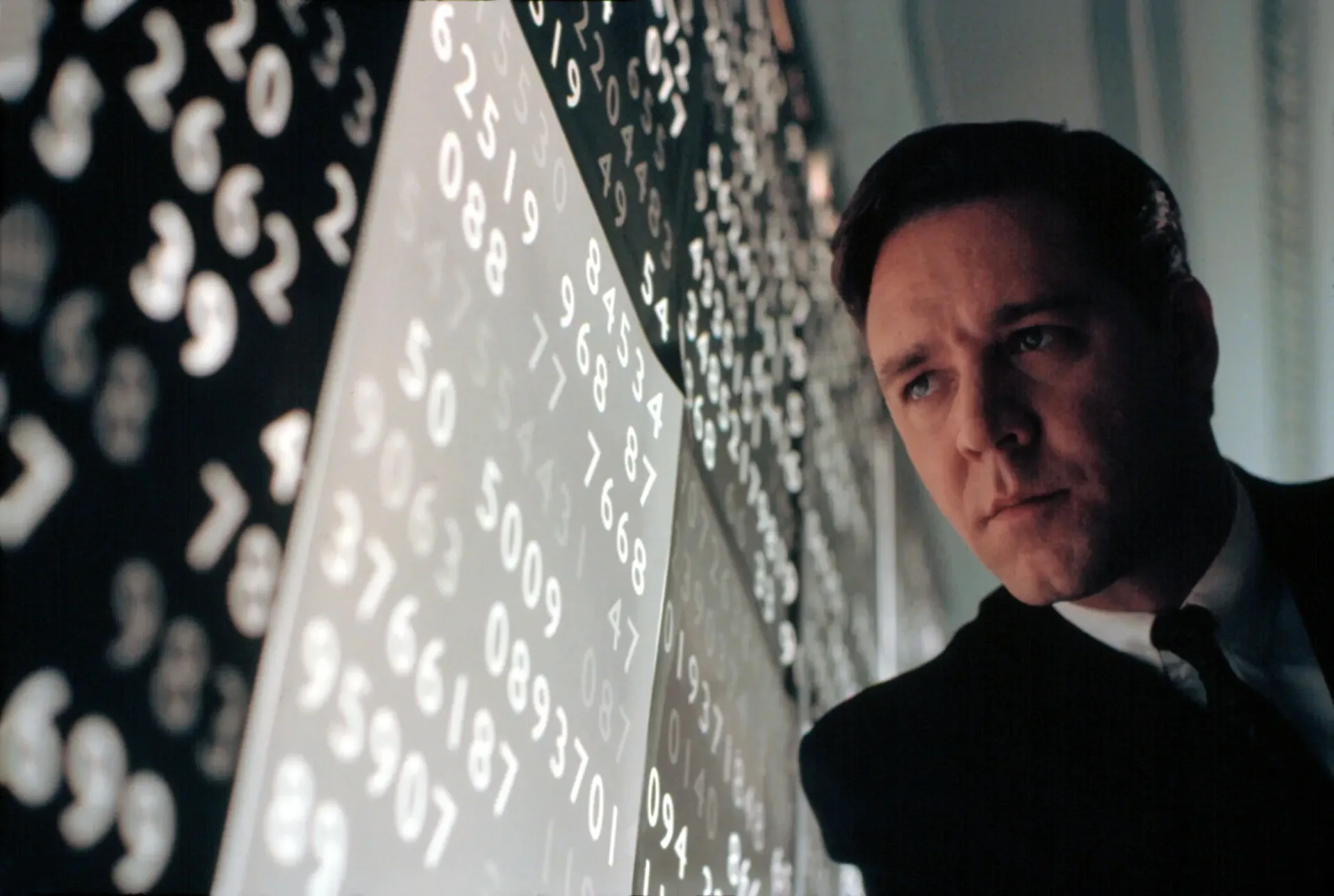
Russell Crowe’s request to shoot A Beautiful Mind in narrative order cost roughly $1 million more, largely because production needed to make two separate trips to Princeton, New Jersey. For director Ron Howard, however, that added expense became a purposeful investment in a performance that had to trace a difficult, carefully revealed psychiatric journey.
Howard has said he ultimately agreed with Crowe’s argument: filming the 2001 drama sequentially would make it easier to calibrate John Forbes Nash Jr.’s changing state of mind. Crowe played Nash, the mathematician at the center of the film, while Jennifer Connelly played his wife, Alicia.
That choice runs against the usual production logic. Films are commonly shot out of story order, with schedules shaped by location access, cast availability, production design and other practical needs. A scene from the ending may be filmed before an early sequence, even when those moments sit far apart in the finished cut. Crowe’s request instead put the chronology of the character ahead of some of those efficiencies.
Why shooting in sequence mattered here
Sequential shooting means filming scenes in roughly the same order that audiences will see them. It does not automatically make a movie better, nor is it necessarily possible on every production. But for a character-driven drama, it can give performers a direct route through emotional changes: they can arrive at each stage after playing what came before, rather than reconstructing that stage from notes while jumping among disparate points in the script.
That was particularly relevant to A Beautiful Mind. The story follows Nash through his academic career while depicting his struggle with schizophrenia. Howard described the challenge as one of calibration: the film’s psychiatric journey and the way it is disclosed to viewers would be complicated to perform if the team began with third-act material and then doubled back to the opening.
In practical terms, “calibration” here means controlling the degree and timing of a performance’s changes. An actor working non-sequentially can still do that work, using script analysis, rehearsal, continuity notes and collaboration with the director. But Crowe’s point was that the progression in this particular role was delicate enough that experiencing it in order could protect the transitions from becoming too abrupt, too early or too telegraphed.
Howard said Crowe made the request in passing, but came to believe the actor was completely right. He then had to press the case with the studio because the sequential plan added approximately $1 million to the production budget.
The $1 million was a scheduling cost, not an abstract creative premium
The additional cost was tied to logistics. Shooting in order required two separate visits to Princeton. That detail is important because it illustrates why chronological filming is often avoided: returning to a location can require a production to repeat travel, accommodation, equipment, staffing and location-related arrangements rather than consolidating all work in one place.
Related coverage includes Why Russell Crowe’s Sequential Shoot Added $1 Million to A Beautiful Mind.
There is no indication that the production spent the extra money on a new effect, a redesigned sequence or an expanded set piece. The reported cost stemmed from structuring the shoot around a creative process. It was a budget increase in service of performance continuity.
Howard characterized that decision as “the right kind of investment,” and connected its value to Crowe’s work. He praised the performance as brave and consistently detailed—qualities especially meaningful in a film whose impact depends on viewers following Nash’s evolving perspective.
The distinction is useful beyond this single production. Big budget figures can sound interchangeable from the outside, but a production cost can represent very different decisions. Sometimes money buys a visible element on screen. Other times it buys time, access or a working method intended to help artists do more precise work. In this case, the reported extra $1 million was tied to the latter.
A precedent Howard pointed to: George Lucas and chronological production
Howard compared the approach to George Lucas’ work on American Graffiti. Lucas filmed that movie in sequence in order to let the physical exhaustion of its night shoots show up naturally on screen. The comparison does not mean the two films had the same production problem. It does underline the broader principle: chronology can sometimes preserve an accumulating quality that is hard to manufacture scene by scene.
For American Graffiti, the relevant accumulation was wear and tear. For A Beautiful Mind, it was the evolving psychological and narrative state required of Crowe’s character. In both cases, the appeal of a chronological schedule was that the production process could support what performers needed to convey.
That does not turn sequential shooting into a universal rule. Standard out-of-order schedules exist for sensible reasons, and experienced casts and crews routinely deliver coherent performances under them. The lesson is narrower: when a role depends on minute changes across a long arc, a director and actor may decide that the added logistical difficulty is justified.
It also reinforces the importance of actor-director trust. A request that affects locations, planning and budget needs more than a creative preference; it requires the director to assess whether the potential benefit is concrete enough to defend. Howard’s recollection suggests that Crowe’s reasoning persuaded him because it addressed a specific problem in the film’s structure, rather than simply seeking a more comfortable workflow. That same balance of script priorities and confidence between performers and filmmakers has surfaced in other high-profile discussions of creative control, including a recent account of trust with actors and script control.
The result and the anniversary remaster
A Beautiful Mind went on to receive four Academy Awards: best picture, best director for Howard, best adapted screenplay and best supporting actress for Connelly. The awards recognition does not prove that one scheduling choice caused the film’s success; filmmaking is far too collaborative and complicated for that claim. But it provides context for why Howard now looks back on the added cost as worthwhile.
The decision was also inseparable from what the film asked of Crowe. The actor had argued that the story’s revelations and psychiatric arc would be difficult to manage if production tackled late material first and early material later, as many shoots do. Howard’s praise makes clear that he saw the eventual performance as fulfilling the promise of that accommodation.
A new 4K remaster of A Beautiful Mind is set to reach theaters Sunday for the film’s 25th anniversary. A 4K remaster is a new high-resolution presentation prepared from existing film elements; it is not a newly made version of the movie. For audiences revisiting the film theatrically, the release also brings renewed attention to an unusual behind-the-scenes choice that was largely invisible in the final product: a location schedule reshaped so its lead actor could travel through Nash’s story in order.
That is the strange elegance of the decision. Viewers are not meant to notice the return trips to Princeton or the budget negotiations behind them. They are meant to see a character’s journey unfold with conviction. Howard’s account frames the extra $1 million as the cost of giving the production its best chance to achieve precisely that.