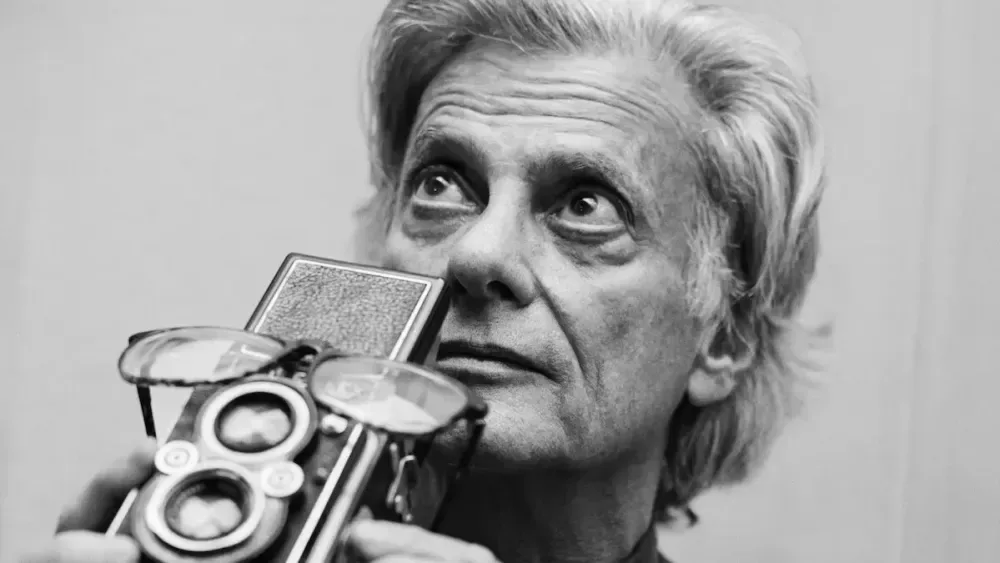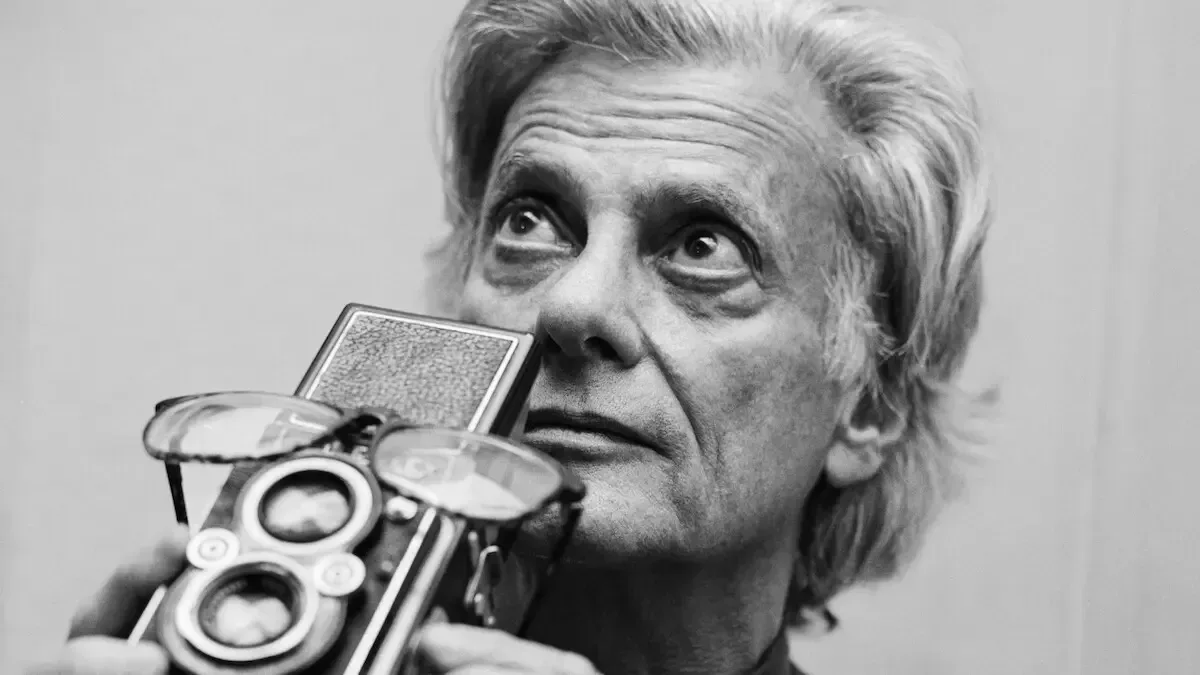
Richard Avedon made some of the best-known images of the 20th century, but the point of Ron Howard’s Avedon is not simply to assemble a greatest-hits gallery. The documentary uses a large body of photographs, archival appearances and interviews to examine the thinking behind a body of work that moved easily between fashion, celebrity portraiture, advertising and portraits of people far from fame.
That range is the movie’s central subject. Avedon became synonymous with glamour and high fashion, yet his pictures repeatedly sought an unguarded human presence rather than a polished public mask. The film traces that tension across his career, presenting a photographer whose commercial success and artistic interests were not separate tracks. For Avedon, the camera was a way to make viewers look again.
Howard directs, Andrew Morreale edits, Robert Chappell is credited for camera work, and David Fleming composed the music. The 105-minute film is rated R and is a Netflix release produced by Imagine Documentaries and Fifth Season in association with the Richard Avedon Foundation.
A career built around the face
The sheer scale of Avedon’s archive helps explain why his photographs remain so familiar. The documentary visits the foundation’s holdings with executive director James Martin and describes a record of 16,000 sittings from 1944 through Avedon’s death in 2004. That total encompasses a remarkable range of subjects and settings, but it is united by a recognizable visual principle: isolate the subject, focus on the face and body, and let the encounter with the camera do the rest.
Among the people featured in the film’s photographic montage are John Lennon, Orson Welles, Michael Jordan, Elizabeth Taylor, Groucho Marx, Twiggy, Anjelica Huston, Truman Capote and J. Robert Oppenheimer. The images have survived partly because they do not merely confirm a celebrity’s familiar persona. They make room for something stranger, quieter or more exposed.
That does not mean a portrait can deliver an uncomplicated, objective “truth” about its subject. A photograph is still made through choices: who is invited, how the sitter is approached, when the shutter is pressed and which frame is ultimately selected. Avedon treats that exchange as essential. The resulting image is not just a record of the person in front of the lens; it is evidence of the particular relationship formed in that session.
One useful technical distinction sits at the heart of the film. Photography often gets discussed through equipment terms such as f-stop, the setting that controls aperture and affects how much light enters a camera. Avedon is presented as being much less interested in this mechanical side than in direction, timing and conversation. His craft, in this account, was rooted in how he made a sitter wait, think, play, resist or relax.
The white backdrop was never empty
Avedon’s famous white-paper backgrounds can look simple enough to imitate. That apparent simplicity is precisely why they are so powerful. A blank field removes furniture, architecture and obvious social signals from the picture. It can make a major star and an unknown worker seem to meet the viewer on more equal visual terms. With little else competing for attention, posture, expression, clothing and gaze become charged.
Related coverage includes Ron Howard’s ‘Avedon’ Maps a Photographer’s Lasting Vision.
The documentary links that approach to Avedon’s service in the U.S. Merchant Marines. At 19, he obtained a role in the photographic department and made identification pictures of enlisted men and workers. He later described taking perhaps 100,000 such portraits. The assignment could have remained routine administrative work, but the white-background images made him attentive to the individuality of face after face.
That origin changes how the white background can be understood. It was not merely a refined studio look or a fashionable minimalist flourish. In the film’s telling, it grew out of repeated encounters with people looking directly into a camera, sometimes uncertainly, with the surroundings stripped away. The backdrop does not explain the person; it asks the audience to confront the person without an easy narrative shortcut.
This also clarifies why Avedon’s style could work across radically different subjects. The approach could accommodate a model in motion, a celebrated actor, an American military leader, Oklahoma oil workers or people encountered during his work on the American West. The social context behind each portrait remains important, but the frame insists on the individual rather than reducing them to a role.
Few exposures, long preparation
Isabella Rossellini recalls a process that differed from the image of a photographer endlessly firing frames. Avedon would sometimes take only around 10 photographs during a sitting, shooting intermittently and prompting the subject to think before trying again. He also described spending much of a booked hour in conversation, perhaps over coffee, before moving to the white paper near the end.
In practical terms, that is a reminder that portrait photography is often a process of attention rather than volume. Modern digital photography makes near-limitless exposures easy, but more frames do not automatically produce a more revealing one. Avedon’s method, as presented here, depended on creating conditions in which a moment could emerge. The decisive action was not necessarily the shutter click; it could be the pause before it.
His portrait of Marilyn Monroe is an especially clear example. The 1957 session, connected to The Prince and the Showgirl, lasted all day and produced images of Monroe in full command of her star image. Yet the most enduring frame came near the end, when she appeared tired and less performed. The picture is compelling not because it authoritatively solves the mystery of Marilyn Monroe, but because it complicates the surface viewers thought they knew.
Likewise, Charlie Chaplin’s 1953 portrait became iconic after the performer held devil horns above his own grinning head. The gesture was spontaneous, but it was not random. It depended on the setting and the photographer-sitter dynamic. Avedon’s achievement was to build sessions where something unpredictable could happen and then recognize the instant worth preserving.
Fashion, reportage and advertising in one visual language
The documentary’s most valuable argument may be that Avedon’s fashion imagery, serious portrait work and advertising did not cancel one another out. The same interest in gesture, personality and heightened presence travels across all three. His models-in-motion images, for example, used an impish energy to encourage movement rather than the static poses associated with conventional fashion presentation.
That sensibility had already become prominent enough by 1957 for the magazine photographer in Funny Face, played by Fred Astaire opposite Audrey Hepburn, to be pointedly based on Avedon. But the film does not stop at his proximity to Hollywood and fashion. It follows his work with the Chicago 7, residents of the new American West, figures from the Warhol Factory and American generals during the Vietnam War. He reportedly waited seven weeks in Vietnam to photograph those generals.
His 1980 portraits of Oklahoma oil workers further challenge any narrow definition of Avedon as simply a photographer of luxury. The work put people not normally treated as glamorous into a visual language of scale and scrutiny usually reserved for cultural royalty. That does not erase the different conditions of fame, class or power around those sitters. It does show how Avedon could make portraiture feel democratic: each face was worthy of sustained looking.
The same continuity applies to his commercial work, including the Obsession perfume television spots described as surrealist miniature films. Commercial assignments supported a lavish lifestyle, yet the documentary makes the case that Avedon did not regard them as a retreat from the work he cared about. Instead, his recognizable approach to looking remained intact whether the setting was a magazine spread, an advertisement or a formal portrait session.
The person behind the photographer
Avedon does not portray its subject as an artist existing outside personal difficulty. It includes his reverence for his mentally ill sister, addresses his troubled marriages and follows the story of photographing his aging father as part of a reconciliation. These elements matter because the photographer’s desire to make people visible was not presented as an abstract theory. It was tied to family, loss and the complications of intimacy.
Howard also brings in John Avedon, the photographer’s son, alongside Rossellini, Lauren Hutton, Twiggy Lawson, Calvin Klein, Adam Gopnik, Hilton Als, John Lahr, Joel Meyerowitz, Sebastian Kim and others. Their presence broadens the film beyond a single critical reading. Models can discuss the experience of being directed; writers and art-world figures can consider the cultural reach of the images; family can address the human costs surrounding a formidable career.
For pop-culture audiences, there is an additional reason the film’s subject remains resonant. Celebrity images are now constant, quickly produced and rapidly circulated, but familiarity does not necessarily make a person seem known. Avedon’s portraits remain useful because they resist easy consumption. Even when the sitter is instantly recognizable, the photograph creates a small disturbance: a pose seems less secure, a stare becomes more difficult to classify, and the viewer is asked to spend longer with a face than everyday media usually permits.
That broader relationship between stardom, image-making and the stories attached to performers continues to shape film culture; for a separate example of how offscreen anecdotes can color an actor’s public mythology, see this report on Judi Dench and the unusual gesture connected to her Riddick role.
Why the documentary’s form matters
A film about still photographs has an obvious structural challenge: it must make stationary images feel alive without overpowering them. Here, Morreale’s editing is central. The documentary layers archival clips, interviews and a large number of Avedon photographs in a way that lets viewers see patterns across decades: the ongoing pull toward directness, the tension between performance and vulnerability, and the visual equality created by the spare backdrop.
The opening reportedly combines Avedon speaking about refusing rules with a montage set to Spoon’s “I Turn My Camera On.” It is an apt setup for a story about a photographer who used recognizable formal choices without reducing them to a formula. Avedon’s work can look immediate because the technique is not foregrounded; viewers first register the person, then gradually recognize the disciplined choices that made the encounter possible.
Ultimately, Avedon positions Richard Avedon not as a creator of a single iconic style, but as an artist who kept applying one demanding question to different worlds: what happens when a person is seen without the usual scenery around them? In fashion, art, commerce and portraiture, his answer was never entirely comfortable. That discomfort is part of why the photographs continue to look so alive.