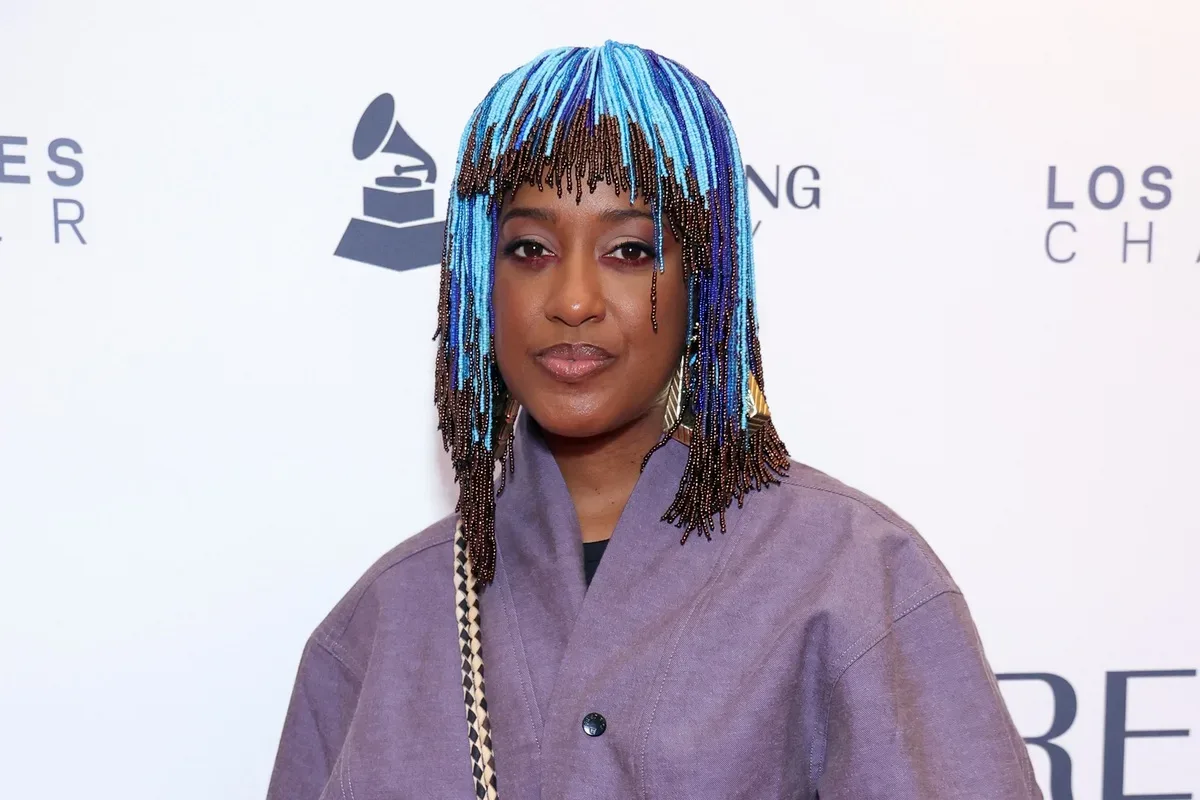
Rapsody is drawing a firm distinction between putting faith in her music and accepting a category built to contain it. Discussing the spiritual current running through God Gotta Afro & Gold Hoops, her fifth album, the North Carolina MC said she does not identify as a Christian rapper.
“I do not consider myself a Christian rapper. I don’t like labels at all. I’m just a truth teller,” Rapsody said in a recent interview.
It is a concise statement, but it establishes an important frame for hearing the record. Faith is present in Rapsody’s work, yet she has described her music as making room for God alongside politics and the details of ordinary life. In that view, spirituality is not a separate department of her art, nor a restriction on its subject matter. It is one thread in a larger attempt to tell the truth as she understands and experiences it.
That distinction matters because genre labels can be useful shorthand while also creating expectations about what an artist is supposed to address, how they should sound and which audiences are presumed to be for them. Rapsody’s objection is not presented as a rejection of faith. It is a rejection of the idea that faith should establish the outer boundary of her music.
Faith without a fixed image
The album title itself is central to that argument. Rapsody explained that God Gotta Afro & Gold Hoops was not intended to assign God one literal or exclusive appearance. Instead, she wanted listeners to see themselves in the divine and consider a presence larger than any single image.
That makes the title an invitation to think about representation rather than a definitive description. The afro and gold hoops evoke a culturally specific image, but the point is not to replace one narrow image of God with another. Rapsody’s stated aim is broader: to make room for people to recognize themselves while resisting the notion that divinity can be fully captured through one look, one identity or one vocabulary.
Her comments arrive in a wider pop conversation where religious language can move between devotion, metaphor and identity. That range is part of why songs and albums involving God often spark debate over intent and categorization, as in the discussion surrounding the origins of Ariana Grande’s “God Is a Woman”. Rapsody’s position is especially clear: her religious themes should not be treated as an instruction to reduce the rest of her perspective.
A continuing resistance to categories
This is not the first time Rapsody has pushed against a label that she sees as narrowing the culture. In 2024, she challenged the practice of separating “female” Hip-Hop from Hip-Hop as a whole. Her current comments extend the same basic reasoning to religion: a descriptor can look harmless, but it can also imply that an artist belongs in a smaller, separate lane.
The two examples are connected by the pressure placed on women in Hip-Hop. Rapsody has discussed the difficulty of trying to fit mainstream expectations for how women should look and what their music should sound like. Those expectations do not only concern fashion or presentation. They can influence assumptions about ambition, subject matter and how much complexity a listener is prepared to grant an artist.
For Rapsody, refusing the Christian-rapper label does not mean removing God from the work. Refusing “female Hip-Hop” as a separate compartment did not mean denying that she is a woman. In both cases, the issue is whether an identifying characteristic becomes a filter through which everything else is judged—or worse, a rule about what the work may be.
Her earlier formulation on the variety of women’s artistic expression was direct: “There is a place for all of it.” That principle leaves space for contrasting approaches without requiring a single model of authenticity. It also helps explain why Rapsody resists an either-or reading of her own work. She can write about faith, political realities and everyday existence without any one of those subjects cancelling the others.
Ghana, South Africa and the record’s larger purpose
God Gotta Afro & Gold Hoops emerged from a period in which Rapsody felt freer to follow her interests. Her travels were a meaningful part of that process. An Afrofuturism exhibition at the Smithsonian prompted questions about Black identity and ancestry, which led her to travel to Ghana. She visited historical sites there and later recorded much of the album in Johannesburg, South Africa.
Afrofuturism is the term used here for a framework that connects Black identity, history and imagined futures. In Rapsody’s account, the exhibition did not merely supply an aesthetic reference. It started a line of questioning about ancestry and identity that became active in travel, reflection and recording.
The available details do not support reducing that journey to a single message, and Rapsody’s own framing argues against doing so. The album is concerned with belief, but it is also concerned with preserving Black culture. These interests intersect in her idea of what the project might become over time: a document that future listeners could encounter, learn from and use to understand Black experiences that might otherwise be lost.
That is a practical artistic purpose as much as an abstract one. A record can preserve voices, references and questions even when listeners arrive years after its release. Rapsody’s description positions the album as more than a collection of isolated tracks. It is meant to carry cultural memory forward.
Learning across generations
That preservation-minded outlook also shaped the album’s collaborators. Producer Mr. Porter suggested that Rapsody contact George Clinton, who appears on “OMG! (Love to Sun Ra).” Rapsody described working with an elder as a chance to listen and learn while helping cultural knowledge remain in circulation.
The choice is significant within the album’s stated interests. George Clinton’s appearance is not presented simply as a guest credit or a nostalgic flourish. In Rapsody’s explanation, the collaboration created a relationship to knowledge passed between generations. The process of listening is part of the work.
The song title also invokes Sun Ra, making “OMG! (Love to Sun Ra)” a point where the project’s spiritual, cultural and Afrofuturist concerns visibly meet. The supplied account does not specify the song’s musical construction or lyrical details, so it would be wrong to claim more than that. But its title and the collaboration fit the album’s wider effort to hold multiple forms of Black cultural memory in conversation.
What Rapsody’s distinction asks of listeners
Rapsody’s refusal of the Christian-rapper label is ultimately a request for a fuller way of listening. It asks audiences not to treat faith as a branding decision, Black identity as a decorative theme or womanhood as a separate musical category. Instead, those elements can coexist in a body of work without being forced into a hierarchy.
That does not make labels disappear. Genres and descriptors remain useful tools for discovery and discussion. But Rapsody’s comments show their limits. A label can help a listener find an entry point, yet it can also encourage them to stop there, assuming they already know the scope of an artist’s concerns.
For God Gotta Afro & Gold Hoops, the more accurate entry point is Rapsody’s own: truth telling. It accommodates her engagement with God, politics, daily life, ancestry, cultural preservation and the freedom to move outside other people’s expectations. Her message is not that these topics must be separated. It is that none should be allowed to define the limits of the others.