Holiday gift lists can become a logistical boss battle long before the wrapping paper appears. During Amazon’s 2026 Prime Big Deal Days, the most interesting children’s entertainment picks are not confined to one kind of play: there are character toys tied to big family franchises, a building set from Super Mario Bros. Wonder, motion-controlled games for the television, and several screen-free audio or activity devices.
That variety matters more than a simple “toy versus tech” split. A gift can encourage imaginative play with figures, construction play with bricks or magnetic tiles, active movement in front of a TV, quiet listening, or early game-learning through a physical chessboard. The practical question for a buyer is not which product has the most features. It is which activity fits the child, the household’s routines and the media they already enjoy.
The sale listing describes the Toniebox 2 Disney bundle as 43% off during the event. Other discounts cited include 20% off the Yoto Player Disney Classics bundle, while various baby-product reductions are also listed. As with any timed promotion, prices, bundles and stock can change, so shoppers should confirm the current product configuration and checkout price rather than treating an earlier percentage as a promise.
Screen-free does not mean low-tech
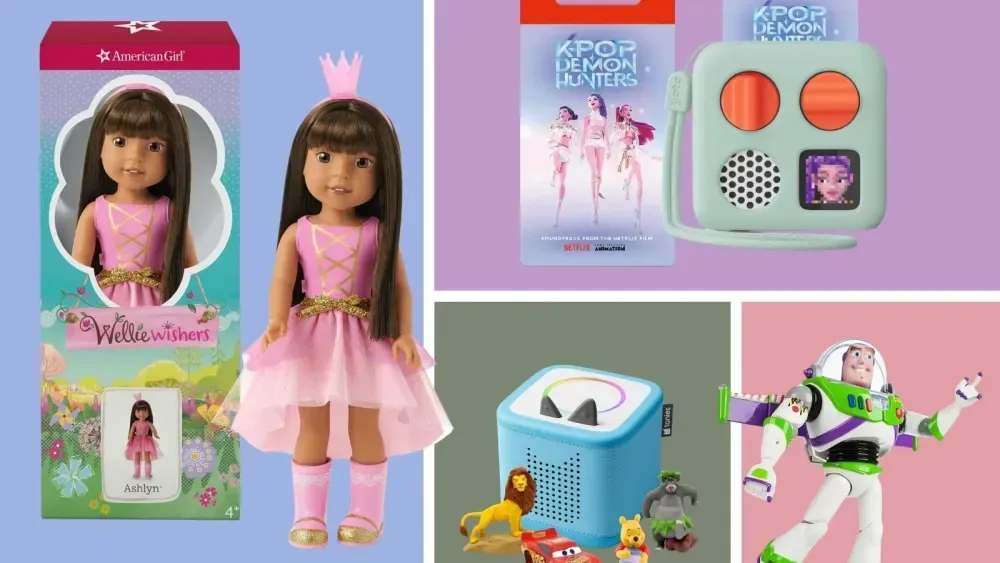
The Toniebox 2 Disney bundle is positioned as a starter option for families seeking a screen-free way to play stories, music and adventures inspired by Disney films. Its appeal is straightforward: audio provides entertainment without putting a phone or video display in a child’s hands. For a family trying to reserve screens for particular times of day, a dedicated listening device can make that boundary easier to understand than handing over a multipurpose tablet.
“Screen-free” is a description of the child-facing experience, not a claim that a product has no technology inside it. Here, it means the central activity is listening rather than watching and tapping through a visual interface. That distinction is useful: a family may want audio stories for a car ride, winding down, independent play, or simply a moment when a phone needs to remain a phone.
Two other products take related but distinct approaches. The Yoto Mini KPop Demon Hunters bundle is described as portable and screen-free, while a larger Yoto Player has a Disney Classics bundle listed at 20% off. The Boppo Screen-Free Learning Tablet deliberately borrows the familiar “tablet” idea without using a display. It has 10 light-up buttons and more than 40 included activities, spanning games such as Bop-a-Mole, Memory and Simon Says, music, stories, podcasts and learning activities.
Boppo also uses Toppos, physical game cartridges that attach to the unit, for further activities. That makes its expansion model legible to children: new content arrives as an object instead of another app icon. The listing says extra Toppos can be purchased and says no subscription is required. Buyers should still separate what comes with the device from optional expansions, because “no subscription” does not mean that every potential activity is included at the outset.
The shared idea across Toniebox, Yoto and Boppo is not that they do the same thing. Toniebox and Yoto focus on listening; Boppo centers button-based interaction, games and activities. A child who wants songs and stories may respond differently than one who wants to press, remember, react and make music. Picking the format before picking the franchise is likely more useful than picking a branded bundle first.
Franchises that move from screen to playroom
Licensed toys are central to the selection, with Toy Story 5, Mario and Paw Patrol: The Dino Movie among the entertainment touchstones named in the listings. This is the part of a gift list where recognition can do genuine work: children who know the characters already have a starting point for a story, game or pretend-play scenario. But the product type still determines what they can actually do with that enthusiasm.
The Disney Store Buzz Lightyear figure is pitched to children excited about Toy Story 5, with Jessie suggested as a companion character for recreating a film moment at home. The Milk Snob Disney Pixar baby swaddle uses Toy Story imagery in a completely different context. It is made for infant care rather than role-play, but it shows how a favorite property can stretch from nursery items to toys for older siblings.
The Paw Patrol 10th Anniversary All Paws On Deck 10 Figure Gift Pack includes 10 figures, including Rex, identified as a wheelchair-using pup, alongside familiar characters. A multipack provides a ready-made ensemble rather than asking a child to build a cast one purchase at a time. That is relevant for imaginative play, where the ability to assign roles, stage rescues and switch between characters may matter more than any individual figure’s novelty.
For Mario fans, the LEGO Super Mario Prince Florian & Castle Bowser Building Toy draws directly from Super Mario Bros. Wonder. The listed characters include Pink Yoshi, Prince Florian, Wonder Bowser Jr. and a Fiery Note Piranha. Construction is the first play phase; recreating scenes or inventing new ones is the next. That two-stage structure can be a useful way to think about a buildable gift: the build occupies one kind of attention, and the finished model can support another kind of play afterward.
There is a broader practical lesson in the Mario set and the Paw Patrol pack. Character familiarity can get a present opened eagerly, but open-ended use is what can keep it in circulation. Figures and build elements can be combined into new narratives in a way a single, scripted activity may not be. That is analysis rather than a guarantee—every child plays differently—but it is a sensible lens for comparing licensed merchandise.
Gaming away from a conventional controller
Nex Playground is the most directly game-oriented device in the group. It turns a television into an active-game setup, using motion-based games including Fruit Ninja; children can jump, dance and play without controllers. Motion-based gaming means that physical movement is part of the input. Instead of primarily pressing a button or moving a stick, the player’s body actions are detected and used to control play.
That is a different proposition from buying a console game, a tablet or a board game. The source material frames Nex Playground around indoor activity for children with energy to burn. For a household, the main consideration is likely the room around the television: motion play needs enough clear space to move comfortably. It also shifts a screen session toward standing, jumping and dancing, rather than a seated experience.
The Harry Potter Chess Set Smart Electronic Board Game takes another hybrid route. It combines a conventional game of chess with an electronic board and an app, adding Hogwarts-themed presentation to a real chess game. “Smart” in this context refers to electronics and app connectivity layered onto the physical board, not a replacement for the fundamentals of chess. Children can still learn and play the underlying strategy game, while the theme may provide an inviting route in for a Harry Potter fan.
These products illustrate why “technology” is too broad a label for a gift guide. Nex Playground translates movement into game input. The chessboard keeps a physical board game at its center while adding electronic interactivity. Boppo offers light-up controls without a screen. The Fire HD 10 Kids Tablet, by contrast, is a conventional display-based device in a robust colorful case, with a year of Amazon Kids+ access to books, games and videos plus parental controls.
Parental controls are settings intended to help adults manage a child’s use of a device. The listing does not detail their individual options, so it would be wrong to assume exactly how they work. Still, their presence is a clear sign that the Fire tablet is designed for a household that wants a wider digital library and adult oversight. It is not the same category of use as a stand-alone audio player, even if both may offer stories and games.
For families building out a connected entertainment area, it can also help to understand the difference between a device feature and the wider home-network setup. Our guide to why most gaming setups need only one Ethernet port explains that networking basics in more detail. It is not a buying guide for these children’s products, but it is relevant context for households considering how their various screens and connected devices fit together.
Creative, tactile and early-learning alternatives
Not every item needs a familiar character or electronics to earn space on the list. The 102-piece Magnetic Tiles Princess Castle Building set is presented as a castle-themed version of a widely recognized construction-toy format. Its value proposition is simple: children can repeatedly arrange and rebuild the pieces, making the activity less about reaching a single finished model and more about experimentation.
The Crocodile Creek preschool jigsaw puzzle uses The Very Hungry Caterpillar and has 12 chunky pieces, plus a durable storage box. Its smaller piece count and tactile format make it distinctly different from a 102-piece building set. A puzzle provides a defined completion goal, whereas magnetic construction is more open-ended. Neither is intrinsically better; they ask for different kinds of attention.
The American Girl WellieWishers 14.5-inch Ashlyn doll is another example of matching scale and complexity to the intended child. The line is described as smaller than the classic 18-inch American Girl dolls, colorful and made for younger children, with outfits and accessories that support imaginative play. That positioning is useful for a buyer because doll size is not merely a display detail—it can influence handling, storage and the relationship to accessories.
For younger children, the Cali’s Books Twinkle Twinkle Little Star musical book offers a rechargeable design and a lullaby focus. The SEREED Baby Balance Bike is listed for ages one and up, while the Hatch Baby Sound Machine combines a sound machine, night light and time-to-rise clock. These are not gaming products, but they reinforce the same gift-list principle seen elsewhere: the most appropriate item may be the one that meets a recurring daily routine, from bedtime to movement, rather than the one with the loudest branding.
What to check before choosing a deal
The most useful approach is to treat the discount as the final filter, not the first. A large percentage reduction matters only if the item will suit the child and work in the home. The available listings support a few practical checks:
- Choose the play pattern first. Listening, physical movement, building, puzzles, figure-based storytelling, digital media and chess are all different activities.
- Check what is included. A bundle may be a convenient starting point, while products with optional cartridges, companion figures or app components can have additional paths later.
- Think about space and routine. Motion games work differently in a living room than an audio player used for quiet time; a large figure pack and a compact musical book present different storage needs.
- Read the age and product details carefully. The balance bike is identified for ages one and up, and the WellieWishers line is described as aimed at younger children. Those details are more informative than a franchise logo alone.
- Verify the current offer. Event-based prices and bundles can change before checkout, particularly as the listed promotion nears its end.
The strongest through-line in this group is choice, not a single must-buy product. A Disney audio bundle can offer a deliberate break from visual media; a Mario LEGO set combines building and imaginative follow-up; Nex Playground makes motion the controller; and a kid-focused tablet brings books, videos and games together with parental controls. The right pick depends on whether the recipient most wants a story to hear, a character to direct, a world to build, a puzzle to complete or a game that gets them moving.