Broadway’s revived Other Desert Cities turns a Palm Springs Christmas gathering into something far more combustible: a battle over memory, authorship, politics and a family tragedy nobody has managed to outlive. Jon Robin Baitz’s Pulitzer Prize-nominated drama, returning to Broadway for the first time since 2011, is set on Christmas Eve 2004, but its central question has no expiry date. Who gets to tell a family’s hardest story—and what does everybody else do when that account threatens the version of the past they have relied on?
Directed by John Benjamin Hickey, the production puts Julia Louis-Dreyfus, Ed Harris, Allison Janney, Lily Rabe and Joe Keery in a tightly wound ensemble piece that moves from brittle jokes to painfully direct confrontations. The play is dark, but it is not solemn at every turn. Its comedy is part of the pressure system: people tease, posture and trade barbs because the alternative is saying exactly what they mean.
That contrast is one reason the play’s domestic setting matters so much. The Wyeth home is spacious, polished and comfortably insulated from the world outside it. Yet Baitz’s drama steadily shows how little protection money, good taste, geography or family ritual can provide when grief has been left unresolved for decades.
A holiday homecoming with an agenda
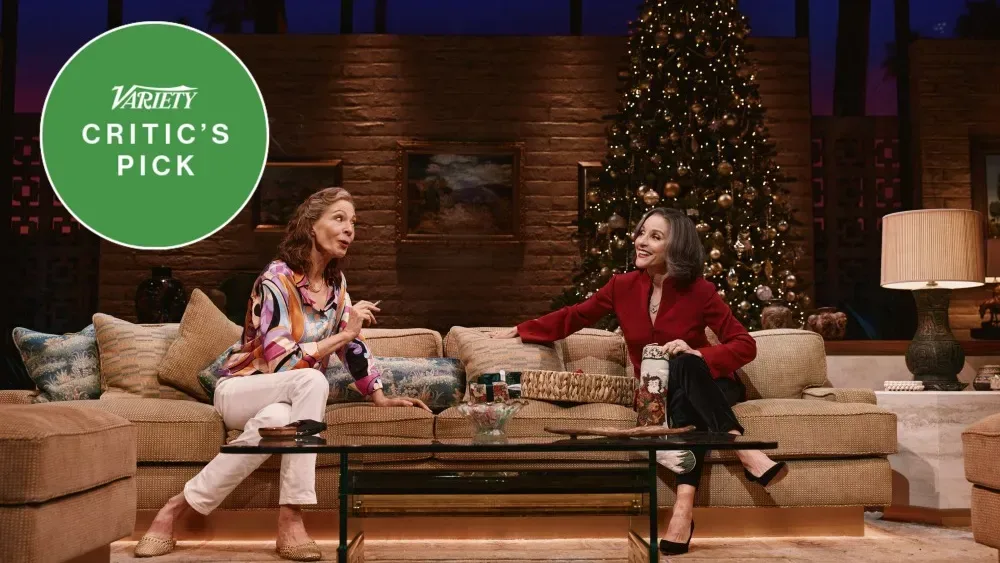
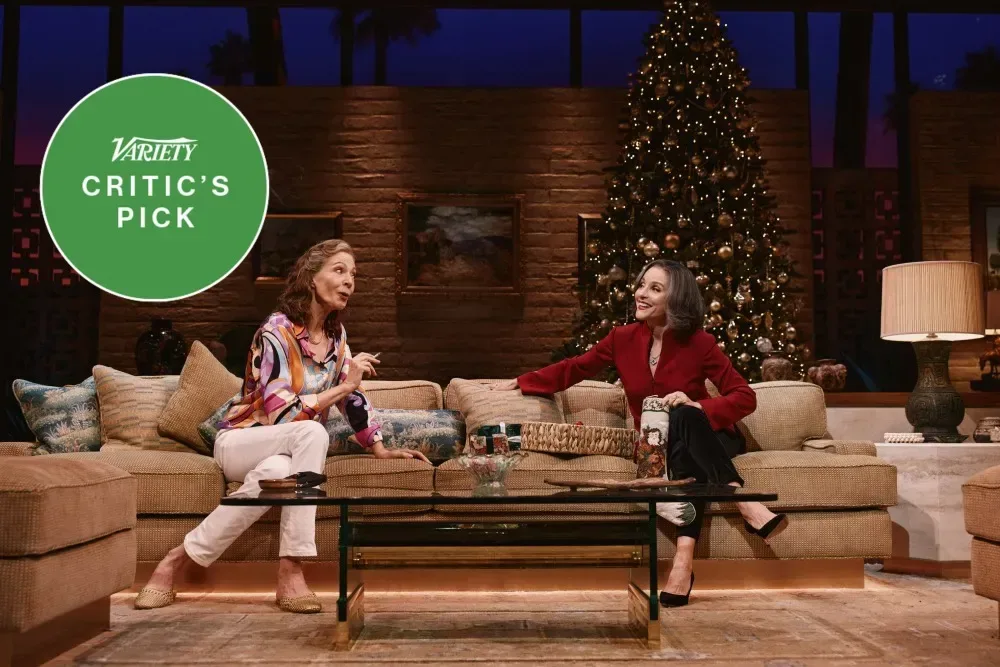
Polly and Lyman Wyeth welcome their adult children home to their Palm Springs house. Polly is played by Louis-Dreyfus; Harris plays Lyman. Their son Trip, played by Keery, lives in Los Angeles and produces reality television. Their daughter Brooke, played by Rabe, is a writer who has spent years struggling with severe depression and has largely stayed on the East Coast. The household also includes Polly’s sister Silda, played by Janney, who is living with the Wyeths following rehabilitation for alcohol addiction.
Scott Pask’s scenic design establishes the family’s cultivated desert refuge with a pristine beige living room and an imposing Christmas tree topped by a Star of David, a nod to Polly’s Jewish heritage. The first image has the controlled, highly managed quality of a holiday card. That is exactly the sort of order the evening will dismantle.
The immediate friction is political as well as personal. Polly and Lyman are committed Republicans, while Trip and Brooke recoil at their parents’ casual racism and sharply different worldview. The play’s 2004 setting is specific, rooted in the years after the Sept. 11 attacks, but it is not a piece of political nostalgia. The ideological divide is meaningful because it exposes a deeper issue: the Wyeths do not merely disagree about public life. They have incompatible ideas about responsibility, loyalty and what should remain unspoken.
As in many family dramas, the apparent small talk is structural. Plans for tennis, a country-club meal and the evening’s schedule give the characters ordinary business to conduct. Beneath it lies a fraught negotiation over who is allowed to disrupt the peace. Brooke’s return after a six-year absence is not simply a holiday visit. She has brought news that makes the family’s carefully observed rules impossible to maintain.
The memoir at the center of the conflict
Brooke tells her parents that her second book will be published in the coming year. It is not fiction, as they assumed, but a memoir concerning Henry, her older brother. Henry died by suicide decades earlier after his involvement in a cult bombing that killed a man. The loss was so traumatic that Polly and Lyman cannot bear even to speak his name; after his death, they left Los Angeles for the desert.
Related coverage includes ‘Other Desert Cities’ Brings a Fierce Family Reckoning Back to Broadway.
A memoir is nonfiction written from the author’s perspective, often using the writer’s own life to examine a larger subject. That form is essential here. Brooke is not inventing a proxy family or disguising the old wound behind made-up names and events. She is claiming the right to put an account of shared history into public view. For her parents, the manuscript is not only a book. It is an intrusion, a possible act of betrayal and a challenge to their authority over the meaning of Henry’s life and death.
Lyman initially takes a conciliatory route. He says he will not read the manuscript, while asking Brooke not to publish it during his and Polly’s lifetime. Polly’s response is much more forceful. She reads it, reacts with anguish and rage, and makes clear that publication could cost Brooke her place in the family.
The conflict therefore never reduces to a simple argument about privacy. The play confronts the moral tension between a family member’s wish to tell the truth as she understands it and another family member’s wish to keep profound pain from becoming public material. Neither position erases the other. The revival’s force comes from treating the struggle as a serious collision of needs, rather than an easy referendum on whether a memoir is inherently cathartic or cruel.
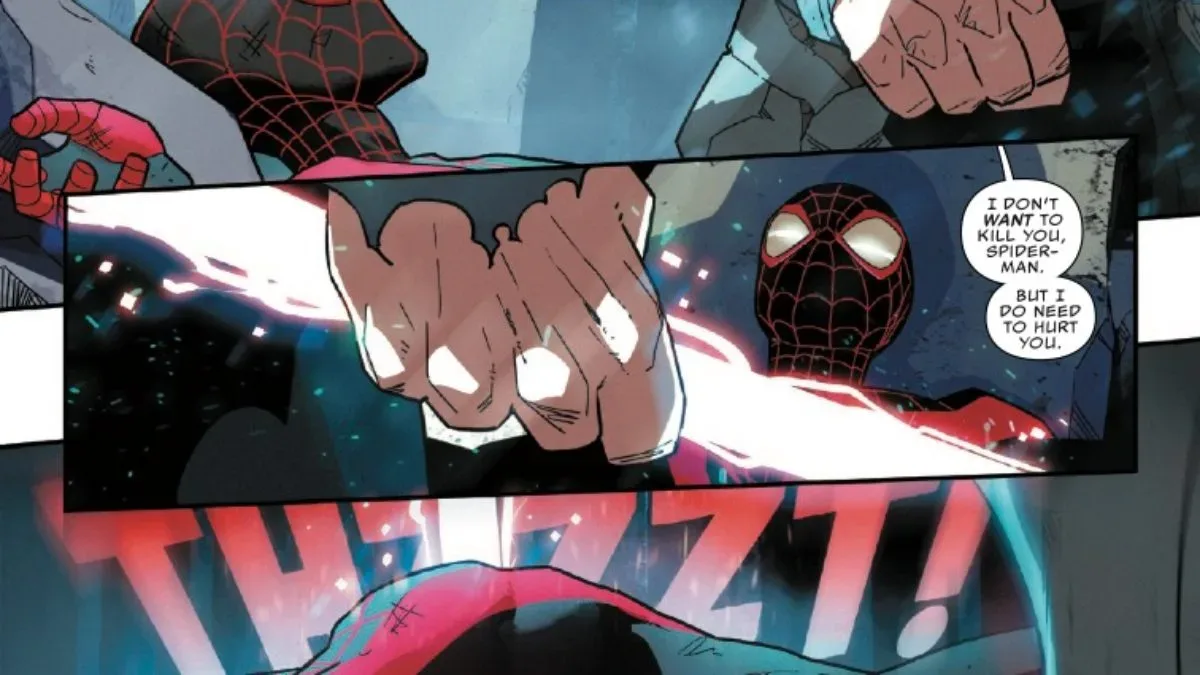
That question of ownership has a natural resonance with other stories about relatives confronting inherited secrets. For a comic-book variation on family history becoming an immediate crisis, see this look at Jeff Morales’ past in Miles Morales: Spider-Man. Baitz’s play uses no superhuman metaphor, but it understands a similarly elemental truth: hidden history does not stop shaping people merely because no one says it aloud.
Secrets, competing memories and the cost of silence
Other Desert Cities is built around the gap between a family event and the stories people tell about that event afterward. Memory in this context is not presented as a neat archive from which a single uncontested record can be retrieved. It is emotional, selective and deeply bound to survival. People remember what they saw, what they were told and what they were able to bear. They may also spend years defending a version of events because changing it would alter their understanding of themselves.
The play’s long-suppressed secret changes the terms of the confrontation and leaves Brooke devastated. Crucially, the revelation does not make truth uncomplicated. It instead reinforces the drama’s central idea that truth is affected by the teller, the listener and the circumstances in which it is withheld or disclosed.
This is where the desert setting gains thematic weight. Palm Springs is not merely a wealthy backdrop. The Wyeths have used distance as a form of retreat after the catastrophe connected to Henry. Their new life has allowed a kind of stability, but the play questions whether removal is the same as healing. A family can relocate, decorate a spotless room and resume holiday traditions. It cannot automatically relocate the consequences of what happened.
The material also engages grief, depression and addiction without treating them as interchangeable versions of the same pain. Brooke’s long struggle with depression, Silda’s alcohol addiction and the family’s grief over Henry shape the household in distinct ways. The writing connects these experiences through their effects on relationships: who gets protected, who gets blamed, who is believed, and who is asked to keep carrying the burden quietly.
An ensemble calibrated for comedy and rupture
The production’s success rests on the cast’s ability to make the Wyeths feel both practiced at being a family and increasingly unable to sustain that practice. Louis-Dreyfus’s Polly is at the center of the evening’s fiercest resistance. Her sharp comic instincts serve the character’s defense mechanisms, allowing a cutting line to land as humor and warning at once. Polly’s cruelty is not softened, but the role’s pain and panic give her anger weight.
Harris gives Lyman the difficult task of appearing measured while the family’s equilibrium disintegrates. Lyman’s initial refusal to read Brooke’s book and his plea for delay can sound like an attempt at peace. They also show the power of avoidance: asking someone else to defer a decision may preserve calm for the person asking while prolonging harm for everyone else.
Rabe’s Brooke has the dramatic burden of bringing the forbidden subject into the room. She is not simply a messenger with a manuscript. Her decision to write is tied to her effort to confront a past that has remained central to her life even as her parents have tried to contain it. The result is a mother-daughter clash that is volatile, specific and emotionally costly on both sides.
Janney’s Silda and Keery’s Trip prevent the play from becoming a closed duel. Silda’s recovery and connection to Polly add another layer of family dependence and resentment. Trip, meanwhile, occupies a different generational and ideological position from his parents, and his presence helps show that Brooke’s crisis belongs to a larger household rather than to two people alone.
The cast’s ensemble rhythm is particularly important because Baitz’s dialogue can pivot quickly from witty observation to outright emotional warfare. The humor is not decorative. It reveals class habits, political attitudes and the ways these people use performance to control a room. When the laughter stops, the audience can feel how little solid ground was underneath it.
Design that frames a polished façade
Pask’s set is joined by costume design from Tom Broecker, lighting design from Natasha Katz, sound design and original music by Mikaal Sulaiman, and hair and wig design by Robert Pickens. Together, those elements frame the play’s central contradiction: a holiday environment designed for comfort becomes the setting for destabilizing disclosures.
The beige room and grand tree do not need to announce danger to be dramatically effective. Their composure makes the later eruptions more vivid. A family accustomed to presentation—the right house, the right rituals, the right narrative—has to face what happens when none of those surfaces can contain the past.
Hickey’s direction is well suited to a drama in which verbal sparring is both entertainment and evidence. The play needs speed for its jokes, but it also needs room for the shock of a disclosure to register. Its two-and-a-half-hour running time gives the characters time to argue, circle old wounds and expose how much has been left unresolved.
Broadway details
Other Desert Cities opened October 18, 2026, at the Hudson Theatre, a 970-seat venue. The running time is listed at two hours and 30 minutes. The top ticket price is listed at $446.88.
The Broadway revival is produced by ATG Productions, Bad Robot Live, Gavin Kalin Productions, Kristin Caskey, Bee Carrozzini and Mike Isaacson. Robert Pickens is credited for hair and wig design; Richard Hodge is production stage manager, and Jim Carnahan CSA is casting director.
For viewers considering the show, its subject matter warrants clear expectations. The drama includes discussion of suicide, depression, alcohol addiction, racism, family estrangement and a deadly bombing. Its wit does not dilute those subjects. Instead, it makes its portrait of a family held together by love, denial and old damage more unsettling—and more absorbing.
At its core, Other Desert Cities is not interested in offering a clean cure for a broken family. It is interested in the harder aftermath of speaking: the fury that follows, the stories that collapse, and the possibility that silence was never truly peace. This revival finds the play’s humanity in that discomfort, making its holiday gathering feel less like a seasonal reunion than a reckoning that has been waiting years to begin.