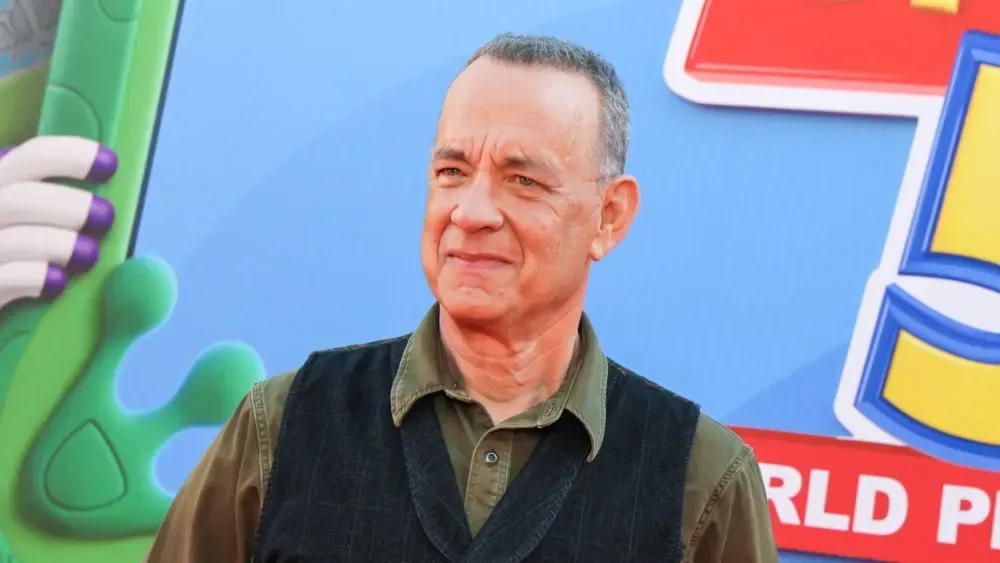
Tom Hanks is headed back to Broadway with This World of Tomorrow, a new play in which he will star alongside Kelli O’Hara. The production marks Hanks’ first Broadway appearance in 14 years, following his Tony-nominated turn in Nora Ephron’s 2013 play Lucky Guy.
The new work arrives with an unusual creative overlap: Hanks is not only its leading performer, but also one of its writers. The play adapts a series of short stories written by Hanks, with James Glossman co-writing the stage version. Kenny Leon will direct. A Shubert theater will host the Broadway run, though the specific venue, complete company and full creative team have not yet been announced.
This World of Tomorrow previously played Off Broadway at The Shed, where Hanks and O’Hara appeared together in a sold-out engagement. That earlier production gives the Broadway transfer a foundation beyond a title and a premise: its central pairing has already performed the material, and its director is returning to continue shaping the work for a larger audience.
A romance built around repeated returns to 1939
The play is described as a time-travel romance set at the end of the 21st century. Hanks plays Bert Allenberry, a man trying to alter what lies ahead by going backward. His destination is one day at the 1939 New York World’s Fair in Queens, a moment he revisits repeatedly.
That repeated-trip structure is an important distinction. Time travel can simply be a setting device, a way to move characters between visually different eras. Here, the premise suggests it is also the dramatic engine. Bert does not make one historical excursion; he keeps returning to a specific day in pursuit of a changed future. The story’s stated idea is that technological advancement does not ultimately determine people’s lives as decisively as choices made for love.
In theatre terms, this is fertile territory because repetition can do more than explain a science-fiction rule. Each return can change the audience’s understanding of a prior conversation, a decision or a relationship. A familiar scene can become newly charged if a character arrives knowing what an earlier version of himself did not. The play’s time-travel mechanism therefore appears designed to serve an emotional question: whether a person can use another chance well when the stakes are personal rather than merely historical.
The late-21st-century framing and the 1939 fair setting also create a deliberate contrast. One location looks ahead from an era of rapid change and public optimism; the other is a future vantage point looking backward. Yet the drama’s emphasis is not on cataloguing imagined devices or treating the World’s Fair as a museum display. Its stated focus is intimate: love, connection, regret and the consequences of individual decisions.
Why the 1939 World’s Fair matters to the premise
A world’s fair is, by nature, a place associated with the future. It presents big ideas, grand designs and an invitation to imagine life differently. Placing a time-travel story at the 1939 New York World’s Fair gives This World of Tomorrow a setting that already carries that tension between present experience and future possibility.
That does not mean the play is necessarily a historical drama in the conventional sense. The supplied premise positions the fair as the fixed point in Bert’s journeys, not as a promise of a wide survey of 1939. The key detail is its singularity: one remarkable day to which he returns again and again. This concentrates the story. Rather than giving a protagonist every era and every outcome to explore, the play binds him to a particular moment and asks what he will do differently with the knowledge he gains.
It is also a useful fit for live performance. Theatre can make repetition immediately legible. The same entrance, prop, gesture or line may recur before an audience, while its meaning shifts with what has happened in the intervening scenes. Sets, lighting, costume and performance can signal both continuity and alteration without requiring the kind of literal visual spectacle that screen science fiction often prioritizes. The supplied details do not describe this production’s staging, so any specific approach remains unknown, but the premise itself is well suited to the medium’s ability to revisit a scene in real time.
Hanks’ role extends beyond the marquee
Hanks’ return is notable partly because he has not been a Broadway regular. His last Broadway role, in Lucky Guy, resulted in a Tony nomination. With This World of Tomorrow, he returns in a project rooted in his own fiction and co-developed for the stage with Glossman.
That creative position matters. An adaptation is the process of reshaping material from one form into another. Short stories can rely on narration, interior thought and the reader’s private pacing. A stage play instead must externalize its conflicts through action, dialogue, performance and theatrical space. Co-writing the adaptation allows Hanks and Glossman to decide which aspects of the stories become central onstage, what Bert must express in front of an audience, and how the play’s romances and temporal shifts are organized dramatically.
There is no indication that audiences should expect a simple transcription of prose. A stage adaptation is its own work, with its own requirements of rhythm and focus. The involvement of a co-writer is particularly relevant in a premise built on revisiting events: theatrical clarity matters when a story asks viewers to track what changed, what remains the same and what a character now understands.
For Hanks, the production also places the writing and acting sides of the project in direct conversation. The performer playing Bert will be interpreting a character shaped in part by his own storytelling. But the play is not presented as a one-person vehicle. O’Hara’s role in both the Off Broadway and forthcoming Broadway versions suggests that the central relationship is integral to the show’s design, not an accessory to the time-travel conceit.
Kelli O’Hara and Tom Hanks bring an established stage pairing
O’Hara’s return is among the most consequential pieces of continuity from the earlier run. The production team has highlighted the onstage chemistry between O’Hara and Hanks, and the pair’s previous work together gives the Broadway staging an existing performance relationship to build upon.
“Chemistry” is often used casually in entertainment coverage, but in a romance it has a practical dramatic meaning. The audience needs to believe that a connection matters enough to motivate difficult choices. In a story about someone repeatedly returning to the past, that emotional credibility becomes even more crucial. The time-travel rules may set the plot in motion, but the relationship is what gives the audience a reason to care whether Bert can change anything.
The earlier production also means the Broadway version is a continuation rather than an entirely untested first presentation. That does not tell audiences exactly how much will change; no revised scenes, casting additions or design details have been disclosed. It does mean Leon, Hanks, O’Hara and Glossman are returning to a work they have already brought before an audience.
For readers looking for other entertainment plans while theatre details develop, Joking Joystick’s latest streaming roundup covers a separate slate of at-home viewing options.
Kenny Leon will direct the Broadway production
Leon’s recent Broadway credits include The Balusters, Othello with Denzel Washington and Jake Gyllenhaal, and Our Town with Jim Parsons and Katie Holmes. On This World of Tomorrow, he will lead the move from the show’s Off Broadway life to Broadway.
A director’s role encompasses far more than positioning actors onstage. For a play like this, direction involves determining how the audience receives its shifts in time, how repeated scenes accumulate rather than merely repeat, and how comedy, romance and speculative ideas are balanced. The production has been described as an American play as well as a time-travel romance, which signals an ambition to make its genre premise serve recognizably human concerns rather than stand apart from them.
Leon has described the project as an opportunity to keep exploring a story about love and time travel with Hanks and Glossman. He has also pointed to the chance for more people to see Hanks and O’Hara perform together. That emphasis aligns with the available information: the Broadway engagement expands the reach of an existing production while retaining its lead actors and director.
What is known — and what remains to be announced
The confirmed core is clear. Hanks will star. O’Hara will join him. Hanks and Glossman wrote the stage adaptation from Hanks’ short stories. Leon will direct. The story follows Bert Allenberry between the end of the 21st century and repeated visits to the 1939 New York World’s Fair. The play will be staged at a Shubert theater.
Several practical details are still open. No specific Shubert venue has been named, and the complete cast and creative team are still forthcoming. No performance dates, ticket information or further production particulars are included in the announcement. For potential attendees, that means the news establishes the project and its principal creative personnel, but not yet the information needed to plan a Broadway visit.
That uncertainty is worth keeping separate from the confirmed artistic shape. It would be premature to infer the scale of the design, the size of the company, the precise role O’Hara plays, or how closely the Broadway staging will resemble the production at The Shed. Those are all areas where future announcements may fill in the picture.
A live-theatre story about second chances
Producer Brian Anthony Moreland has framed the production around the lasting force of love amid a changing world. That theme runs through the announced premise as well: Bert’s technological means of reaching the past does not appear to be the final answer to his problems. The story instead puts weight on what he chooses to do when offered the chance to return.
There is a pleasing fit between that idea and the form of Broadway theatre. A live performance cannot literally be replayed in the way a recorded film can, even when the script is unchanged. Each night is another encounter among actors, audience and story. This World of Tomorrow turns recurrence into its subject, but it will deliver that subject through a medium built on the particularity of the present moment.
With Hanks returning to Broadway after 14 years, O’Hara reprising her partnership from the sold-out Off Broadway run, and Leon directing, the production has a substantial creative center already in place. The remaining announcements will determine its fuller Broadway profile. For now, its most distinctive promise is a romantic drama that sends a man back to a future-facing day in 1939—and asks whether love, rather than invention, is the real force capable of remaking tomorrow.