Jocelyn Bioh’s School Girls; or, the African Mean Girls Play arrives on Broadway as a deceptively compact comedy: a 75-minute story set at a Ghanaian boarding school in 1986, full of teenage teasing, music fandom, fashion envy and the ever-volatile politics of a friend group. Yet the play’s small social world contains much larger pressures. A Miss Ghana pageant becomes the immediate contest, but the real struggle is over who gets to be seen as beautiful, worldly, deserving and safe from ridicule.
Directed by Whitney White, the production is set at Aburi Girls Boarding School in the Aburi Mountains of central Ghana. The setting matters because Bioh’s characters are not generic high-school archetypes relocated to an unfamiliar backdrop. Their friendships, ambitions, class signals and relationships to America are all part of the play’s particular 1986 Ghanaian environment. The comedy has the speed and sharpness of schoolyard social maneuvering, while the story addresses colorism, anti-Blackness and the lingering cultural consequences of colonialism without reducing the girls to symbols of those forces.
That balance is central to what makes the production hit so hard. The girls can be funny, petty, affectionate, anxious, vain and cruel—sometimes in the span of a single exchange. Rather than treating adolescence as a temporary prelude to the “real” drama of adult life, School Girls treats it as its own intensely consequential moment. A look, an insult, a rumor or a pageant opportunity can rearrange the hierarchy of an entire room.
A boarding-school clique with a pageant-sized fault line
The action begins with Ama, played by Lucia Aremu, Mercy, played by Jordan Rice, and Mercy’s cousin Gifty, played by Nia Otchere-Sarfo. Ama is kind-hearted and looking ahead to finishing school and marrying her longtime partner. Mercy and Gifty bring a more carefree energy, with their attention fixed in part on persuading Mercy’s doctor father to buy the latest Nikes. Their conversations establish a group that is shaped by ordinary teenage desires: status, romance, popular music and the thrill of imagining a more glamorous future.
Erin Morton’s Nana is newer to their circle. She wants to attend university, but her body makes her vulnerable to cruel comments from the other students. Nana’s experience gives the play one of its most painful recurring tensions: she is present in the group, yet is repeatedly made to feel that she must take up less space within it. The writing turns that pressure into more than a simple bullying plot. Nana’s attempts to diminish herself in voice and demeanor underline how public judgment can become internalized.
At the center of the school’s pecking order is Paulina, played by Denée Benton. Paulina presents herself as the group’s unquestioned authority, name-dropping American relatives and speaking of a footballer boyfriend, Kofi, whom nobody has met. Her swagger is entertaining, but it is not harmless. Paulina’s insults, especially toward Nana, operate as a way to keep everyone else in a lower position—and to keep her own vulnerabilities out of view.
Paulina’s attention is soon focused on Miss Ghana 1986. With encouragement from Headmistress Francis, played by Heather Alicia Simms, Paulina plans to pursue the pageant in hopes of reaching Miss Universe. The headmistress is described as both strategic and maternal, making her support more complicated than simple cheerleading. She recognizes the value and possible opportunity in the competition, even as the pageant standard becomes a source of conflict among the students.
Paulina permits the other girls to participate, with Nana excluded. That choice makes clear that the pageant is not merely an extracurricular activity. It is a gatekeeping mechanism inside the school, one tied to ideas about appearance, self-presentation and who is thought to possess public value.
Related coverage includes ‘School Girls; or, the African Mean Girls Play’ Brings Black Girlhood to Broadway.
Ericka’s arrival changes the rules
The fragile order Paulina has maintained is disrupted by the arrival of Ericka Boafo, an American Ghanaian student played by Jasmine Amy Rogers. Ericka arrives with markers of a life and consumer culture that carry immediate social weight: a Midwestern accent, Calvin Klein clothes and Black American hair and skin-care products. Her lighter complexion is also treated as an advantage by the people around her.
In practical story terms, Ericka is the new student who threatens a reigning queen bee. But the play gives the situation more layers than a familiar clique-war setup. Paulina does not simply fear losing a popularity contest. Ericka embodies a constellation of traits that the surrounding beauty culture rewards: proximity to American consumer status, a particular kind of accent, clothing and lighter skin. Paulina sees that the contest may have been tilted before either girl enters the audition room.
Colorism is key to understanding that conflict. The term refers to prejudice or preferential treatment based on variations in skin tone, often privileging lighter skin. In the play, colorism does not appear as an abstract lecture. It influences who appears pageant-ready, who is admired and who is made to feel that the world has already judged them. Paulina’s response is destructive, but the production also shows the insecurity that feeds it.
Paulina uses skin-bleaching products and constructs stories about herself, revealing that her certainty is a performance rather than a stable fact. The bleaching creams are especially significant because they turn a social hierarchy into a bodily demand: the idea that one must alter oneself to be eligible for respect, desire or opportunity. Her campaign against Ericka is therefore both a bid for control and an attempt to strike at the person she believes has been handed the advantages she lacks.
Ericka is not presented as a flawless outsider who exists only to expose Paulina. She has a private source of shame that Paulina seeks to weaponize. That decision preserves the play’s focus on the damage that competition can do among young women rather than creating a cleanly innocent side and a cleanly villainous one. The girls have genuine wants and wounds, and their social environment gives them incentives to convert those vulnerabilities into ammunition.
Comedy, music and the texture of 1986
The production’s humor is not a detour from its dramatic concerns. It is the means by which the girls build rapport, test limits and survive difficult circumstances. They talk about White Castle as a supposed fine-dining experience and share a deep enthusiasm for New Edition. Bobby Brown’s “Every Little Step” is heard from a boom box near the beginning, while the production also nods to Whitney Houston and Janet Jackson.
Those musical touchstones place the characters in a living pop-cultural moment rather than a sealed-off historical setting. They also show how songs, clothes and celebrity can give teenagers a language for aspiration. Pop references do not erase the school’s conflicts, but they make the friendships feel lived-in: these are young people using shared cultural obsessions to flirt, posture, joke and imagine wider possibilities. For another look at arguments over the relationship between video games and music culture, see this examination of claims about games and popular music.
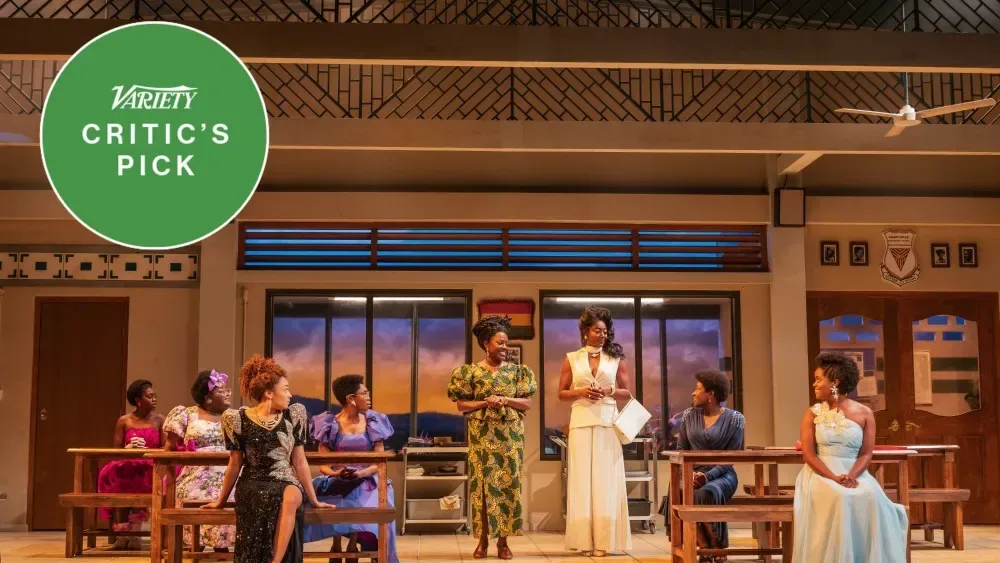
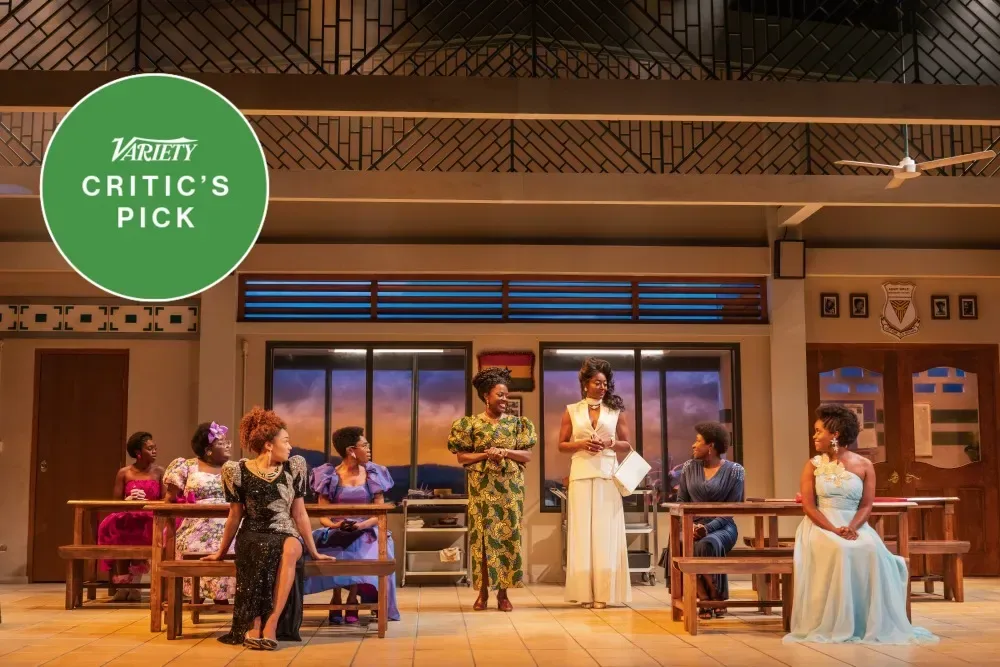
The scenic design by Teresa L. Williams places the action in a clean but modest school cafeteria, with lighting by Stacey Derosier. That ordinary communal space is a smart container for the play’s escalating emotions. A cafeteria is where students eat, gossip, form alliances and find themselves exposed. It is domestic enough for warmth and public enough for humiliation. The location helps the play make a contained ensemble story feel pressing rather than small.
Costume designer Qween Jean uses green, orange and gold-toned uniforms for much of the production. Uniforms visually place the girls in the same institution, but not on equal footing. Their status is constantly negotiated through behavior, perceived beauty and access to things beyond the school. When they audition for pageant recruiter Eloise Amponsah, the uniformed students appear in bold, glittering period dresses. The change is not just a costume showcase; it literalizes the move from schoolgirl routine into a performance of adult femininity and public desirability.
The adult mirror in Eloise Amponsah
Patina Miller plays Eloise Amponsah, a former Miss Ghana who now recruits for the pageant. Eloise’s carefully cultivated Western styling and accent add another dimension to the production’s examination of aspiration. She is a possible image of the polished success Paulina wants, but also a reminder that social reward can come with a cost. The contrast between the two characters asks what kind of self-fashioning is required to reach the status Paulina covets—and what may be sacrificed in the process.
This is where colonialism enters the play’s concerns with particular force. In this context, the term does not only point to historical political rule; it also describes the endurance of imported standards that can shape ideas of refinement, beauty, authority and worth. The play connects those standards to pageantry, speech, clothing and the social treatment of skin tone. It does so through the girls’ day-to-day encounters rather than by pausing the drama for a history lesson.
Gifty’s dyslexia adds another strand to the production’s portrait of private struggle. She is willing to read only in front of Mercy, demonstrating the trust that can exist within the same social circle that also enables exclusion. The detail broadens the story’s understanding of vulnerability. Each girl has something she fears others will use against her; the question is whether friendship will provide shelter or become another site of surveillance.
A finely matched ensemble
The strength of the production rests on the ensemble’s ability to let the comedy and hurt coexist. Benton’s Paulina must dominate scenes while revealing enough fracture beneath the performance for the role to avoid becoming a one-note bully. Rogers’ Ericka needs the poise that draws others toward her while carrying the burden of a guarded secret. Aremu, Rice, Otchere-Sarfo and Morton each define distinct responses to the group’s rules, from romantic hope and exuberant humor to academic ambition and anxious self-protection.
Simms’ Headmistress Francis and Miller’s Eloise widen the frame beyond student life. Their presence makes clear that the girls are not inventing every standard from scratch. They are encountering adult institutions and role models that can offer guidance while also reinforcing the standards that wound them.
School Girls; or, the African Mean Girls Play opened at the Samuel J. Friedman Theatre on September 28, 2026. Its Broadway arrival comes nearly a decade after its Off-Broadway premiere, reuniting Bioh and White after their work on Jaja’s African Hair Braiding. The production’s concise runtime is part of its impact: it does not need a sprawling canvas to make its point. In one cafeteria, among one tightly watched group of students, it captures the joy of Black girlhood alongside the brutal ways a culture of comparison can turn that joy against itself.