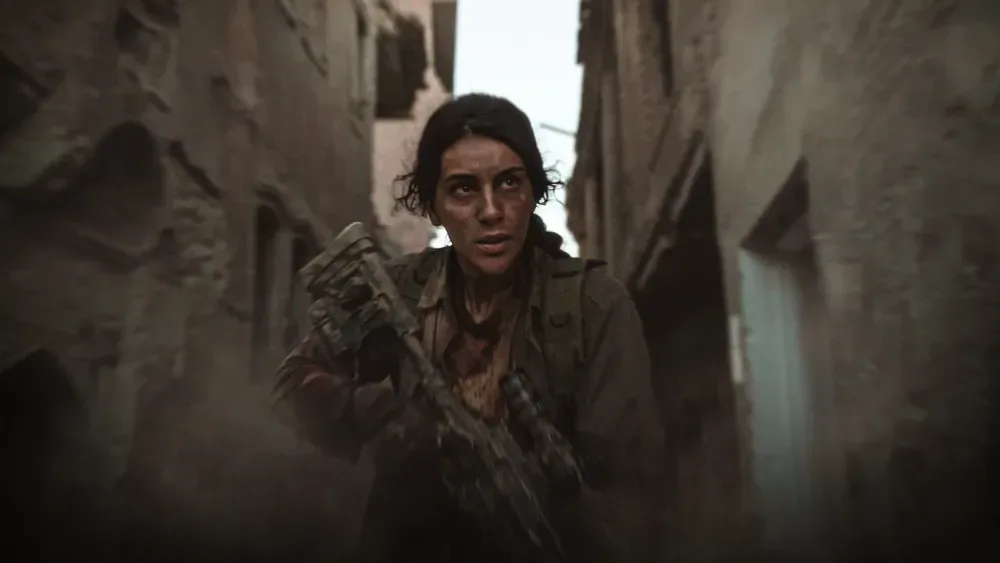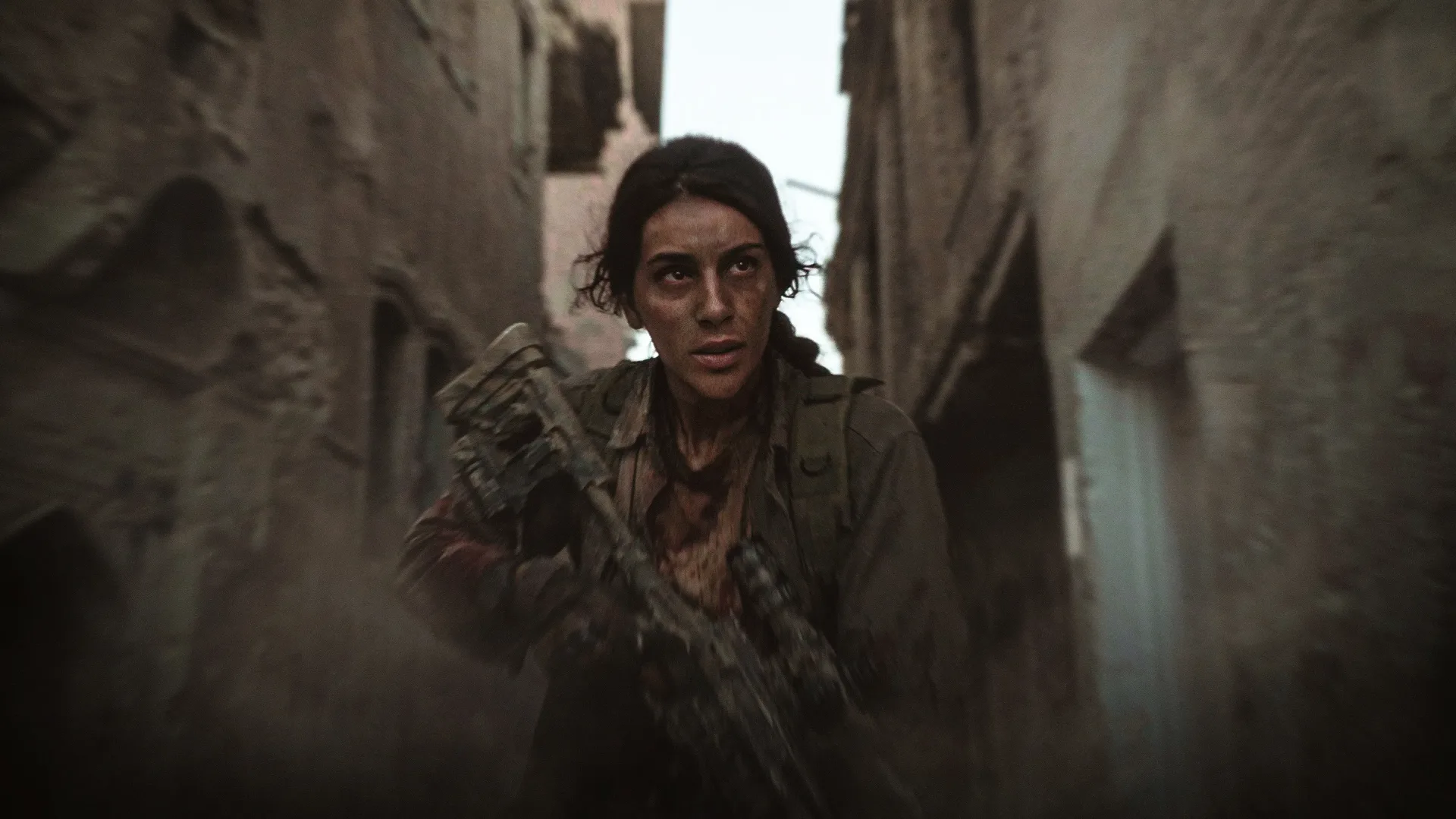
No Paradise If You Are Killed by a Woman places a woman at the center of a war-film role frequently reserved for an indestructible male action lead. But Halkawt Mustafa’s Iraqi Oscar submission is not built as a straightforward barrage of sniper set pieces. It is a 110-minute Kurdish war drama about trauma, endurance, displacement and family, using the story of one exceptionally capable Peshmerga fighter to move through the devastation brought by Islamic State’s 2014 assault on Iraqi Kurdistan.
The film screened in the Venice Open program out of competition and marks Mustafa’s third fiction feature, following Red Heart and El Clásico. His new film is a Norway-Iraq-UAE-Sweden co-production, with Avan Jamal leading a cast that also includes Thorbjørn Harr, Kanar Sarchl and Kader Jalal. Its dialogue spans Kurdish, Arabic, Norwegian and English, matching a narrative in which the distance between Norway and Iraq is never merely geographical.
That combination gives the film an unusual identity. It has the surface grammar of a sniper thriller at points: reconnaissance, patience, routes through hostile territory, a target who must be located, and a rescue operation with everything riding on it. Yet its larger interest is the cost carried by the person moving through those objectives. Vyan is not introduced as a battle-hardened operative with a conveniently mysterious past. The story traces the violence that remakes her life, then asks what is left after survival becomes a duty and a weapon becomes an extension of that duty.
Vyan’s path from Norway to the Peshmerga
Jamal plays Vyan, a 24-year-old Kurdish émigré living in Norway. She arrives in Iraqi Kurdistan in 2014 with her parents and younger sister, Helin, only for Islamic State’s attack to shatter the family. Vyan and Helin are taken and sold into sexual slavery after their parents are killed. Vyan escapes by killing the man who purchased her, reaches Peshmerga-held territory, and enlists in an elite all-women unit as a sniper.
It is necessarily harrowing material, and the premise does not treat Vyan’s prowess as an empty superpower. Her eventual reputation is immense: after three years of fighting, she believes she has killed more than 100 enemies. Islamic State fighters’ belief that dying at a woman’s hands denies them paradise makes female Peshmerga snipers particularly frightening to them. Within the film’s story, Vyan’s notoriety produces a reported million-dollar bounty on her head.
The title is therefore both a provocation and a statement of the ideological terrain surrounding Vyan’s service. Mustafa presents the Peshmerga—defined in Vyan’s voiceover as “before death”—as fighters who go into combat from resolve rather than fear. The script gives that idea an earnest, patriotic force. For audiences interested in films that connect a personal protagonist to broader histories and communities, its Kurdish perspective is central rather than decorative.
The film also makes room for customs and music that maintain that connection. Vyan’s rifle is described in terms of its “singing,” while traditional Kurdish songs are performed by her Peshmerga captain and a Kurdish commander in Mosul. These touches matter because the film’s war zones are not presented as anonymous action-game maps. They are places with cultural memory, interrupted daily life and people trying to preserve something more than territory.
A rescue mission with stealth-game tension
The plot shifts after Vyan stops an Islamic State suicide truck bomber in an armored vehicle before it can strike her unit’s base. Gravely injured, she returns to Norway to recover. There, a government official played by Harr puts her in an impossible position: accept state protection under a different identity because her status as an Islamic State target may endanger others, or face prosecution for taking part in a foreign conflict.
Related coverage includes ‘No Paradise If You Are Killed by a Woman’ Centers a Kurdish Sniper’s Fight.
Then comes the call that transforms recovery into another mission. Helin is still alive, but remains in Mosul under the control of an Islamic State fighter known as the Swedish sniper. Vyan’s choice is clear to her even if it is reckless on every practical level: she prepares to go back and rescue her sister alone.
The latter stretch is where No Paradise If You Are Killed by a Woman comes closest to the concentrated tension of a stealth game, though its stakes are far too real and painful for the comparison to be more than structural. Vyan works silently through tunnels and ruined urban spaces, studies the aftermath of battle, and uses deduction alongside help from a Kurdish commander with Iraqi government forces in Mosul. Her task is to identify the Islamic State snipers keeping civilians from leaving the wrecked city.
For players, the methodical side of that structure may be recognizable: information is incomplete, movement is limited, and an encounter is as much about waiting and line of sight as it is about firing. Yet the film is more concerned with isolation than power fantasy. Sniping is framed as a lonely discipline that demands stillness and calculation. Vyan’s quiet becomes part of the pressure, not dead air between explosive sequences.
That deliberate approach means viewers seeking a pure action picture may find fewer conventional highs than the premise suggests. Conversely, the film’s pronounced melodramatic and sincere register may not align with viewers looking for a more detached arthouse treatment. Its strongest fit may be for audiences open to a war drama that marries genre mechanics to a direct emotional and political commitment.
Mosul’s ruins are more than a backdrop
Mustafa’s past work informs the project. Research for his 2015 television project The Women ISIS Fears, along with his experience as a war photographer who encountered strong female fighters, helped inspire the film. He has dedicated No Paradise If You Are Killed by a Woman to his daughters.
That background can be felt in the film’s attention to the physical landscape of conflict. Cinematographer John Erling H. Fredriksen gives the camera a searching, mobile quality, while the production’s use of real Mosul locations brings an inescapable weight to the setting. The ruins of the city—once a major, thriving population center—are evidence of the brutal campaign to drive Islamic State out. The setting does not need artificial embellishment to communicate what has been lost.
Sound does substantial work, too. Mattias Eklund and Jan Kasskawo’s sound design builds unease around a protagonist who often has little or no dialogue. In an espionage or shooter game, silence might simply signal that the player has entered a stealth zone. Here, silence carries grief, focus and the danger of being noticed. The result turns listening into part of the drama’s suspense language.
Wibecke Rønseth edited the film, while Trond Bjerknes composed its music. Together with Fredriksen’s cinematography and the location work, those elements create a polished technical package for a film whose plot depends on the viewer understanding both Vyan’s practical skill and the vast emotional burden underneath it.
Why the film’s game-like comparisons only go so far
It is tempting to describe the Mosul section in level-design terms: infiltrate a hostile city, read environmental clues, identify opposing snipers, reach a captive family member. But the most compelling distinction is that Vyan cannot reset, reload or put the mission aside. The story’s structure creates suspense because every choice is informed by a history of irreversible loss.
That makes it a useful companion piece, in spirit, to stories where an apocalypse is filtered through one person’s determination to protect a relationship rather than merely survive. Games can accomplish that with remarkable force when systems and character goals reinforce one another; the personal stakes behind an end-of-the-world story are often what give its broader catastrophe meaning. Mustafa’s film pursues a far more grounded and devastating version of that principle.
Jamal’s Vyan is the essential focal point. The role requires her to carry scenes through physical alertness and restraint, particularly as the narrative enters its quieter, more tactical movements. Her character’s legend—the feared woman sniper with a price on her head—could easily have overwhelmed the person beneath it. Instead, the film’s framing keeps returning to the sister who was taken, the family that was destroyed and the survivor trying to decide how much of herself remains available for one final act of rescue.
No Paradise If You Are Killed by a Woman is not a conventional action spectacle, despite a premise that could have been reduced to one. It is a technically accomplished, often tense drama that locates its story of resistance in Kurdish culture, real places and a heroine shaped by both ferocity and loss. Its blend of warfare, melodrama and purposeful tribute will not be calibrated for every audience, but its commitment to Vyan’s perspective gives the film its clearest and most distinctive power.