Jelena Maksimović’s Until the Day Ends begins with the ingredients of a familiar political reconciliation story: a committed student activist and a young man orbiting a right-wing social group are forced together amid mass demonstrations in Belgrade. But the Serbian filmmaker’s first narrative feature appears determined to resist an easy lesson about ideological harmony.
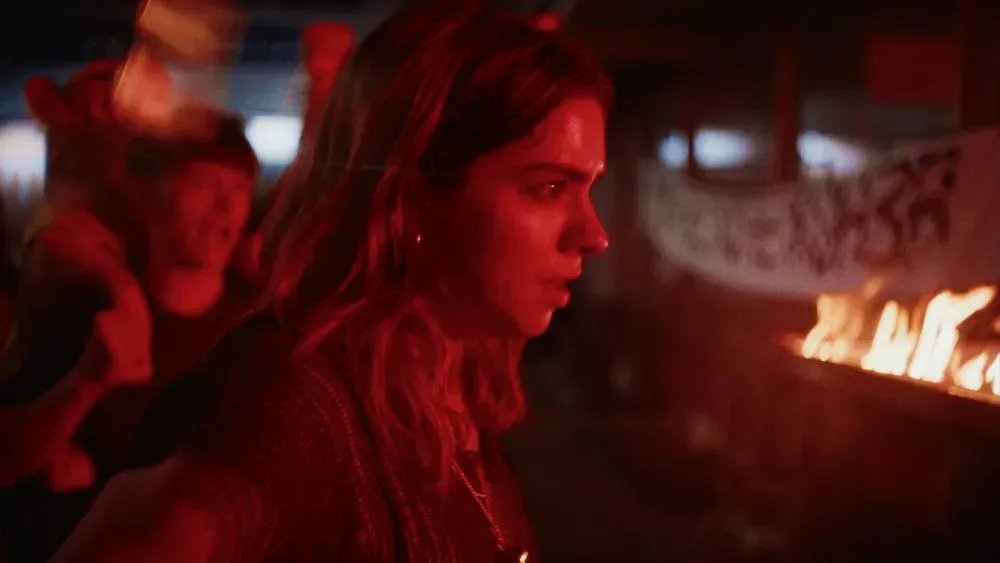
Set against the atmosphere of Serbia’s real anti-government protests in early 2025, the 90-minute film follows Lena, a 20-year-old student activist played by newcomer Lena Trifunović, and Stefan, a 22-year-old working-class punk played by Andrija Krivokapić. Their connection takes shape through conflict rather than consensus. After both participate in an act that badly injures a police officer during a demonstration, they leave town for the night, navigating attraction, fear and their incompatible political positions.
The title’s deadline is important. This is not presented as a sweeping chronicle of a movement or an all-purpose diagnosis of political polarization. It is a compressed flight through one night, where pressure makes the characters reveal themselves without magically resolving who they are.
A protest story rooted in a specific reality
The film uses the wave of demonstrations in Serbia as its backdrop. Those protests followed the 2024 collapse of a train-station canopy in Novi Sad, a tragedy that killed 16 people. That factual setting gives the drama weight, but Maksimović’s emphasis is intimate: what unrest looks like from a corridor, a crowd, a family argument or the perspective of two people who suddenly have reason to run.
Maksimović had previously made the nonfiction features Taurunum Boy (2019) and Homelands (2020). That documentary background is felt in the reported street-level texture of Until the Day Ends. The cast is largely non-professional, and the performances lend the story a plausibly lived-in quality rather than a polished, overly explanatory quality. The film’s Serbian dialogue and multinational production structure—spanning Serbia, Bulgaria, Slovenia, Montenegro, Germany and Croatia—also place it in a regional filmmaking context without diluting the specificity of Belgrade.
Vérité, a term often associated with documentary practice, broadly refers to filmmaking that strives for immediacy and an observational feeling. Here, that apparent realism is not the entire visual strategy. Maksimović and cinematographer Paul Spengemann reportedly combine it with roving camera movement, pronounced lens flare and a deliberately heightened sense of motion. In other words, the film does not simply observe political unrest from a safe distance; it seeks to put its audience inside the unstable momentum of it.
Lena and Stefan are not a tidy ideological match
Lena enters the story with certainty. She is committed to the protests and distrustful of authoritarian power, even when that commitment leaves her isolated at home. Her older brother Milan, played by Miodrag Miša Dragičević, is firmly right-wing in his sympathies and treats her idealism as naïve. The conflict is therefore not confined to signs, chants and clashes on the street. Politics has already entered Lena’s domestic life.
Stefan is connected to Milan’s political circle, but the film gives him a less fixed position than the company he keeps might imply. He appears to go along with a pro-government group without being fully persuaded by it. Lena notices that hesitancy and pushes at it, first through antagonism. The friction matters: their eventual bond does not emerge because one character delivers the perfect argument and changes the other’s worldview.
Related coverage includes ‘Until the Day Ends’ Finds Friction and Flight in Belgrade Protest Drama.
Instead, the pair’s shared culpability after the protest creates a temporary alliance. The cobblestone incident is not softened into a romantic gesture or reduced to a plot device. It has a victim, consequences and an urgent practical result: Lena and Stefan need to get away. The film’s interest lies in the uncomfortable gap between private feeling and public responsibility.
That makes the premise more complicated than a simple story of people “seeing past” their differences. Lena and Stefan may find desire and recognition in each other, but the available details indicate that their political disagreement remains real. Neither a grand conversion nor a clean agreement awaits them. The film instead places emotional proximity alongside unresolved belief, which is a considerably more difficult dramatic space to occupy.
Movement is part of the film’s argument
One of the film’s strongest formal choices is its opening long take, which travels through dim, disorderly university hallways. The building has become a makeshift encampment for students, with flashes of red cutting through a generally shadowed environment. A long take is a shot that plays continuously without visible cuts. It can be used to preserve the geography of a place, create tension in real time or make viewers feel that they are travelling alongside a character.
In Until the Day Ends, that technique introduces a university transformed by unrest. The space is not merely a background for dialogue; it is a site of collective occupation and uncertainty. The visual design reportedly carries an almost apocalyptic mood, but the details remain physical: cluttered rooms, bodies in passageways, signs of students adapting an institution to a new purpose.
The protest sequence then becomes the film’s high point of velocity. Maksimović reportedly goes as far as using a shot from the cobblestone’s point of view. It is an audacious flourish because it momentarily attaches the camera to the object that changes the characters’ lives. The device could have been a hollow stunt in a less controlled film, yet it fits a drama preoccupied with action and consequence: an instant of rebellion becomes a physical trajectory with irreversible results.
After that surge, the story becomes more concentrated. The second half is chiefly a two-hander, meaning a drama built around the interaction of two central performers. The pace may become less urgent after the demonstration, but the shift serves the premise. Public chaos gives way to a smaller, more volatile encounter in which Lena and Stefan must reckon with what happened and with one another.
The central performances are crucial to making that reduced scale work. Trifunović’s Lena is described as physically coiled and difficult to predict, capable of authority and immaturity in the same breath. That contradiction is vital. Lena’s optimism is not presented as calm moral superiority; it is angry, frustrated and vulnerable. Krivokapić’s Stefan provides a counterpart who is combative in a different register, uncertain enough to be pulled toward Lena while still shaped by the loyalties around him.
Why ambiguity matters here
Political dramas can too easily turn people into representatives of a position. The activist becomes the conscience of the narrative, the opponent becomes a straw man, and a final exchange delivers the approved answer. Until the Day Ends appears to reject that model. The film does not deny ideology; in fact, it gives ideology tangible stakes in Lena’s family and Stefan’s social world. What it declines to do is treat intimacy as proof that those stakes have disappeared.
This is where the film’s form and subject connect. The restless camera, the flight from authority and the compressed duration all deny viewers the comfort of settled perspective. Lena and Stefan are moving too quickly to turn their encounter into a thesis statement. Their resistance is joint in one narrow sense, but their reasons, commitments and future obligations do not suddenly become identical.
That distinction has practical value for audiences approaching a politically charged youth drama. The film’s story contains an act of violence, a police injury and a protest environment shaped by real tragedy. It should not be mistaken for a carefree opposites-attract romance. Its emotional charge seems to come precisely from the fact that desire, solidarity, fear and ideology refuse to line up neatly.
For a sharply different example of character-centered storytelling in interactive media, Joking Joystick has also covered the CBT-focused dark comedy Vampire Therapist. The comparison is not one of subject matter, but it underlines how much a work’s central tension can depend on characters confronting beliefs and behavior rather than simply defeating an external obstacle.
Festival momentum, with no wider release details stated
Until the Day Ends, whose original title is Do Kraja Dana, premiered in the Horizons program at the Venice Film Festival and subsequently appeared in Vienna and Hamburg. It is also in the main competition at the Tokyo Film Festival. Those selections point to substantial international festival attention for Maksimović’s fiction debut.
The screenplay is credited to Maksimović, Ivan Salatić and Olga Dimitrijević. Jan Klemsche edited the film, while Vladimir Živković and Ace Vaptsarov composed its music. Jelena Angelovski produced, with a group of international co-producers supporting the six-country production.
No general theatrical, streaming or home-release plan is included in the available information. For now, the clearest picture of Until the Day Ends is of a festival drama whose urgency comes less from a promise of political unity than from its willingness to leave two young people—and the audience—inside a tense, unfinished argument.